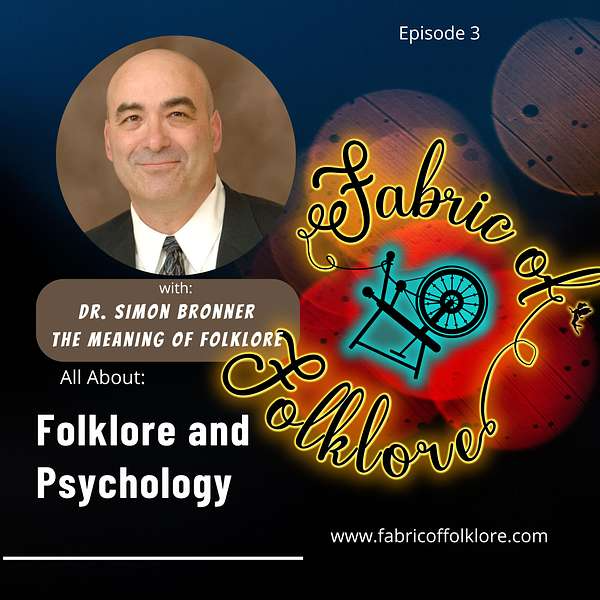
Ep3. Folklore & Psychology
Dr. Simon Bronner, Dean of the College of General Studies and expert folklorist at the University of Wisconsin Milwaukee explores a range of topics: Meaning of Folklore Book Practice of Folklore book Chain-Carvers-Old-Crafting Whirligigs-Peter-Gelker-Lynn-Gamwell book:
The post Ep3. Folklore & Psychology appeared first on Fabric of Folklore.
Follow us:
Fabric of Folklore website
00:00:23:17 – 00:00:58:08
Simon Bronner
Welcome folky friends. My name is Vanessa Y Rogers, and you are listening to Fabric of Folklore, the podcast, where we unravel the mysteries of folklore. And my hope with this podcast as we dig deep into the meaning of folklore behind folklore is to help us to understand one another better. Because although we are all unique individuals and we come from unique families with different cultures and traditions, we are all connected in this life journey and understanding folklore makes that really clear.
00:00:58:25 – 00:01:28:15
Vanessa Y Rogers
So I hope you’re all ready because we have a fantastic show today. Not only is our guest stellar, but we are going to be talking about the psychology of folklore, which is just going to be mind blowing. So welcome, Dr. Bronner. And let me give you a little intro. First, Dr. Bronner is a distinguished professor of American Studies and is folklore emeritus at in Sylvania State University.
00:01:28:24 – 00:01:58:03
Vanessa Y Rogers
He received his Ph.D. in Folklore and American Studies from Indiana University and is the author of many, many books on and relating to folklore. The two will mostly be referencing today, however, is the meaning of folklore and whirligig. The Art of Peter Gallagher, which was coauthored by Lynn Daniel in this section of this collaborative book, covers the convergence between the two fields of psychology and folklore.
00:01:58:04 – 00:01:59:26
Vanessa Y Rogers
So welcome so much, Dr. Bronner.
00:02:00:15 – 00:02:02:07
Simon Bronner
Thank you very much. Great to be here.
00:02:03:07 – 00:02:17:03
Vanessa Y Rogers
And so let’s get started with talking a little bit about you and your journey into folklore. How did you find out about the the field and what brought you to it?
00:02:18:20 – 00:02:54:21
Simon Bronner
Well, I could tell you that officially it was because I took a transfer from it. Of course, my first year of college that was on folklore by someone by the name of Bill Nicholson, who was truly an inspiring teacher. And I hope everyone’s listening, has one of those in their in their lifetime. And although I had come to Binghamton University to study history and political science, that truly changed my direction at that point.
00:02:54:21 – 00:03:27:07
Simon Bronner
I could tell you, though, unofficially, I feel like I lived folklore and I knew about it even before then because I was an immigrant and from parents who were uprooted from Europe and the war. And in that experience coming to the United States and also before then to the Middle East, I became very aware of other cultures all around me and trying to figure out where I fit in.
00:03:27:07 – 00:03:49:10
Simon Bronner
And folklore is a key to identity. And so not only in my school experience and in my ethnic school experience, but also in just that journey and that migration that I think a lot of your listeners who either know immigrants or have been an immigrant probably share.
00:03:50:07 – 00:04:00:07
Vanessa Y Rogers
Was there an experience that you that you recall where you felt different in particular?
00:04:01:22 – 00:04:33:27
Simon Bronner
There are many that I would say, and I think one of them is just the home experience side. I did play sports, which my parents did not understand at all, and especially the American game of football, which I was attracted to and made no sense to them. Hmm. Certainly. And and even watching it, they still couldn’t figure out why it was going on.
00:04:33:27 – 00:04:59:01
Simon Bronner
And later on I got to write about that as the American game and why Europeans do not understand the American game of football. And again, I found psychological reasons for that that have to do with the American experience of the frontier or that’s what I hypothesized. And that piece has gained a lot of traction.
00:05:00:12 – 00:05:12:13
Vanessa Y Rogers
Well, cool. Well, definitely have to add a link for that because that sounds like a very interesting piece, though. What about the field do you enjoy today?
00:05:13:29 – 00:05:54:09
Simon Bronner
I think because I’m exposed to it every day, and particularly as I’ve found myself betwixt and between the old world and the new world, I’ve often found the folklore was the bridge and that that that sense of expression that we all have, but they may not be aware of. Often in my pieces I talk about everyday life and things that are common, and then when I identify them as folklore and analyze them as such, I think it’s an eye opener for people they’re familiar with.
00:05:54:09 – 00:06:29:24
Simon Bronner
Children’s rhymes are familiar with proverbs. They don’t always have cognizance of what their meanings are to their lives. And that’s where I think being a folklorist is indeed significant and especially a chance to talk about tradition. Mm hmm. We have historians talking about the past. We have sociologists talking about society. I feel that we don’t talk about tradition enough and its relationship to modernity, even though I think that’s crucial to our human existence.
00:06:30:04 – 00:06:32:03
Vanessa Y Rogers
Modernity, I’m not familiar with that word.
00:06:32:22 – 00:07:17:15
Simon Bronner
A modern modernization, progress, technology, these kinds of things that we often assume displace what has come before or what is cultural. And we talk about that process as being ongoing, but especially in the 20/20 century and in the 21st Century, there’s a sense that that pace of modernization and modernity is accelerating, maybe because of technology particularly. And every day you can hear people talk about what was lost and concerned about their cultural identity and that feeling of belonging.
00:07:18:04 – 00:07:20:18
Simon Bronner
And that comes from folklore, I would argue.
00:07:21:20 – 00:07:45:23
Vanessa Y Rogers
Yeah. Well, so I discovered you because I found the one of the books that you wrote called The Meaning of Folklore. And I was really excited about and talking to you about this book because when I started this podcast, that was the whole reason I, I wanted to do this podcast is because I wanted to understand what, you know, what was behind folklore, what was behind the folk.
00:07:46:02 – 00:08:19:20
Vanessa Y Rogers
And it was reading my, my children. I wanted to understand their meaning and their significance. And so it seemed to like it seemed serendipitous that I would find a book that kind of encapsulated exactly that title. And then when you told me when I was emailing you and you said it was about the the late Allan Dunn, this, I was kind of astounded because I had I had seen his quote everywhere and I didn’t actually know who he was.
00:08:19:20 – 00:08:35:27
Vanessa Y Rogers
I had just seen him quoted all over the place. So anyways, I feel like this is a great place to start. So can you tell us about the book, The Meaning of Folklore? What is it about and why? Why you felt the need to write it?
00:08:37:17 – 00:09:15:07
Simon Bronner
Well, that’s actually a good segway from what I said before, because Allan Dundee’s is credited for what is often called the modern definition of folklore. And probably still some of your listeners are thinking folklore is something that isolated hillbillies have somehow in some remote holler playing on a banjo and not really having great human communication. Whereas and there’s still some of that in the studies of peasants and in Europe.
00:09:15:28 – 00:09:51:20
Simon Bronner
But what Dundee suggested is that in fact the expression of folklore is an everyday need and a human need, and it has not been displaced by technology and computers and media, but in fact those devices actually enhance the communication of folklore. And he came up with this idea that a folk group is going to consists of two or more people who have any trade in common and use tradition to give them a sense of identity.
00:09:52:03 – 00:10:26:04
Simon Bronner
So that means radio engineers, doctors, lawyers, I fluting elites have folklore. If they associate with a group and they have inside jokes, if they have sayings, if they have nicknames, fact you could argue that the first bit of folklore that we all have is the naming of a child. Right? And in the how we tell a story about why that person got that that particular name.
00:10:26:18 – 00:11:16:29
Simon Bronner
So that was very influential on me, particularly in school as I was a child of the sixties. And there are all kinds of cultural revolutionary things going on at the time and questions about modernization, culture and counterculture at the at the time. And then Dandies went on and this is probably more of the controversial part of his studies to suggest that we project anxieties, aspirations and joys through folklore, that the reason it is necessary and an everyday experience is because we have everyday anxieties that are disturbing to us.
00:11:17:08 – 00:11:53:02
Simon Bronner
And so one of the ways to deal with them is to externalize them, whether that’s transference or to symbolize them. We often disguise our feelings or we talk about our prejudices through jokes, or we tell stories about our daily experiences to others and started analyzing those things, often with results that were not cheery, that were not sugary sweet the way we we think sometimes of folklore as cute, right?
00:11:53:02 – 00:12:29:02
Simon Bronner
Folklore as quaint. And he was talking about racist jokes. He was he was talking about sexual sayings. He was talking about insults and he was talking about songs, bawdy songs, sometimes. And why those persist. And then I think I followed that up and in the meaning of folklore suggests some ways in which that does occur with other kinds of of forms.
00:12:29:02 – 00:13:00:18
Simon Bronner
I’m particularly interested in children’s folklore because of the idea that folklore is very influential on our human development, for example, and that the games and the sports and the stories we tell, the gestures that we have and learn at that time, often from peers are going to affect our our future and understanding that process and also why new forms of folklore emerge.
00:13:00:18 – 00:13:28:16
Simon Bronner
So it’s not just studying, let’s say, a gesture and then tracing it back all the way to ancient history. But even those that may have emerged recently, what their origins are and why we did them. And an example of that is actually in another book, the Practice folklore is Who’s your Daddy? That I found really emerged at the end of the 1990s.
00:13:28:16 – 00:13:58:00
Simon Bronner
It tended to be male centered. I would study the situations in which it arose. It seemed to be a new genre, so to speak. And I asked, why did it emerge? No one knows the origin of it, but yet it’s something that millions of people recognized, even if they didn’t practice it themselves. And yes, it is related to an anxiety that people have, particularly about gender relations.
00:13:58:15 – 00:14:06:13
Vanessa Y Rogers
So to explain a little bit more how can you explain where anxiety would be exhibiting by saying, who’s your daddy?
00:14:07:04 – 00:14:20:09
Simon Bronner
Sure. During the time it arose, there was the feminist movement, women’s movement, which was really challenging the equality of the sexes.
00:14:20:09 – 00:14:26:22
Vanessa Y Rogers
And what your range are we talking mid-nineties. Okay, yeah.
00:14:27:01 – 00:15:00:19
Simon Bronner
Mid and I was even able to trace its rise and its fall somewhat after the turn of the millennium there. And it especially seemed to come out in sports which were still segregated by sexes at that time. Now we’re having controversies about wrestling and those that are integrating different sexes, and particularly in basketball, where there was a lot of dominance.
00:15:00:19 – 00:15:37:19
Simon Bronner
This idea of the tall player being dominant over the short player. And one of the analysis was that what that did is to put the other player in a feminine position. So by saying who’s your daddy? You’re infantilizing or you’re making that other player into a woman symbolically, right. And this was at least in that frame a way to express some of the anxieties about change, about social change.
00:15:37:28 – 00:15:58:10
Simon Bronner
That was going on at the time. One may argue that it lost popularity later because it wasn’t as much an issue, although others are looking at other examples in which the particularly workplace kinds of tensions are mediated by jokes and sayings and so forth.
00:15:58:10 – 00:16:09:06
Vanessa Y Rogers
So interesting. And so you said that Ellen Dundee’s is how you pronounce it. Yes, he he did a lot of father wrestling, is that correct?
00:16:10:18 – 00:16:41:17
Simon Bronner
Yes. He was a strong advocate for particularly psychological approaches. He taught at UC Berkeley, a very prominent institution, and produced a lot of students who followed in this idea of modern folklore, but probably fewer who went along the path of psychological kinds of analyzes because it’s it puts us as observers in a difficult position. We’re telling you what you think.
00:16:43:04 – 00:17:18:17
Simon Bronner
And that can have certain consequences for your social relations. Let’s let’s face it now, there may be times when you’ll say actually as a bit of folklore, I don’t know what came over me. And then I’ll say, well, I have a theory to try out on. You see what you think. But for a lot of folklorists who are studying people who are not necessarily in the limelight, this can be a fragile kind of relationship.
00:17:18:17 – 00:17:46:09
Simon Bronner
And then, yeah, if I say is this I have and I’ve worked with people in this regard that the carving of wooden chains in old age is an idea of the youth orientation and and dealing with the anxiety of death, that that’s going to be difficult for them to admit. But I’m saying that’s the reason they’re doing it in many ways.
00:17:46:09 – 00:17:46:20
Speaker 3
Mm hmm.
00:17:47:02 – 00:17:48:06
Vanessa Y Rogers
From their observations.
00:17:48:19 – 00:17:49:00
Simon Bronner
Yes.
00:17:49:18 – 00:17:49:26
Speaker 3
Mhm.
00:17:50:18 – 00:17:57:29
Vanessa Y Rogers
So what did folklore look like before he started making these claims of modernity?
00:17:58:04 – 00:18:39:06
Simon Bronner
Montérégie Well, I could tell you, even in my early classes, the examples that were given was someone going into the southern Appalachians, such as Cecil Sharp, who got renowned. He was an English folk song and folk dance enthusiast, and he got very excited because he heard that in the isolated mountains of the southern Appalachians, there were people who were singing what he thought were ancient British ballads and what were they doing there?
00:18:40:18 – 00:19:12:04
Simon Bronner
So he went to an East, started hearing these ancient songs, and this was a kind of model everywhere. And other people started going into the backwoods and they just assumed that it was it consisted of people who the folk and even the use of the now who were isolated and did not have contact with modernity again, to use that that term.
00:19:12:04 – 00:20:01:24
Simon Bronner
So people also looked for folktales that were on the scope of Cinderella and the Grimms Tales from the 19th century that people spoke now and then again, the Southern Appalachian great excited excitement about Jack tales because they related to Jack and the Beanstalk that people imagined were all gone and an ancient and there’s value in that. There’s an esthetic to that that we find this great artistry and sometimes the assumption that people are literate, but yet they can recite 50 verses of an ancient ballad like Lord Randall, for example, or Blackjack Davey songs that some of your listeners may may know.
00:20:02:12 – 00:20:27:28
Simon Bronner
But yet done this suggesting you could hear it in the workplace. And in fact, one of his books was on something called photocopied broadside cards. There were these illustrations that were copied on a on a copier or faxed at that time. Don’t know what the origins were, but they repeated, they varied and people would hang them on the wall.
00:20:27:28 – 00:20:56:20
Simon Bronner
They were a photocopied form of humor. Now we find them on the Internet. And there’s also the idea that there’s Internet folklore is folklore. Generally, we talk about means or some of the digital folklorists talk about that. And so you have a very different kind of landscape with taking your course and the equipment in that huge equipment in the back of the car.
00:20:56:20 – 00:21:22:01
Simon Bronner
As Alan Lomax in the famous Library of Congress expeditions to the South did to receiving emails with humor or proverbs and trying to collect them, analyze them, and fact to interview the senders about why did they send that and why do they use that as an avatar or whatever it is.
00:21:22:01 – 00:21:25:01
Vanessa Y Rogers
And why were you inspired to write this book.
00:21:25:14 – 00:21:42:05
Simon Bronner
The Meaning of Folklore? Well, I learned a great deal from Dundee’s. I was aware that he felt the folklore didn’t pick up on his psychological theories as much as they should. He died prematurely.
00:21:42:05 – 00:21:43:16
Vanessa Y Rogers
And why did he die?
00:21:44:05 – 00:21:46:16
Simon Bronner
He died at the age of 70.
00:21:46:16 – 00:21:48:14
Vanessa Y Rogers
And he was still active in the field.
00:21:48:29 – 00:22:17:06
Simon Bronner
Oh, yeah. I mean, again, he generated his own legend. And because he died in the classroom, he had a heart attack while he was teaching. I actually know one of the students who was there at the time. It was very scary. But again, the society is so dedicated to the field that he died while teaching and he was supposed to retire shortly after that.
00:22:17:06 – 00:22:22:08
Simon Bronner
But he yeah, he wasn’t going to retire. He went out with his boots on to use of.
00:22:22:13 – 00:22:22:18
Speaker 3
The.
00:22:23:11 – 00:22:53:19
Simon Bronner
Of folklore. And the story is that at the time I was reviewing a book of his, our manuscript that was about to be published. And so then I went back to the publisher and I said, Well, what are you going to do now that he’s got some valuable material, but he’s he can’t work on it. And you’ve got to be careful the conversations that you start.
00:22:53:19 – 00:23:47:07
Simon Bronner
Because then they said, Well, why don’t you write it? And the irony, irony is that he had asked me to write a foreword to the book, but then it turned into my doing his biography, talking about his analysis, doing these edited notes on some of his materials, and adding other kinds of material to it. So it truly was a labor of love, but then an opportunity to turn what he had written in the last 40 years to look ahead to the future and what this kind of work can result in that I think can benefit us all by giving us insight on why we do what we do and how we think and act.
00:23:47:15 – 00:23:55:01
Vanessa Y Rogers
Can you give us an example of one of the things you studied that looked at why we do what we do?
00:23:56:01 – 00:24:36:13
Simon Bronner
Sure. Maybe continuing on the feminist theme, when I in my folklore classes asked for examples of children’s folklore, often what would be proposed was a kind of ritual that people had different names for, sometimes called Bloody Marys, sometimes Mary Worth. And it was always girls. They and because I was teaching college undergraduates, they would say, Well, we did this when I was 12, 13.
00:24:37:13 – 00:25:04:03
Simon Bronner
I was often in elementary school or middle school, and we often had a slumber party. We might go into a bathroom, light a candle and say, Mary, I believe in you three times. And then they would think that the candle would go out or they would see something and they would all scream and that would be the end of the ritual.
00:25:04:24 – 00:25:05:01
Speaker 3
Mm hmm.
00:25:05:16 – 00:25:31:07
Simon Bronner
So people had noted this for this ritual and this rhyme has a lot going on. And it raises questions. Why only girls? Why don’t boys engage in this? Why at that age? And then more to the point, why do people express this? Or what is the ritual for?
00:25:31:25 – 00:25:32:04
Speaker 3
Mm hmm.
00:25:33:00 – 00:26:07:13
Simon Bronner
And Dundee’s proposed that what was missing from the analysis because people were just thinking it’s a pre-adolescent kind of prank or whatever is the importance of Bloody Mary. So that was often there, and sometimes they would even prick their finger to produce blood. And there was often a story associated with the girl in the mirror as someone who died prematurely.
00:26:07:29 – 00:26:09:04
Speaker 3
Mm hmm.
00:26:09:08 – 00:26:40:04
Simon Bronner
And he proposed this was because of a fear of menstruation by pre-adolescent girls. Mm hmm. This was an anxiety that in American society was very difficult to broach. Other societies work on that transition, and they would have rituals to mark it, make it public. In American society, we tend not to. And so this was sublimated, if you will, and came out.
00:26:40:04 – 00:27:10:21
Simon Bronner
And this ritual explains why it’s about girls and the symbolic projection of Bloody Mary. As someone a little older, I’d gone through this, but there’s a certain horror in her, in her blood, and there are people who disagreed with them because it’s not easily proved. You didn’t have interviewees who said, Yeah, we did it because I was having anxieties over menstruation my first period.
00:27:11:21 – 00:27:41:08
Simon Bronner
But he would show that through the ritual and the idea that the narratives that were expressed often had this association with a young girl, often with blood. He made the case for people to think about, not just to make some kind of grand psychological theory, but also to suggest or to point out, yeah, there’s this anxiety and we should be aware of it.
00:27:41:20 – 00:28:09:03
Simon Bronner
So he had an applied aspect to in that he often would hold up what he would think would be disturbing images such as, again, his work on racist jokes and ethnic jokes as well, and say by understanding the motivations, by understanding their meanings, we might have insights and then some solutions as to how to deal with the source problems.
00:28:10:17 – 00:28:17:26
Vanessa Y Rogers
And so folklorists don’t conduct studies that would that be a correct assessment?
00:28:17:27 – 00:28:57:01
Simon Bronner
Well, if you mean laboratory, yeah. Kinds of studies, not so much. There are some laboratory studies that have been published, but folklorists generally work in the field. They work with real life situations. There is a famous laboratory kind of study of someone who introduced a Shakespeare story with Bush people in Africa because he wanted to see if it became folklore and examined the transmission process.
00:28:57:01 – 00:29:10:21
Simon Bronner
And indeed he found out. But then it got adapted to their cultural values. And so that’s a famous one that is often cited in terms of the the folkloric process.
00:29:11:01 – 00:29:14:04
Vanessa Y Rogers
So the story changed considerably right.
00:29:15:04 – 00:29:28:16
Simon Bronner
But they weren’t saying, oh, here’s a story by Shakespeare, but now we’re going to tell you orally that you got incorporated into their structure. But he knew it because he introduced it.
00:29:29:10 – 00:29:35:04
Vanessa Y Rogers
So how do you feel like his ideas has influenced your work in particular?
00:29:36:18 – 00:30:23:09
Simon Bronner
Well, I use the idea of projection and also symbolism a great deal. I think perhaps a difference between us is that I’m also looking more practices. He, because of some of his literary interests, would often be looking for texts if you will. And I was interested in the things that people do that they may not identify as a joke, a tale, a story, but then I would see them repeated and embroider them with cultural aspects and and report that out.
00:30:23:19 – 00:31:06:26
Simon Bronner
One of the pieces that I did in the practice of folklore that has gotten attention, for example, is that I pointed out that when there were school shootings, there tended to be an accusation that the shooter must have had Asperger’s syndrome. Is that folklore? But the way that I viewed it, it was a repeated story that was associated with that event to try to explain what is unexplainable or unfathomable and a, again, people seemed to resonate with that because there was often a need.
00:31:07:07 – 00:31:24:23
Simon Bronner
And unfortunately, those events have continued. And with each one, I still see the same thing of trying to explain how could that happen? And folklore was one of the ways to revert to that, to find explanation for an unfathomable event.
00:31:25:12 – 00:31:26:16
Speaker 3
Mm hmm.
00:31:27:02 – 00:31:49:20
Vanessa Y Rogers
Well, let’s just focus a little bit and talk a little bit more about the psychology, the convergence of psychology and folklore. And so you coauthored a book with Lynne Gammill, and you wrote a section towards the end. Can you tell us a little bit about what that was about?
00:31:51:08 – 00:32:13:02
Simon Bronner
Sure. Well, first, I have to give you a background that I had earlier done a book on wood carvers called Old Men Crafting, meaning in which I was asking why men in old age would carve what seemed to be meaningless chains made out of wood.
00:32:13:28 – 00:32:16:05
Vanessa Y Rogers
And where is this that you’re seeing people?
00:32:17:12 – 00:32:45:21
Simon Bronner
This was actually my dissertation, which was in southern Indiana. And I identified over a dozen of these wood carvers and found out what their story was, often relocated from rural areas to urban areas. It was an adjustment. They were also retired and they had feelings of anxiety because they were no longer respected for their crafts or for their work.
00:32:46:05 – 00:33:04:16
Simon Bronner
Mm hmm. And so this was one of the ways to show their productive and creative. So Lynn Gamm well knew that book, and she wrote me challenging me to say that she was working with a whirligig maker.
00:33:05:05 – 00:33:05:13
Speaker 3
Mm hmm.
00:33:05:29 – 00:33:16:01
Simon Bronner
And wanted to know if my ideas applied to this whirligig maker that she had identified by the name of Peter Gallacher.
00:33:16:23 – 00:33:18:14
Vanessa Y Rogers
And can you describe what a whirligig is?
00:33:19:06 – 00:33:58:04
Simon Bronner
Oh, sure, I’m sure you’ve seen them, and that is that they would be a figure who often would seem comical that you might be somebody churning butter or a man with big giant arms that is like a windmill and the wind blows on these giant arms and the figure moves. And they’re often put in gardens. They’re often homemade, not something that you would buy commercially, but in a lot of yards.
00:33:58:04 – 00:34:14:29
Simon Bronner
That’s the kind of thing that people would put up. And this particular person seemed to follow the pattern of somebody who in as an older adult, started making these whirligig.
00:34:15:17 – 00:34:15:27
Speaker 3
Mm hmm.
00:34:16:17 – 00:34:50:20
Simon Bronner
And then mysterious Lee, stop making them. And so I did a little more research on that. She was dealing with this from the point of view of an art curator. So she was asking me again, from a cultural viewpoint, what is going on here? What is the significance of whirly gigs? Again, something that we think is, you know, as being fanciful but not something that’s going to project our inner feelings.
00:34:50:20 – 00:35:28:20
Simon Bronner
And I said, Well, I don’t know, but I’m willing to find out. Mm hmm. And in talking to Peter Gallagher, I discovered that he took this up in response to his father’s death. And his father was a craftsman. And, in fact, his father had given him tools as a birthday gift, maybe hoping that he would do that. He was a medical professional, so he felt in his eyes that you did not have the approval of his father.
00:35:28:20 – 00:36:05:07
Simon Bronner
You would think, oh, he’s got to love his son who’s got this great lucrative job. But he felt that he was a disappointment to his father, and his brother had continued to be a tradesperson. And so he felt like the outlier in his family. And the story he told is then he went into his workshop. He saw these tools that his father had given him, and he started making it almost like a tribute or maybe, I’m sorry, saying I’m sorry I didn’t do this, but I want to honor you.
00:36:05:21 – 00:36:31:29
Simon Bronner
And he at least he shared that it made him feel better. It was a form of therapy. But then he went further than his father did. And he had very creative kinds of work on Adam and Eve. Religious themes, a lot about money, which then I applied to his life that he had made a lot of money, but that didn’t mean he was necessarily happy.
00:36:32:22 – 00:37:01:04
Simon Bronner
So again, with these personal feelings that he was externalizing through these kinds of whirly gigs, they were not something he sold, he just made them. And then at what point did he need them any longer? Since he wasn’t doing it for an occupation? Interestingly, Samuel encouraged him to put it in an exhibit and. The exhibit got critical acclaim.
00:37:01:25 – 00:37:17:17
Simon Bronner
But the problem is that it depressed him because it made his feelings public. He didn’t know that public didn’t catch on to that because the captions didn’t say Peter Gallagher made this because he was depressed.
00:37:18:09 – 00:37:18:21
Vanessa Y Rogers
Yeah, right.
00:37:19:15 – 00:37:56:14
Simon Bronner
But he felt vulnerable when it became public. So I’m sounding like I’m psychoanalyzing him. But the point was that when we look further, there are often motivations that are not going to be on the surface, but that help us realize that there are different ways in which we cope with stress. And one of them is to rely on tradition, and particularly to use our hands to produce these kinds of works that are personally and socially meaningful.
00:37:57:18 – 00:38:02:24
Vanessa Y Rogers
So the descriptions in the book were written by J.M. or by Peter himself.
00:38:04:10 – 00:38:46:15
Simon Bronner
They were written by Jim. While the captions. Right. And then I provided the narrative and the background, and I’ve written more on him for a European book that is coming out in addition. But then I also did something on Canes again, following this idea of why? Why do people have canes if they don’t need them to walk? There are people who might have or had a walker or a walking stick, but there are a lot of people who have canes, especially men, as a kind of decoration, and then they do all kinds of creative things with them.
00:38:46:18 – 00:38:56:14
Simon Bronner
And again, I saw that as an expression of manliness, particularly at a time when they might be feeling frail in a youth oriented society.
00:38:57:08 – 00:38:58:01
Speaker 3
Mm hmm.
00:38:58:26 – 00:39:06:23
Vanessa Y Rogers
Yeah. You know, for me, I always think of a wizard with a cane, or especially, I guess, more of a step. But so that.
00:39:06:23 – 00:39:07:11
Simon Bronner
Empowered.
00:39:07:12 – 00:39:08:25
Vanessa Y Rogers
Lucy. Yeah.
00:39:09:09 – 00:39:11:06
Simon Bronner
This is an empowered person.
00:39:11:27 – 00:39:17:28
Vanessa Y Rogers
Right? Yeah. Or. Or wisdom. For some reason, I’m not really sure why I would associate wisdom.
00:39:18:22 – 00:39:24:19
Simon Bronner
Well, I would say because you’re associating wisdom with old age sees.
00:39:25:18 – 00:39:25:29
Vanessa Y Rogers
The.
00:39:26:14 – 00:39:50:07
Simon Bronner
Symbolic progression, and then you’re thinking, Oh, that person must be wise. They’ve got this cane or a specter. But yes, then the further analysis, maybe the psychology, logical analysis, the association of age. So it becomes compensatory that you’re compensating for what might seem like a weakness with the strength.
00:39:50:26 – 00:40:36:05
Vanessa Y Rogers
Okay. So in this section that you wrote for the psychoanalysis section, you really go into the history of how the two fields of psychology and folklore started to communicate. So they could, you know, help one another. And you start off with a quote by Sigmund Freud. I’m going to read it real quick and the psychoanalysis and folklore have not allowed themselves to be deterred from transgressing these prohibitions and have been able, as a result, to teach us all kinds of things that are indispensable to understanding of human nature.
00:40:36:18 – 00:40:38:03
Vanessa Y Rogers
So Freud.
00:40:38:03 – 00:40:38:11
Speaker 3
Is.
00:40:39:05 – 00:40:50:21
Vanessa Y Rogers
Credited with being the father of psychology in a lot of ways. But would you say that he was also, in his own way, a folklorist or what is his connection to folklore.
00:40:53:05 – 00:41:34:22
Simon Bronner
In his study on jokes and their relation to the unconscious? He went beyond his clinical analysis of people with mental problems, and he identified jokes that he heard, which we would call folklore as expressions of the unconscious and of conflicts. So you could say that he was folklorist starkly aware, even though he was still a psychologist, he wouldn’t called, have called himself folklorist, if you will.
00:41:35:15 – 00:42:05:16
Simon Bronner
But this was a great revelation at the time because collections of stories were done to show that a certain people had a narrative repertoire and we didn’t think they did as certain people would be creative. We didn’t think they were or was to find the origin of Cinderella, let’s say, by collecting all these stories across the world. And he’s doing it with individual people and then asking the context.
00:42:05:16 – 00:42:36:14
Simon Bronner
And particularly at that time, he was one of the first people to talk about gender relations and ethnic relations as he focused on Jewish jokes and anti-Semitic jokes to ask why we have anti-Semitic jokes if we’re supposedly getting enlightened. Of course, this turned out not to be true with what happened in Central Europe and, World War Two. But this is what is his thinking was at the time.
00:42:36:20 – 00:43:15:04
Simon Bronner
And he was also asking why there’s there are so many indirect references to feces and sex, which was controversial at the time with Victorian kinds of standards. Now, he did end up writing a foreword to a work by Gregory Bork about scatological customs all around the world. And this is remarkable because he clearly bought it clearly was an ethnologist or or a folklorist.
00:43:15:04 – 00:43:44:29
Simon Bronner
He went out among Native Americans and he wasn’t using psychology. He was thinking, Boy, there are awful lot of these rituals around feces. But then Freud, in his introduction is saying, Oh, there’s something here. And that’s because this is, again, something that’s disturbing, it’s personal. It’s about the body. And we sublimated and it comes out in different ways.
00:43:45:19 – 00:43:46:06
Vanessa Y Rogers
Okay.
00:43:46:27 – 00:44:35:03
Simon Bronner
So and then others, including Alan Dundee’s, picked up on that with different kinds of genres, songs and stories and even artwork that that followed from that early experience. There are some who criticized Freud then as being very male centered, and I just mention this. I don’t know if we’re getting short on time, but one of Dundee’s contribution is to talk about womb envy because Freud talked about penis envy and the idea that at the age of five, children become aware of their differences, of their physical differences with the idea of that the penis is superior.
00:44:35:26 – 00:44:50:08
Simon Bronner
And he Dundee said, Well, that doesn’t quite sound right, because what about these other instances in which males are jealous of the power of women to procreate?
00:44:50:25 – 00:44:51:13
Speaker 3
Mm hmm.
00:44:51:24 – 00:45:17:24
Simon Bronner
They have babies. And now we see a lot of movies with that theme. Don’t like men having babies. And Dundee’s would have loved those kinds of films that have come out. So he looked for example, at Santa Claus, and he said, Santa Claus is an example of womb envy. This figure whose large, rotund looks pregnant, comes in with a bag going down a chimney.
00:45:18:06 – 00:45:45:14
Simon Bronner
What kind of birth? Canal, if you will, spreading presents. Oh, my God. A lot of people did not buy that, I should say to you all. But I mean, it’s an example of this kind of idea. Or he also talked about wishing well. How many times have you or your audience thrown a penny in a fountain? Why? What is that about?
00:45:46:00 – 00:46:00:23
Simon Bronner
Just because there are a lot of other pennies at the bottom. Well, Dundee’s claim that this is another example of womb envy because of the coin and the water as a maternal kind of symbol.
00:46:02:13 – 00:46:04:27
Vanessa Y Rogers
Okay. Okay. That’s interesting.
00:46:05:15 – 00:46:29:21
Simon Bronner
And so and that’s in the book, the in the meaning of folklore or the folklore of wishing wells, which I found interesting, had not been reprinted before. I picked up on that, but I liked it because it’s another example of an everyday practice. Yeah, that people may do what they think of as mindlessly, but actually involve a lot of mind.
00:46:31:15 – 00:47:00:17
Vanessa Y Rogers
Yeah, that’s that’s very true. And and you in the and so back to the other book you talk a lot about the the history of and then you start with the Jubilee conference I believe and you said it was a milestone event because psychoanalysts were the first time speaking directly to folklorists. Can you talk a little bit about that event and what it led to?
00:47:01:13 – 00:47:40:06
Simon Bronner
Yeah, this was in London and Europe was, after all, the hotbed of psychoanalysis, and it was also some of the name of Ernest Jones, who was one of the students of Freud, who was very active there. And the two fields were of folklore, and psychoanalysis were both rising fields at the time. Folklore was a very popular topic in the Victorian era, which would have to be another podcast to talk about why that is.
00:47:40:07 – 00:48:01:23
Simon Bronner
But yeah, so the idea was here are these two rising fields are getting a lot of press. There are not academic departments for them yet, but yet there are a lot of books coming out. Mm hmm. There’s there are many learned societies devoted to these two. Why don’t we bring them together for a dialog?
00:48:04:03 – 00:48:47:07
Simon Bronner
But it was filled with tension, so the idea was great. And to have this dialog. But again, the folk, the Victorians, particularly at that time, had a difficult time of thinking of meanings that were outside the awareness of the people that they had in place erupted against their idea. The folklore consisted of survivals of the ancient bizarre past because the psychoanalysts wanted to say, No, this is going on now and you’re as likely to have folklore as the people in the bush that I mentioned before.
00:48:47:21 – 00:49:27:04
Simon Bronner
Mm hmm. And the whole colonias view was challenged by this idea. But yet, coming out of that, the psychoanalysts realized what the potential was in this body of folklore. The focus was studying. Even if folklore is didn’t analyze it, the way that they did the folklore. The Victorian folklorist then began to understand. I think, or the silver lining is that there are also emerging forms of folklore.
00:49:27:05 – 00:49:57:22
Simon Bronner
It’s not all in some savage past, which was part of the terminology of the time. So how do they explain new kinds of legends such as the Hitchhiker, for example? I’m sure your listeners are familiar with that. This idea of a T and there are songs about this teenage girl leaves the party and the boyfriend won’t pick her up.
00:49:58:25 – 00:50:07:29
Simon Bronner
And so she hitchhike the ride with someone and then she disappears.
00:50:08:14 – 00:50:08:24
Speaker 3
Mm hmm.
00:50:09:05 – 00:50:41:07
Simon Bronner
And so the person who picked her up is all confused about it and goes to the house anyway. And they say, Oh. Just a minute. Please come inside. And then he looks on the mantel. He says, That’s a picture of her. That’s her right there. Mm hmm. They say, Oh, yes, on this day this happens every year that that’s our daughter who died on this day on the way from a party site.
00:50:42:00 – 00:50:42:10
Vanessa Y Rogers
Yeah.
00:50:42:17 – 00:51:12:21
Simon Bronner
So and again, this has been interpreted variously, but it seems to be a 20th century story with the advent of transportation. There’s some of said you can also hear this with carriages. But the idea of migration. There’s a ghost part of it about the supernatural, though you notice there’s no mention that that’s our ghost. That’s left for the commentary, for the discussion.
00:51:12:21 – 00:51:32:03
Simon Bronner
This is why I say to look at practices and how people use this and use it to broach some difficult kinds of topics. The vulnerability of women comes out in this and there’s a whole subgenre that’s very popular of the urban or contemporary legend.
00:51:33:23 – 00:51:38:12
Vanessa Y Rogers
Of what their purpose is and why why we we enjoy talking about them so much.
00:51:39:03 – 00:51:57:04
Simon Bronner
That and also that they are forms of folklore that are emergent, that they often speak to danger that we perceive now. So you probably remember when there was a whole thing about the cat in the microwave oven, for example.
00:51:57:08 – 00:51:58:07
Vanessa Y Rogers
Was not one.
00:51:58:18 – 00:52:02:03
Simon Bronner
Oh, well, I see a nod from your engineer.
00:52:02:12 – 00:52:04:06
Vanessa Y Rogers
Yeah, please. This story.
00:52:04:15 – 00:52:51:24
Simon Bronner
This story about now someone gets a new microwave and their cat is wet, so they have this great idea of putting it in the microwave oven. It zaps the cat. So that disturbs cat lovers there. This repeating the story was very popular. And again, it was this discomfort with that new technology, for example, or even the Kentucky Fried Rat, for example, that someone goes to a fast food chain and they get what seems like a rat in their box at the time when fast food places were emerging and there was a kind of mystery, how did they produce that food so quickly?
00:52:51:26 – 00:53:15:17
Simon Bronner
Write mass, produce it and give it to us. That could be all podcast, I’m sure, but that’s some examples of the genre. And they rise and fall with often these kinds of technology, these that that come out. And there’s certainly a lot of stories and legends about computers and still today so. Oh, okay.
00:53:15:19 – 00:53:19:28
Vanessa Y Rogers
I need I need to hear a legend about a computer now.
00:53:22:09 – 00:54:08:04
Simon Bronner
Well, I think we could just talk about the idea of that. I’m sure many of your listeners probably will come in with that. There’s a ghost, a machine, and that it has a mind of its own. So how many times has someone at work come in to work and and say, my my computer has a mind of its own, or it’s doing this to me Now, maybe that’s a belief rather than a specific story, but this is a I think, a very common projection about concern that the machines are going to be controlling the humans, if you will, in in the workplace.
00:54:09:11 – 00:54:39:18
Vanessa Y Rogers
Yes, I definitely if you have. Do you have an Alexa at home? If you ask Alexa, what was it? What is the machine and the term the Terminator, the one that takes over anyways, if you ask Alexa if she is this machine, she Skynet? Yes, exactly. If you ask Alexa, see Skynet. She has a really hilarious retort which says that she’s not.
00:54:39:18 – 00:54:50:23
Vanessa Y Rogers
And it’s. It’s really funny, but it was it must have been mentioned enough for the programmers to have put that into her and her response mechanisms.
00:54:51:09 – 00:55:18:05
Simon Bronner
I haven’t done that, but I’ll give it a shot. You certainly know a lot of people, a lot of people reacted. To 2001, A Space Odyssey. Was it Harold? Was that the the computer’s name and the whole Hal? Thank you. O again had a mind of its own, even though it’s supposed to be controlled. And this is also an example of that folklore also applies to popular culture.
00:55:18:05 – 00:55:39:06
Simon Bronner
We see this on an everyday basis that might even be structural, so it might not be the exact story. There have been a lot of folklorists have looked at things like Star Wars and said, Well, that’s a fairy tale trope. For example, in a structure that that people recognize. And that’s one of the reasons for its appeal.
00:55:40:02 – 00:55:40:28
Speaker 3
Mm hmm.
00:55:41:12 – 00:56:00:17
Vanessa Y Rogers
Well, and you could say, like, you know, we give personality to basically all machines. I mean, we we name cars and boats. Yeah. Right. And there, there, there must be, you know, meaning and folklore behind all of that as well.
00:56:01:24 – 00:56:21:06
Simon Bronner
Absolutely. And if you go to Japan, they even have a wish that you can hang or because of their animistic religion there that would ensure that the spirits are good to you in the car or St Christopher Medal is applied then to the car.
00:56:21:27 – 00:56:55:28
Vanessa Y Rogers
Hmm. Interesting. Okay, so we’re running. We’re running low on time. So let me see what the last questions I want to ask you. And what would you say is your biggest takeaway? And where do you see psychology and folklore going in the future? And what are you seeing and doing right now? I guess?
00:56:56:19 – 00:57:02:17
Simon Bronner
Well, maybe a way to close this is then to talk about the application of search.
00:57:03:00 – 00:57:03:12
Vanessa Y Rogers
Okay.
00:57:03:13 – 00:57:51:17
Simon Bronner
Yeah, because all along I I’m basically an academic researcher and I do these kinds of studies using library work as well as tradition bearers to interview. But I’m also concerned about what we do with this knowledge to benefit society, if you will. And there was a sense, as I said, with Dundee’s, where they wanted to expose ethnic and racist jokes to be able to have a conversation by dialog, because a lot of my work has been on aging and on human development in childhood and old age and adolescence, even adulthood as well.
00:57:52:03 – 00:58:06:26
Simon Bronner
I’d like to see encourage judgment of cultural expression as therapy and ways in which people can express themselves through folk art and through traditions.
00:58:07:03 – 00:58:07:24
Speaker 3
Mm hmm. Mm hmm.
00:58:08:12 – 00:58:57:26
Simon Bronner
And also, even now that I’m an academic, dean, I think about trying to create a cultural environment, not just an academic environment here. Mm hmm. And that’s one of the ways. Personally, I think I’ve applied some of my work that people have a sense of belonging, a sense of comfort, where they are, because cultural minders and I probably have introduced my own rituals in my university here in the workplace as well, because of my understanding of the need for mindfulness, the need for comfort, often in a strange, unpredictable future, which seems to be the normal in the 21st century.
00:58:58:19 – 00:58:59:16
Speaker 3
Mm hmm.
00:58:59:26 – 00:59:30:13
Simon Bronner
And there are examples of that already. There are people who do music therapy, art therapy. And I’m suggesting we can integrate folklore story telling, art making. We have in my college something we should just call the makerspace in which we have 18 year doing craft, a lot of them folk crafts. So they and this is interesting. They will say, you do it and realize this is a folk craft such as origami.
00:59:30:13 – 00:59:36:16
Simon Bronner
It makes it more meaningful for them, the depth they feel like they’re part of some greater picture.
00:59:37:22 – 00:59:49:26
Vanessa Y Rogers
Do you see this as a new a new area of study, of a convergence of psychology and folklore combined? Or where do you see this going?
00:59:50:02 – 01:00:41:21
Simon Bronner
I don’t want to say it’s new. There are works and bibliographies that people can look at, but it’s often been at the point of suggesting it. And I would say that perhaps it’s an emerging applied field, but then raises its own kind of theoretical and ethical kinds of questions. And so I see great potential for it, especially early as mental health issues have gotten on the front page of newspapers and our sense of love and hate for technology and progress, quite honestly with you, that we love this idea of we can have the world at our fingertips.
01:00:41:21 – 01:01:05:03
Simon Bronner
But then there are times we say, I have to get off the grid. It’s it’s too too much information, if you will. Yeah. And that an understanding of the persistence of folklore, its functions for us as a society and also as individuals, I think is a wide open area for exploration.
01:01:05:29 – 01:01:17:18
Vanessa Y Rogers
And do you do you see psychologists studying folklore as well? I mean, I know that you, as a folklorist, as you were dabbling in psychology, are you seeing the vice versa as well.
01:01:19:05 – 01:01:49:26
Simon Bronner
I do. And I’ve quoted those kinds of studies. I’m very interested in that. In fact, a relatively new group in the American Folklore Society is one on folklore and science, and we have a psychology working group that is small, but I we’re having great conversations and and great topics, and it includes psychologists who are doing more laboratory studies, for example, with children.
01:01:50:08 – 01:02:23:12
Simon Bronner
And and for instance, they’re using their use of wishes and belief. And what at what point in our lives do we learn that there’s no Santa Clause? And the reality it’s this of the mundane? And do we still all do wishing I have an essay on wishing, for example, as a very basic human response that is challenged by modernization and whether that’s good or bad, even looking at digital correspondence.
01:02:23:12 – 01:02:34:21
Simon Bronner
I have another essay, so I just throw this out to your listeners. Why do we start so many emails with I hope you’re well or I wish you well.
01:02:35:02 – 01:02:35:16
Speaker 3
Mm hmm.
01:02:36:18 – 01:02:51:04
Simon Bronner
That repetition, that variation suggests a whole cultural kind of connection between us and the use. Even though this is a formal piece of technological writing, if you if you will.
01:02:51:23 – 01:03:15:02
Vanessa Y Rogers
Yeah, it is something that I write in my emails, but I, you know, my personality is such that I have to get out the meat of what I’m writing first, and then I go back and I write the niceties, the cultural niceties that are expected in an email. And so if it was just me, I would just read the note, the meat, and I’d be okay.
01:03:15:09 – 01:03:24:09
Vanessa Y Rogers
But I know that there’s there’s expectations and then there’s consequences when you don’t meet those expectations.
01:03:24:19 – 01:03:54:19
Simon Bronner
Well, you’ve entered into a cognitive process, if you will. And I bet you think about whom I sending this to, what is appropriate for me and my personality as well as the receiver. And there’s pressure on you because sometimes you have to figure out who you’re writing at. Will they take this the wrong way, particularly because they can’t see your face, they can’t see your gestures as I’m doing here right now and so forth.
01:03:54:27 – 01:03:55:15
Vanessa Y Rogers
Exactly.
01:03:55:15 – 01:04:03:04
Simon Bronner
So that’s a good example of emergent practices that then get perceived as culture and tradition.
01:04:03:20 – 01:04:13:25
Vanessa Y Rogers
Right. Well, I want to give you a little bit of space to talk about your new book that you have on the market. Can you tell us a little bit about that?
01:04:14:27 – 01:04:43:02
Simon Bronner
Yes, The practice of folklore incorporates a lot of these studies that I mentioned under the idea that everyday practices that we engage in truly have, meaning many of them outside of our awareness. So they include everything such as belief in the boogeyman, or how parents use the boogeyman as social control for their children to the singing of songs such as Barnacle Bill.
01:04:43:11 – 01:04:54:08
Simon Bronner
Many men know and women not so much why those kinds of practices persist, why they occur, and what they mean.
01:04:55:18 – 01:05:20:04
Vanessa Y Rogers
Interesting. Well, that might just have to be another podcast. I always do find it so interesting. You know, I’m married and when I speak with my husband, we speak in one way. But then when he gets on the phone with another male, it’s an entirely different kind of conversation. They They they just have a completely different way of speaking to one another than he has with speaking with me.
01:05:20:06 – 01:05:24:08
Vanessa Y Rogers
So I definitely find that practice of folklore very fascinating.
01:05:24:18 – 01:05:29:21
Simon Bronner
Well, as a folklorist, I bet if you pointed that out to me, say, I don’t do that. What do you mean?
01:05:29:22 – 01:05:31:21
Vanessa Y Rogers
Oh, no, He’s very well aware of it.
01:05:31:29 – 01:05:32:18
Simon Bronner
Okay.
01:05:33:04 – 01:05:42:03
Vanessa Y Rogers
He’s always talking about this is what guys do. This is how guys communicate this. You have to you have to be in the guy world to understand this.
01:05:42:21 – 01:06:08:27
Simon Bronner
Well, maybe that’ll be your next book. There is a movie, a Gran Torino. If you’re familiar with that. There has a hilarious scene with Clint Eastwood explaining to this immigrant how you talk like a guy in a barbershop. And the immigrant teen is confused because he’s saying, if you want to show you like someone, you insult them. He’s looking.
01:06:08:27 – 01:06:22:05
Simon Bronner
What? What do you make of that? Yeah. You don’t want to get into it and be nice to another guy. You might do that to a woman, but not to a guy. But you have to keep your distance. So then.
01:06:22:10 – 01:06:22:28
Vanessa Y Rogers
Insulting.
01:06:23:00 – 01:06:31:25
Simon Bronner
It turns out to be. Yes. And he has a string of insults, and then the person takes it the wrong way and picks up his back.
01:06:34:19 – 01:06:41:13
Simon Bronner
It’s hilarious, but very telling. I think people laughed because they said, Oh, I resonate with that.
01:06:41:26 – 01:06:48:05
Vanessa Y Rogers
Yeah. Or why do we do that? That is very fascinating. Okay, well, that’s funny. So those.
01:06:48:05 – 01:06:48:16
Simon Bronner
Insults.
01:06:49:12 – 01:07:11:24
Vanessa Y Rogers
Yeah, absolutely. Thank You so much for coming on the show today. And and thank you, folks, folks, for joining us on the podcast. As usual, all links that we’ve mentioned today and maybe some pictures of the whirly gigs and some of the artwork that you talked about, we can add on there as well so that you can see some examples on our website.
01:07:11:24 – 01:07:43:15
Vanessa Y Rogers
WW w dot fabric of folklore. And you also also have links for how to find Dr. Bronner’s Whale and his books, his many, many books on folklore. And also if you enjoyed the episode, we’d love to hear from you. And so we have a Facebook group page and we would love it if you commented and let us know what you think and what who you want to hear from next or what topic you would like to hear about and please subscribe so you never miss an episode.
01:07:44:12 – 01:08:04:18
Vanessa Y Rogers
And if you are watching on YouTube, make sure and like if you are listening on iTunes to give us all the stars. All of the stars. But the most important thing that you can do is tell someone about the show. So even if it’s just the cashier at your local grocery store, you can tell them about how the This Fabric of Folklore podcast is not actually about fabric.
01:08:04:24 – 01:08:14:19
Vanessa Y Rogers
It’s all about folklore and it’s the bee’s knees. So thank you again, listeners, and I can’t wait to join you again to unravel.
01:08:14:19 – 01:08:41:25
Speaker 4
The mysteries of folklore.