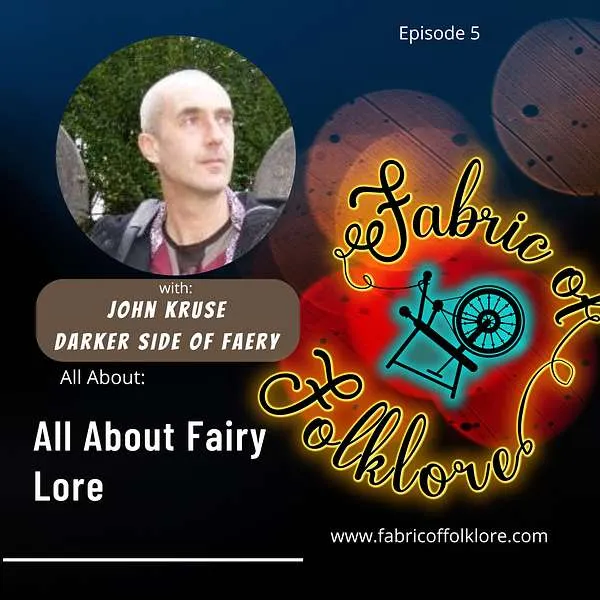
Ep 5 All About Fairy Lore With John Kruse
Are fairies lovable creatures as modern movies portray them or dark mischievous beings, who intend humans harm? Our guest on today’s episode, John Kruse, has studied the writings of British citizenry and clergy from hundreds of years past, and has written multiple books, both fiction and non-fiction on British fairy encounters. We talk about the darker side of fairy lore and how our perception of them has changed. We also discuss the influence on today’s music, art and storytelling of fairy lore on not only British culture but other English-speaking country’s cultures as well.
The post Ep 5 All About Fairy Lore With John Kruse appeared first on Fabric of Folklore.
Follow us:
Fabric of Folklore website
00:00:23:11 – 00:00:55:20
Speaker 1
Welcome, fellow Victorians. All right, This is where I just made up words. Is giving it a try. Am. This is fabric of folklore. And I’m your host, Vanessa Rogers. This podcast is striving to understand our history and therefore better understand ourselves through the lens of folklore. We do this by interviewing really interesting guests each week, such as authors, historians, folklorists, anthropologists, musicians, artists.
00:00:56:01 – 00:01:27:28
Speaker 1
It’s going to be a wild ride, and I’m so glad that you’re here with us today. You are not going to want to miss our guest today. His name is John Cruz and he was born in South Yorkshire, which is in England for those of us, not in Britain. He studied or written about British folklore, and particularly in British fairy lore at topics range across theory law, the Arthurian cycle, English and Celtic myth and folk customs.
00:01:28:11 – 00:01:51:09
Speaker 1
And he’s written a books in both fiction and nonfiction dealing with these themes. So in total, he’s written 48 books, but they are across a range of subjects and styles. So welcome, John. I’m so glad to have you today. And my first question is, I’m just exhausted reading your resume. Do you ever sleep?
00:01:52:01 – 00:02:26:18
Speaker 2
I do, yes. I I’ve been concentrating on the books for the last six, seven years now. And a lot of the fairy books were written in the last couple of years when we were in lockdown here in Britain. So there was I’d gathered lots of material together. So it was an ideal time to actually pull all those those bits of information together into a to a range of detailed books on the subject.
00:02:26:20 – 00:02:37:07
Speaker 2
So yeah, I mean, it’s it’s a kind of obsession in a way that I, I like to put things down on paper and get them out.
00:02:38:11 – 00:03:07:24
Speaker 1
Well, we’re so glad that you are, because it’s such a fascinating topic. But before we get into the theory, Laura, because obviously it’s very fascinating, I really want to understand you better and how all of your interest ties tie together. Because when I went onto your website, you your interests include law, mythology, history, art, poetry, cinema and music as well.
00:03:07:24 – 00:03:13:17
Speaker 1
And I just kind of want to see how that journey has happened to get you here today.
00:03:14:18 – 00:03:53:03
Speaker 2
Well, obviously, the the law side doesn’t have a great deal to do with what we’re going to be talking about today, other than maybe just that the habit I got out of researching those books of just wanting to to get back to the the original source of a piece of information. So we know if I was dealing with particularly the law I was dealing with here in England was it was to do with with bailiffs and that hadn’t been reformed at all when I first got involved with it.
00:03:53:03 – 00:03:57:19
Speaker 2
So it was all case law going right back to the early Middle Ages.
00:03:58:23 – 00:03:59:16
Speaker 1
Interesting.
00:03:59:17 – 00:04:31:11
Speaker 2
And, you know, I wanted to read the original cases, so I knew what people had actually said throughout that in the second hand kind of version of that. And I think that idea carried over into the the fairy law work that I’ve done that, again, a lot of books are based on somebody else’s book. And I always wanted to try to go back to the original source whenever I could get hold of it.
00:04:32:05 – 00:05:02:16
Speaker 2
Mm hmm. And I live in London, and luckily, just down the tube line from from our house is the British Library. So I could go and look at a lot of the original books. And a lot are online anyway these days. So I suppose that the habit of trying to go back to the very first word that was written about it has carried over from this sort of very boring and serious area of law.
00:05:02:16 – 00:05:15:06
Speaker 2
And so something a bit more interesting. And I’d done I’d done 30 years of dealing with the law, and I was a bit sick of it. And it was nice to have a change as well, to be honest.
00:05:16:20 – 00:05:32:14
Speaker 1
Well, I am interested in hearing if there’s any like antiquated law that came up in your research when you were seeing all the medieval laws that haven’t changed at all. Was there anything that was super interesting that popped up?
00:05:33:27 – 00:05:58:18
Speaker 2
Well, it was it was all it was all technical stuff to do with with English English enforcement. But I mean, it was just a what what what grabbed me in a way, was the fact that in the earliest act of parliament that I was dealing with was was a thing called the statutes of Marlborough from 1267, I think it was, and it was still in force and it hadn’t been changed.
00:05:58:18 – 00:06:23:02
Speaker 2
And that was just a sort of ridiculous situation that. I come from a background of advising people who were in debt and who were being pursued by bailiffs, and the idea that in the 20th century you could be chased by bailiffs using law that had been developed in the 13th century, it was just ridiculous. Casino circumstances, a change so much.
00:06:23:21 – 00:06:51:01
Speaker 2
Not just not just I suppose they did the legal system, but you know, the way people live and the possessions. People have such trying to carry over medieval ideas and so to modern circumstances was just ridiculous. Yeah. So that was part of the challenge. I mean, just to say the British Parliament has updated the law now and it is a lot better than.
00:06:51:26 – 00:06:58:29
Speaker 1
That’s great. All right. So how did you get into very law? What took you to the on attorney?
00:06:59:08 – 00:07:36:21
Speaker 2
I think it was it was back when probably when I was still in my teens, I started to get interested in the stories of King Arthur, like he was saying. And I’d probably after I went to university, I started to probably read a bit more maturely and sophisticated about that. So I was again, reading about King Arthur led me to, like you said, the Celtic myths and the Irish myths and Welsh myths and so on.
00:07:36:21 – 00:08:09:05
Speaker 2
And one thing led to another and you know, if you if you’re reading a lot of the stories about King Arthur, you know, you’ve got Morgan Le Fay, who is, you know, a sort of fairy character, and inevitably you’re going to end up sort of coming across fairies on a regular basis. And I probably about, I don’t know, 1981, 82, I bought my first book about fairies.
00:08:09:28 – 00:08:41:00
Speaker 2
And for a couple of years I was really interested in it. And amongst the pick up some of the kind of the classic books on the subject and then probably for 30 years, I didn’t really think about it again. They were still there on my bookshelf, but I hadn’t I hadn’t really looked at the subject particularly closely. You know, I got interested in in other things completely, like you were saying, in a sort of poetry and music and and other stuff.
00:08:41:00 – 00:09:13:10
Speaker 2
But then back in early 2016, I, I had a period when my health wasn’t particularly good and I just happened to pick up a book I bought back then, which I hadn’t I don’t think I read properly. And I and I started reading list again and it just sort of clicked and I thought, yeah, I would like to do something with this and I’d like to to, to restart this interest because it’s always been kind of in the back of my mind.
00:09:14:00 – 00:09:16:23
Speaker 2
But I thought I could, I could do something.
00:09:16:24 – 00:09:19:21
Speaker 1
Do you know what it was about that book that grabbed you?
00:09:20:15 – 00:09:50:11
Speaker 2
Um, I think it was. It was. It was a book. But there’s a very famous English author on the subject whose second name is on the shelf behind me. His second name is going to completely desert me at the moment. It was called the Fairies in in British tradition, in literature. And it was it was partly the idea that there was there were they the stories that are being collected.
00:09:50:11 – 00:10:22:13
Speaker 2
But then there was the way that it flowed across into into poetry and into plays and into novels and into into music as well. And the idea that it was quite a a sort of major cultural influence in a way that so much of British culture is sort of built on fairy stories in one way or another. I think that was what kind of excited me, and it was more than just the fairies.
00:10:22:13 – 00:10:23:05
Speaker 2
The talk about.
00:10:24:09 – 00:10:30:13
Speaker 1
Where we where do you see that? How it British societies built on on fairy lore.
00:10:30:28 – 00:11:13:18
Speaker 2
Well, I mean you know a very simple example is, is William Shakespeare obviously a and a so so many of the really favorite plays, obviously, Midsummer Night’s Dream and the Merry Wives of Winds and and bits and pieces in in other of the plays by him and also equally in other place in that period. The fairies are sort of there as just kind of a fact of life which everybody took for granted and everybody understood stood and they started from that basis and then developed the stories from that.
00:11:14:22 – 00:11:45:01
Speaker 2
And yeah, in coming into Victorian times, there was a real boom in, in poetry and particularly poetry based on fairy stories and not just in, in this country. I mean, lots of folks in the States as well were, were picking up on on fairy themes as well. And and it became very, very significant in British art at that time, partly the pre-Raphaelites, which everybody knows.
00:11:45:01 – 00:12:00:00
Speaker 2
But there was a whole kind of school of British fairy painting, too. So yeah, I think it’s something that’s quite underestimated by people in a way, how significant esteem it’s been.
00:12:01:06 – 00:12:16:06
Speaker 1
Do we know how far back the stories go? Like when do we know? Do we have any idea of when the first Stop fairies story was told or what group of people were originally telling the fairy stories?
00:12:16:29 – 00:12:48:12
Speaker 2
Well, you can I I my blog British fairies on WordPress. I’ve got follow followers from all over the world. And a man from Vermont was in touch with me in the last week saying, well, my my family originally came from Suffolk in the east of England. And did I know what the sort of fairy lore was there when I said to him, Well, some of the very earliest British fairy stories come from Suffolk.
00:12:48:12 – 00:13:20:00
Speaker 2
There’s a there’s a story about the green children from a village called Wool Pit in in East Anglia, which is dated to the early 1200s. And there’s a couple of other stories from Suffolk from about that time. So you’ve certainly got fairies as we still recognize them today from not that long after the Norman conquest. And you go the other side of that back into Anglo-Saxon times.
00:13:20:00 – 00:14:02:02
Speaker 2
Then they called them out, but there were still definitely elves that bear a very close resemblance to what we call fairies today. So you could probably go back right to the the Anglo-Saxons arriving in this country and say, well, they were dealing with fairies as we’d recognize them. And then separately from that, you’ve got all the the fairy stories in Wales and the fairy stories in the north of Scotland where people speak Gaelic, which again are, you know, fed into a modern idea of fairies.
00:14:02:02 – 00:14:16:10
Speaker 2
So my argument would be, well, they’ve been here since the start really. And I was doing there’s been people in the British Isles then they’ve been dealing with the factories that live in the British Isles.
00:14:17:06 – 00:14:24:01
Speaker 1
And why do you think that is? Why do you think that? It’s been here from the start?
00:14:24:01 – 00:14:53:10
Speaker 2
Well, I suppose that that can maybe come down to terminology. And I probably I tend to not say I’m I wouldn’t say I’m a folklorist because that tends to be a bit more of a you know, I haven’t got a qualification in that area. I’m not an academic folklorist. I’d say I’m a fairly low risk stiff again, inventing a word.
00:14:54:10 – 00:15:28:05
Speaker 2
And I’d say my approach is very much to to take the attitude. Well, people have been telling these stories based on their personal experiences for several thousand years. So my approach in all the books I’ve written is not so much to sort of say, Oh, that’s an interesting story, and then try to analyze why it is that people would think such odd things and what the sort of rational explanations of that might be.
00:15:28:05 – 00:15:57:16
Speaker 2
My approach in all the books I’ve done is to sort of say, Well, these people saw this, this person, and they had an interaction with this person and and we should take that seriously and we should accept that there is kind of living in parallel to to the British population. There is this other British population, a supernatural population, which is has always been here.
00:15:58:17 – 00:16:26:19
Speaker 2
So that’s how I’ve I’ve approached it and I just decided to pay the witnesses the compliment of taking them seriously and know of saying, you know, that that’s what you do, that’s what you saw, that’s what you felt. I’m not going to question that. And therefore to to explain this all on that basis, that the fundamental basis will the fairies exist and we’ll work from that point.
00:16:27:21 – 00:16:27:29
Speaker 2
Oh.
00:16:29:04 – 00:16:46:14
Speaker 1
Yeah. There was also be you wrote a book called The Fairy Faith in British Music. Yes. And it examines how theories have influenced different musical styles. Can you talk a bit about that?
00:16:47:20 – 00:17:16:06
Speaker 2
Yeah, well, I think I mean, I suppose that does again, go back to yeah, to when I was in my teens as I was growing up in the I was born in 1960, so I was entering my teens in the early seventies and one of the first bands that I listened to was Led Zeppelin. And inevitably one of the first songs that I really got excited about was Stairway to Heaven.
00:17:16:23 – 00:17:48:03
Speaker 2
And, you know, I, I, I’ve always been quite attached to that song, and I see that as really an archetypal kind of fairy song, really. And they’re taking some of those key ideas of British folklore and they’re turning it into a into a rock song. But it’s, it is, it’s a fairy tale to not say. And yeah, there’s those.
00:17:48:11 – 00:17:54:23
Speaker 1
Or any of the lyrics. What lyrics are you referring to? I mean, do you remember any of the lyrics.
00:17:55:26 – 00:18:32:04
Speaker 2
Well that, that stuff about the, the spring cleaning, your hedgerow and so on the May Queen this, this idea of, of being a kind of some sort of nature goddess of some disquiet and yeah, I mean the whole, the whole kind of it’s not so much the the, the word what the story is telling is just the I suppose the all of it is, is quite supernatural and quite magical I would say.
00:18:32:04 – 00:18:59:12
Speaker 2
And Yeah, yeah you could, you could maybe put different labels on it. And you know, Robert Graves talked about the white goddess and this, this sort of yes, this, this, this nature goddess. And that’s one way of looking at it. But you could equally look at her as being a fairy queen and that’s yeah, there’s obviously a section in in the book discussing Stairway to Heaven.
00:19:00:25 – 00:19:39:23
Speaker 2
But yeah, and back in the seventies, late sixties, early seventies, Marc Bolan and T Rex were very much into, you know, before he became the glam star that everybody remembers. A lot of the stuff that he was writing again was very kind of magic and myth and fairy orientated. So yeah, it’s, it’s been there through British classical music and then into British rock music.
00:19:41:00 – 00:20:32:21
Speaker 2
A you know, certainly all of the 20th century. And then as I say in in the very phase in British music, it’s slightly expands from that point because in the last, I suppose 30 or 40 years and particularly in the last 20 years, I think, you know, because of the Lord of the Rings films and you know, there’s a there’s an incredibly sort of strong element in, in, in various forms of heavy metal now, which is all kind of Tolkien and elves and goblins, you know, in this bands out there that records albums entirely in Elvish or in Orcs or whatever.
00:20:33:27 – 00:20:46:01
Speaker 2
And yeah, they, you know, there’s a whole kind of sub genre of rock music which is entirely built on the work of J.R.R. Tolkien.
00:20:46:01 – 00:20:50:11
Speaker 1
How interesting. I had no idea. That’s so fascinating.
00:20:50:24 – 00:21:21:00
Speaker 2
Yeah. I mean it’s yeah, it’s become quite cliched in those circles. I think it is. But at the same time, you know, it’s it’s an incredible inspiration for people and there’s people out there writing entire kind of operas and sort of death metal operas based on the works. The tool kit is still going and it’s got extra impetus from the Peter Jackson films coming out, but it pre-dates that.
00:21:22:02 – 00:22:13:21
Speaker 2
Know again, in the mid-seventies, I think one of the first albums was a Danish musician, produced an album based on Lord of the Rings. I think it was, and you may not know him so well in the States, but Sir Cliff, Richard and I, one of the kind of great figures of British music, if not contemporary British music, Sir Cliff Richard incredibly even recorded a song about Galadriel back into the mid-seventies, which I was quite, oh, stunned to discover because it’s not really what you associate still with it, but it just was such a strong element around then, and it hasn’t really sort of lessened since.
00:22:13:21 – 00:22:22:19
Speaker 2
I don’t think it’s maybe become a bit more niche, but it’s, you know, it’s still very, very relevant to lots of of metal musicians.
00:22:22:19 – 00:22:29:08
Speaker 1
Definitely not the metal music. I would pick up the theory more.
00:22:29:12 – 00:22:57:15
Speaker 2
Well I think is you know, it’s it’s not the fairy lore that I write about. It’s very much the fairies as reimagined by Tolkien. Right. So it’s all about yeah, it’s all about kind of vast battles between armies of all land, armies about wolves and and dwarves and that kind of thing. It’s yeah, it’s, it’s not a much more sort of domestic and rural kind of fairy.
00:22:57:15 – 00:23:01:10
Speaker 2
That is mostly what I’m spending my time talking about.
00:23:02:10 – 00:23:08:23
Speaker 1
But you do have a book that’s called The Darker Side of Fairies that does kind of look at that, right?
00:23:09:05 – 00:23:58:06
Speaker 2
Yes. Yeah. Well, I think that’s that’s another I think that’s probably another motivation why I did want to to write the number of books that I’ve written, because there is obviously a very strong popular kind of idea of fairies as being very nice and quite girly and probably most suited to little girls, you know, and and if you say fairy to a lot of people, then they’ll just think of they’ll think of Tinkerbell and they’ll think of little girls dressed up in pink tutus with with wings and a tiara and a wall and and that kind of thing.
00:23:59:23 – 00:24:50:26
Speaker 2
And that’s something which developed in British culture and worldwide culture, I guess, sort of from the early 20th century onwards. But it’s not what British folklore, British fairy lore is about. Yeah. And really that’s, that’s why I, I created the blog on British fairies and that’s why I did that. The first book I wrote was about British fairies and and it’s, it’s a thing you must stress throughout all the things that I’ve written, but particularly the darker side, the fairies, that if you go back to the actual folklore and you look what people have said about fairies over the last few centuries, they’re not very nice people, they’re not party friendly.
00:24:50:26 – 00:24:56:12
Speaker 2
A lot of the time they can be quite cruel, they can be quite selfish.
00:24:57:09 – 00:25:05:16
Speaker 1
Can you give us an example of like a like a short story of a cruel or. Well, I find fairy.
00:25:05:20 – 00:25:48:18
Speaker 2
Saying fairly sort of common. Well, they they like to they like to tease people. And they can be they can be quite cruel to humans a lot of the time. And that tends to that tends to manifest itself in various forms of kidnaping, for example, like people may be taken just to act as servants for the fairies. And it’s quite common for particularly children to be taken to to work in their kitchens and to do all the menial chores and so on.
00:25:49:01 – 00:26:24:29
Speaker 2
Women may be taken, perhaps just after they’ve had a child because they want the the new mother to witness the fairy child, or they may take young women in order to to have babies with them. Or alternatively, the other very common theme is, is I don’t know if you’ve heard of Changeling. Yes. And the Changeling idea is that they will take your baby for whatever purpose and they will leave instead.
00:26:25:13 – 00:26:54:08
Speaker 2
And the elderly fairy in the in the cradle that looks like a bit like the child that’s been taken. But is it a few hundred years old in reality, I think that serving two purposes for the fairies, because on the one hand they’re sort of getting fresh blood into the fairy race by bringing this child up as a fairy in the fairy community.
00:26:55:07 – 00:27:21:07
Speaker 2
And at the same time, I think cynically, they’re saving all the costs of looking after an elderly person in their community. They just dump it on the humans instead. And they the humans have to to to take care of this very demanding child that never really grows up and just sort of lies in its cot and has to be fed and has to be washed and all of that.
00:27:21:07 – 00:27:59:05
Speaker 2
So yeah, this is very kind of harsh and calculating attitude to towards humans that we’re kind of there to be used really. And clearly taking people’s children is is incredibly cruel, but the fairies don’t really care about that. Yeah. And it serves their interests so, so they’ll do it. They’re able to do it because they’ve got the magical powers and they don’t have any qualms about how that’s going to affect the victims.
00:27:59:05 – 00:28:33:09
Speaker 2
So, yeah, I mean, when you look at it, the relationship between the human population and the fairy population, a lot of the time is quite tense and quite, quite nasty really. I mean, there is intermarriage and there’s a there’s a quite a strong tradition of people taking. Typically, it’s men taking fairy brides, but it doesn’t have to be like that.
00:28:34:08 – 00:29:07:13
Speaker 2
So we can go on and we can successfully have children together. But a lot of the a lot of the stories are much more violent. And like the title of the book, there are a lot darker and a lot of a lot of the folklore that exists is different ways of setting yourself from the fairies so that they can’t steal your food and they can’t steal your possessions and they can’t steal members of your family.
00:29:08:16 – 00:29:12:05
Speaker 1
So what what are things that people would protect themselves from the fairies?
00:29:12:10 – 00:29:46:24
Speaker 2
There’s a whole range of kind of different magical procedures that people will use. And so the Christian symbolism is is is used quite a lot. So people will they’ll maybe carry a page of the Bible around with them or a page of a prayer. They’ll have obviously a a cross on them. Or maybe if they think that they’re in the presence of a fairy or they’re suffering a fairy attack, then they may just bless themselves or something like that.
00:29:47:22 – 00:30:22:24
Speaker 2
But there’s also much older kind of stuff, which is nothing to do with with Christianity. So the fairies don’t like iron. So if you people would often walk around maybe just with a a pin pushed into of the lapel of their coat or something like that, because just a little bit of metal on you would be a protection or they’d have a knife with them, something like that, or various sorts of wood will protect you from the fairies.
00:30:22:24 – 00:30:55:01
Speaker 2
So a cross made out of the Rowan Tree mountain ash is a is a very good protection. And then really odd things like this, particularly in the Highlands, in Scotland, one way of protecting the family would be to set fire to an old shoe. No, I don’t really know why that works. Power of it. It smells terrible. But yeah, it’s, you know, there’s.
00:30:55:03 – 00:31:35:00
Speaker 2
There’s a whole range of different kind of practical tricks like that which will defend your house. So yeah, the, the, the individual themselves from a fairy attack of some description. So yeah, big, big part of the folklore is, is all the things that you can do to, to avoid the fairies rather than to encounter them. You know nowadays a lot of the, the stuff you see online is ways of making contact with fairies and ways of becoming friendly with the fairies.
00:31:35:13 – 00:31:50:17
Speaker 2
And I think lots of British people from 200 years ago and further back would really wouldn’t understand why anybody would want to do that, because they think it was just a really, really strange sort of idea.
00:31:51:27 – 00:31:57:04
Speaker 1
But our perception of fairies has changed quite a bit, so that probably feeds into that.
00:31:57:15 – 00:32:31:15
Speaker 2
Yeah, definitely. But you know, I think what’s changed those perceptions is not particularly based on on the folklore. It’s it’s come out of these come out of fiction. You know, I think if you want to find anybody to blame, particularly the I’d say the the woman who designed the flower fairies back in the 1920s is probably one of the culprits because that started this idea that fairies were.
00:32:32:14 – 00:33:08:05
Speaker 2
Yeah, very, very harmless, very pretty, very small. And they were yeah, they were sort of dainty and pleasant and, and suitable material for, for children to find out about. And that, that was a pleasant idea that she had, but it wasn’t really based on any, any sort of solid folklore basis. And I think I just give people quite a misleading idea of what most of the actual folk folklore has to say about these things.
00:33:08:29 – 00:33:30:25
Speaker 2
Mm hmm. I think, you know, so there are some people who don’t like to be told that, but that that’s, I suppose, part of the, if you like to give it a very grunt and the sort of mission that I’ve been on through the last few years is just, like I said, right at the start, going back to those original sources and saying, Well, this is actually what it says.
00:33:31:19 – 00:33:35:09
Speaker 2
Yeah, like it or not.
00:33:35:09 – 00:33:41:07
Speaker 1
Well, do you have a favorite fairy story that particularly stands out to you?
00:33:41:21 – 00:34:10:17
Speaker 2
Well, I think I think one of the one of the ones that has always stuck in my mind is that the one I mentioned a while ago, the Green children from Wolpert in Suffolk, which is one of those very early stories, but it’s one of the most I think it’s one of the most sort of intriguing in a way that it was it was kind of harvest time, the end of the summer back in the the early 1200s.
00:34:10:17 – 00:34:36:25
Speaker 2
And suddenly in this village, these two children who were completely green appeared and they couldn’t speak English. And the only thing that they would eat was peas, the fresh peas that they were all fed. And nobody knew where they’d come from of this, because nobody could understand. And it took some time for people to to be able to communicate with them.
00:34:37:08 – 00:35:24:04
Speaker 2
And what they said was that they they lived in a kind of underground country, which they called well, it was called by the people who recorded it, St Martin’s allotment. And it wasn’t Sunny, but it wasn’t dark either. It is this continual sort of twilight. And one day they’d been out. I forget maybe looking after their sheep or something like that, and they’d like seen light in the distance and they’d heard noise in the distance and they’d followed that and they’d gone a long, long passages and then suddenly come out into the open air and they were just stunned by the brightness and by the heat.
00:35:24:04 – 00:35:47:00
Speaker 2
And then people from working in the fields found them and took them away. So they were unable to find their way back to the entrance to the underworld. And and they they stayed living in the human world in Suffolk. Then the boy, there were two of them. There was a girl and a boy. And the boy didn’t last that long.
00:35:47:00 – 00:36:35:12
Speaker 2
But the girl, the girl stayed in the human community and she she grew up and she married a local man and presumably, you know, somewhere there are still people who are descended from one of these green children. And interestingly, one of the things that they said about her was that, yeah, she did get married. But I think that until at least until she got married, she was she was quite shocking to a lot of the the people of the time because she was quite promiscuous, you know, And she’d she’d have lots of boyfriends and she’d sleep with lots of people, which is it was disapproved of then and maybe doesn’t again.
00:36:35:12 – 00:37:11:10
Speaker 2
Really fit in with a almost quite asexual view of fairies today. But again, the folklore and a lot of the stuff from the Middle Ages, that’s what the fairies are like really. You know, they’re quite sort of liberated in their attitudes and the way not very faithful. And they yeah, they did have quite a reputation. So that that aspect of that story did fit in with the broader kind of ideas about their their morality and their behavior.
00:37:12:26 – 00:37:41:03
Speaker 2
So yeah, it’s, it’s a story which when you’ve got a lot of people who experience that and a number of people working in the field found these children and then they were taken to the local lord of the manor and they, I think they lived in his household. So you’ve got dozens of people who came into contact with them, Justin in the local manor house and the local community.
00:37:41:17 – 00:37:56:15
Speaker 2
And then this girl stayed living there for the rest of her life. So you can’t say, Oh, well, it was just made up by an individual person. Or maybe it was just some funny experience that a person with a mental health problem had.
00:37:56:15 – 00:37:59:14
Speaker 1
Did her coloring remain green? Did they treat.
00:37:59:14 – 00:38:17:03
Speaker 2
It as a more human food? And I think that maybe the longer they were there in the the full daylight, then they they became yeah, they were no longer green colored tennis player.
00:38:17:03 – 00:38:44:18
Speaker 1
How fascinating. Well, on your blog, one of the things that you post is that you say that with your blog you wanted to ask what you’re trying to get at three main questions. And I kind of wanted to ask this question back at you. The first was how did such a highly structured alternative universe come to be imagined by previous generations?
00:38:44:18 – 00:39:11:05
Speaker 2
Well, I think I think probably the particular question I wrote maybe when I first started the blog, and that’s probably now I feel that was a bit more of a folklorist question than the same question. If you if you like. I think I was, yeah, I was I was probably being a little bit hesitant in my commitment to the fairies at that point.
00:39:11:05 – 00:40:02:01
Speaker 2
And, and yeah, as I said, I think the over the last six years, the more time I’ve spent sort of dealing with it then the more I’ve, I’ve, I think my feeling is always been, well, you know, lots and lots of people have had these experiences and I think we should we should take them at face value unless we had lots of mass hallucinations or we’ve had person after person having the same sort of mental delusions, then the consistency of it and the constancy of it has brought me around saying, well, it’s not something that they’ve imagined so much as something that actually happened to them.
00:40:02:01 – 00:40:48:10
Speaker 2
And and as I said, we’ll start from that basis, we’ll belief them and we’ll try to do this. They and so I suppose, yeah, I mean, you know, for example, I’ve written a little book called On the Fairy Life Cycle, and that is my original title, which the publisher didn’t like was I called it a fairy anatomy. And and it was very the what the book does is say, Oh, I’ll tell you in a this is a description of kind of physical description of of fairy physiology, what they eat, what they drink, how long they live, how their body works, that kind of thing.
00:40:49:00 – 00:40:56:07
Speaker 2
And just treating it as Yeah, it’s a kind of it’s a, it’s a biological study of fairies, if you like.
00:40:57:18 – 00:40:59:03
Speaker 1
And how long do they live.
00:41:00:18 – 00:41:33:01
Speaker 2
A long time. They can. I mean, does it, does some people think that they’re immortal, but I think the evidence is that they, they, they do live quite a few hundred years but they will eventually die and they can be killed. And occasionally people do kill them. The yeah, there are a few stories where humans have actually killed fairies.
00:41:33:01 – 00:41:48:22
Speaker 2
So they’re not they’re not invincible. Definitely they can be got rid of if you read determined to do it. But most of the time people are be a bit too cautious to to do anything so extreme.
00:41:48:22 – 00:41:59:02
Speaker 1
Okay. So I’m going to skip the second question because I think you kind of answer that one. And the third one that you posted was what is the ongoing impact of those beliefs?
00:42:00:16 – 00:42:02:29
Speaker 2
Well, that’s yeah, that’s a big one, I think.
00:42:03:18 – 00:42:03:28
Speaker 1
Right?
00:42:04:16 – 00:42:35:21
Speaker 2
Because I think there is that like we were talking about before, there is that cultural impact that is still there is as a theme fading through in in popular music it’s still there as something which which motivates art. So you’ve you’ve if you look online, you know there’s still people creating pictures of fairies and elves and so on.
00:42:36:04 – 00:43:30:05
Speaker 2
So it’s still something which people see is as a very vital source of inspiration. And it’s it’s still something that people want to write about. You know, I’ve I’ve written a couple of of stories and lots and lots of other people are drawn to writing about that subject as well. So as a source of of art and literature and, and film, you know, I mean, recently on, on Netflix, we watched an Icelandic series called Katla, which was about changelings, and there was there was a Swedish one called Elves that was available, which was released, I think sort of during the autumn some time in a weather family.
00:43:30:23 – 00:44:02:11
Speaker 2
Yeah. Find where they’re staying is infested with out something. So you know, things which are being produced now and obviously are seen as having a market coming from fairy inspiration. So it’s still something that is significant to a lot of people. And then on the sort of the factual side, well, people are still seeing the fairies on a regular basis.
00:44:03:28 – 00:44:47:04
Speaker 2
I’m a a member of a very loose group of people called the Fairy Investigation Society here. And the person who coordinates that, my uncle Simon Young, he he does a regular fairy census which just collects people’s fairy experiences from all over the world. And he’s constantly getting reports of encounters coming in. So, you know, again, it’s not something which is embalmed in old books in the British Library, something which is still.
00:44:49:06 – 00:44:52:06
Speaker 1
What are some examples of experiences people are reporting.
00:44:52:26 – 00:45:38:22
Speaker 2
And I mean, one interesting thing is I think the way people see things is to it would appear is to a certain extent shaped their preconceptions or maybe by their language anyway. So, you know, when when they’re asked to give a description of what they they saw, they will reach for the most familiar terms. And quite often you get people saying, well, it looked like Gollum or it looked like Legolas or whatever, or they or it look, Tinkerbell is is a very, very common one.
00:45:39:23 – 00:46:19:24
Speaker 2
And I don’t know if you know, but the original stage play of Peter Pan, because the the Victorian, the Victorian theater couldn’t really cope with having a fan flying around the auditorium. They, they just used a light and Tinkerbell in the original production was just a light that flashed around on stage. And quite a lot of people do report the fair experience of being a light or lights.
00:46:19:24 – 00:46:57:08
Speaker 2
Even this are maybe they see in the bushes, in their garden or in a in a forest or something like. So certainly a lot of the the ways that people try to put their experience into words, borrowing from popular films and popular fiction and that kind of thing. But there’s a range of experiences and people will maybe just catch sight of these little lights in the trees, or they will have much more face to face experiences.
00:46:57:08 – 00:47:33:20
Speaker 2
This, there’s been hundreds of them reported, but one one particularly unpleasant one I think was from I think it was Australia. The woman had the experience of her house was invaded by, I suppose again what we call dwarves or gnomes or something like that. And they actually took her prisoner and they kind of they tied her up and they, they, they pinned down in her room so she couldn’t move at all.
00:47:33:20 – 00:48:05:27
Speaker 2
And she was trapped for hours by these small creatures. And obviously she eventually managed to escape. I can’t quite remember how it came about, but again, it wasn’t it wasn’t a friendly it wasn’t a pleasant experience at all. It was it was very, very scary for her. And the motivation was clearly not was not at all benign towards they wanted to do harm.
00:48:06:24 – 00:48:44:28
Speaker 2
There was no one. Yeah. And people will see really, really strange things as well. Things which don’t fit in with anybody is really particularly standard vision of what a fairy is. But there have been quite a few reports of what are essentially, again, going back to Tolkien, probably what we call ents of true walking dreamlike beings. But again, the fairy census has produced several of those which where people have seen these these moving bushes or moving trees.
00:48:46:10 – 00:49:03:09
Speaker 2
And it’s well, it’s very difficult to explain it. But again, they’re not it isn’t just one isolated sighting. There have been at least a half dozen. I think so, Yeah. It’s it’s it’s a fascinating area. It’s a still developing area.
00:49:04:12 – 00:49:16:27
Speaker 1
We don’t have a whole lot more time with you. But I did want to have you talk a little bit about how theories are seen often today as protectors of the forest. And I think you you have a book about that as well, right?
00:49:17:16 – 00:49:51:13
Speaker 2
Yeah, I mean, I did I did one on on fairies in the natural world, partly in response, I think, to that or this prevailing idea that fairies are, if you like, eco guardians and the prize Amory purposeful making contact with us is because they’re concerned about the climate crisis and they’re concerned about environmental degradation and they want to work with us to do something about that.
00:49:52:07 – 00:50:23:05
Speaker 2
And that’s a theme which is come out quite strongly in it in in a number of books since probably the 1920s, there was a there was a man called Rock Ross Sea was his abbreviation, according to his first name. But he was somebody or the Campbell And he yeah, he had an encounter with a faun, which isn’t a fairy at all in a park in Edinburgh.
00:50:24:21 – 00:51:04:19
Speaker 2
And the reason for making contact with him was to to say to him, Well, we need you to, to pay attention to the natural world and do something about this which was quite advanced, I guess, in the 1920s when hardly anybody thought about that. But yeah, that theme has come more to the fore. And again, if you go back, as I’ve done in the British folklore and it’s it’s it’s hard really to trace any, any real traditional origin for that.
00:51:05:16 – 00:51:37:00
Speaker 2
Just depressingly, again, you know, the British fairies as people have seen them over the centuries, a not particularly environmental kind of characters. You know, they, they, they farm and then mine, you know, and there’s a whole family of a fairy is called the knockers who people encountered down mainly the tin and led mines and that kind of thing, you know.
00:51:37:00 – 00:52:15:26
Speaker 2
And they they are extracting minerals from the ground just like humans are. So a lot of their activities are not very environmental and not very clean at all. And again, I think partly that the trend in in modern literature has come out of the Victorian period when again, there was a tendency to say to make fairies quite small and quite child friendly and to say, oh well they, you know, they, they live in flowers and they’re associated with flowers.
00:52:17:03 – 00:52:49:28
Speaker 2
And I think from that, that the original idea that yeah, they, they, they live in the countryside and they like to play with birds and, and flutter around pretty flowers. It does kind of expanded into this more kind of eco garden view with the fairies. But as I said, it’s, it’s hard to really find any traditional basis for that.
00:52:49:28 – 00:53:28:25
Speaker 2
They, they live in the countryside on the whole and they’re obviously much more attuned to the environment than humans are of. And they’re much more they make much more use of natural products than humans do now. And there may be associated particularly with certain trees, but it’s really quite difficult to push beyond that and say that they’re they’re really a very green sort of community of people.
00:53:28:25 – 00:53:34:08
Speaker 1
All right. Well, what are you working on now and where can people find you?
00:53:34:08 – 00:54:10:05
Speaker 2
Work well into the next book to come out is most of the books I’ve done in the last couple of years have been with a little publisher in in the west of England called Green Magic. They’re based near Glastonbury, of course, and the latest book Coming out with Green Magic is is in Do quite soon and is about Welsh fairies and a because Wales is quite a small country.
00:54:10:18 – 00:54:47:05
Speaker 2
I thought it was it was it was a good subject just to, to, to look at in detail and particularly to look to see how Welsh fairies are different to British or to English fairies and to Scottish fairies and maybe to CORNISH fairies and see what the distinct characteristics are. So that, yeah, I’ve done I’ve done the number like that’s a deal on British Pixies, and I did one on the Fairies of the Isle of Man the year before last, I think it was now.
00:54:47:05 – 00:55:40:15
Speaker 2
So it’s just really concentrating on on that particular area. And I also self-publish a few things. So I did I did a just a few weeks ago, I published a book called Spirits Spirits of the Land, and that’s looking at the the idea of the fairies as being very, very long standing parts of the British environment and the British view of of the the country and of themselves and how they are kind of an underlying factor in the British soul, if you want to call it that, and how British people understand themselves and understand the landscape.
00:55:42:04 – 00:55:47:00
Speaker 2
So yeah, that’s that’s the most recent stuff I’ve been.
00:55:47:00 – 00:55:48:11
Speaker 1
And so where can people go to.
00:55:48:27 – 00:56:18:05
Speaker 2
Oh yeah, well they the classic thing of all all good bookshops, the two big books I did in the last couple of years were with Suellen, who are in Minnesota is it’s not I think it’s Minnesota. My you know, I’m not quite sure pretty sure it’s Minnesota. So yeah I mean the school in international and they’ve got a massive distribution.
00:56:18:05 – 00:56:40:21
Speaker 2
So those are the sorts of books that you should be easily able to pick up in, in shops as well as online. But yeah, you’ll find those on on their website. And Green Magic of course has got its own website and and you can order all these things through Amazon and all my, my self-published stuff is done through Amazon as well.
00:56:40:21 – 00:56:44:24
Speaker 2
So yeah, it’s only a couple of weeks away.
00:56:44:24 – 00:56:51:09
Speaker 1
Well definitely add your your website which should have links to most of your books as well. Oh, our web page.
00:56:51:23 – 00:56:52:05
Speaker 2
Thank you.
00:56:52:24 – 00:57:26:01
Speaker 1
Okay. Well, thank you so much for joining us. This is just a fascinating conversation. I feel like I when I was going through your website, it was like I could have a four hour conversation with this man. So I’m very glad that you you join us today. And let’s see, have. All right. So we’re going to have to wrap up today’s episode of Fabric of Folklore, the podcast where we unravel the mysteries of folklore.
00:57:26:12 – 00:57:48:10
Speaker 1
If you enjoy today’s episode, text your best friend right now and tell them to give us a listen. Word of mouth is the strongest boost for small podcast like us. Make sure you subscribe as well. And if you have a favorite folk tale or a guest you want us to bring on, let us know. This is you also tell us what you want to hear on our Facebook group and until next week.
00:57:48:27 – 00:57:49:18
Speaker 1
Thanks so much.
00:57:50:14 – 00:57:58:19
Speaker 2
Thank you.