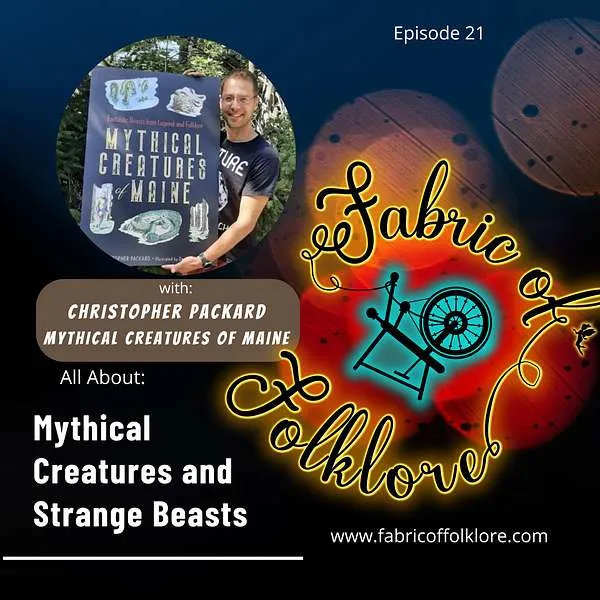
Ep 21. All About Mythical Creatures of Maine
Do you believe in creatures that live at the edge of our reality? In this episode, we discuss fearsome critters both wonderful and terrifying. Strange beasts found in the Maine wilderness and told of by European settlers, the Abenaki or “first people”, and loggers as well of others. Christopher Packard, author of Mythical Creatures of […]
The post Ep 21. All About Mythical Creatures of Maine appeared first on Fabric of Folklore.
Follow us:
Fabric of Folklore website
00:00:00:00 – 00:00:37:27
Unknown
Well. All right. Welcome, folks, folks. My name is Vanessa Rogers, and I am your hostess of the fabric of folklore podcast. And this is the podcast where we unravel the mysteries of folklore. And on this podcast, we love stories, we love folk tales, but we don’t just want the surface level. We want to really dig deep. We want to have context to better understand, have better clarity.
00:00:37:29 – 00:01:02:08
Unknown
We want to understand the history and significance of the the folk tales and traditions that we’re learning about. And so that’s really what this podcast is all about. It’s kind of like when you go to a museum and you see a painting and it’s it’s beautiful and you can you can admire its beauty, but when you understand the history behind it, it gives you a much stronger connection.
00:01:02:11 – 00:01:28:03
Unknown
The example I found recently, although that was really neat, was the creation of Adam is one of Michelangelo, Michelangelo’s most iconic works, and it’s in the Sistine Chapel and concealed within the rose and traces of the figure of God is a representation of the human brain. And many people think that it was Michelangelo’s attempt at a covert attack, on the church’s attempt at attack on science.
00:01:28:08 – 00:01:58:09
Unknown
And so when you have these understand things of these stories and this art and music, then we just have a stronger connection. So if this sounds like a podcast that you are interested in, please subscribe. Please review. Please give us all the stories because it really helps a burgeoning podcast like ourselves to have those reviews and have those stars so that other people understand that this is a really cool podcast that they should give a try.
00:01:58:11 – 00:02:24:15
Unknown
And we have such a fun topic for you. Today. We’re going to be diving into Maine folklore again. Some of you will remember the podcast that we had with Michele, a source who talked about the Ghost of Nellie Butler. And today we’re going to be talking about a different Maine folklore, fearsome critters, strange beasts, both wonderful and terrifying that I’m going to be butchering some words here, so I apologize in advance.
00:02:24:18 – 00:02:48:16
Unknown
The Abenaki are the first people had their tales of glue stop. And Pamela, I think is how you say it. And other tales came from the European settlers and others sprang up almost out of nothing around the fires of logging camps. Our guest today is Christopher Packer. He’s the author of Mythical Creatures of Maine and is a full time high school science teacher.
00:02:48:17 – 00:03:11:12
Unknown
He’s also a trail runner, a sword fighter, a storyteller, an outdoor adventure and a homesteader. He has worked as an ecological restoration technician, a field biologist, naturalist and an outdoor educator. He has degrees in biology and education, but he feels that most of his learning came from his passion for discovery and his drive to bring people together. So welcome to the show.
00:03:11:19 – 00:03:31:00
Unknown
Erica Folklore. Christopher, we’re so glad to have you. Hi, thanks for having me. I appreciate the invite. And like I was saying before, one of the things that I really like to do is to have a better context of our guests, is to ask them a little bit about their their history. And the first thing that came up for me is sword fighting.
00:03:31:07 – 00:03:56:01
Unknown
Tell us a little bit more about some of these hobbies. This sounds so fascinating. Sword fighting, storytelling, homesteading. Tell us about these things. Yeah, well, I think I just have too many interests. So the sword fighting that I do in college, I did some like sport fencing, you know, like on the Olympics with that. Not in the Olympics, obviously, but with foil and AP.
00:03:56:02 – 00:04:22:07
Unknown
But recently I’ve been more engaged with the Society for Creative Anachronism and doing historic like recreation of Western martial arts with like a like a rapier, like a like a Three Musketeers sword. And so I’ve always really been interested in like, sort of like ancestral, like things and ways of being and just to like, understand our stories and like the where we come from and who we are.
00:04:22:07 – 00:04:41:11
Unknown
Like, I think it’s really cool to be able to step back and like, do some of that old stuff, like farming on my homestead. You know, we raise a lot of our own food. We butcher animals. We, you know, you know, do all that and do a lot of music at my house, as you might be able to tell, though, I’m not the musical one in the family.
00:04:41:13 – 00:05:05:02
Unknown
And is it your wife or your children? Yes. All all of them, but not me. Oh, I have the gift of words and not music so much. But you can appreciate their music. Oh, very much so. And I mean, that’s one of the greatest folk traditions, you know? And so I just throw words at things that I don’t have music to throw into it.
00:05:05:04 – 00:05:36:16
Unknown
Well, do you help them write lyrics for their music or do they write their own music, or do they just recreate other people’s music? Yeah, both my wife and my oldest son are both really great songwriters. And my my youngest is trying to figure out what what his interest is exactly. But there’s a lot of songwriting and my my skills are not usually called upon, but they’re useful elsewhere.
00:05:36:18 – 00:06:02:21
Unknown
Absolutely. Well, and so give us a little bit of background on your previous experience. So you were an ecological restoration technician and a field biologist, a naturalist and outdoor educator. How did this all feed into your interest of Maine folklore? Yeah, so. Well, I was a biologist and and I guess I still am a biologist. I’m a full time science teacher, high school science teacher.
00:06:02:23 – 00:06:26:10
Unknown
And previous to that, though, I worked as a field ecologist and botanist and did surveys and things like that. And I spent a lot of summers in Maine with my grandfather and he had some great stories about these sort of, you know, he was a great woodsman, a guide, a trapper, and, you know, kind of the Yankee ingenuity of doing like everything to make ends meet.
00:06:26:10 – 00:06:50:13
Unknown
And, you know, he he had these fascinating stories about some pretty ridiculous creatures and scary creatures sometimes. And I just thought he was making all these up. And, you know, but I loved it. And I would I got you know, nature is just such an important part of my life and being out there. And I decided to study it and talk about it and teach about it.
00:06:50:15 – 00:07:12:06
Unknown
And I really didn’t think anything about, like these creatures, though, like, interested in like Bigfoot and the Loch Ness Monster and like, my grandfather’s creatures were certainly some of the things that were like Faces of Nature that brought me to that and and sort of kept me there and helped me have like a relationship with, with nature, with it through these these stories and these creatures.
00:07:12:06 – 00:07:36:01
Unknown
And the idea that the unknown is out there and that there’s, like all these mysterious things just waiting to be discovered. And, and I stumbled across an old folklore book in a thrift store, and I saw these stories, some of which featured creatures that my grandfather had told me decades ago. And and I was like, Wow. I thought Grampy was just making those up.
00:07:36:03 – 00:07:55:27
Unknown
And and so I my wife says, I became a little bit obsessed. I would have like, wake up and be the coffee and creature hunting and like, old books and newspapers and magazines. And I’d get in these conversations with these old timers and talk to all sorts of people about them and, you know, just made this big collection.
00:07:55:27 – 00:08:23:23
Unknown
And she’s like, You should do something with that. And, you know, in my mind I was doing something, but it was a pretty good idea. So I put it into a book and, you know, and and that’s mythical creatures of men and it kind of like linked it, you know, in one type of creature led to other types of creatures and, you know, you know, so you mentioned like there’s a Native American people in Maine are the Wabanaki and the Abenaki is like an old fashioned term for them.
00:08:23:24 – 00:08:48:11
Unknown
That is one of the groups of the Abenaki, and they have all sorts of stories and of course they were lumberjacks and guides and hunters who talked to people like, you know, my grandfather, my grandfather’s grandfather, and, you know, the stories all kind of blended together. And so like originally I was just going to tell stories about like these guide creatures, and they just started getting connected to like modern cryptids and Native American creatures.
00:08:48:11 – 00:09:13:05
Unknown
And, and so I wanted to like, you know, like Pokemon. I wanted to collect them all and, and tell about them because you really couldn’t tell one story often without referring to something else, you know? And, and the way that folklore and oral tradition works is it’s all just like, woven together into, you know, like a tapestry that, like, you can’t, you know, one thread doesn’t mean anything.
00:09:13:12 – 00:09:36:25
Unknown
It’s like how all these cultures meet. And Maine is just such a really cool place with this, like melting pot of cultures is, of course, the first people, the wabanaki, the five nations of them, and then the Akkad, the French Acadians settled here and then the English came. And then the Canadians, like from Quebec, came, which was a different pulse.
00:09:36:25 – 00:10:03:07
Unknown
And the Irish and the Scottish came and all those stories, and even like Swedish people and Norse people came and the stories like wove together and changed as these people met and, you know, stories passed from one generation to another. And it’s just become really fascinating to really track down these stories. And every time I think I’m done finding all the stories, there’s like a million more.
00:10:03:09 – 00:10:23:16
Unknown
And they’re all they’re like so many of them are still alive and or have changed. And, you know, I when I started, I was really obsessed with this idea of like the true nature, like what was the original one. But that’s not really the important thing in folklore. But I got like way off what we were talking about.
00:10:23:16 – 00:10:41:27
Unknown
You asked me in biology, but I was a bio. You know, I’m a biologist who loved nature and heard these stories and, you know, was like, how, how do these connect? And like, why are these important? And those are the questions that have been rattling around in my head. Are there similar questions that you might ask as a biologist?
00:10:42:00 – 00:11:06:27
Unknown
Yeah, they’re absolutely the questions I ask. And so like my students, these, you know, these these young people that I’m working with every day talking about like, you know, logical thinking and evidence based thinking and like what what it means to be real. And how do we verify something is, you know, and you know, like what you know, why questions is something that science doesn’t do great.
00:11:06:27 – 00:11:33:29
Unknown
And, you know, it’s very good about like delving in and finding details. And and I think my science mind is really, you know, encouraged me to look at these things in a very, you know, sort of agnostic, open minded way, because science never disproves anything. It just collects evidence that like leads to like verification, you know? But there’s no like evidence that something doesn’t exist.
00:11:34:00 – 00:12:00:09
Unknown
Like lack of evidence isn’t proof that it’s not out there. So, you know, I’m not saying like, these creatures are necessarily out there in a biological sense, but they’re very real and they’re alive and they’re a really important part of, at very minimum, our culture, but also maybe our relationship with the way we interact, not only with each other in culture, but with the world around us.
00:12:00:09 – 00:12:25:19
Unknown
Like there’s cautionary stories in these tales and there’s like, you know, some some lessons to be learned about how nature works and what you got to watch out for and how to get along with things. And how to respect things and what to watch out for us. So can I go back to where you say that science doesn’t answer the why question very well.
00:12:25:19 – 00:12:54:10
Unknown
Can you talk a little bit about that? I I’m not familiar with that. Yeah. So I like it. But people often want to know, like, why did it turn out that way? And like, there is no like, why other than like it worked. And so it continued to be passed on. Like there’s, there’s, you know, it the why is only just like because it is effective at passing itself on in that way.
00:12:54:10 – 00:13:16:00
Unknown
Basically in a biological sense. You know you’ve got like this idea, you can make a hypothesis about anything and then you collect evidence to support it and you might have like a more verified hypothesis that this statement of like what I think is going on, you know, science answers questions about like what is happening and like maybe being able to have like predictive things.
00:13:16:00 – 00:13:56:18
Unknown
But then it’s, it’s at it’s nature like supposed to be very objective and and shouldn’t have like, you know, necessarily like a an agenda. Well it doesn’t have an agenda, you know, and it doesn’t tell you know, we still give things story science is about collecting facts and creating laws, which are statements of like what’s going to happen under a given set of circumstances and the best we do is like this idea of theories where we like string together these verified hypotheses and say they’re they’re unified in these ways, but but there’s never like a why answer in science.
00:13:56:18 – 00:14:22:11
Unknown
Like, why did life evolve? Why does this gene get passed on like, other than a very, very pragmatic thing? So like, why do these stories like, culturally get passed on? Because they’re important, Because they’re effective at doing whatever they do, bringing people together, bringing people joy, teaching people lessons, giving people a relationship with nature that makes them engage with it.
00:14:22:11 – 00:15:02:28
Unknown
And that’s why why these are so important, you know, But it’s always that it’s it’s something outside of science that gives it that why it’s important. So that folktale kind of fills in that gap. They they try and answer the why to what science does it necessarily do. They do it in a pretty creative way and, you know, they’re you know, in a sense they’re you know, I don’t necessarily think most of them most of the folktales that get passed around, especially about like fearsome critters, which are like lumberjack and guide and hunter tales that like they they would tell like kind of like tall tale, you know, Paul Bunyan esque kind of stories.
00:15:03:00 – 00:15:35:01
Unknown
You know, they’re they’re not moralistic. They’re not about like, you, you should do this. It’s like, you know, like this will happen if, like, they are they’re very scientific statements, you know, albeit based, maybe not so much in science and maybe more in, you know, in imagination or creative thinking or, you know, just another way of looking at reality, you know, I mean, depending on how you want to how you want to think about it, I guess.
00:15:35:03 – 00:16:02:29
Unknown
And how so in your you know, your bio, you talked about how you enjoy bringing people together and is that through telling folk tales or what do you what do you mean by that? Yeah, So I do like I have like when I’m out, like talking and doing talks at libraries, I’ll have like a top hat and a vest and like I’ll be an 1800 star and actually, you know, like kind of channel a persona and tell stories.
00:16:02:29 – 00:16:22:16
Unknown
And so I’m really into like, telling stories and, you know, of also sometimes folk tales, sometimes stories that I’ve written, you know, and that’s such an important part of the human experience, like telling stories both like, you know, for purely entertainment and also like to get to know each other and they’re real. You know, sometimes we tell stories about our own lives.
00:16:22:20 – 00:16:47:12
Unknown
That’s important, too. But and that’s one of the things and that’s like why I want to tell these stories of this place where I live and this thing that was important to my family, that’s important to so many families in Maine and is interesting, frankly. And also I’m really into like community organization. I’m involved in a lot of like organizations that put on events in Bangor, Maine, where I live.
00:16:47:14 – 00:17:15:11
Unknown
I organized. I wanted to meet authors and introduce people to books they hadn’t heard of. So I put together like a book fair with 30 authors, and hundreds of people came. And, you know, just because, like, that’s how you bring people together, you just do stuff and make things happen. And that’s, you know, and you tell stories and people listen and then they’ll tell the stories and that’s you know, and it’ll it’ll get people interested in what’s out there.
00:17:15:11 – 00:17:40:19
Unknown
Yeah, absolutely. And so when did you so you talk about your grandfather. He was the first person to introduce you to these stories. When did that interest start rekindling? Yeah. I mean, so like he told me those stories when I was little. My dad told me the stories too, which he got from my grandfather, and I assumed my grandfather got them from his father and all that.
00:17:40:19 – 00:18:03:06
Unknown
But, you know, and I was little when I heard those stories. And like, I mean, then I in junior high was really into like Big Foot and Loch Ness Monster and like, what are these mysterious creatures? And they’re like, decrypted, you know, that that is the modern folklore. We are the folk, and that’s the lore that, like, people watch and talk about.
00:18:03:06 – 00:18:32:09
Unknown
And I collect a lot of folklore and stories on social media, actually. And I love hearing people’s stories and experiences and they’re very like these early stories about some of these other creatures, these lumberjack creatures, the fearsome critters. But, you know, when I picked up that book, I had kids of my own and started thinking about my grandfather’s creatures again was, you know, I guess it was probably about a decade ago at this point.
00:18:32:12 – 00:19:01:20
Unknown
And so I was in my thirties and, you know, it just was something I found and, you know, was thinking that that was interesting. Yeah. So, yeah, absolutely. And so how do you feel like your love of science and folklore go together? How do they feed one another? Yeah, I mean, science and especially the type of science I’ve decided that like is the appropriate type for me, which is teaching.
00:19:01:23 – 00:19:32:04
Unknown
And you know, as you know, it’s all story, you know, it’s, it’s a story about like what is in the world, how the world works, what might be out there and you know, how how do we understand the world. And so like to me like to a lot of people they’re like how you know, how could you write a book about mythical creatures and like all these things that are not verified by science and you are literally as a science.
00:19:32:04 – 00:20:08:17
Unknown
Yeah. And I’ve spent hundreds of hours, you know, more than, you know, looking for plants and doing ecological surveys and, you know, things like that. So to me, there’s no there’s no like all that different. Like, you know, the idea of science is only about 100 years old, like our modern conception of it. This idea that things have to be repeatable and verifiable, we have to collect this evidence to make it real is not a not a long term human technology.
00:20:08:17 – 00:20:28:14
Unknown
Right? Like, it’s not a way that we’ve had a relationship with the world for most of our existence, for like pretty much up until the last four generations. That isn’t how it is. So your ancestors, our ancestors, whoever they are, you know, they lived close to the land. Their lives depended on it as farmers, hunters, fishermen, you know, and women.
00:20:28:14 – 00:20:50:16
Unknown
And like, they had to know where these creatures would be and when. When anthropologists would go places and talk to people who were not in the, you know, the Western mindset where these anthropologists were, they would be like, yeah, you know, there’s moose and there’s bear. And the salmon run up at this time and you got to watch out for the little people around this pool because it’s trouble.
00:20:50:23 – 00:21:17:18
Unknown
And that’s really important. So don’t make them that and that you know in the water monsters over here and like you know this you know this hairy forest giant like and there’s these cultural things that pop up again and again and again. And, you know, we divide cultural and psychological and imagination and spiritual and scientific, but like, that’s not how the world works, right?
00:21:17:18 – 00:21:48:22
Unknown
The world is not neatly divided into these, like, ways of thinking about things. That’s just a very modern conception. And so I reject the whole idea really, that there is a boundary between those. And, you know, these creatures are real in ways that science doesn’t fully have the capacity to understand. And people get really angry when I say that sometimes, you know, what kind of person they had.
00:21:48:25 – 00:22:20:03
Unknown
All right. Well, people are just like, what do you what do you mean? These creatures are real? Like they’re like, insulted. And especially if they know that I am literally a scientist. And I don’t mean that they’re biological in that way necessarily. Not in the way that we understand biological and modern science. But, you know, like when I give a sometimes I give like a talk and I talk about like, you know, a big part of that is what’s real.
00:22:20:03 – 00:22:44:28
Unknown
And like all these things that are not scientifically very verifiable, that are like absolutely culturally so vital that they change the total way that we see the world and the way that we live our lives that are not testable by science outside of psychological or cultural means. I mean, like take the stock market, take religion, take our emotions towards other people.
00:22:44:28 – 00:23:09:18
Unknown
There is no way to quantify any of that. But no one says that you don’t love your mom because we can’t prove that no one says the stock market isn’t real, you know, even though it goes up and down on a whim, you know, and, you know, like people lose $1,000,000 in a day, you know, $1,000,000,000 company goes out of business like that and all that value is gone.
00:23:09:25 – 00:23:44:00
Unknown
And that value was like, you know, so important to our culture. People are retired solely on that belief, on that cultural construct that very much becomes real and becomes a part of our world. Like stocks are real, but they are 100% not real, right? Just like in an objective way. Yeah. And these creatures are real and they allow us to create a relationship with the world around us.
00:23:44:00 – 00:24:12:05
Unknown
And every culture has those creatures and it’s so vital, like it’s an integral part of people’s daily life. Up until the last hundred years that you have a relationship with these, you know, these beings that are just in story right? You know, so, you know, I think stories are all alive and are part of the fabric of the world.
00:24:12:05 – 00:24:40:13
Unknown
Right. And it’s not just folklore. That’s that’s like weaving itself together. It’s it’s all of our ways of thinking and all of our ways of, like, understanding reality. So getting really fearless. No, I love it. I love it. I love philosophy. Yeah. But I mean, that’s like, so important. I think, like, that’s the missing. That’s, that’s, that’s part of the missing piece of why these stories seem so crazy to us.
00:24:40:13 – 00:25:07:18
Unknown
And in some ways, like some of these creatures, the fearsome critters that we’ll probably eventually talk about, though, if we don’t, that’s okay too. Is is is like they are silly, you know, And they do have, you know, absolutely, you know, you know, squishy cultural importance and and ways of bringing together people and, you know, bona fide folklore motifs and all that.
00:25:07:18 – 00:26:01:00
Unknown
But, you know, they you know, they’re cautionary stories. They’re about the forests turning against the people who are like cutting it down. And that’s like absolutely a continuation of the the the way that, say, the first peoples creatures would respond to somebody who was so distressed, actually destroying everything, giving, you know, no credence to that, you know? And so, like, of course, the creatures become dark and fearsome and, you know, smash you with their heavy tail into a into a vaporous, bloody pulp and sniff you up through their mouths because they don’t even have a mouth anymore, you know, but they, you know, that’s not that different to how indigenous, wherever you’re at, creatures treat
00:26:01:00 – 00:26:24:29
Unknown
people who disrespects their place of being. And then as we move out of lumberjack culture and into guide culture, the creatures become more gentle again, which is really cool. Like so my grandfather’s creatures were a little bit creepy, but mostly like even the same creatures that were really dangerous, like, you know, 50 years before are now less dangerous.
00:26:24:29 – 00:26:53:28
Unknown
They’re like, You don’t need to worry about them, but like, don’t make them too happy or don’t make them too mad because, you know, there’s still these, like, literal, direct cautionary statements about, you know, the dying mom who’s in the upper right hand corner there. You know, and, you know, but they’re no longer like, you know, killing people that come into their territory and like, you know, making, you know, hunters get lost and, you know, smashing people with the balls on their tail and things like that.
00:26:53:28 – 00:27:19:26
Unknown
They’re just these features of the landscape have become like names of stones along the way of the Appalachian Trail in the White Mountains. Or do you do you feel like this is possibly a reaction to our removal from being within the wilderness? Like we’re outside of the wilderness and we’re no longer like a part of the woods? We were like removed from it.
00:27:19:28 – 00:27:56:10
Unknown
I feel like we had a guest that came on and Nancy Marie Brown, and she talked about how in Iceland it’s really common for Iceland orders to believe in elves. And part of that was because they they have a stronger connection to their environment because the environment itself is so volatile and dangerous. And they really have that that understanding better than a lot of a city folk that are really far removed from any sort of wilderness.
00:27:56:12 – 00:28:23:28
Unknown
And I wonder if you have that that take on it. Yeah, I do. And like a lot of these creatures, like people like will say, oh, these maybe have gone extinct, right? Like the stories have been lost because we’re not outside sitting around a campfire talking about these as much and they’ve been replaced by like modern cryptids and like skinwalker and Wendigo, which is actually like a really old one, actually, they’re both really old ones.
00:28:24:00 – 00:28:46:06
Unknown
And and Bigfoot and Mothman and Dark Man. And, you know, which are where wolves are do go to And, you know, they’re they’re now like, not necessarily deadly, but they’re really scary, right? Like, but if you met a Wendigo, like it would eat you, like you would be dead. Like, that’s what all the traditional stories are about. Like, it’s not like, oh, yeah, I saw this thing.
00:28:46:06 – 00:29:03:21
Unknown
It was super scary. It must have been a Wendigo. No, because you would be dead, right? Like, that’s that’s how that works. And, you know, so like this. But that doesn’t mean it’s not what it is. I guess, like, maybe these things change, maybe they don’t. That’s a really interesting one. But I’m not going to where I’m not going to get too far into that whole.
00:29:03:23 – 00:29:26:02
Unknown
And, you know, and then the guides had stories about when that goes to I’ve got like 1930s and 1920s stories about those in Maine and all sorts of stuff. So and they’re different as well. You know, give us an example of, of a creature that is different, that is has the same name but has different characteristics depending on who’s doing the telling.
00:29:26:04 – 00:29:53:06
Unknown
Hmm. Yeah. So there’s like, so the Wendigo I guess is probably probably the best one because it’s so like alive in our culture right now. Like, as, as a story is like a spirit. And, you know, I don’t know. Are you familiar? I always I only am familiar because it was on Sleepy Hollow, the TV show. Sure. So go ahead and give us a reenactment of the Wendigo.
00:29:53:09 – 00:30:28:24
Unknown
Yeah. So Wendigo is an Algonquin cultural group, which the Wabanaki in Maine are part of. And I’m at full disclosure, I’m 100% not Native American in any way, you know, so this is if you want to know the real skinny about this creature, you got to go to them. But this is a spirit that is like so well established that they actually came up with like a psychological this, you know, disorder that was related to this, that was in like the official codex of like the medical profession for years.
00:30:29:02 – 00:30:53:17
Unknown
And it was specific to this culture of people. And so what a Wendigo is, is it’s a spirit, it’s a cannibalistic giant, but it’s not a race. It’s not a creature in itself. It’s a spirit that like infects people, kind of like a werewolf, like you get cursed with it or you call the spirit into your into yourself cause you’re like crazy and evil and you know, or you like you are a cannibal.
00:30:53:17 – 00:31:14:01
Unknown
And then you end up, like, being possessed by this Wendigo spirit. And, you know, you start to feel, you know, in a lot of the traditional stories, you start to not want to eat regular food and everywhere feels really hot because your heart becomes made of ice. Ice that is, you know, is much harder than ice is. Ice is harder than water.
00:31:14:03 – 00:31:56:08
Unknown
And that that heart of ice changes you and, you know, you you can grow into different sizes and, you know, will have hair and all over your body and get so hungry like a like a hunger that’s like so great and agreed that’s so great that the more you eat, the hungrier you become. And so they spend all their time, like in, in the winter, wandering around through the wilderness looking for people to eat and you know, they stayed to the northern forests and the dark places and they’ll chew off their own lips and non their shoulders, and they’re just like this horrible fearsome creature and their howl can kill you or like, stun you
00:31:56:08 – 00:32:20:27
Unknown
or, you know, and then they’ll capture you. And there’s, there’s some beautiful traditional stories that are captured about, like, you know, even this terrible creature that was so dangerous and, you know, you needed to, like, stay away from their stories of, like, redemption in these cultural stories that are about like families surviving by, like, welcoming these Wendigo and and treating them like their grandfather.
00:32:20:27 – 00:32:41:24
Unknown
And they end up like, you know, sort of, you know, he’s redeems himself this Wendigo back to back to his humanity. So it’s, you know, very much related to this idea that like it is a separate thing, but it is a spirit that comes into you and could go away, you know, And I’m I’m of course, not doing it justice because I’m not a part of that culture.
00:32:41:24 – 00:33:12:27
Unknown
But, you know, then people hear about this and like, you know, often the cure for Wendigo was to kill them, right? Like they were literal people that were called Wendigo hunters. And they would, you know, in these cultures, that’s a thing that some of those people did. And and it later like so as as these cultures sort of became more damaged from colonization and interaction with European settlers.
00:33:12:27 – 00:33:41:05
Unknown
So like by the time I start seeing, you know, you start seeing stories that are transmitted, you know, passing from native cultures to Western cultures, which is in like the late 1800s, is the earliest ones I’ve seen that aren’t just like straight recordings of of native people is like they’re lumberjacks, you know, and some of them are Native Americans are using Wendigo like faking Wendigo sightings.
00:33:41:05 – 00:34:02:29
Unknown
Like there’s, you know, in Legends of Our Land by Charles Skinner in the 1800s. He records this this incident where these lumberjacks had taken snowshoes and put, you know, rabbit hides on the bottom and created these giant tracks that look like they were furry. And then they dropped a drop of blood right into the center of each footprint.
00:34:02:29 – 00:34:24:28
Unknown
And that was a sure sign that it was a Wendigo. And so if you wanted to cut wood somewhere, you could do that. And then the people who are cutting there would leave and then you could like, move in. And so, like, he recorded that. That was that’s one of the earliest like transmitted to like, you know, I guess like Western, you know, like American kind of culture.
00:34:25:00 – 00:34:47:02
Unknown
And so they were trying to get people to to leave so that they could cut down the. Yeah, well, so not Native Americans, but like other lumbering crews. Oh okay. So like lumber crew one wants to cut where lumber crew, too is already set up. So they go fake a Wendigo because you don’t want to mess with them.
00:34:47:02 – 00:35:28:15
Unknown
You stay away from the forest pools where they hang out. You know, you don’t cross their paths and things like that as some of the folklore and you know that that I’ve seen historically recorded and you know, and they use it to actually scare them away. And then by say, like the early 1900s, like you’ve got guides talking about like Wendigo as if they’re like little people that like you don’t cross their path, but like, sometimes they’ll follow you, but then they might decide to help you and, you know, and then they get they kind of like go away for a while and then they become this, like, scary, like woods demon again that we
00:35:28:15 – 00:35:53:06
Unknown
see in our modern crypto zoology, like specials on, you know, History Channel or Discovery or whatever. And, you know, you hear people talking about on social media and Reddit and all that is, you know, the stories that people tell about Wendigo now are like these these scary beings that definitely have ill intent but don’t actually haven’t actually killed people or like, in fact, where have they like?
00:35:53:06 – 00:36:15:15
Unknown
And we just don’t hear about it because we don’t tell stories in that same way. Right? Like I mean, I don’t know. But that’s that’s an example of how those stories have changed over time. And there’s also things where like clearly like names have been transferred from one creature to the other and things, you know, things of that sort.
00:36:15:18 – 00:36:49:22
Unknown
So when you started writing this book, did what was the purpose of writing this book and did it change at all through the writing of the book? Did you and did you have something that you were trying to achieve? And did it stay the same throughout the writings or that? Tell us about that process. Well, I wanted it to be like truly an all ages book, a book that like could meet you if you’re a kid and you just want to look at pictures and read captions and like, imagine these creatures, you know, from whatever little snippets you read.
00:36:49:22 – 00:37:19:25
Unknown
And I did that with books when I was a kid, or if you want to read the text or like, then look at the references or whatever and go on. So I wanted to create like a record that collected what I hoped would have been a comprehensive and it’s quite comprehensive, but I keep finding more things and I’m working on it on some other volumes that will will follow this, which is cool because that’s the way of folklore, is there’s always more because that’s how it goes and there’s always more to discover.
00:37:19:27 – 00:38:09:14
Unknown
And, and, and so I, I mean, that was my goal was to like bring the, you know, one, one podcast I did its subtitle was called The Spirit of Maine. And he’s like, You’ve got to be on this podcast because you wrote a book about the spirits, right? And I’m like, Yeah, yeah, totally. That’s what I want. Like, these are the things that like draw people into the place where they are is like the, the, the mystery, the spirits that live here, however, they manifest and whether it’s only for a story or only an imagination or only an imagination that you’ll admit, you know, or whether you end up with a heartfelt belief about some
00:38:09:14 – 00:38:30:01
Unknown
of these creatures. And there’s creatures of all sorts. There’s some that are like really joke creatures that are maybe like, you know, spirits that are angry. And that’s how they manifested. And then they turned into jokes as we deal with their humor in that joking way, you know. But we’re like, nobody could believe some of these creatures. But they do.
00:38:30:02 – 00:39:07:04
Unknown
I’m getting off of it again with your question. I’m sorry. So yeah, so like, I wanted people to remember the main stories like the and I think every single state could probably collect, you know, folklore about creatures that have been in it. And I’ve been so delighted to go around the state and talk to people and have them tell me their recollections of hearing these stories or the stories that they tell or the experiences that they’ve had with some of the magical creatures or more culturally significant creatures that they feel are real.
00:39:07:04 – 00:39:38:09
Unknown
So who are you interviewing? Who are you talking to? To collect these stories? Pretty much. So I go to like a lot. I go to like festivals and book fairs and I go to libraries and people kind of want to hear this stuff and like, they want to know how does a biologist write this? And a lot of so many people, like over 50% of the people like 100 or like in this country, 100% believe ghosts are real and like other types of like supernatural creatures as well.
00:39:38:12 – 00:40:05:03
Unknown
And for so many people, that’s like a big part of like their idea entity, their spirituality. And so all the people that, you know, I’m sometimes like contacting historical societies, they’re like going out of my way to like find an old timer, a guide that I’ve heard is, is, has a story, but mostly I’m meeting people and then they’re kind of interested in my book and I’m like, Where are you from?
00:40:05:03 – 00:40:22:17
Unknown
Like, what kind of things have you heard of where you’re that? And then they’re like, Whoa, there’s all this. And like, I get to hear a lot of people, their grandfather’s stories or, you know, and, you know, like some like there’s this one called the wedge sled or the side hill down here, which is a creature with different length legs.
00:40:22:17 – 00:40:43:25
Unknown
They’re longer on one side and shorter on the other. And so they can walk around a mountain and keep their back level, but they can only spiral around or spiral down and and, you know, and so this is like a creature that’s alive and well in Maine and people still talk about it. And it’s it’s very widespread throughout the country and has been for for many years.
00:40:43:27 – 00:41:08:20
Unknown
And, you know, there’s there’s lore about like things that its fat is good for and that like but you can’t eat it but then some people do eat it and like how to hunt it and how to get away from it if it chases you. And some of them meet people and some of them eat rocks and like all, all these different things, but they always have those different length legs and they’re a little bit scary and you might not want to make them mad, you know, you got to have some, you know, some to get away from them.
00:41:08:20 – 00:41:27:22
Unknown
You’re just like, you know, you you run uphill and then like, get behind them and, like, scare them and then they turn around and they fall, fall over or you, you, you go around and like you go up and then down, and then they chase you trying to get around and you meet them from behind and you can, you know, catch them that way.
00:41:27:22 – 00:42:03:02
Unknown
There’s, you know, there’s all sorts of ways to like head them off and things like that. And, you know, or if they’re if they’re chasing you, they just run downhill or something like that. But then they have ways of of getting getting around there as well. And so one person was like, you know, my grandfather called my dad side Hill, Georgia, like for my whole life until, you know, until my dad and my grandfather passed, like, and I never knew why this guy says to me and he says, Now that you’ve told me about this side Hill Dowager, you know, now I know what he meant.
00:42:03:02 – 00:42:29:07
Unknown
My dad always had a limp. And so he, you know, he had this weird walk like you would have if you had two different length legs. And so, you know, and, you know, we’re talking you know, there’s a lot of like little people stories from different cultures that are in in the book. And a lot of people have like little people stories to tell or stories about like their grandfather or something like, you know, was a beaver trapper.
00:42:29:07 – 00:43:01:04
Unknown
And they would always like, scope it out, make sure, you know, they were actually beavers and not little people disguised as beavers. There’s some really interesting lore about that, how that how little people disguise themselves as beavers what would well like a lot of like creatures in Native American law and even European law change shape like or change size and that’s like a manifestation of their power, of their multiple like duality of of existence, really.
00:43:01:04 – 00:43:42:18
Unknown
And it’s just a way that they disguise themselves. And, you know, maybe a lot of the things we’re seeing are these magical creatures in some of those stories, or maybe some of them are. And so like, there’s this one French, you know, French little person called the lute then and it was always bad luck if you had like a black cat adopt your, you know, your farm or a white dog or a yellow snake or some odd colored animal adopt your farm, you didn’t want to chase it away because it was almost certainly one of these lute then that are these little people that usually it’s translated to like alpha leprechaun when it’s translated to
00:43:42:18 – 00:44:00:16
Unknown
English, but they’re just like a little person, like a little house self that, you know, inhabits farms and, you know, helps you out. But, you know, they really like horses, so they ride them around and they put braids that you can’t untangle in your hair. And that’s how you know for sure that they’re and there’s all these like, crazy ways to get rid of them.
00:44:00:16 – 00:44:27:22
Unknown
Like they’re obliged to put everything back where they found it, unless you, like, make them really mad and then they might, like, steal stuff. But so if you had one that was like causing you trouble, you know, tire out your favorite horse every night, you would you put like a bowl of, like grains on the door where they were coming in and then they would knock it over as they came in and spill them, and then they would feel obliged to pick them up every time and put them back in there.
00:44:27:22 – 00:44:45:10
Unknown
And then eventually they would spill them and they wouldn’t pick them up and they would be gone, you know, or you could put flour across the floor and see where they were coming in, and then you could wait and like catch them in a sack. And then you had a looted in a sack. But then if it saw you when you got rid of it, like you were in trouble.
00:44:45:10 – 00:45:10:09
Unknown
So like that was usually not the best way to get rid of them. And then my favorite is like they’re really disgusted by certain behaviors. So like, if you, you know, if you really want to make them go away, you can eat and poop at the same time. And they’re like, This guy’s gross out of here. And that’s like in his old stories or like, do it on the manure pile, you know?
00:45:10:09 – 00:45:33:02
Unknown
And you’re like, what? Like this? But there’s like, like how like, how do you live with these creatures? Because if you make them mad, they might like so your pants up at the knee or, you know, turn the meat in your soup to rocks or other things like that, you know, and all sorts of things to make things go missing, bring bad weather, like ruin your crops or, you know, let your animals out or whatever.
00:45:33:02 – 00:46:04:08
Unknown
So, you know, but they would also help you and like protecting things and make things be bountiful if you had a good relationship with them. And, you know and that’s a French Acadian and Canadian and you know legend that’s like they still talk like there’s active legends in Quebec and up in Aroostook County, which we affectionately call the county you’re in, which is like way up next to Canada and where a lot of French French heritage people live.
00:46:04:10 – 00:46:38:18
Unknown
So, so why do you feel like these stories are worth preserving? Well, I mean, they are like to our ancestors, we’re like carrying on their traditions like they were that so important that like they were things that you would absolutely tell and want to make sure that people knew their their ways of being in relationship with the world, being in relationship with your ancestors and the way that they viewed the world.
00:46:38:18 – 00:46:56:01
Unknown
Because it’s so easy to say, oh, look at progress, look at like, you know, the magic of the phone that we have, you know, that sends like invisible waves through the air and gives us access to the some of human knowledge, you know, on the Internet at any instant, at all times. You know, that’s that’s our magic today.
00:46:56:03 – 00:47:25:03
Unknown
But like, what are we missing by being so busy, so plugged in, so away from the world and a way from each other that, you know, we don’t even have any concept of what we’ve lost because we’re so busy doing what we’re doing. And that’s what people always do. But these stories are worth saving because these are gifts from our ancestors that tell us an important lesson that I don’t think I fully understand.
00:47:25:03 – 00:47:53:20
Unknown
Even though I’ve committed so much time and purpose in my life to like spreading them. These are things that have vital cultural information and vital maybe spiritual or relation information with, you know, our world in environmental crisis today, you know, we’ve forgotten that there’s a right way to live and we’re just so busy living and, you know, do I need three guitars?
00:47:53:20 – 00:48:22:15
Unknown
I don’t know. Probably not. You know, my grandfather only had one. But, you know, I mean, like, I don’t know, like and I’m not telling anybody how to live or that’s, you know, but these stories do in their own way. And, you know, if we slow down and take time to find these creatures, you know, and to fi share these creatures with each other, like there’s something good that’s going to come out of it.
00:48:22:17 – 00:48:46:07
Unknown
And I think we can all use that connection. You know, connection is such an important thing that stories and creatures and we’re frozen for a second. There you go. Okay. Yeah, I hope you can edit that now. We can edit that out. The exciting, the more real the last part I heard you say is the thing about connection.
00:48:46:09 – 00:49:21:15
Unknown
Yeah. Like connection is like really the crux of we have folklore, right? Like, and like its connection to things that we are easy to understand. Like other people are ancestors, the world around us and its connection to like this deep past, this deep natural history and way of being and psychological and spiritual meaning that like is not obvious to us is a thing that I think we have largely forgotten.
00:49:21:18 – 00:49:54:28
Unknown
And in moving and especially as like Americans, we pick ourselves up and we’ve come and we have this beautiful melting pot that we’ve created. And, you know, that’s imperfect, but like always improving, you know, just the melts all this stuff together. But our ancestral like cultures, whatever they were, you know, if they’re English or French or like I’m mostly Ukrainian, you know, other than Packard, which is like colonial Mutt, I guess, from Maine.
00:49:55:00 – 00:50:16:17
Unknown
And, you know, it’s, you know, like what? What have we lost like in that? And we we don’t know. And it’s difficult. Like, I don’t know if anybody knows like and and so I think this is just a way that we bring ourselves together as sharing these stories and thinking about them and taking the time to consider them.
00:50:16:19 – 00:50:41:29
Unknown
Yeah, that’s that’s just a beautiful way of thinking of it. And So I want to read this little part that is from your intro at the end of some might wonder how the creatures such as the ones in this book could be real. And yet, unknown to science, I can’t fully explain the situation, though it is safe. Say that these creatures live at the edge of our reality.
00:50:42:06 – 00:51:09:02
Unknown
Perhaps they live in the reflection of our world. One we can only visit in dreams and stories. Or perhaps they have special adaptation that allows them to live outside of regular space and time. And when I read that that section of intro, I immediately thought of the Outlander series. Have you read that? That series? I have not. So it’s a historical fiction and.
00:51:09:05 – 00:51:38:21
Unknown
Part of it is that she falls back in time through basically a stone circle, and she travels back about 200 years and there’s a section where they are in the in the Loch Ness area, and they talk about how their hypothesis of who Loch Ness is, is the Loch Ness monster, is that he’s possibly falling through time just like she did.
00:51:38:27 – 00:52:17:02
Unknown
They, she she it’s sometimes visible to people and sometimes not because somehow it’s it’s changing its time in reality. And so that was what I immediately because that just kind of blew my mind when I read that in in the book. And so I was just curious if there are ideas about different dimensions or realities or dream spaces or how some people who are telling these stories view these creatures.
00:52:17:08 – 00:52:42:00
Unknown
If that is an element in any of these these folktales? Yeah, Yeah. I mean, first of all, I thought you were referring to Outlander is like as a book, but you’re talking about the TV show. Well, if this one in the same, it’s also a book. I’ve seen some of the episodes of that, so I am actually. Okay.
00:52:42:00 – 00:53:27:01
Unknown
Yeah, it’s originally a book series and they put into it all three things were originally. Yes, yes. And but yeah, there are definite early hints about like, like every culture has this other world, but it’s not another world that’s separate. It’s like part of our world. It’s it’s false to think. I think about these other worlds as something separate, even like if it’s a time world, you know, it’s it’s just a shadow, a space that’s adjacent to but connected intimately to our world as well, you know.
00:53:27:01 – 00:54:02:26
Unknown
And so whether it’s European folklore and traditional belief, and it’s hard to separate that from like spiritual belief, you know, it’s, I think, a fundamental like there’s fairyland, you know, like you can you step into the like ring of, of mushrooms and you end up in fairyland and don’t eat the food or you’ll be there for seven years and all that, you know, like that’s, you know, and you come back mad or you come back like despondent, never able to live in the regular world.
00:54:02:26 – 00:54:39:18
Unknown
And then there’s like echoes of similar theme as distinct but like related things about like going into the world below or the world above. And in these Algonquin stories, at least the way they were translated originally that the Wabanaki in Maine had talked, have talked about and do talk about, because they’re still here. And and, you know, of course, like all around the world, I think that’s a way that we under stay in the world as as people.
00:54:39:18 – 00:55:10:23
Unknown
And it’s really, again, just like this scientific thing that we have this this one reality, this one life in this one way and only, things that we can test and touch and observe directly or through our phones apparently is also directly measuring, you know, the invisible waves that they pick up. You know, like there are hidden worlds that are outside of our perception that we know all about and what and we find more all the time.
00:55:10:23 – 00:55:34:23
Unknown
What do you mean? Of course, Like, well, like. I mean, like there was a not so long ago that we couldn’t send, you know, like microwave messages to our phones to be able to communicate with other people, you know, with those invisible, undetectable, harmless, you know, long wavelength waves that, you know, we don’t have a biological ability to detect, but they’re absolutely real.
00:55:34:25 – 00:56:05:10
Unknown
And then, of course, like you always see people talking about like what we, you know, the frontiers of science, like the weirdness that happens in quantum states, like where you have like entanglement, like where you do something to this particle. And this particle over here, you know, responds, even though they have no basis for physical connection. It’s called entanglement, you know, and and, you know, you’ve got the idea that electrons are both a particle or a wave, depending on if you’re watching, watching them, they’re a particle and they’re a wave.
00:56:05:10 – 00:56:27:29
Unknown
If you stop watching them, you know, or forget, you are watching them. You know, they change their behavior and their physical features in the way they work in our world. And like, I’m not saying like those other fairy worlds or dream time or like, you know, the world, you know, these other worlds or times or whatever is related to quantum stuff or not.
00:56:27:29 – 00:56:58:10
Unknown
I’m totally agnostic about how science relates to all this stuff. Science is doing what science is doing, and these stories have been around for millennia and in all of our generations, you know, so they’re real. And there are people who experience those all the time through, you know, that like those except variances that they have. Like people are always like, I saw what I saw.
00:56:58:11 – 00:57:22:22
Unknown
Like whatever you, you think I saw, like, I don’t care. Like, this was a real thing. And, you know, there are, you know, all sorts of like fairly well understood like spiritual practices that people have that like allow them to, you know, work with what would you know, what they might refer to as like other dimensions or like other worlds.
00:57:22:22 – 00:58:04:03
Unknown
I don’t think the people practicing would, would call it that. But like shamanic culture and things like that, like have these, these journeys from the body where they fight things and encounter spirits that are absolutely real and like part of our world and affect our world. And they’re just a different way of looking at it. And those are like, you know, like shamanic stuff comes from like specific cultures, but like there’s these animistic themes that anthropologists recognize that have been in that have been part of all cultures for pretty much all cultures that we can figure out, you know, for so many years until we sort of like sort of give it up or change
00:58:04:03 – 00:58:38:03
Unknown
it or trade it for science or like whatever way that we want to, you know, we start thinking about the world as we leave our traditional culture or some other culture comes into that and replaces it with another economic and social system, you know, and, you know, but these remnants, fragments, these story echoes are those lessons, those those gems that our ancestors have rolled to us from the past, that that we can choose to pick up and see what we look like.
00:58:38:05 – 00:59:06:13
Unknown
And, you know, when we when we gaze on those stories or those experiences and and I think there are ways to, like, delve into that more, if that’s what you’re interested in, or you can just appreciate them as beautiful cultural story that brings people together and connects them with the world and makes them think deeply about who they are as a as a person and whatever that meaning for them is for whoever is experiencing these stories.
00:59:06:16 – 00:59:40:09
Unknown
That’s the important part, right? Like stories are for whoever hears them, right? That’s what meaning they garner from them. Yeah. And the longer we spend with them, the more meaning we garner from them, you know? And I mean. Yeah. So I don’t know if it’s 100% subjective, but it’s definitely whatever we experience is always through the lens of our, like our experiences and cultural experiences that we’ve built up over our life.
00:59:40:10 – 01:00:23:20
Unknown
Absolutely. So let’s dive into some of the tellers of these stories. So you talked about in your intro, there are five nations of native tribes that are a lot of the folktales that are in your book are the originators of is that right? Yeah. Well, so the Wabanaki people are five nations from south to north. They would be the Abenaki, the Penobscot, the passing, McQuaid’s, the Malusi and Mick Mac or McMahon I guess is the correct pronunciation.
01:00:23:22 – 01:00:52:07
Unknown
And, and they, of course, are the people who have had the relationship with this land the longest. And their stories were obviously here first. And to ignore those stories would of course be doing a horrible injustice to those spirits that are in those stories and the those people who had those stories to tell because they interacted with other people.
01:00:52:09 – 01:01:18:13
Unknown
And so those the native people who live here, of course, had stories, they shared them and they were recorded by anthropologists. And, you know, and I have native friends, I’ve had experiences with people, and I kind of consciously left out like I want people to, like, learn the native stories from Native people because it’s so frequently like Ben that like other people tell their stories.
01:01:18:13 – 01:02:07:02
Unknown
But I also felt like it would be a huge injustice to leave them out. And so, like, I, I don’t tell the stories, but I tell about the spirits that you might meet here in Maine so that if you wanted to find out more, you could you could go to those native people. And so those are a really important source, I think, of of understanding like what the spirits of Maine and the folktales and folklore, you know, are, because they’re the backdrop of the people who came here, you know, as a colonial from Europe, how they started to experience the world and understood and who taught them about this new place that they were in.
01:02:07:02 – 01:02:29:27
Unknown
And of course, you know, a lot of antagonism between those peoples in early times. But then you get, do you want me to go on? Do you want me to delve into that? Annie Yeah, well, I was just going to say, when you say spirits, do you mean like the spirit of the or the actual physical spirits that are haunting the forests or what do you mean by that?
01:02:30:00 – 01:02:53:22
Unknown
Yeah, I mean at all. I don’t, I reject that. There is a boundary between the two. I mean, like if, you know, the tellers of those stories were like, here’s a thing that happened. There are legends like the language, the Algonquian language has conjugations for like distant past and like, immediately present things and locomotive like that. This is a location oriented thing.
01:02:53:22 – 01:03:17:05
Unknown
And like, so the language that they seem to have used to tell these stories to the anthropologists was not the the creatures in this book. While some occur in the distant past are all there in the book because they have, you know, they’re talked about as if, you know, as being real, as being things that you can encounter.
01:03:17:07 – 01:03:44:00
Unknown
And, you know, like Paul Bunyan is a great example to skip to a different culture like that. The early anthropologists who studied the lumberjacks telling that are like these stories are like the anthropologists are like these stories are absolutely fake. They’re made up. There is no person named Paul Bunyan. And then like, but they’re like, The lumberjacks will swear forever and never say that that’s that he’s fake.
01:03:44:05 – 01:04:29:16
Unknown
They will in fact claim that they worked with them two seasons ago and like was in his camp and like, saw some of these things and and like a lot of like the lumberjack tales that we see are literary tales that were passed down or like, cleaned up because lumberjacks are pretty rough fellows. Like, they were like they were pretty rude and like rough and like, you know, totally inappropriate as, as, like, guys joking around if they’re, like, hanging out, not showering for, you know, in a one room building, like they’re very crude or sexual or a wet things every and all of it.
01:04:29:23 – 01:04:53:21
Unknown
And but like all the like all the sexual stuff is like cleaned out of the stories I think by the you know and they’ll even write like this is the and then there was some that are not appropriate like the anthropologists that to to to record and you’re like what like this is a science supposedly a scientific study of culture like how can you not record what they were saying.
01:04:53:21 – 01:05:19:22
Unknown
Yeah but like I mean, it’s just like the time they’re in, like that would be totally inappropriate. And so, like, you know, everything is through culture, Like it’s this invincible. And my minor in college was anthropology, so, you know, so I have like this strong, like I think culture is like the glasses through which we see the world, like it totally changes, like how we interpret.
01:05:19:24 – 01:05:41:23
Unknown
Absolutely. And so, you know, and it’s real, right? Like you can’t be like culture is not real. It’s like 1,000% real to our experience. And, you know, so like, whatever it does, like it’s just doing its best. Like, I mean, then people are not to make excuses for anybody for whatever. But, you know, I mean, that’s, that’s how it is.
01:05:41:23 – 01:06:12:16
Unknown
So, so yeah, I mean, spirits of the story and I mean like they’re talked about as real and so who am I to say that’s just a story. Yeah. Do you have an example of one? I mean, like the the Wendigo we’re talking about earlier, there’s a host of little people that get talked about like, you know, little will, three foot, one foot, two foot like people that, you know, these different races and different ways to interact with them in these stories.
01:06:12:16 – 01:06:41:16
Unknown
You know, so anthropologists like separate and a lot of times like folklore is like legends from like just folktales. Like folktales are like just stories and like legends or things that are told as true, right? And it doesn’t mean they’re not true or like are true. It’s just like that is the tellers like interpretation of this story is it’s true.
01:06:41:16 – 01:07:24:15
Unknown
And like it’s completely inappropriate I think to say that those stories are false and like, because I’m a scientist. So, like, I I’m collecting cultural information. It’s absolutely real. And I mean, I’ve had some weird experiences, you know, in my life. So like, I mean, things that people would think are crazy, like ghosts and stuff like that. And I mean, I’m not going to tell those stories now, but like, who am I to tell somebody what what their reality is or what they’re, you know, and stories like especially with indigenous people are so tied up in spirituality because they’re still in their culture, right?
01:07:24:15 – 01:07:59:06
Unknown
Like they’re not like, removed. They’re not like changed religions through conversion a thousand years ago or 100 generations or whatever, you know, So like the separations that we make between story and reality and religion and nature are like not real for, I think, indigenous people in a traditional. But you would have to ask somebody who was was living that I really know and I’m not sure the question makes sense to somebody who’s living that.
01:07:59:12 – 01:08:26:01
Unknown
Like it’s it’s an absurd question. Like, what do you mean these things are separate, right? Like, and I think if you go far enough back to somebody who’s living like whatever this place based culture that they had been, you know, like, you know, in that way non civilized, I guess, as we might say today. You know, I think the question doesn’t make any sense.
01:08:26:01 – 01:08:48:09
Unknown
But to us like it, we want to know, is it this or is it this? And I’m saying like, yes, it’s the it’s those things, right? And that makes people mad. Yes. I don’t like making you mad, but yeah, like there’s no like. Right. Like that line is fake. We made it right. It’s a story like that’s the story that we’re telling.
01:08:48:09 – 01:09:13:11
Unknown
It’s our cultural situation. It’s our culture. Yeah, right. And so and I’ll do that for, like, all of the creatures here are real, like, and because they’re told is true or they wouldn’t be in that book and you know, and some of them are absolutely silly, but it doesn’t mean you can’t have experiences with them. So whatever that means.
01:09:13:11 – 01:09:54:13
Unknown
So we talked a little bit about that. The first nations people. What about the French and the English people who came over? What stories did they bring over and how did they change once? They were in Maine or in that region. Yeah. So there’s two waves of French people that come over. The very first people were Acadians. And, you know, so like our national park that’s in Maine, Acadia is named for them where, you know, there was an important French admiral, General, whatever named Cadillac who had a colony there.
01:09:54:13 – 01:10:25:17
Unknown
And then it was like, this was New France where I am right now. And, you know, and it was all part of Quebec and Nova Scotia was part of that and New Brunswick and all that. And then, of course, the British came. So like the the French stories are, I think, a lot more intact. Like, like as like a folklorists hat, like as far as like traditional like what is similar to like French stories.
01:10:25:19 – 01:11:09:13
Unknown
And I write a little bit about this in this book, like talking about some of that, but it isn’t a huge part of my study. And and so like you’ll hear a lot of like the Luton’s stories and the luger to like those stories basically come over and they’re regional within French, so within France. So it’s sometimes difficult to tell like, is this a change story or is that just like, you know, from Provence, you know, or like, you know, Britney and not like Paris, You know, I mean, like because they’re different because you they’re living these sort of, you know, more or less very agrarian, like the type of people that come over like
01:11:09:13 – 01:11:34:18
Unknown
what what is their relationship with the land and their traditional stories and the type of English people that come over is actually quite different. It’s it tends to be the people who write about the English. Things come over and then set up education systems like basically the English stories are more or less like lost, like whatever came over.
01:11:34:21 – 01:11:53:29
Unknown
There’s like a few things. There’s this little person that like, haunts, lumberjack called SOC Saunders, and he would cause all sorts of accidents, you know, tying up logging chains and pushing trees the wrong way and letting the horses go. Kind of like the looting. But, you know, and they would, you know, talk about, you know, you didn’t give me that time suck.
01:11:53:29 – 01:12:23:22
Unknown
SAUNDERS And apparently this was like a big deal for some period of time. This this named creature, little person, you know, in all these various camps, or at least a few camps and, you know, but mostly you hear like the transcendental writers, like Thoreau and Emerson and Whittier, like in Longfellow, just literally saying, like these, English stories do not come over like there aren’t fairy stories.
01:12:23:24 – 01:12:47:15
Unknown
But then you’ll see like little snippets where, like, they’re like, man, you know, like there’s some educated ends up in like Downeast Maine, which is like, you know, way out towards Canada coastal part. And they start talking about, you know, how, you know, everybody here believes in witches and goblins and imps and fairies and it’s just total chaos.
01:12:47:15 – 01:13:12:08
Unknown
Right? And, you know, and talk to Michelle Shaw and there’s like ghost stories and orbs and things like that and that are around. But like, it just it doesn’t survive five in the literature. Whereas the French who were here, there was a lot of like, you know, they and like the Native Americans, like they became insular communities because of linguistic and cultural barriers.
01:13:12:08 – 01:13:45:10
Unknown
There’s actually a lot of discrimination against French people because, like we actually went to Maine is the only that’s gone to war with another country all by itself. It was called the Aroostook War and we declared war on Canada over like the county which is a French region of of Maine like and who got it and Canada, you know I think like the king of Sweden you know ultimately like negotiated the new border and like we got the southern half that’s Maine and they got the New Brunswick portion.
01:13:45:12 – 01:14:16:15
Unknown
Oh, you know and that’s that’s a Canadian people which is not at that koala, which is like a later French arriving people do Acadians did did end up in Quebec but they got sort of like over and so there were multiple pulses of these sort of rural, like old timey kind of stories. And you see some of that kind of stuff surviving like Labrador, which is like a Canadian province that’s like way up north of here.
01:14:16:17 – 01:14:44:00
Unknown
And you’ll see some fairy stories that survived there because like, there isn’t like cultural centers in Labrador. It’s like, like there’s nothing there. They would probably mad at me for saying something, but they can’t find me because I’m down here. And and so, you know, like, I think they existed, but they’re they didn’t get passed on because of the cultural like the way we melt America.
01:14:44:03 – 01:15:18:19
Unknown
And so if you have a an easy to see like you tend to be isolated and then your cultural stories survive for longer periods of time, more intact arms and and oral storytelling maintains a larger part of like the culture, too, to some extent, I think. And it gets replaced with like literature as you become part of this, like sort of like homogenized American culture.
01:15:18:19 – 01:15:42:21
Unknown
And I’m not bashing like, I love America. That’s great. But, you know, like we we what have we sacrificed to create this place? You know? And like, we don’t we don’t know, like you and I don’t know. Maybe you do. I don’t. I don’t. I would like to. And that’s why I do this. And and so, like, you lose a lot of that.
01:15:42:21 – 01:16:02:02
Unknown
And then, like, Irish and Scottish people come and like there’s some interesting writings about, like they had there’s this creature in the book called The Phantom or the Specter Moose. It’s this giant, like twice the size of like a regular moose and it’s like white and you can’t shoot it. Or if you shoot it, it like comes back to life.
01:16:02:02 – 01:16:30:07
Unknown
And there’s like all sorts of cool stories about it. And it it goes back to the 1800s. But the original stories are like, Oh, this is just like some Irish guy, you know, was talking about it. Nobody believes like there there is unbelievable is the French. And you’re like, well, what? And then like and then some hunter sees it who is like some they call them rustic haters or sports who come up from southern New England and, you know, sees it and they’re like, oh, it is real like.
01:16:30:08 – 01:16:53:22
Unknown
And you’re like, this is this is so interesting. And so there’s always these like pieces that you find that are like, you know, and so like in a sense, like your culture stays more intact, the more isolated you are from, the dominant culture. And I think that’s pretty common, like around the world, for better or for worse. And it’s probably also tied to it.
01:16:53:24 – 01:17:16:14
Unknown
It’s definitely tied discrimination as well. But, you know, the benefit is you keep your culture, you know, and you keep this face to face culture a little bit longer. And then then then the dominant culture that you know, and that has its own benefits to some extent, that certainly doesn’t make up for, you know, like justifying discrimination or anything like that.
01:17:16:14 – 01:17:46:05
Unknown
But, you know. So do you have a personal favorite of the mythical creatures? Huh? No offense. My least favorite question, because I love them. You love them? Oh, yeah. That which is the worst possible answer. I love like, I guess the two like, types of creatures that I love the the most are like, I, I love little people.
01:17:46:05 – 01:18:20:29
Unknown
Like little magical, like elves dwarves, you know, and like, whatever indigenous or luthien or like, suck. Sonders Like the idea that these little house elves or forest elves live and interact with us and have a way of disappear saying and stepping into another world and like helping or hindering us, depending on that that I love. And, you know, when I was younger, I had like a weird experience that I kind of think of as a little people experience.
01:18:20:29 – 01:19:05:15
Unknown
And so I love those stories and how Universal they are I also love the the, the overall fearsome critters, the lumberjack and guy critters like the ding mall or fungus or like my grandfather. And this is the same creature, the the the Helton thumper, this big like cat otter headed short necked like low to the ground, like big cat with a giant long thick tail and a big hard ball on its tail that it could swing around and like attack people with for defense or break the ice or break a dam or, you know, knock down trees or splinter them up or like bang on its mate to make sure it’s got strong one, you
01:19:05:15 – 01:19:41:03
Unknown
know, with this big bristly bony ball on its tail. Like, I love those because those are the ones that like Drew me in to this and called me to do this work, these fearsome critters, these guide and lumberjack and hunter stories and the side heel gouging ears and wedged ledge chompers in the film Blue Birds and just these unfortunate and like, scary and like, funny creatures that are really a reflection of our relationship with the forests, you know?
01:19:41:03 – 01:20:05:08
Unknown
And, you know, fir lumberjacks are often scary and dangerous and for guides are a little bit dangerous if you don’t know what you’re doing and then like, become a little bit funny and, you know, are are still talked about here in Maine. And I love that. So I love those living pieces of folklore, like there’s less and less each each year, I think, you know.
01:20:05:08 – 01:20:39:21
Unknown
And so I like these and I like telling the stories. And I always am like, now you tell these stories, right? Because that that’s, you know, and that’s how these live on. Do you want do you see one as the most unique to Maine? MM Um, you know, the fearsome critters in general like start in, in Maine and of course all the wabanaki creatures are pretty unique to like this region, northern New England and Maritime Canada.
01:20:39:23 – 01:21:01:27
Unknown
But it, I think I, I can’t think of any that are like truly, I mean you’ve got like the top road shag them. I think that one’s only in Maine or started out in Maine. There’s a lot of them that started out in Maine but then they make their way to the upper Midwest and you know and down south.
01:21:01:27 – 01:21:22:26
Unknown
So what does that one The marsh Oh, the Tilt Road. Shag them. Well, he’s a tough one. You know, he’s he’s real imitative. He’s he’s got his half moose and half bear. And that’s not to say he looks like a half bear and a half moose. He’s kind of a bipedal walks on two legs, creatures, very curious, sort of an innocent like face walks upright, you know.
01:21:22:26 – 01:22:00:10
Unknown
But he gets tired every quarter mile or so. He switches legs from the moose legs on his back to, you know, walk on his front legs, which look like bear paws. And it’s very you know, there’s no greater, you know, embarrassment than coming into camp and not knowing whether you’re tracking a moose or a bear And they tend to like pick up loose things that they find, you know, like so if you’re coat’s gone missing or your pants, like it was probably the toe road shag them on the picked them up and they’re called Tote Rhodes tote road shag arms because the shaggy Milo likes to follow a toll road which everybody knows is the
01:22:00:10 – 01:22:28:29
Unknown
road, the tote, the logs out on the woods road and you know, like a surveyor, they’ll, you know, they watch what people are doing and they follow the same paths, follow surveyors. And every quarter of a mile, which is, you know, the chain links on on a surveyor’s chain, they’ll actually switch their legs and, You know, when they find a witness tree or a property corner, they’ll actually circle it and pay homage to it before they continue on.
01:22:28:29 – 01:23:03:16
Unknown
So they tend to like repeat those. And it’s kind of my hypothesis that, you know, we don’t do a lot of that surveying in that old fashioned way or like we don’t have boots on the ground doing logging anymore. It’s machines. And so here we’ve got, you know, the the Appalachian Trail. And so there’s these people called through hikers which hike from Georgia to Maine or Maine to Georgia, and they look pretty shaggy by the end, just like tote road, shag them all night and, you know, things go missing sometimes and it’s a little hard to tell, you know, is that a through hiker passing through town?
01:23:03:19 – 01:23:29:22
Unknown
Is that a shag of mine? And, you know, there’s a lot of creatures like that that have kind of stories that go along with them and kind of explain silly things and, you know, things to look out for. So that’s the tow road. Shag them on. And so what has surprised you the most during this this work that surprised me the most?
01:23:29:24 – 01:23:59:09
Unknown
I guess what really surprised me was how inner like how the stories like linked together and like like, like Willow the Wisp, which is like a floating orb that leads people astray, like in French Canadian, that’s faithful, a And that changes into like the Phil Omalu bird, like this, like horrible, like distortion of the French language that there’s this glowing nocturnal bird that would fly around like changes.
01:23:59:09 – 01:24:20:23
Unknown
And then like, I find another story that like, oh, it’s, it’s a bird, but it flies backwards and it’s brightly colored and it doesn’t like bridges, which is another like Willow, the West French-Canadian story. And so now you’ve got a Philip marlowe book, Blue Bird that’s like lays square eggs and flies backwards because it doesn’t care where it’s going.
01:24:20:23 – 01:24:59:17
Unknown
It only cares where it’s been, you know, And, and, you know, you got to watch out for them. And if everyone’s chasing you, you just cross a bridge and you can’t get after you. But, you know, that relates to like the French Canadian faithful have these these sort of if you were real bad and you didn’t go to mass for seven years, you might turn into a lu guru, which means you turn a wolf each night and oh, you weren’t saved for another seven years of being a lu guru if you truly didn’t repent or use the name of God or nobody drew your blood to cure you of this curse, you know, you’d turn
01:24:59:17 – 01:25:27:13
Unknown
into a willow, the wisp of faithful, a flying fire and, you know, and they would chase people. And the way to get rid of them, you know, is you can’t attack those directly like the Lu Guru. You can just draw it’s blood and it’ll turn back into a person. But, you know, actually cure them of the curse. But the faithful, you have to find the person who it’s come out of and it’s come out of their mouth and you have to flip them over and then it can’t get back in.
01:25:27:13 – 01:25:58:25
Unknown
And or you can find a crook in a tree and you can jump through. And you, if you put knife in there, they can’t get through the same way that they follow you. And so, you know, this creature that was like scary and would chase people and lead them or like related to a werewolf and related to like violating cultural norms of good religion, like, turns into this lumberjack creature that’s this backwards flying bird that is now known across the country.
01:25:58:27 – 01:26:30:10
Unknown
And I, like, found these records where it literally you can see it changing from one thing into the other. And it doesn’t make any of them not real. It makes them alive, you know, the way that they evolve as a story and get seen how they’re important and what kind of information they transmit and the way that we relate to them.
01:26:30:13 – 01:26:57:26
Unknown
So, you know, I mean, that the kind of thing that I didn’t expect to see I mean, like I thought anthropology was a little bit interesting in school, but biology was my real jam. And like animals, you can’t really watch them easily change and evolve, like in a human life to regenerate or to, you know. But but our stories are oral stories do.
01:26:57:26 – 01:27:21:17
Unknown
And, you know, spirits don’t follow the same rules of the way of being. So, you know, it doesn’t negate them as being real. Like we see things is like fixed this is this and it will always be this. But that’s not how like, like ancestral knowledge treats the world. Everything is cyclic. Everything is changing. Like the rivers don’t stay the same.
01:27:21:17 – 01:27:41:25
Unknown
Like That’s a terrible idea. When we try and, like, make the straight river, it’s just going to get out. Right? But like everybody knows, rivers move around and change and seasonally are different in like a floodplain is literally part of the river. It’s supposed to be part of it. And like, these are like ancestral pieces that like, you know, it doesn’t mean anything.
01:27:41:27 – 01:28:04:09
Unknown
That doesn’t mean it’s not real. If our nature changes, like if if you have an existence as a man and then you have an existence as a wolf at night, you know, all because, you know, you violated cultural norms, you know, and then you find out who the Lu Guru is and then you’re not allowed to tell anybody for whatever reason that I understand.
01:28:04:10 – 01:28:28:06
Unknown
You know, like, who was the guru, you know, And, you know, so, like, that’s this surprising is like the stuff that’s so like, you know, like watching it change, watching it be connected as our culture changes. And, you know, I, I had somebody say, you know, like, well, spirits just appear to us in whatever way we can understand.
01:28:28:07 – 01:28:57:13
Unknown
Like it’s like through our own cultural glasses. And so, like I, I guess I, you know, like, like I wasn’t ready to see how much things can change, but like, how they can, like, have a same identity as they passed know. So I don’t know. Yeah, absolutely. So what do you want the readers or the listeners of this podcast to take away from your book or this, this particular episode about fearsome creatures.
01:28:57:16 – 01:29:36:16
Unknown
Yeah. Yeah. Well this stories are all around us and that like we, like, like fearsome critters are like truly American culture, right? Like, and they are funny. They test our bravery and they teach us lessons and they are scary and they bring us together. And so what I want people to do is like, find those stories of your place wherever you’re at and learn them and tell them and take the time to like reflect on them and look for those creatures and then share them with other people.
01:29:36:16 – 01:30:08:02
Unknown
And, you know, whenever I sign a book, I always write all these stories are true, right? And and always tell yours. And then I tell people, like always tell your story and, you know, like, don’t, don’t ashamed of however you view the world, like share your story, your experience, and also share these and don’t accept that there are lines of how things are supposed to be because that’s not how things work, right?
01:30:08:02 – 01:30:36:21
Unknown
Like, things change and move. And that’s good. That’s that means they’re alive, right when they don’t. Yeah. Dead. Absolutely. And yeah so always tell your story and follow the stories Find the truth Right. Well that’s just Yeah that’s I think this is a great place to end unless there’s something that we’ve missed. Is there something that we’ve missed in this, this episode?
01:30:36:23 – 01:30:52:24
Unknown
Now, now you got me to talk about all sorts of things other than I was like, I’m only going to talk about fearsome critters because that’s the book I’m working on. But then, like, I can’t not talk about all the creatures that are in the book, you know, because you got to tell the story. So I think that’s great.
01:30:52:24 – 01:31:25:07
Unknown
We went on, Oh, great. Well, thank you so much for joining us. The fabric folklore. And thank you, folks, you folks, for listening. We will have all of the links that we talked about on the show up on our website. WW dot fabric of folklore icon. And if you have a question that I didn’t ask or if you have comments we have a Facebook community page for to continue the conversation.
01:31:25:09 – 01:31:49:20
Unknown
So what did you think about the episode and what fearsome critters had you heard about? Had you heard about the Maine folklore mythical creatures? We want to hear from you. And that is where you can continue this conversation. And and if you enjoyed it, today’s episode, please, please, please remember to subscribe, share, comment and like and review us because.
01:31:49:20 – 01:32:08:25
Unknown
Like I said in the intro, that is how people find our show. If you are reviewing our show and you’re giving us all the stars, then that is how other people find our show. And the more people who watch and listen to the show, the better, right? Because the more interconnected we we are and the better we understand one another.
01:32:09:00 – 01:32:24:21
Unknown
So Thanks for joining us on Fabric of Folklore, where we unravel the mysteries of folklore. Once again, my name is Vanessa Rogers. And until next time, keep the folk alive.