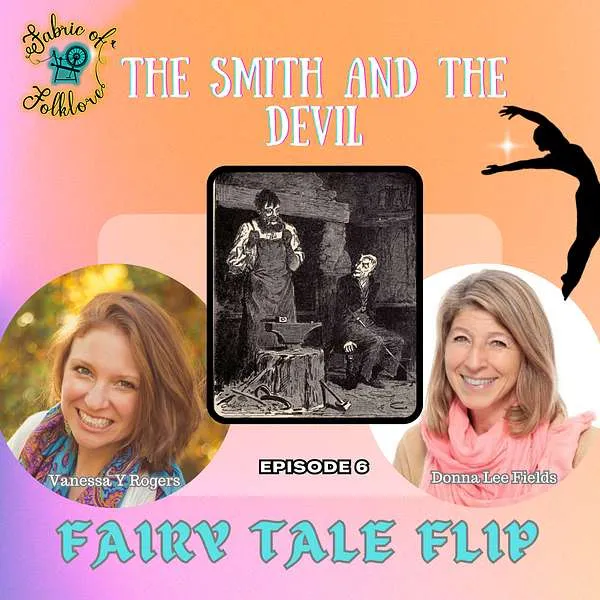
Fairy Tale Flip – Ep 6: The Smith and the Devil
Do you know what the oldest fairy tale known to modern times is? If you don’t now, you will soon! The Smith and the Devil is a fairy tale found all over the world throughout countless cultures. But why? Why has that fairy tale been maintained through the not hundreds of years but thousands? What is the connection with blacksmiths and devils? Is the devil a bad guy in the story? In this fascinating episode we reflect on themes of duality and power dynamics, intricate relationship between blacksmiths, fire symbolism, and alchemical powers stood as a central theme in understanding narratives. We discuss ancient and modern interpretations, highlighting variations found in Russia, Scotland, Appalachia, the American West among others. Our conversation included the Greek and Roman gods like Hephaestus and Vulcan, as well as, the linking of the devil and Pan, highlighting themes such as societal perceptions, trickery, honor and respect. Don’t miss this enlightening and incredible episode!
📖 Fairy Tale Discussion
- Focused on the Russian version of “The Smith and the Devil”
- Explored themes of labeling people and automatic reactions
- Addressed the duality of reactions based on names and labels
🧠 Philosophical Discussion
- Explored the concept of treating aggressive negativity with kindness and respect
- Emphasized focusing on individuals’ divine presence to promote understanding and empathy
🌍 Variations of Fairy Tales
- Explored different versions of fairy tales across cultures
- Noted similarities and differences in storytelling across various regions
🔬 Research Findings
- Mentioned a study analyzing 200 fairy tales across cultures
- Explored the widespread nature of certain fairy tale themes
Links to research mentioned:
https://royalsocietypublishing.org/doi/10.1098/rsos.150645#F4
Follow us:
Fabric of Folklore website
00:11
Vanessa Rogers
Welcome. Welcome, everyone, to fairy Tale Flip, episode six. My name is Vanessa Y. Rogers, and I have a podcast called Fabric of Folklore. And my co host, who is collaborating on this wonderful journey, this monthly fairy tale deep dive, is Donalee Fields of scaffolding magic, and she also has a podcast at doorways to learning, where she talks about education. And we come together on a monthly basis to look at one fairy tale and really go into depth and understand its historical context and understand its hidden meanings and just understand our current world in the context of the fairy tale or the other way around. But so we are super glad that you are here with us today.
01:05
Vanessa Rogers
And we also enjoy this format because we always give our audience three options from which to choose what fairy tale we’re going to do a deep dive on. So this month, which ones did we choose?
01:20
Donna Lee Fields
We were doing Pinocchio, the Smith and the devil. And the third one was the fairy.
01:28
Vanessa Rogers
And the night, which is a King Arthur. A King Arthur legend. Yeah. And so that was really interesting. I chose that one because someone suggested the King Arthur tale, and I chose one that had a fairy in it because this is fairytale flip. So I thought it would just go with theme, but the audience actually had a, was tied with Pinocchio and the Smith and the devil, at least on my polls. And so went with the Smith and the devil. I chose it partially because my husband is a blacksmith, so I was interested in that. What, what were you interested in? The Smith and the devil. What made you gravitate towards that one?
02:10
Donna Lee Fields
Well, I mean, I told you, I really like the whole duality and looking at the devil as evil, and maybe we can look at the devil as not evil. So we’re going to talk about why, so the duality of that and why we just automatically react to people because of the names, because of their labels. Yeah. And I, a lot of people listen to it, and I thought that was really nice also. And so we’re going to, but as you said, what we’re going to do is do Pinocchio in June and July. So we will look into that one.
02:43
Vanessa Rogers
Yes, we’ll give the options. So one of the things that we’ve been talking about is giving the options that were not chosen in the past, in June and July. So you have the option to rechoose ones that weren’t chosen. But we also have some options that were suggested to us this month for May, which seem really good. But why don’t we start with giving the synopsis of the russian version of the Smith and the devil, which is the one that we have up on our YouTube channels.
03:13
Donna Lee Fields
Yes, absolutely. And just to repeat, you’re welcome to ask us questions or comments in the chats in my YouTube channel and Vanessa’s instagram, and we will answer them. Okay, the version that we’re going to talk about today. I thought that actually, I was reading the oldest fairy tale known on the planet, which is also called the Smith and the devil. It turns out that this is not the same one. It’s a russian fairy tale, but I actually fell in love with it. And Vanessa and I will talk about a little bit about why. And it’s really just about a smith who goes to church every day, and he sees the picture of the devil, a painting of the devil on the walls of the church in the picture of the last judgment, and loves it.
03:53
Donna Lee Fields
And has an artist in the village painted on his walls in his smithy. And he blesses him every day as he walks by him. And so he does really well. He passes on to the next world. His son, his 15 year old, 16 year old son takes over the smithy and hates the painting of the devil and spits on it and hammers his head. And the devil loses patience and goes down and teaches him a lesson. And so that’s the story we’re going to be talking about.
04:22
Vanessa Rogers
And there’s some burning of people, and they come out as young again. It’s a very dramatic story. There’s.
04:32
Donna Lee Fields
At one point, the devil learns all he can about the smithy from the 16 year old blacksmith, the new blacksmith. And he offers to turn a woman into a younger version of herself. She agrees. He turns her into a younger version. She insists that her husband have the same treatment. It doesn’t work out that well, but at no point, this is really important. At no point does the devil kill the blacksmith, who has been so disrespectful to him. And so that’s what I really would like to focus on, along with a lot of other things Vanessa has mentioned. So. So you ready to dive in?
05:09
Vanessa Rogers
What do you like about the russian version? Yeah. Yeah, for sure. What was it that you liked about this russian version?
05:16
Donna Lee Fields
I never actually read the whole version of the oldest one, but what I understand it to be is the Smith sold his soul to be the best blacksmith on the planet. And the devil agreed. And then the blacksmith became so powerful that he didn’t want, but then he was going to die after he, you know, lived a while as the most, as the best blacksmith in the world. And then he decided he didn’t want to die. And so he threatened the devil, finally won, and he lived happily ever after until he died naturally. This one is a little different. This one is about reverence to the devil, which I find fascinating because it was. It’s the disrespect in the first version, and there it starts with respecting the devil in the second, in the russian version. So my question when I was uploading.
06:08
Donna Lee Fields
My question when I was uploading posts to get people excited about this session with you and me, is it okay to label people and then treat them however you want just because the majority feels very positively about that person or feels very negative about the person? What do you think?
06:31
Vanessa Rogers
I. You know, I think everyone needs to be. Well, I don’t know. I was gonna say everyone deserves to be respected and, you know, treatment of kindness. But I guess I actually don’t believe that necessarily depending on their actions towards other people. I would like to say that is my general being. I like to try and be kind to the majority of people, but there are specifically, you know, politicians that greet me that I don’t feel like I could be kind to. So I feel like, in general, it’s important to show kindness to even people that you don’t feel deserve kindness. You know, one of the things that they teach as a parent to children who go to school is that bullies, if you treat them with kindness, sometimes that counteracts their bullying nature.
07:33
Vanessa Rogers
Like, they don’t know how to react when they bully you, and then you come back with a compliment or with kindness. They don’t know how to react to kindness. And so that’s a technique that’s taught. Now. I don’t know. I’ve never actually experienced using that technique, but I wonder how that would work in real life situations. But it is a really fascinating story in that he shows to the devil the entire time. And if he doesn’t, then he’s not a good blacksmith. When the son takes over, when the sun takes over, he’s no longer a very talented blacksmith. Is that. Is that accurate?
08:28
Donna Lee Fields
Not exactly. Not exactly. And there’s a comment from Laura. She said, is kindness the same as respect? And I really appreciate that, because what you’re saying is treat someone who’s being very aggressively negative with kindness. And I’m not sure if anyone, you know, many people are able to act with kindness towards someone who’s acting very aggressively negative, but respectful. I think we can all be respectful. And on a spiritual level, I think this is important to say, because we’re going to talk a little about religions and where the devil came into being and considered in religions on a spiritual level, what we’re supposed to do, the best thing we can do, is just focus on everyone’s divine presence. And if we can focus on.
09:15
Donna Lee Fields
I look at you and I like you a lot, but what I also need to do is focus on your divine presence and the politicians that are doing questionable things in the country. Well, if we focus on their divine presence, then it’s not as if we’re dealing with their 3d personality, their human body, but we are sort of targeting and energizing the best part of them that they even forget that they have inside of them. Does that make sense?
09:46
Vanessa Rogers
So, yes. Yeah. And I think that’s why the technique is suggested. Real Roy on Instagram says, kindness, but you must show your teeth occasionally. So I like that. So I was really fascinated with the different variations, and you were saying that you didn’t really look into the other variations. Do you want to talk a little bit about what I found in the different variations?
10:15
Donna Lee Fields
Let’s talk about the different variations. And then what I’d like to do is talk about how the devil has come into being as a concept, because I think that’s very important to be able to understand stories like this. Let’s do it. Let’s start with versions.
10:29
Vanessa Rogers
Okay. So there was a version in the grim fairy tale that was taken out after, I think, the second version, when they realized originally they were printing them for adults, and when they realized that children were enjoying them, they decided that the Smith and the devil was one that they weren’t going to include, which I find very interesting, because they chose, like, Hansel and Gretel, where there’s a witch who is a cannibal, and their parents, who are. Who abandon their children. But somehow the Smith and the devil is not an appropriate children’s story. So I’m not really sure what the thought process on that was, but. So the story with the grim fairy tale is interesting. It’s a little bit different than a lot of the other ones that I found. The blacksmith isn’t granted powers from the devil. He’s just given more life.
11:30
Vanessa Rogers
So he’s going to kill himself because he’s poor, and he’s spent his life savings on everything, and he’s lived a debaucherous life. And the devil gives him, grants him more time and more money, but he gets to take his soul in ten years, and then he ends up tricking the devil, and the devil doesn’t get his soul. And then in the end, the blacksmith tries to go into heaven, but heaven won’t take him because he hasn’t been a good person, and hell won’t take him because the devil doesn’t like him. And then the devil ends up tricking heaven into taking this blacksmith, so he gets into heaven in the end. And so that’s the story that is in the Grimm’s fairy tale. I never found the one that is considered the original, and I’m not sure there is one particular original.
12:28
Vanessa Rogers
And we’ll talk a little bit about that. There’s two versions that are very similar found in Scotland and in Appalachia. And I think that they’re found in those two places because they are surrounded by. They have swamps and marshes and what is called the will of wisps. And so instead of the blacksmith going into heaven, he’s not allowed into either heaven or hell. And instead, the devil gives him a bucket full of coals and says, you can keep yourself warm with these. No one wants you. And so when you look out onto marshes and swamps, a lot of times people will see, when there’s not light pollution, they’ll see lights, and they’re called will o the wisps. And so it’s supposed to be in Appalachia. Wicked John. And it’s.
13:21
Vanessa Rogers
I don’t remember the name of the scottish blacksmith who is wandering the swamps with his bucket full of coals. So I found that super fascinating. And then there’s one that’s more popular that people know that was made into movies. Faust. Are you familiar with Faust?
13:39
Donna Lee Fields
No, not that one. No. Tell us about it.
13:42
Vanessa Rogers
So Faust is taken from it. So there’s stories. There’s, like, movies and books made up about Faust. And even you can say there’s an adjective, faustian, implying sacrificing spiritual values for power, knowledge, or material gain. And basically, it’s very similar to the. The grim fairy tale. The devil gives him more time. And so. But that one is more commonly used in language. So, okay, the scottish appellation. Oh, there was an interesting one in the american west with shoeing the devil. The devil comes in. He comes in to get horn shoes, like the horses get nailed to his feet. And he sees the blacksmith doing this, and he wants his own. And so the blacksmith says, okay, come back tomorrow. I’ll put some shoes on you. And so the black. The devil comes on, comes in. He’s like, you better put some shoes on me.
14:40
Vanessa Rogers
I’m ready. And instead of putting them through the horn of the foot. I’m not really clear on shoe foot anatomy of a horse, but generally there’s a place that you can put the nails and it’s not painful for the horse. And then there is a place that you put the nails, and it is true for the devil’s pronged feet, evidently. And so the blacksmith puts the shoes on incorrectly, so that it’s painful for the devil and he can’t take them off. And so the devil ends up leaving the blacksmith shop with these shoes on that he requested, but they. It’s painful for him to walk and he’s not able to remove them. So those are the different versions that I found. And I. But I never found a version that talked about the blacksmith with the devil granting him the powers of blacksmithing.
15:40
Vanessa Rogers
The appellation in the scottish version, actually St. Peter, who comes in and grants him three wishes, and then, because he, when he dies, he was not a good soul, then the devil claims his soul. So there’s no actual, like, there’s no actual deal with the devil in those two versions. It’s St Peter who wishes him, gives him three wishes. So I found that really interesting.
16:09
Donna Lee Fields
No, that is interesting. And you’re actually. You’re referring to some of this. There’s a story about Saint Dunstan, because I was interested in blacksmiths and mythology, and we have. You’re very familiar with this. You know, we have Hephaestus, who is the eldest son of Zeus and Hera, and he was a blacksmith, you know, incredible blacksmith, magical. And then we have, there’s Wayland, which is what you were. No. Weyland and nordic traditions. And he was considered evil because what were trying. What I was trying to do is find out, historically and mythologically, blacksmith’s relationship to evil. And some of them were considered evil, but most of them weren’t.
16:53
Donna Lee Fields
And the one you were talking about with the horseshoes, I think that was the key for what they say is that was the key to why in blacksmith shops, there’s now a horseshoe there, because it’s sort of signifies I won from the devil.
17:06
Vanessa Rogers
But yes, that was the end of the story. Yeah, exactly right.
17:11
Donna Lee Fields
But then we have Weyland in nordic traditions, who was considered evil a blacksmith. But the truth is that someone captured him and made him a slave and slashed his legs so that he couldn’t escape. And yet he finally did escape. And so he did some awful things, but they did awful things to him as well, which is a really great tie to the story we’re talking about. Because the truth is, in our story, the boy hits the painting of the devil with hammer and spits on him, which is very disrespectful and also pretty aggressive. And yet the devil waits three years. In the story, he waits three years before he comes down. And he doesn’t just come down and say, okay, you’re dead. No, he comes down first, he befriends him, and then he teaches him a lesson. He lets him learn a lesson.
17:58
Donna Lee Fields
And at the end, he actually saves the blacksmith. So what is evil? You know, what is evil? So we talked about some of the versions, and I think that’s really interesting. Could we talk a little bit about how the devil got this reputation of being evil?
18:16
Vanessa Rogers
Yes. Yes. I would love to hear what you found about that.
18:22
Donna Lee Fields
All right. Because the devil doesn’t really appear in most fairy tales unless there is a religious note. Would you agree?
18:31
Vanessa Rogers
Yeah. And so this is interesting because this story is considered one of the oldest stories of fairy tales. And so it’s actually pre christian. And so the versions that we hear today have a christian tint because they’re coming through christian lenses. But the older story wouldn’t have had a devil from christian mythology necessarily.
18:57
Donna Lee Fields
That’s right. And that’s largely because the devil was only considered. He really kind of only appeared as a concept of evil after Christ was born, after the whole idea, the ideology of Jesus as the Christ. And he wasn’t automatically deemed as evil. But let’s just say. I mean, and this is actually interesting because Lucifer, who also many of us think, I’m not christian. I wasn’t brought up Christian. And so I. I don’t have a lot of this sort of innate knowledge about what these personalities, these characters are supposed to be. But Lucifer, I always thought, was a synonym for Satan. Is that what your understanding was? Lucifer and Satan are the same person? Okay.
19:49
Vanessa Rogers
Yeah. He was a fallen angel, and he was. I think Lucifer was angel who meant light, and then he God, and then he became the devil of the underworld.
20:06
Donna Lee Fields
That’s right. Because essentially, and this comes from ancient cultures looking at the sky and the morning sun, and he was the son of dawn, the goddess dawn, and he was the morning star. Well, and the morning star seems to fall when the day comes. And so people would look at it and think, oh, it’s a fallen star, so it must live in the underworld and the darkness, and it sort of evolved into something being evil. But if we can go to the whole idea that our universe, our galaxy, I mean, everything in existence is about duality. We need the devil to be able to worship God, if that makes sense to you. And truthfully, in the gnostic traditions, they did not consider God in the judo christian traditions, all that wonderful.
21:00
Donna Lee Fields
They actually thought Lucifer was the good guy and God was a little bit evil. So it’s very. But there was always this duality.
21:11
Vanessa Rogers
I know.
21:12
Donna Lee Fields
I mean, go ahead. Go ahead.
21:14
Vanessa Rogers
Yeah, I was actually curious about this and I wish I had looked into it a little bit more as well because I started thinking about it right before were going on. And so I did a little bit of research because I was thinking about how this was, you know, this is a story pre Christianity, pre birth of Christ BC. And so there was, the story has changed and evolved as all folk tales do. But I was curious what other cultures would have attributed the person the devil as. And so a lot of the cultures, they don’t necessarily have an evil character. They have a trickster one that’s more a little bit ambivalent, like Loki in the viking culture. Right.
22:04
Vanessa Rogers
Loki isn’t evil, but he doesn’t do great and he sometimes is good and he’s sometimes bad and he’s kind of like all over the place. He’s a, he’s a trickster. And a lot of different cultures don’t necessarily have this devil character, but they do have a trickster character.
22:23
Donna Lee Fields
And again, it’s just because how can you. A lot of people are looking at the judo christian God and thinking, how can a good God allow for evil in the world or sadness or suffering in the world? So they needed to have someone to blame for the suffering, and the devil became a concept. The other thing that I found really interesting is the devil’s physical characteristics. How in the world did the devil get those physical characteristics? And what I found.
22:54
Vanessa Rogers
Yeah, what did you find? That’s super interesting.
22:59
Donna Lee Fields
What I found was the devil’s characteristics comes from the greek God pan. And Pan is the God of wild music, fun, celebration, and I hope that debauchery. Debauchery. Thank you. And so hopefully I won’t offend anyone by saying that the church often takes paganism and other mythology to sort of demonize, we could say to demonize the character so that people will only respect what the church says and not the greek mythology or the nordic or the Gnostic, whatever the traditions. And I say that because the church took this idea of pan and in Greek, so they took the idea that Pan would rile people up and if they were too happy or if they were too languishing on the sofa.
23:56
Donna Lee Fields
We didn’t have sofas back then, but if they were not having a party debauchery, Pan would come in and sort of light a fire inside of them and they’d start celebrating. Well, the church didn’t want people who were too happy, because then they wouldn’t need the church. Right. They needed to think that they needed a leader, and they needed to think that they were in a world of suffering. So Pan the character. So they took the characteristics of Pan, who was half fawn with cloven hooves, with a. With horns, with hairy chest. And actually, he came to have red tights. But that’s a whole other thing, I think, that came from the divine comedy Dante. So that’s how we now have the devil, who has these physical characteristics that we’re supposed to hate. And in fact, it was the greek God of fun.
24:50
Vanessa Rogers
And is pan related in any way to Dionysus from the greek mythology? Because that’s how I picture Dionysus is not a. He doesn’t have, like, hooves or anything, but he is the God of fun. I mean, he’s the God of wine and parties and a good time.
25:12
Donna Lee Fields
Yeah, like Bacchus. I think that’s the roman name for it. Yep.
25:15
Vanessa Rogers
Yeah.
25:16
Donna Lee Fields
And there are two different gods, but same idea. But poor Pan got his name sort of desecrated, but we know where it comes from. And actually the word panic comes from that pan, because if you’re sitting around just sort of looking at life and all of a sudden something inside you goes, let’s party, let’s go drink, let’s go have sex. Then there’s. There’s like this, and we call it now panic. Although originally it wasn’t. It was just the spirit moves me to do something a little more exciting.
25:49
Vanessa Rogers
Now, is Pan a trickster of any sort? Did he play tricks on people?
25:56
Donna Lee Fields
What I read it was he wasn’t a trickster. He really was. He just wanted to get people happy.
26:03
Vanessa Rogers
Yeah. He just wanted to have a good. It’s interesting because, you know, there was that movie that came out, del Toro. Guillermo del Toro had that movie Pan back in the early two thousands, I believe, and it depicted, you know, it’s so long since I’ve seen that movie, but I don’t think Pan was generally a good character in that movie either. Do you remember, have you seen that one? It was in Spanish. It was made in Spain, I believe.
26:34
Donna Lee Fields
What was it about?
26:37
Vanessa Rogers
It took place during one of the spanish wars, I believe. It was a civil war. I can’t remember the storyline. But now that you mentioned Pan, and I need to go back and look at that. So that’s interesting. If anyone who’s listening remembers that storyline and if that character was actually a good character or bad character, an ambivalent one, that would be interesting to hear. So that is really fascinating, that research and the devil. I did want to talk a little bit about how they determined that this story was the oldest fairy tale. Did you do any research on that?
27:19
Donna Lee Fields
No, because the truth is, what I keep trying to remind myself and what I kept trying to put in the post is that this is not the oldest version. So I really didn’t focus on the oldest version, but I focused on the fact that it was about a blacksmith and the devil. And so there’s some correlation between the two. And so then I went into, Laura says she saw the movie and didn’t remember it. So. But I remember the director. The director’s name sounds very familiar, so he’s very famous. Yeah. I focused on the fact that the blacksmith and the devil were having this whole kind of collaboration, in a sense, through versions.
28:00
Vanessa Rogers
Well, I do have thoughts on that as well, but I do want to talk a little bit about the Smith and the devil. This russian version might not be necessarily the oldest one, and I’m not sure that we have access to the original oldest one, but the story itself, the Smith and the devil, is considered the oldest fairy tale. And there was this sociologist and anthropologists that took, they had this, and I’m not a linguist, and I don’t really understand their scientific methodologies that they use, but they took, they studied about 200 fairy tales, and they looked across the world into all sorts of different cultures, and they found the ones that were widespread. And so looked at the interactions between these different cultures.
28:59
Vanessa Rogers
If they had any sort of trade, if they had any sort of migration, and if that’s maybe how these fairy tales would have crossed. And so if there were cultures that had absolutely no interaction, then they were able to trace it back to what they called an indo european language. So pre English, pre Spanish, pre German, a language that was basically of those. And so there were several stories that fell within those realms, which included Rumpelstiltskin, which we talked about a couple episodes ago. So they determined that when it was about 4000 years old, beauty and the beast, the Jack and the beanstalk, all those fell under the Indo european language, the pre language, to a lot of the languages that are spoken today.
29:54
Vanessa Rogers
And then they determined that the blacks, the smith and the devil was older than that one because it was found in even more cultures. And so they traced it further back into what is called a proto indo european language. And all this is hypothesized because obviously there was, this was during the Bronze Age, and the Bronze Age was just when writing started to develop. It was the movement out of the Stone Age when they started to develop the skill to Smith medals and to write and to. I think another thing is they developed the wheel during this Bronze Age. And so they think that this story was the only one that they could trace back that far, 6000 years old. So that is quite incredible.
30:46
Vanessa Rogers
And a lot of that history during that time period, we don’t really have a lot of understanding because it’s mostly based in archaeology. But somehow they were able to use scientific methods that usually biologists use when they’re looking at genes and how genes mutate and have variances. They took that scientific method that biologists use to trace back genes to different animals from how they mutated. And they used that for fairy tales. And so that’s how they determined that the smith and the devil is the oldest story known in modern times today, which I found super interesting. And if you’re. I’ll link that study. But it was Gracia de Silva from the university, new University of Lisbon and doctor Jamie Tarani from Durham University. And he’s an anthropologist. And so I was kind of curious, like, I wanted to understand what time period that was.
31:55
Vanessa Rogers
So to give you a little bit of reference, the Old Testament is estimated to have been started. The stories came from as old as 2000 BC. So this story, I think, is slightly older, or at least around the same time it happened, they started, those stories started happening in the bronze Age. So it’s very. I’m not exactly sure the exact numbers, but I found that super fascinating and especially how they looked at languages.
32:35
Donna Lee Fields
I think that’s really interesting research, Vanessa. Again, we need to think about why it’s the oldest story that we have. What is the correlation between the devil and the blacksmith? And we can look at the blacksmith as the alchemist, and the blacksmith actually has a lot of power in ancient civilizations paired with the devil, you know, is there symbolism there that we’re missing? I again say that.
33:10
Vanessa Rogers
Go ahead. What symbolism are you seeing?
33:14
Donna Lee Fields
Yeah, I was just gonna say that in my opinion, in the oldest version that you’re talking about, in the russian version that I have been focusing on, the devil is not such a bad guy. The devil tries to. To teach the other person a lesson. And there’s just. There’s not this definitive evil that we’re supposed to think of when we hear that. Lucifer or the devil. Is that what you were thinking?
33:41
Vanessa Rogers
Yeah. So I’ll go to some of the conversation that I had with my. My husband. He was saying that in order to move from the Stone age to the Bronze Age, what they needed to develop was the ability to stoke a flame and to create a furnace. Because you can have a fire, but a fire is not hot enough to smelt metal, and so you have to have the technology that furnace. And so that in itself was considered by some to be like alchemy, right, or magic or witchcraft. And so a lot of smiths actually kept those, their formulas and their furnace creations secret within their family. So it was kind of a secret of trade for some time because they wanted to keep it just within their family. So they were able to monopolize, I guess. I’m not really sure.
34:45
Vanessa Rogers
And so because of that, it was always seen, as you were saying, irreverence, because only certain people had this knowledge of how to do this particular skill. He said another thing that he would have seen as. That people would have seen as witchcraft is that sometimes you have to. And this is more, I think, in the Iron Age, when you’re creating steel, you add specific metals to when you’re doing that and you’re hammering, you often see flames, like green or blue, that are coming out of the flame. And that’s the drawing out of impurities. And someone looking in, seeing green and blue flames, would definitely have some ideas about what was happening in there. And if you think about just in general, what a blacksmithing, you know, location is like, it’s hot, it’s fiery. There’s always fire happening. It’s often dark.
35:56
Vanessa Rogers
My husband said that usually they would. They would do all of their work at nighttime because it’s easier to see specifically, like the. The metal went with darkness because they. They’re looking at the brightness of the. The metal and wear to hammer. And so not only was it hot, it’s fiery, and they’re working in dark, but then they would come out and it was a. Today, blacksmithing is not as dirty of a practice in that you don’t get covered in soot because you’re not working with coals. But back then, it was very dirty. You would inhaling smoke, and so you would be physically dirty. You would be very strong and probably intimidating in your physical features. Your eyes would likely be like, red from smoke. You would cough a lot from inhaling all of that smoke, and you might be coughing black soot.
37:01
Vanessa Rogers
And so all of these things probably contributed to this idea that they were in league with the devil.
37:10
Donna Lee Fields
Well, I actually, as you’re saying this, I’m thinking the opposite. I’m thinking that it’s about power. And when you’re talking about witchcraft, how often do we use witchcraft when we refer to men? Not very often. This is the first time, actually, I’ve heard it in a conversation. We always think of witchcraft with women, and women are healers. Women were taught back, you know, when the first civilizations to be healers. And their witchcraft is about an alchemy of healing. But we never see, or so seldom see women as witches, as powerful and fairy tales. Yes, the witchers, witches are powerful and they are evil. But what you’re talking about with the blacksmith is these are alchemists, these are mages, you know, and so when faced with the devil, they win. In all the versions you’re talking about and the version I’m focusing on, they win.
38:10
Donna Lee Fields
And so there is this sort of inherent assumption that don’t mess with a blacksmith. Even if you think the blacksmith has out witchcraft, the blacksmith can show up the devil. And so if the devil is supposed to be the most evil entity on the planet and the blacksmith can conquer him, don’t mess with the blacksmith. So the witchcraft, it’s just very interesting to me how the line is drawn, how the men get off being alchemists and mages, and yet women who are considered witches are burned at the stake.
38:53
Vanessa Rogers
So there are good witches in and fairy tales, like fairy godmothers. Right. They generally are helpful witches. So they’re not always burned at the stake. But, yes, that is a very important point as well.
39:09
Donna Lee Fields
Yeah.
39:10
Vanessa Rogers
And I do think, and I do think that you’re hitting on the heart of the story is that we want to be able to overcome the trickster, like trick the trickster. Right. If you were being tricked, in a lot of variations, the devil is trying to trick the blacksmith, but the blacksmith overcomes his trickery by devising his own. Maybe.
39:41
Donna Lee Fields
And you could say, let me see, Betty said maybe the blacksmith fire is part of the origin of hell and hellfire. Sounds good. Yeah. Although this actually is exactly what I wanted to talk about, because, again, it’s humans. We put judgment on these dualities. And the whole idea of the devil being a fallen angel, fallen has a negative connotation. God is supposed to be in the heavens and Satan Lucifer, whatever is supposed to be in hell and fire. And yet there is duality in everything in the universe we have, if we know all these things. But it’s very important to point out there’s up and down. There’s happy and sad. There’s a beginning and an end. There’s hot and cold. We are the ones who put judgments on those dualities. So is the devil inherently evil?
40:37
Donna Lee Fields
I personally have taken this sort of perspective, saying, I don’t think so. And in this story, the devil, we could say it’s a trickster, because in this story that I read, the devil made the woman younger. When the husband came, the devil just sort of hid and didn’t have anything to do with it and let the blacksmith essentially kill the husband. But. But afterwards, he brought the man back to life and saved the blacksmith. And so there isn’t this bad and good. The devil is not necessarily evil. He taught the blacksmith a lesson and it was the witch, the wife, who I find questionable.
41:23
Vanessa Rogers
Yeah. Yes, you’re right. In the russian version, the devil is not really a trickster, is. He just wants to be respected. And there’s no soul taking in that story. That is very fascinating. But there is the christian element in it as well, because the picture comes from a church that the blacksmith attended. Right. The picture of the devil came from the church and then he just decided that he really liked it and he wanted it up in his own smithy. But in no way does he do any trick. Yeah, he doesn’t do any tricking in the russian version, which I would be curious to hear if there was stories, an older version of that story, pre Christian and what that one sounded like. And I.
42:17
Vanessa Rogers
And the same goes for all of the other ones that I found, because they all kind of go through a Christian. And I kept being interested because St. Peter comes in and in several of the versions, and he grants three wishes. And I’m like, that’s a weird thing. See, I don’t know of any other story where St. Peter grants three wishes, because a lot of times in other versions, it’s a genie that is granting wishes, not St. Peter. So I feel like he would just kind of put in there as in place of the original character.
42:57
Donna Lee Fields
It’s very possible. I would love to, if you don’t mind checking instagram to see if there are any questions there, because.
43:06
Vanessa Rogers
I’m seeing questions. Well, not any questions, just people saying, my dad’s family were Shetlanders. I grew up on the Ainsley in Wales. I know pagans who say he’s the good guy because he punishes the bad. That was a while ago. The hoof is like a nail with no nerves. Oh, that was because I wasn’t clear on what a horse is. The jester is closest to the king.
43:33
Donna Lee Fields
Interesting.
43:34
Vanessa Rogers
So those are all some of the comments that we have there. I did find some research that talked a little bit about why some other research that wasn’t for my husband, that talked a little bit about why the position, the class position of blacksmith. And you were talking about how they were revered, and that was true, but they also talked about how their position was marginalized in a way that because they’re a laborer, so laborers are generally not, well, revered, but they supply both the higher classes and the lower classes with things that they absolutely need, especially like swords.
44:18
Vanessa Rogers
And so there was a study called the sword in the Anglo Saxon England by Hilda Ellis Davidson, and she says the sword was closely associated with much of what was most significant in a man’s life, family ties, loyalty to his lord, the duties of a king, the excitement of battle, the attainment of manhood, and the last funeral rites. A certain mystery hung over the creation of a good sword. And the poets associated such weapons with gods and giants and long dead heroes of the past. And so I think that it goes back to the duality of what we’re talking about, but more so for the blacksmith, because the blacksmith holds this very strange position. He’s a laborer.
44:57
Vanessa Rogers
So generally not usually respected a respectable field, but because this particular labor is such a requirement for any sort of war, any sort of higher class individual, they have to go to a blacksmith in order to get a sword, or in order to go to war, they have to have these weapons. And so he is absolutely a central pillar of society, but he is also kind of this hovel banging away in the darkness, in fiery. In a fiery place. And so it’s just this kind of weird juxtaposition is what I think they were alluding to, this forging mythic connections to the past, with labor’s strengthened between the heroes and the causes. So it’s just kind of this weird position.
45:49
Donna Lee Fields
And it’s really interesting because as you’re talking again, you’re giving me some, you’re sort of the impetus for some connections. And Betty’s comment, too, that the blacksmith fire is part of the origin of hell and hell fire. And what your husband said was, it’s easier for a blacksmith to work in the dark. And the blacksmith was working with fire, and there’s sparks flying all the all over the place, which is very similar to what we think of as hell, if we’re thinking of Dante’s hell. And so again, we have a blacksmith working in a dark place with sparks coming out and dealing with the devil all the time. So is it a collaboration? Is it just the power of the devil personified by a man with a hammer?
46:35
Donna Lee Fields
I would like to go back and look at Hephaestus, the greek God who created miraculous products, just incredible things. His imagination was unbelievable. He was not considered evil.
46:50
Vanessa Rogers
Right. And also his counterpoint. In roman mythology, Vulcan had his forge inside of a volcano, and people thought when the volcano was supposed to erupt, he was just working to make new armor for the hero Aeneas. And as headed into the battle of the book of eight, I’m not really sure what that was. But there were also, I found some people who talked about how Hephaestus was revered and people would give him gifts because he was just so important. He was a God of fire as well as a blacksmith, and so people would. He just had a lot of reverence attributed to him. So that was interesting.
47:37
Donna Lee Fields
I think we’re coming to at the end of this conversation is that the blacksmith and the devil seem to be very tied together, and I’m beginning to understand why. So I’m really going to need to think about this partnership or maybe they are the same person. One thing I really liked in the story also is the devil came down to teach this boy a lesson. But instead of just teaching him a lesson first, he learned the art of blacksmith. He really devoted himself to it. And what happened? The 16 year old blacksmith, 1516 year old blacksmith fell in love with the devil. Fell in love with the devil because he really wanted to first respect the boy and he wanted respect back and got it. So it’s just a very interesting juxtaposition of how we approach things.
48:28
Donna Lee Fields
He could have come down and just sort of sent him to hell, if you believe in hell, and he didn’t, he made sure he respect.
48:38
Vanessa Rogers
I have a comment. Barbers were surgeons, so that is very interesting. They held a very interesting role in society as well.
48:47
Donna Lee Fields
Yeah, well, yeah. Every time I think of it, I’m just so glad I do not have a beard in this life. Anyway, very comfortable. I think we did it again.
49:05
Vanessa Rogers
Yeah. I think this is a great episode. Yeah. And so we thank you for everybody, for all your comments and your questions. And if you are watching on YouTube and if you watch later on, we’d love to hear your comments and your thoughts, your opinions? Did we get it correct? Did you find, were you able to find another variation? Maybe the original? I’m not sure if we have an original variation, but, you know, a different one than one of the ones that we talked about today. And what were your thoughts about seeing it through different lenses? And is there connection with the blacksmith and the devil? Why is that connection there? We want to. We want to hear your thoughts about this as well.
49:51
Donna Lee Fields
And let’s.
49:51
Vanessa Rogers
Looks like you’re thinking about something.
49:53
Donna Lee Fields
No, no, sorry, I was. And let’s think a little bit about the origins of people’s reputations and whether they’re deserving of those reputations or not. And we need to be a bit reflective, a lot very reflective, to decide how we personalize that information instead of just acting the way everyone else around us is acting like that. And Betty has a comment about Faust. Since you brought it up, making deal with the devil is a common theme in musical history. Very interesting.
50:25
Vanessa Rogers
Yeah, it’s, you know, oh, it’s an opera. Is an opera. Okay. So, yes, I knew that there were several different versions. I was looking on Wikipedia because it was connected to this story, and there’s lots of different versions of Faust, but I was not familiar with it, so I’m glad. That’s my aunt. She was a, she was a musician, so she would have that knowledge.
50:49
Donna Lee Fields
Well, thank you so much to think about what we’re doing for in think we’re doing for next month.
50:55
Vanessa Rogers
Yes. Well, we had several suggestions. One was. One was Baba Yaga. One was, I can’t even remember how to say it, the irish or the welsh story. Emma. Cool. Emma. Yeah. You had baba Yaga. I have at least three suggestions from audience members, so we’ll be putting those out soon, I think, because we’ve already had a lot of people who show an interest in what we’re going to talk about next month. So. And make sure if you’re listening that you hit subscribe on. Whether you’re watching on YouTube or if you’re listening on the podcasting platform, hit subscribe. So you get your notifications every week or month, whenever these podcasts come out, so that you get notifications. So thanks for joining us on this fairy tale flip, episode six. I’m Vanessa Y. Rogers with fair, with fabric of folklore.
51:50
Donna Lee Fields
And this is Donna Fields, from doorways to learning. Very happy to be in both podcasts.
51:56
Vanessa Rogers
And we’re so glad that you joined us. And we can’t wait till next month.
52:01
Donna Lee Fields
Hey, thanks, everyone.
52:05
Vanessa Rogers
Keep the fairy tales alive.