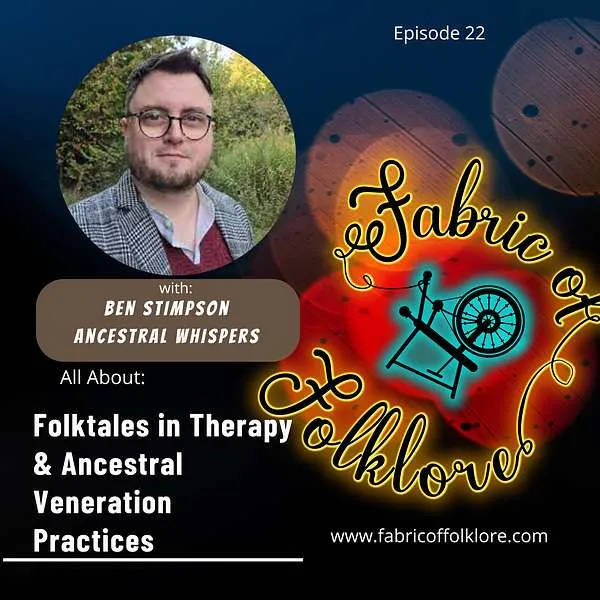
Ep 22 All About Folktales in Therapy and Connecting with Ancestors
Have you ever heard of folklore being used in therapy sessions? In episode 22, Ben Stimpson, a therapist, lecturer, student, and spiritual director uses a new effective therapeutic practice that combines storytelling, and personal narrative to get at the heart of clients’ challenges. He walks us through how it works and why it’s effective. We […]
The post Ep 22 All About Folktales in Therapy and Connecting with Ancestors appeared first on Fabric of Folklore.
Follow us:
Fabric of Folklore website
00:00:13:19 – 00:00:26:00
Unknown
welcome, folks. You folks are welcome to Fabrica folklore. I am your hostess, Vanessa y Rogers in this really nerdy folklore podcast, we dive into all aspects of culture.
00:00:26:06 – 00:00:48:06
Unknown
We love stories like folk tales, but also customs and rituals and holiday practices. All the things that make us feel connected to our country, our community, our family, our businesses, our friend groups. These folklore traditions help to define who we are and what is important to us. So this sounds like a podcast that you would be interested in.
00:00:48:08 – 00:01:20:22
Unknown
Definitely hit that subscribe button today so that you are getting your notifications every Tuesday when our podcast comes out. So definitely hit that subscribe button and today’s show is going to be so cool because we’re talking to Ben Stimpson about two practical folklore applications how folklore and mythology is used in therapy sessions and his new book, A Guide to Building Ancestral Veneration Practices, which is basically a how to guide for connecting with your ancestors.
00:01:20:22 – 00:02:01:16
Unknown
So Ben Stimpson is a therapist, a lecturer, a student and a spiritual director. He’s developed courses on a variety of topics, including ancestor veneration, the power of story and folklore. When not working with clients or writing, Ben is engaged with his area of study religious studies in medieval and classical studies, folklore and spirituality. So thank you so much for joining us, Ben.
00:02:01:19 – 00:05:41:10
Unknown
Oh, I’m so glad that you you message because I have never heard of doing therapy with folktales and I just think that that is such an interesting application. So I definitely am excited to talk about that. And can you tell us a little bit about your journey into how you got into psychotherapy to begin with? Oh, LARPing right?
00:05:41:13 – 00:11:27:11
Unknown
Mm hmm. So I have I have several questions. Okay. So when you say that you you choose character, So explain again how you are doing your living through a character and with the monomyth. Can you explain that a little bit more or. Yeah. MM hmm. Mm hmm. That was not the American tale, But yes, it’s so you you start out a a spiritual based therapy program.
00:11:27:17 – 00:14:09:02
Unknown
Have you always been a spiritual person? Mm hmm. Yeah. Mm hmm. Mm hmm. Mm hmm. What a story. How fascinating. Yes, absolutely. It is so interconnected. And I find that in my own life, like, you know, different parts end up coming together and. And fit so nicely. I really. I’ve been thinking about, you know, when I when I’m doing this podcast, I really enjoy having, you know, I love the folk tales, but I really love when we intersect, completely differing thing with seemingly different subjects together.
00:14:09:09 – 00:15:07:03
Unknown
And, and they and they come together so nicely and you wouldn’t think like we had someone come on and talk about medicine and folklore and you wouldn’t think that those two would have anything to do with one another. And yet they they say it really nicely together. So I love that your story just kind of it’s puzzle pieces.
00:15:07:05 – 00:19:29:04
Unknown
Mm hmm. Mm hmm. Mm. Mm hmm. Mm mm mm mm. No, I love it. I love it. So. Okay. Um, let me see. I have lost track of my questions. Um, okay, So tell us how in a therapy session, it would work for you to use folklore? Mm hmm. Mm hmm. Mm hmm.
00:19:29:07 – 00:23:19:02
Unknown
Yeah. Mm hmm. Mm hmm. Mm hmm. Right. Mm hmm. Mm. Mm hmm. Um, it’s the first one that I remember connecting with is the legend of the Bluebonnet, and it’s. Have you heard of it? It’s a Texas legend, and it comes from, I believe, the Comanche tribes. And basically, it’s a little girl, and she is an orphan, and the tribe is starving to death because they don’t have food, because it hasn’t rained in so long.
00:23:19:04 – 00:23:42:23
Unknown
And so someone goes to the mountain and and it’s decreed that someone needs to make a sacrifice, but no one wants to make a sacrifice. And so this little girl who’s an orphan who has one doll with blue feathers from a blue jay, and that’s a her only possession that she has, she sacrifices this doll that came from her parents for her people.
00:23:42:25 – 00:24:47:01
Unknown
And then the it rains and the the world is covered in blue. Bluebonnets from the feathers from the blue jay And she is then upgraded in her her tribe is the one who saved her people. And it’s just a beautiful tale. And I think it really connects, you know, to this told to it was told to me as a child and it really I’m not an orphan or anything, but it really connected with me that she she was able to make such a sacrifice when she only had that one thing that connected her to her parents.
00:24:47:04 – 00:25:11:01
Unknown
You know, I find things hard to let go, I think. And so that’s the sacrifice would have felt really hard for me. And so I you know, I think it was just kind of astonishing that she would let that go when she didn’t have her parents anymore. And it was, you know, the only thing that connected her with her past, that physical thing.
00:25:11:08 – 00:26:00:12
Unknown
And so that was what connected me, I think, to the story. Yeah. I mean, you know, every every spring Texas is covered in bluebonnets and it’s beautiful. And so it’s easy to be reminded of that story on an annual basis because, you know, it’s a is a physical reminder all over the state. Oh, yeah. Well, I am I have a blog post about that legend and I’ll, I’ll, I’ll put up a couple pictures of the the Bluebonnet fields and it, and this website in there’s a podcast here it is.
00:26:00:12 – 00:31:30:24
Unknown
It is gorgeous when it’s covered in blue. Bluebonnets. Right. Mm. And why do you think, why do you think the fact that folklore does that over fiction, What is the defining or. Yeah, I actually forgot what the question was and so when you are with the I so your therapy sessions are are usually one on one and so do you typically start in the fashion that you asked me what is a folklore or a folk tale that really resonated with you or how do you know what folk tale will resonate with them?
00:31:30:26 – 00:36:57:09
Unknown
MM mm hmm. Mm hmm. Mm hmm. Mm hmm. So then in this course, would you go through your own past and create a story that is a metaphorical a journey that, like, you went through as a as a human? Is that what you. Mm hmm.
00:36:57:12 – 00:41:51:13
Unknown
Mm hmm. How are mermaids? Spiritual? Mm hmm. Oh. Uh huh, How interesting. I’ve never heard that. Mm. Mm hmm. So. So folk religion versus organized religion, What? Can you give me a more concrete example? Mm. Mm hmm.
00:41:51:16 – 00:44:29:29
Unknown
Mm hmm. Mm hmm. Yeah. Yeah, absolutely. So this therapy that you’re doing, is it considered experimental? Is it is it recognized in the DSM? What is it called? Yeah. Is it a. Mm hmm. Okay. Mm hmm. Mm hmm.
00:44:30:02 – 00:47:01:07
Unknown
Mm hmm. Okay. And can you talk a little bit about any research that has been done on this particular branch of therapy? Mm. Mm hmm hmm. Mm mm. Mm hmm. I did come across a study that I found really interesting. It was done in Sao Paolo. Sao Paolo. Um, and it was not for therapy, but it was done to help reduce pain and stress.
00:47:01:10 – 00:47:36:27
Unknown
And it was I don’t know if you’re familiar with it. It says storytelling is twice as effective playing games. And they did this experiment on 81 children who were in the hospital and they had two sets of children and it was games were helpful. But the the folktales storytelling was twice as effective as the storytelling. It I guess it distracted them more it and they were they felt less pain They their cortisone levels were what are the cortisone levels?
00:47:36:27 – 00:50:19:28
Unknown
Are those the ones that increase your stress? Yeah. Mm hmm. Mm. Is that the one where they’re like whispering in and doing like. Yeah. Mm hmm. Mm mm mm. Yeah, absolutely. So what tools do does this type of therapy give to individual ALS? Because I know in therapy, a lot of times what you’re, you’re gaining is tools to deal with your challenges.
00:50:20:00 – 00:52:10:27
Unknown
And what, what tools are you given with this? Mm hmm. Mm hmm. Mm mm mm. Mm hmm.
00:52:10:29 – 00:54:55:22
Unknown
Mm hmm. Mm hmm. Mm hmm. Mm mm mm mm. Mm hmm. Mm mm mm mm. Well, let’s move on to your book, because your book is also super fascinating. Ancestral whisperers, a guide to developing ancestral veneration practices. Can you tell us about you know, the journey to writing this book? What were your how did you come to want to write this book?
00:54:55:24 – 01:00:00:14
Unknown
MM hmm. Mm hmm. Okay. This. Mm hmm. Mm hmm. Mm. Mm hmm. Mm hmm. Mm. Mm hmm. Mm hmm. Mm hmm. Mm hmm.
01:00:00:16 – 01:03:03:25
Unknown
Mm hmm. Mm hmm. Mm hmm. Mm. Mm hmm. Mm hmm. And how would. So I know that in your book, you probably walk people through steps, but how would I decide what ancestors I want to give veneration so that the word is. Is that another word for worship, or what does that mean exactly? Mm hmm. Mm mm. Mm hmm.
01:03:03:28 – 01:04:52:08
Unknown
Mm hmm. Mm hmm. Mm hmm. And so would you say there’s a distinction between veneration and worship, then? Mm. Mm hmm. Mm hmm. Mm hmm. Mm hmm. Yeah. That’s one of the things I discovered when I was traveling. There was one of the first things that really stuck out is that there were so many things that I did that I didn’t realize that were cultural, and I didn’t recognize it until saw other people doing something entirely different and realizing that it was just because.
01:04:52:08 – 01:06:10:13
Unknown
This is how I grew up and this is, you know, it was just something that I learned. It was a learned behavior. But I didn’t realize that was not everywhere in the world. Huh? Mm hmm. Uh huh. Yeah, absolutely. Yeah. That’s so funny. Okay, so let’s see. How would I find what ancestors I would want to venerate? Mm.
01:06:10:16 – 01:07:40:16
Unknown
I know my aunt has done some ancestral tree, but I haven’t really studied it very much. I’m glad she did it. I’m glad she did the work. But because that is not something that I really want to dive into. But it’s so glad that we have this already laid out for me. Hmm. Mm hmm. Mm hmm. Mm hmm.
01:07:40:19 – 01:10:21:11
Unknown
Mm hmm. Mm hmm. Mm hmm. Mm hmm. Yes. Jim Hindle. Mm hmm. Uh huh. Mm. Mm hmm. Mm hmm. Well, do you feel like the catalyst is for people who decide to connect with their ancestors? Mm hmm.
01:10:21:13 – 01:11:39:23
Unknown
Mm. Yeah. Yeah. Mm hmm. Yeah, right.
01:11:39:25 – 01:12:11:17
Unknown
Right. Yeah, right. Mm hmm.
01:12:11:19 – 01:14:17:14
Unknown
Mm hmm. Mm hmm. Mm hmm. Yeah, Absolutely. So can you tell us some examples of that? People do for ancestral veneration? Mm hmm. Right. Mm. Wow. Mm mm. Mm hmm. Mm hmm.
01:14:17:16 – 01:17:02:23
Unknown
Mm hmm. Yeah. Yeah, Yeah, yeah. Mm. Mm hmm. So when you’re doing this, is there, like, a specific person that you’re you’re speaking with, or are you in speaking with a group? How how does that work? How are you visualizing who it is you’re giving food to or having a conversation with?
01:17:02:25 – 01:19:34:08
Unknown
Mm hmm. Mm. Mm hmm. Mm hmm. Mm hmm. Mm hmm. Mm mm mm mm. Mm hmm. Mm hmm.
01:19:34:10 – 01:20:10:15
Unknown
Mm hmm. Yeah. I was going to ask that. What if you don’t really feel a connection with your ancestors, if you. If you have maybe disdain, maybe if your ancestors, slave holders, or you really didn’t feel like they were people that you wanted to venerate, do you just suggest finding other other people? Or how would you suggest if someone really didn’t feel a connection?
01:20:10:18 – 01:20:56:11
Unknown
MM mm hmm. Mm hmm.
01:20:56:14 – 01:21:07:21
Unknown
Mm hmm.
01:21:07:23 – 01:21:15:20
Unknown
Mm hmm.
01:21:15:22 – 01:21:38:23
Unknown
Mm hmm. Mm hmm.
01:21:38:25 – 01:22:31:18
Unknown
Mm Mm. Uh huh. Yeah. Mm hmm.
01:22:31:20 – 01:23:24:29
Unknown
Yeah. Mm hmm. Mm Mm. Mm hmm.
01:23:25:01 – 01:23:37:26
Unknown
Mm hmm.
01:23:37:28 – 01:23:59:13
Unknown
Mm hmm. Right. Mm hmm.
01:23:59:16 – 01:24:18:15
Unknown
Right. Mm hmm.
01:24:18:17 – 01:26:30:06
Unknown
Absolutely. Well, I feel like we could talk about this all day, but I did want to give you. I did want to give you some space to talk about the Salem Festival Folklife Festival that you are going to be speaking at soon. Can you tell us a little bit about that that?
01:26:30:08 – 01:26:48:23
Unknown
Now, this is all in line. Mm hmm.
01:26:48:25 – 01:27:21:07
Unknown
Wow. That’s amazing. Okay, cool. Thank you so much for joining us today. This has just been such a fascinating conversation.
01:27:21:09 – 01:27:28:00
Unknown
Oh, and that’s why you’re moving to the UK right now.
01:27:28:00 – 01:27:52:08
Unknown
And thank you, folks, folks, for joining us on our journey today to learn more about the use of folklore and mythology and therapy, as well as how to create practices to connect with our ancestors. All the links that we talked about, which were a lot, will be on our website, which is w w w dot fabric of folklore dot com including the book that Ben has just put out and his website.
01:27:52:11 – 01:28:23:24
Unknown
Have you used therapy yourself in folktales or using mythology. Would would it work well for you, do you think. Do you have ancestral practices that that you already utilize. We want to hear from you. We have a Facebook community page specifically for that. So it’s a fabric of folklore, podcast, community, and that is where we continue the conversation, where you can share with us your thoughts about the about your experiences and about what we have talked about today.
01:28:23:24 – 01:28:45:28
Unknown
So we definitely want to hear from you and that is that is the place where we invite you to come. So if you’ve enjoyed today, please hit the like button, hit the subscribe button because is so helpful for a new podcast rate and reviews on Apple. Apple Podcasts. If you review us, I will give you a shout out.
01:28:46:00 – 01:29:01:13
Unknown
It is absolutely one of the best things that you can do if you enjoy our show. And thanks for unraveling the mysteries of folklore with us. And until next time, keep the folk alive.