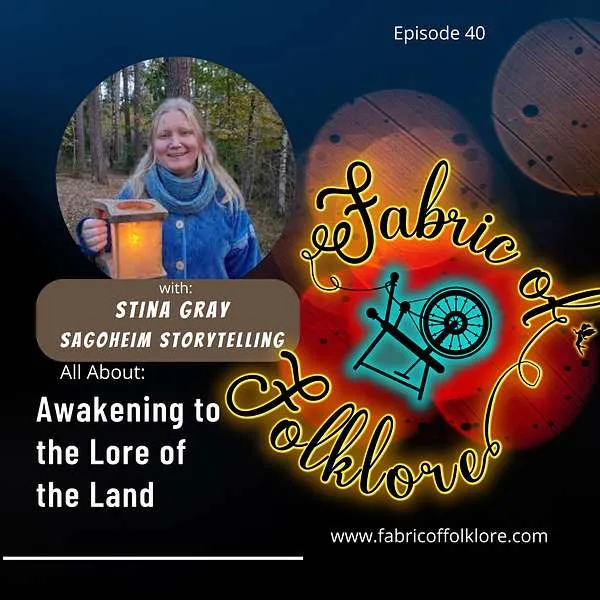
Ep. 40: Returning to the Singing Earth with Swedish Storyteller Stina Gray
Have you ever taken a journey that awakened your senses? In episode 40, we speak with Stina Gray, a professional storyteller, ethnologist and author with roots in Sweden and New Zealand. She talks to us about her heartwarming stories, performances and also her new book, When the Woods Sang: Returning to the Singing Earth. It is about her journey into the singing, weeping woods of her Motherland and to the heart of her path as a storyteller. The journey awakened her senses to the lore of the land, showing her that everyone and everything has a song to sing and a story to tell. It’s a session filled with inspiration, connection to nature, and the magic of stories. Tune in now!
Stina’s Website
Follow on Social Media
Fabric of Folklore website
Follow us:
Fabric of Folklore website
Vanesa
·
00:13
Welcome, folksy folks. Welcome to Fabric of Folklore. I’m your hostess, Vanessa Y. Rogers, and this is a podcast where we unravel the mysteries of folklore. This podcast is an exploration of the human condition. We’re pulling at the ball of folklore string, unraveling till we find its center. Its core stories are important to folklore, urban legends and myths, but also songs, traditions, and even food. We’re unraveling that ball of yarn to understand the history, the significance, and the importance of the Mattucinas dance as a prayer, like we discussed in episode 15 with Norma Elia Cantu, or how the first juneteenth celebration broke out spontaneously in Galveston, Texas, in episode 17 with Ed Gotham. Or how the urban legend of Springman evolved in Europe as it crossed borders across the continent, and what it came to represent to different groups of people during different time periods.
Vanesa
·
01:13
This podcast is about finding the core. Finding our core. As humans, story knows no border, and when we share our stories with one another, we connect at a deeper level, closer to that core. And that is what we are after on this podcast. Finding those connections, following the braided folklore yarn across the imaginary lines that are drawn by government representatives to discover what it means to be part of this human experience. So if that sounds like a podcast that you are interested in following, make sure that you hit that subscribe button right now. Whether you’re watching on YouTube or you’re listening on Apple or Spotify or whatever podcast platform that you prefer. Hit that subscribe button so that you get notifications every week when our podcast drops. And if you are a longtime follower, thank you so much.
Vanesa
·
02:01
We would really appreciate it if you would consider rating and reviewing our podcast. If you can, give us some stars and just drop a few lines about why you like our podcast, it’s so helpful for new people to be able to find us. Our guest today is Steena Gray, a professional storyteller, ethnologist, and author with roots in Sweden and New Zealand. She tells heartwarming stories in Swedish and in English, but also offers performances, workshops, story walks, circles, and retreats. Her book, when the woods sang returning to the singing earth, came out in June 2023. It is about her journey into the singing weeping woods of the motherland, into the heart of her path as a storyteller. The journey awakened her senses to the lore of the land, showing her that everyone and everything has a song to sing and a story to tell.
Vanesa
·
02:49
We’ll be talking to her about her new book and her experience as a storyteller. So thank you so much, Dina, for joining us today on Fabrica folklore.
Stina
·
02:58
Oh, I’m so happy to be here. Thank you for inviting me.
Vanesa
·
03:02
Well, I’m glad that you were able to join us all the way from Sweden. You’re the first person we’ve had from. Oh, ok. Yay. Our first guest that we ever had was from Norway. So, your neighbor.
Stina
·
03:18
Yeah.
Vanesa
·
03:20
Can you tell us a little bit about your journey into storytelling?
Stina
·
03:26
Yeah, sure. So I grew up in New Zealand. I was born here in Sweden. Then I moved to New Zealand with my mum when I was four years old. And I’ve grown up with stories all throughout my childhood. I just loved going into that magical fairy tale realm, and I loved writing stories, my own stories. But I think what really got me into the art of telling stories is something that happened when I was around 18 or 19 years old, and I was at a place in southern Sweden called Mundikula Retreat center, and they had, like, an open mic night so anyone could step up onto the stage and share something. And I had the story that I had written, a story inspired by a dream. And it’s a story I still love to tell.
Stina
·
04:30
It’s a story that can also be found in my new book. And I had written the story, and I had it on a piece of paper in my hands and just felt like it was pulling me to go up there on that stage. But I was so scared. But I faced that fear, and I stepped up onto the stage and I shared the story. And afterwards, it was really amazing to meet people in the audience. A lot of people came up to me afterwards and were so deeply moved by the story and by the way I had told it. And that really moved me and really opened my eyes to how magical and how healing storytelling can be. So that’s when I think that first little seed of inspiration started to take root in me.
Stina
·
05:28
A feeling of wanting to explore the art of telling stories more. That’s where it all started, I would say. And then I’ve been continuing that path in many different ways, learning from wonderful storytellers and teachers and finding my way of telling stories.
Vanesa
·
05:51
You said your very first story that you told up on a stage. It came from a dream.
Stina
·
05:58
Yes, it came from a dream. And as a child, I had a lot of very strong dreams. Like, my dreams were really, like, going into a story realm. And sometimes I would take those dreams and put them into a story form, bring them out onto a piece of paper. So that was really my initiation into storytelling, telling the stories of my dreams.
Vanesa
·
06:27
That’s so wonderful, because I find that my dreams in particular, they disappear after just a few minutes after I wake up. And sometimes if I don’t write anything down quickly, then it just dissipates. Is that the same with you, or do you recall it? Have a better recall?
Stina
·
06:50
Yeah, I don’t think I have as rich and vivid dreams as when I was a kid, but it goes in periods. Like, sometimes I have periods when I don’t remember my dreams at all, and then I have periods where they are strong. And I do think you can affect that in how much attention you bring to your dreams. If you really want to remember them and have an interest in dreams and the wisdom they can offer, then I think that just that presence and that intention can make you remember your dreams better. I also find, at least for me, I don’t know how it is for you, but I’m really affected by different places. So some places I find make me dream much more intensely than other places.
Stina
·
07:44
Also, if I’m out camping in the woods and are really out in nature a lot, they can bring about some really cool dreams that I wouldn’t have when I’m at home. So, yeah, it’s fascinating.
Vanesa
·
07:58
And we’re not going to talk about your book quite yet. That’s a little bit for later. But the start of your book is kind of from a dream, is that right? Or is it a little unclear?
Stina
·
08:13
Do you mean like the prologue? Yeah, chapter one.
Vanesa
·
08:18
It was the prologue, I guess, when you were talking to the woods woman.
Stina
·
08:23
Yeah. The woods woman. Yeah. How to describe that? I would kind of call it a sort of daydream. So the story of the woodswoman is very much at the heart of this book. And as I described there, it came to me when I was out in the woods one winter, many years ago, and I had this experience there that wasn’t like anything else I had experienced before. It felt like I was just listening to the story. Like it was actually, the story was there. It was there at this place, and I was just sort of listening to a part of it, and I’d never had that experience before. So that brought about a whole journey that I basically write about in that book. Yeah.
Vanesa
·
09:25
How interesting. So do you have a favorite story that you tell, and has that changed through your storytelling journey, or has it pretty much stayed the same?
Stina
·
09:40
A favorite story? There are so many favorite stories. How to choose? So, I mean, the story of the Woodswoman is absolutely a favorite. So I tell my own stories that I write, but, yeah, also traditional folktales, old stories I love to tell. The story of Snow White, that is a really famous story collected by the Brothers Grimm, and that’s been a favorite story to tell over the past few years. And as always, with all the stories I tell, they do change all the time. They aren’t set in stone. They change with every telling, with every audience, every place. And every time I go into the story, you see it always with new eyes. And these stories just have so much to teach us. It’s such a fascinating journey living with the stories.
Stina
·
10:46
And I think that stories that I know really well, the stories that I tell and have told many times, they feel to me like a house. If you imagine a story as a house and the stories you know really well, you’re really at home in that house. It feels like an old friend. You’re really comfortable there and you know where things are there. And yet still, every time I go into the house of Snow White and the seven dwarves, there’s always something new to discover. So I always try to approach the stories with a lot of openness and curiosity, with the eyes of a little child just open to learning something new. Yeah.
Vanesa
·
11:36
So what is it about Snow White that you like?
Stina
·
11:42
What is it? I think it came to me a few years ago, maybe three or four years ago. I just sort of saw like a beautiful edition of the, the story as a children’s book in a bookstore. And it just sort of spoke to me. I just felt really curious to read the story again because it had been so many years. I mean, that’s a story I read growing up, as many of us have probably read or seen as the famous Disney film, but I read it as well growing up. I had a collection of grim tales that I was really fascinated by when I was around 910 years old, I think. So I was just curious about going into that story again now as an adult. And it’s a story that really moves me.
Stina
·
12:46
It’s a story that always has something to teach me. Those are the stories I love to tell that move me somehow, that have something that heals me and shows me something about myself and about my life. The story of Snow White is, for me, a story of initiation. It’s a story of woman’s wisdom. I often tell it in groups of women, woman circles. And it’s a really beautiful and very healing story to share with other women or with anyone, really. It’s a story of transformation, of life and death and rebirth, as so many of these old fairy tales are about. Yeah, no, it’s a story with so much to offer. Story about going into the wild. Going into the wild and finding that sanctuary where the seven dwarves live.
Stina
·
13:59
These seven dwarves, which I think are a really great symbol for our own wild, our inner wild companions, or helpers that can see things that I don’t always see, so to say, and how important it is to be connected with that and to take care of it. So she learns she needs to take care of that house, keep it tidy, keep those little dwarves fed so that they can help her listen to their advice. So I think we also have that kind of inner sanctuary inside of us that wants to help us and take care of us and see things clearly with intuition.
Vanesa
·
14:52
And so you tell both traditional stories and you write your own stories, is that right?
Stina
·
14:58
Yeah.
Vanesa
·
15:01
You said before that your first story came from a dream. Is that primarily where your inspiration comes from, or does it come from? Where would you say that you draw your inspiration from?
Stina
·
15:14
Yeah, I tell many different kinds of stories. Folktales and fairy tales, legends, myths. And my own stories. My own stories can come from dreams. They are often inspired by different places. They can come just sort of out of the blue as well. I find that stories are sort of always speaking to me, my own stories, but also other stories that just sort of catch my eye sometimes. Like the story of Snow White that day in the bookstore. Sometimes stories just come and knock at my door. And I’m always, as much as I can open to that because then I think they have something to show me and something to teach me. And I love many different kinds of stories. Yeah, absolutely. Old stories and new stories, I would say.
Stina
·
16:16
I’m perhaps especially passionate about telling stories from places I know and where I am rooted. So here in Sweden and in Scandinavia, telling stories that are sort of at home in this environment where I live. But I also love telling stories from all around the world.
Vanesa
·
16:40
And why do you think that people are drawn to stories and to folklore? What is it about that?
Stina
·
16:50
I think that stories, I see them as a kind of teacher, so a kind of mythic teacher and guide stories have so much to offer us and teach us about what it is to be human and what it is to be human in this world and with everything that we can go through in life, all the changes and all the challenges about being human, being a child throughout all the different stages of childhood, being a man, being a woman. Stories have so much to teach us about our environment. There are so many stories rooted in the landscape around us, stories that I think have become quite forgotten today. So I love as a storyteller, bringing those stories to life, stories that can teach us about the place where we live, about the forests and the mountains and the rivers, giving them a voice.
Stina
·
17:53
And I think stories have always been there to guide us. And with the old stories, I think it’s just so fascinating when you approach a very old story and some of these old stories, who knows how old they are? And I just imagine when I meet one of these old stories, a long row of storytellers standing behind them, storytellers that have taken care of the story, that have actually made the story survive to this day. And each storyteller has put their own presence, their own voice, their own life into the story and just made it richer and richer. So what beautiful, rich, precious treasures stories are. I think it has so much to teach us about being human.
Vanesa
·
18:56
Absolutely. And you also studied as an ethnologist, is that right?
Stina
·
19:02
Yes, I studied ethnology here in Sweden. Yeah.
Vanesa
·
19:07
And is ethnology the same as anthropology, or is it just a branch of anthropology? What is ethnology, and what did you study?
Stina
·
19:18
Yeah, you could say it’s a branch of anthropology. Ethnology is basically the study of culture, the study of humans as cultural beings. So what is our culture? What are our values? How do we live our everyday lives? So ethnologists are usually very interested in the everyday culture, the norms and the things we do every day that we don’t always think about. But it’s an incredibly broad subject. There are ethnologists that study our culture today. There are ethnologists that get more into folklore and the older traditions and sayings and dialects and so on. When I studied ethnology in Stockholm at, I mean, I was, of course, very interested in storytelling and in folklore.
Stina
·
20:20
And as soon as I got the opportunity, I just really wanted to go into the folklore archives that we had access to, which we could write about as a part of our studies. So that was the kind of ethnology studies that I was mostly immersed in. So one term, for example, I was in the folklore archives in Upsala learning about something that we call the skuksro in Swedish, so the guardian of the forest and the stories about her in our folklore. So I’ve been really a lot in the Folklore archives learning about our old stories or some of our old stories. I mean, there’s so much to see there. Yeah. So that’s a little bit about ethnology. As an ethnologist, I also got to learn about how to go out and collect stories today, learning how to do interviews.
Stina
·
21:39
So, yeah, in my book, I’ve collected a lot of different stories from folklore archives, my own stories, but also through interviews with people today. And, yeah, a lot of that comes from my training as an ethnologist.
Vanesa
·
21:59
And you don’t just tell stories, you have other things that you offer. You do performances and workshops and circles and retreats. Can you talk a little bit about those types of things?
Stina
·
22:09
Yeah. As a storyteller, I do performances in a lot of different places. I’ve performed at museums and at festivals, in churches and festivals and bookshops, libraries, bringing storytelling to all ages, to children and to adults. And I also offer workshops where we really get to go deeper into the story and explore it and discuss it and see how does the story move us and where. I also weave, like, creative exercises that just help us to explore the story more and then story retreats, diving into the healing power of storytelling, really trying to make a beautiful held space where we can explore the medicine of stories, like how they speak to us and how they speak to us differently.
Stina
·
23:17
I think it’s wonderful with stories how they, when we really open up to them, they can offer me my very own sort of unique soul medicine that speaks to me in a really special way. The medicine it offers someone else might be something completely different, but it’s just what you need at that time in your life. So I’m really passionate about that. And I also do story walks, telling stories outdoors in the woods, telling stories about the nature, spirits, and just stories about places. I love to do storytelling outdoors and I do woman circles as well, as I said earlier, offering stories for women. And that can help us to understand what it is to be a woman and just throughout all the different phases of womanhood. What is it to be a mum?
Stina
·
24:22
What is it to be a woman in her thirty s and her forty s and just all the woman’s wisdom stories. There are a whole lot of them. And it’s very special to explore stories in that space with only woman. I don’t know if you.
Vanesa
·
24:43
Have you experienced that, a woman’s retreat with stories?
Stina
·
24:47
Yeah. Have you done something like that?
Vanesa
·
24:50
No, I haven’t. I would love to. That sounds amazing. I am in a mom’s group, and so we do a lot of things with just women, but it’s usually just a few hours rather than like a weekend retreat. But that does sound amazing. I would say probably the last time I did a retreat of any sort would be like, way before I had children. But that sounds so lovely and I love the idea of telling a story when you’re walking through the woods. So do you walk and then stop and tell a part of a story and then walk again and then tell another part of a story? Is that how it generally works?
Stina
·
25:37
Yeah, basically. So I’ll have a certain part of the forest where I’ll lead a group and we’ll stop at certain parts of the path and hear either a shorter story or I’ll have a longer story that we’ll hear little portions of along the way, depending on the story and the place and the time of year and so on.
Vanesa
·
26:03
And I was looking on your website, and one of the stories that you talk about is star stories. So are those some of the ones that you tell in the woods? I would imagine that you would want to tell Star stories out under the stars, preferably.
Stina
·
26:22
There are so many stories about the sky, about the moon and the sun and the stars. I love to tell those kinds of stories and learn new ones. I mean, there are so many from all around the world and. Yeah, I find them fascinating.
Vanesa
·
26:42
I think one that I saw in the description was that our galaxy was created by the breast milk of. Was it a goddess? Is that one of the stories that you tell?
Stina
·
26:53
Yes. So the Milky Way, that’s probably the one you’re thinking of, the Milky Way, as we call it in English. It’s called that, at least what I’ve heard, because it was created by the breast milk of a goddess.
Vanesa
·
27:11
That’s such interesting imagery. I don’t think I’ll ever be able to look at the stars the same.
Stina
·
27:18
Yeah. And the Milky Way is called many different things around the world. So here we call it Gautan in Swedish. So it means, like, the winter street or the winter path. So you can sort of see it as a sort of shimmering, glittering winter road in the middle of the winter.
Vanesa
·
27:41
Well, I wonder if it looks different where you are because you’re so much further north. I don’t know. I’m not very well versed in what the stars look like in different areas. I just know that they are different in the southern hemisphere as opposed to the northern hemisphere. But I imagine it looks different the further north you get.
Stina
·
28:04
Yeah, I haven’t thought about it. Maybe they do.
Vanesa
·
28:08
I don’t know. So I was curious. I know that you do stories both in Swedish and in English, depending on what language your audience is speaking. Do you find that you tell stories differently depending on what language you’re speaking?
Stina
·
28:31
Oh, yeah, absolutely. Swedish and English are quite different languages, like different sounds in your mouth. And I guess the story just comes out a little bit differently in both languages. Well, Swedish and English are at least quite similar, but no, definitely they come out a bit differently. And I think knowing different languages just makes. I find that it makes my storytelling richer because sometimes there are words in English that you don’t have in Swedish and also the same. There are words in Swedish that you just really can’t find the exactly same word or sound or expression in English. So it’s fascinating to explore. I mean, I grew up with English in New Zealand, and I’ve been living in Sweden for around. I think it’s around 15 years now. So I’ve been learning, relearning my mother tongue, basically. Swedish was my first language.
Stina
·
29:49
Then growing up in New Zealand, I basically forgot Swedish and had to relearn it coming back here. And now living here for around 15 years, I think, in Swedish and English at the same time. Sort of hard to explain, but they’re both very present all the time, and also in storytelling and in my writing, I write much better in English than in Swedish.
Vanesa
·
30:19
Well, in Sweden, are you taught in Swedish, or are you taught some, at least in English? Because I know that most people in Sweden can speak at least some English. Is that right?
Stina
·
30:32
Oh, yes. Most people here very good at English. They learn English in school here. I went to school mostly in New Zealand. I grew up mostly with English.
Vanesa
·
30:52
And your audiences, do they react differently if they are english speakers or swedish speakers, do they react differently to different parts of your stories? Do you find that there’s a cultural difference in how stories are received?
Stina
·
31:08
What an interesting question. I don’t think I’ve thought about that mean. Yeah, I think they do mean. Of course, someone who grows up in Sweden, has grown up in a different culture and a different place and sees things quite differently, usually from someone who, I don’t know, grew up in Texas or in New Zealand or somewhere else in the world. And also, I find it interesting. My partner is Italian, so I also find it interesting, like, sharing stories with him and just seeing from his perspective, like, he’ll see things that I had. I had never thought about. Yeah, no, it’s fascinating with all the different languages and.
Vanesa
·
32:06
And. Okay, so let’s see. You lived in New Zealand for a long time. What do you feel like you learned about yourself living in different countries and speaking different languages? What did you come away with? Having a better understanding of?
Stina
·
32:28
I think growing up in Sweden and New Zealand has definitely made me someone who can move about quite easily. I’ve lived in many different places, which, in a way, makes me feel like I can be home just about anywhere. And I also think growing up in many different places, at least for me, it has made it really important for me actually knowing my roots and where I come from, it’s something that has been really important to me on my life journey. So growing up in New Zealand, like I said before, I forgot Swedish. I forgot my mother tongue. I didn’t want to speak it anymore. There were no other swedish kids in school. And when you’re a kid, you just want to fit in and be like everyone else.
Stina
·
33:29
But as I grew older, I found a longing to actually relearn the language that my mum speaks and the language from Sweden, where I was born and just get to know my roots more. That became more and more important to me, like, knowing where do I come from? Because even though growing up in New Zealand, I felt very at home there. I think I became more and more aware of that. Well, I’m not really from here, like, my family come from a different place. So coming back to Sweden, I was 16 when I moved back to Sweden and went to school here in Stockholm. And it just became really important to me to learn my mother tongue again and get to know the country where so much of my family comes from.
Stina
·
34:34
And then over the years, it’s also become clear to me how much New Zealand will always be a really big part of me. So, yeah, I think just growing up and being a part of two very different countries and places in the world has certainly made me the woman that I am today. And it’s made it really important for me knowing my roots, knowing where I come from, both in terms of where my ancestry comes from, but also roots in terms of where you actually grew up and the places that you have a close relationship with. Growing up in New Zealand, the places where I grew up, there will always be such a big part of me. I’ll always carry them very close to my heart, and that’s become more and more clear to me. Yeah.
Vanesa
·
35:38
And you say in your storytelling repertoire, you really gravitate towards heartwarming stories, is that right? Yeah.
Stina
·
35:48
I think the word heartwarming is a good word to sort of describe me as a storyteller. I love to tell stories that warm the heart, that nourish the soul, that create a really warm and beautiful and magical space. Yeah.
Vanesa
·
36:12
And how do you go about finding these stories that warm your soul?
Stina
·
36:18
Well, I guess just finding the stories that warm my heart, that touch me and move me in some way, but also hearing them from other storytellers. I have storyteller friends, and we’ll send each other stories. So, yeah, it’s wonderful to be a part of a community of storytellers, I guess, continuing that ancient tradition of sharing stories with each other, the stories that move us and that feel like they have something good to offer.
Vanesa
·
36:56
Let’s talk about your book. We mentioned it before. It’s called when the woods sang. There’s another part to it. Right. When the woods sang, what is the.
Stina
·
37:10
Returning to the singing earth.
Vanesa
·
37:11
That’s right. Returning to the singing earth. Okay, tell us about the title.
Stina
·
37:18
When the woods sang. Yes. So this title, I think you can see it as a sort of thread that comes up throughout the whole book in many different ways. It’s a title that speaks of the song of the earth, like the song, the living presence of nature. And that is something that I write a lot about my own experience of becoming more and more aware of the stories and the songs that live in the places around us, opening my senses to those songs. And at the heart of this book is the story of the Woodswoman, a story about a time when the woods sang with the voices of these woods women. And this is a story that really inspired the whole journey that I write about in this book. Yeah. And this title it’s also inspired by.
Stina
·
38:35
Because when I was as an ethnology student exploring old stories in the folklore archives here in Sweden, something I came across a lot is how people, they often expressed a deep sadness about how quiet the forest was becoming, how the nature spirits were leaving and how the people were leaving the forest. The forest was becoming a very quiet place. It wasn’t singing with life in the same way as before. And many of these storytellers expressed a really deep sadness about that.
Vanesa
·
39:21
And did they express why they felt that the woods were no longer singing their songs?
Stina
·
39:30
Yes. So these stories in the folklore archives, some of them that I write about in this book as well, so many of them are collected, like, in the early 19 hundreds. So around 100 years ago, a time of great changes here in Sweden. And the landscape. So the forests and the landscape and the society were changing a whole lot. People were moving more and more into towns. Many left Sweden also in the 18 hundreds, in the early 19 hundreds to America. Many Swedes were also moving up north, where the forest industries were expanding. So the forests, the landscape were changing a lot with the industrial revolution, just as many other places. So people. People. These storytellers that I met in these folklore archives, many of them were really sad about that.
Stina
·
40:46
They were seeing their villages and their homes and their forests changing a lot.
Vanesa
·
40:55
Can you give us the story of the woods woman? I know it’s probably pretty long, but can you at least give us parts of it?
Stina
·
41:04
Yeah, sure, I’d love to. Yes. So, once upon a time, many years ago, I was out walking in the woods. And it was a sunny winter’s day. And a white blanket of snow enveloped the land. And there were many animal tracks in the snow. But what really caught my eye was a pair of human footprints, as if someone had been out walking barefoot in the snow. And I followed these footprints, and they led me deep into the heart of the forest. They led me to a hut covered in snow. And as I approached it, I heard the sound of a woman’s voice softly singing, ho oser. I went until the woman’s voice stopped singing and said, welcome, my friend. Come warm yourself by the fire. Curious, I crouched down and crawled through the tight entrance into the hut.
Stina
·
42:35
And inside there was a fire. And on the other side of the dancing flames was a woman unlike any other woman I had seen before. Her hair was long and thick and full of spider webs and crawling things. Her eyes were dark and bright, like glowing coals in the night. She wore many layers of skins and furs, and her bare feet looked as though they were made of old bark. She was a woodswoman, and she told me a story about a time long ago, when the woods sang with the voices of her kin. There was a time long ago when women could be seen in the woods. And the woods woman. They reflected the whole forest and all of its different inhabitants. Some were big and others were small. Some were loud. Others were quiet. Some had wolf tails, others had fox tails.
Stina
·
43:43
They were all very different, but that which united all of them was their deep love for their home. The woodswomen were guardians of the woods, keepers of the woodland law. They knew the forest like the back of their hands and watched over all who lived there through autumn and winter and spring and summer, seeing that all was well, all was in balance. And as it should be. In their keeping was the very heart of the forest. And in order to protect it, they had to keep it, drumming by the singing of its songs and the telling of its stories and the remembering of its ancient wisdom. And in those days, the songs and stories of the woods were well known and loved by all.
Stina
·
44:41
The people walked in the footsteps of the woodswoman, learning the fine art of living in tune with the drumming heartbeat of the land and the people helped the woodswoman preserve the woodland law, remembering all those old songs and stories. But not only did they help preserve it, they also brought it to life by the spirit of their own songs and by the love and by the wise presence of the people. The woods and all of its guardians thrived as never before. But what happened? Where are the Woodswoman now? Why have the woods become so quiet? Some say that the Woodswoman never left and that it was the people who changed. The people left the woods and instead of calling it home as they once did, they began to call it the wild. The people became townspeople.
Stina
·
45:52
Their children grew up learning that the wild was a dangerous place, full of dark and menacing creatures. And among the townspeople were few who still remembered the songs and stories of old. And they watched over the hearth of remembering, seeing that the flame, however faint, kept burning. And it is said that the Woodswomen once gathered at the edge of the forest, looking out over towns and villages, and they sang a song so sad and so gray. Dark clouds filled the skies and drenched the earth with rain. And the people felt a sorrow they couldn’t explain. The children cried without knowing why. And the Woodswoman’s tears fell down on the earth and the great mother took them with her loving hands and laid them gently down to rest.
Stina
·
46:57
And if you go in the woods and listen very closely, you might just hear that weeping song of the woods woman softly singing in the wind ho owes louder and clearer. Maybe you’ve heard it, maybe you have felt it. Have you heard the song calling us to return home and to remember? Have you heard and felt the song calling us, asking us to remember when the woods and the rivers and the mountains and the meadows sang with life and to imagine what it might look like if we helped those songs come to life again, stronger and richer and more beautiful than ever before?
Vanesa
·
48:24
Well, that’s just gorgeous. I love that story. Where did the song come from? Is that a song from. I assume that it has some origin.
Stina
·
48:41
Yes. This song of the Woodswoman, their weeping song. It came to me in a forest here in varimland, the province of Sweden, where I live today. So a few years ago, me and some other woman here in Sweden, we started something called the woods woman’s gathering. We were four women gathering in a little cottage in the woods just for a few days to share stories and just to basically drink coffee all day and have a good time and go out for walks in the woods. And one day I went out in the woods all alone. And I stood and leaned against a pine tree. And that melody just came to me. Ho. And I started to sing it, and it brought me to tears, and it reminded me of the story of the woodswoman. And it just felt to me like that song.
Stina
·
50:02
So that’s the melody I sing. It comes from a forest here, not so far away from where I live.
Vanesa
·
50:11
How interesting. I was reading through some of the first chapter that you had sent me, and I pulled out a few quotes, and this is one, and it might have been from the description that you were just giving. There’s a stillness in the winter woods that seems to bring the world to a standstill. It holds you in the palm of its hand, unlocking a door into another world that can only be entered through the portal of such stillness. Such portals are overgrown with ivy in the world of things and thrills. And I don’t know if that was exactly the time, but I think that it is so hard in our world today to stand still, especially. I mean, there’s so much going on all the time. It’s hard to even have a single thought that’s uninterrupted.
Vanesa
·
51:03
Can you talk to us a little bit about stillness and the relationship between folklore and magic?
Stina
·
51:12
Sure. It’s very true. It’s such a busy, full on world and society and just being a human with everything you have to do. For me personally, this experience of really tuning in to the songs and stories of the land, it came when I really started to slow down and listen a lot. So the story of the woods woman came to me one winter when I was living in a cottage in the woods. And I was almost every day out walking very slowly and just listening to this forest. And I found myself in a time of my life where a relationship had ended. I didn’t know where I was headed, I didn’t have a job, and I was just sort of like a standstill.
Stina
·
52:19
So I just went out into the forest every day, walking, slowing down, and I guess listening in a new way. And that’s when that story came. And then, I think around a year or so later, I signed up to go a one year full time course in bushcraft skills. So for a whole year, I was out in the woods a whole lot, learning all sorts of different skills about how to be in the woods in a wise way, how to make shelter and make fire, and all these basic skills. And throughout that year, that listening became deeper and deeper, I would say, because I was just out so much listening. And I started to experience nature in a new way. And I think we all have that connection. It’s just about, like you say, finding the space to listen.
Stina
·
53:27
I also think that we are different. I mean, of course we are. We’re really different. And I think when we listen and tune in, then we can tune into different things. Maybe if I go into a forest and listen very deeply, I might hear a song or a story or just something else, and someone else might tune into something completely different. So I think I sort of like to see us as different kinds of instruments, and we have the ability to tune into different things. We listen. And I think, I’m sure that many of our stories, like our old stories, our folklore, many of our stories are rooted in the landscape in that way coming from people’s relationship with their homes, with their forests and the places that they know.
Vanesa
·
54:30
Yes. For instance, my daughter, who’s four, when she goes out to the forest, she sees bugs. She loves bugs, and so that is where she focuses. She’s able to find them in the most obscure places that no one else can find. But it’s very true. Everyone has different ways of focusing and listening. Yeah, I love that about her. So you talk about discovering more about yourself as you’re writing this book. Was there anything in particular that you learned about while you were going through the process of writing this?
Stina
·
55:25
Yeah, it’s been a real journey of writing this book. I’ve been writing it for, I would say, about six years. And, yeah, I mean, of course, it’s a big process of learning and seeing things in new ways, and I guess just seeing the journey I’ve been on in a new way, bringing it all together, bringing together all the stories and a lot of different interviews with people that have taught me so much. In the first chapter, you would have read two of those interviews. So I’ve collected interviews with a lot of different people, talking to them about their relationship with nature, about their stories, and about their journey of being human in this world. Yeah. So you’ll meet a lot of different people, a lot of different storytellers in the book.
Vanesa
·
56:35
And you write that you find that some stories require singing, not only of me, but everyone present. I love that. Can you talk a little bit about that? And how do you get your audience to sing? Do they know the lyrics that you’re singing, or do they just go along?
Stina
·
56:54
Yeah, no, I’m definitely a singing storyteller. I love to weave music into my stories, and, yeah, I often create songs for the stories I tell, and I find it a really wonderful way of engaging an audience. So often there’ll be songs that are really simple. Sometimes they don’t even have words, so it could be one story. I tell the story of Varia, the wolf girl. I have a song that just goes many times throughout the story. Very, very simple song, just singing the name Varia, which basically means wolf in Swedish. And every time the audience hears the song, I invite them to sing along. So throughout the whole story, we’ll all sing the song together several times. Just variabariya. Variabariya. So often they’re just really simple songs that everyone can join along with just to. I think they’re also very good with.
Stina
·
58:13
Some stories are very long. Like, they might go on for a whole hour. So bringing the song is just a good way of just keeping the energy alive and people listening. And here I would also say when everyone sings together, it creates this feeling of being there together, and we’re all bringing this story to life. So I do find it really powerful and magical doing that with the stories.
Vanesa
·
58:45
I love that. I agree. When everyone’s singing together, it just feels like a binding experience.
Stina
·
58:56
Yeah. It’s very warming and just brings you together, feeling like a family, singing and bringing the story to life. I just love it.
Vanesa
·
59:09
So this is another quote that I found in your book. Storytelling is magic, a very real and old kind of magic that doesn’t have anything to do with tricks and illusions. Can you talk about why and how it is magic?
Stina
·
59:27
Yeah. So you just have to say, once upon a time, long ago, and then we’re off in that magical realm of once upon a time. So I think it is absolutely magic. Storytelling takes us to a magical place where everything is possible, and it is magical. It’s a real kind of magic, I think, awakening our creative fantasy and getting us to connect with our own inner magical landscape and all the different elements and powers and characters and things that live there and that are a part of us. Yeah. What do you say?
Yeah. I’ve had a lot of guests that come on and talk about the magic of storytelling, and several of my guests use it in the way that you were talking about for healing purposes. I had a guest that come on with a therapist, and he talks and he uses folklore in a way to talk through his clients challenges and issues, and it takes us out of ourselves, and we are able to see things in different lights, and then we’re able to relate them back to ourselves. And I think that sometimes that is so necessary because we get stuck just thinking about what’s happening to us. But if we open it up into other people’s viewpoints, then we’re able to see broader. I also feel that our brains are hardwired for storytelling.
I was reading, it was a study that was done, I think it was in Brazil, and it was done on children who were in a hospital, and they were testing whether or not games and puzzles were more effective or storytelling was more effective in lessening pain, because all of these children were experiencing some pain or another. And storytelling, I don’t remember what the specific statistic was, but I think it was double the effectiveness of the games and the puzzles, which is in some ways surprising because you have to be so focused when you’re doing a puzzle or you’re doing a game. But it seems that our brains are just designed to want to fall into those story lands and story worlds and explore.
Yeah, absolutely. They are a really powerful medicine for the soul. That is something I have found so much in my own journey. Stories have been helping me since I was a little girl through all kinds of challenges in life. I think that’s the big reason we tell stories, because they can help us to deal with things and approach things, emotions, and all sorts of things inside of us and in our lives that can be hard to talk about otherwise or find words for or know what to do about. But the stories help us to approach them in a really wonderful and healing, powerful way, helping us to get in touch with emotions that need to come up, helping us to see things that we might not have seen otherwise. The stories, well, at least the stories I love and love to tell.
I mean, of course, stories can also do harm. They have a power to heal, but they can also do harm. That depends on how they’re used, but they are powerful, and they have a lot to offer. And, yeah, as you say, we’re storytelling creatures. We are storytellers.
We’re definitely designed for that. So this is another quote. I love taking quotes from your story. I like your writing style. It’s lovely. Okay, so one of the quotes that you said is, I once heard someone say that stories that are meant for telling die when they are written down in a way that is true. The story comes to life through the power of your presence when you read it or share it with a friend. And this is so interesting because it’s coming from your book, which is written down. Can you walk us through this a little bit about why stories are better in oral form?
Yeah, I mean, stories are, like, originally an oral form. Many stories are much older than we’ve been writing them down. And storytelling so the art of oral storytelling here, the stories are really alive. Each time I tell the story, it’s different. It’s like stepping inside a new river every time. And the story is different. It’s alive. And that’s why putting a story, a living oral story, down onto paper is really difficult. Yeah, I heard that someone say that once, that stories that are meant for telling, that are meant for being told orally, it’s a little bit like they die when you put them down onto a paper. And I think, in a way, it is true that in order to bring that written story to life, it needs your living presence.
You bring it to life when you read it and really go into it, or perhaps even more. I think when you share it with a friend, you tell it and you read it and you share it with someone, then it really comes to life. I think oral stories that are meant for telling, they are meant to change. They’re not set in stone. They change with every telling. And that’s what’s so beautiful about them as well. So if you were to tell the story of the Woodswoman, maybe it would be a completely different story. Depending on who you are and the forest where you live. It’s probably a completely different forest to the kind that I know, and that’s how it’s meant to be. I think I struggled a lot putting, like, the oral stories, my own stories, down onto paper.
I mean, all of the stories in this book are the stories that I tell, and it’s hard to bring them down onto paper into this form because you want to change them all the time. But at the same time, I think it’s wonderful how a book can bring together these stories. And now this book is flying all around the world to readers. And, yeah, I hope that they enjoy these stories that I’ve collected and tried to bring onto paper in the best way possible.
Yes, I agree. Oral Storytelling is so beautiful, and I feel that it is coming back into fashion. But the beauty of a book is that it’s enduring, and it lasts for so much longer. I think about the Celts and how they were such huge storytellers, and yet so much of what we know about them is from hearsay and from missionaries who were trying to convert them into Christianity. And they didn’t write down their own history and their own stories. And so it’s lost. And I just find it sad because so many people are very intrigued by them in particular. And I think maybe it’s because we don’t know much, because a lot of it was lost.
Absolutely. Yeah. It’s so true. Many stories and oral traditions would have been completely lost if someone didn’t write them down. So it’s a wonderful tool to have, and at the same time, just knowing its limits and knowing many stories that are written down, often I find that the bones of the story are written down, but then to really bring it to life, you have to give it flesh and blood and bring it out from the paper and tell it in your own way. That’s when it really comes to life.
So you also wrote something that spoke to me in part because. So I’ll read what you said. In order to share anything with the world, you have to face that fear of being judged, making mistakes, and looking like a fool. And this has come to light for me a lot, because putting out a podcast was one of the most brave things I feel like I’ve done, because it’s easy just to not put yourself out there. But once you put yourself out there, you can be judged and laughed at. But then if you don’t put yourself out there, then what are you leaving for the world? And so it’s this give and take. But I related to what you were saying at that point. Can you tell us a little bit about your experience with that?
Oh, yeah, absolutely. Sharing a podcast or a book or just doing anything out there that puts you in the limelight, that’s a really brave step. And, yeah, you have to face that fear. And I would say I have faced that fear a whole lot. Putting myself on the storytelling stage and just daring to do this, to be a storyteller and do what I love, which is telling stories and sharing the story magic. And I think writing this book and publishing this book, it’s definitely one of the scariest things I’ve done on that path. Absolutely. It’s really scary sharing something that you’ve been working on for a really long time with the world. And, of course, you have to face that fear of looking like a fool, making mistakes, and that’s a part of life.
Absolutely.
Yeah. I am also a big fool. I’m both a wise woman and a fool, and I have so many different sides of me, as we all do, I think.
But can you be a wise woman without being a fool? I feel like that is, you absolutely have to be willing to make a fool of yourself in order to gain that wisdom.
Yeah, no, I think you do. I think everyone has that in them. You have the wise woman, the wise man, the wisdom keeper, but you also have the fool and the clown. And you have to make mistakes. You can’t go about life and do anything without also making mistakes in the process. And as my piano teacher always taught me, it’s the mistakes that help us learn. It’s a part of being human.
It is. So some of the stories that you tell in the book, you talk about nordic folklore, mythology, and rewilding, and we’ve been talking a little bit about rewilding. Are you seeing a resurgence of people wanting to go into the woods and listen more, or what is your feel on that?
Yeah, definitely. And I think rewilding storytelling, which is something I’m deeply passionate about, is growing a whole lot as a reflection of the times we are living in. It’s so important for us today to find a way of helping our environment, to heal from the wounds that we as humans have made there. And I think the stories we tell are a big part of that, because stories, they reflect our culture and they shape our culture. They have a big impact on the way we relate to the world and to the landscape. So, no, I see a lot of other storytellers, but also guides and a whole lot of people working with that in different ways. And I think that’s wonderful. Just as an example, I see storytellers talking about, but how can we more and more rewild our language? Like the language we’re using?
How can we make our language more rich in the way we actually describe our environment, the different kinds of trees and the different kinds of animals? And there are a lot of words that we’re forgetting today because we don’t spend as much time outdoors. So the words we use and the way we’re describing things has a really big impact on how we understand our world and our environment. And, of course, impact the way we care about our environment. You have to have a relationship with it in order to really care about it and want to take care of it. And I think stories have a lot to do there.
Absolutely. So what would you say you would like your readers to come away from after reading your book?
I hope that this book and the stories collected in this book inspire readers to go out and listen to the songs and stories of the place where they live and just become more aware of the stories all around them and inside of them. I hope that these stories inspire and offer something healing and beautiful in their lives. And it’s really wonderful hearing now from readers around the world how this story inspires them in many different ways.
Yeah, that’s lovely. Okay, so we’ve covered a lot. What have we missed. Have we missed anything that you feel like is important that the audience understands?
No, I don’t think so. You’ve asked some really good questions. Yeah, no, I can just mean I live in Sweden and work here and I mostly do storytelling and a whole lot of events in Swedish. But I do offer, like, online storytelling events in English from time to time. So if anyone is interested in that, then just check out my website and see what’s happening there. Yeah.
And that website is the Ww dot sinagray.com, is that right? Yeah, that’s right. And we’ll put that link up on our website. And for Listeners, it’s ww dot fabricoffoclore.com. So we’ll have a link to her website and a link to her book, which is on her website as well. But you can purchase it directly from your website, is that right?
Yes, you can purchase it directly from me at my website.
Can you buy it off of Amazon or anywhere else?
Yes, it’s also on Amazon, I think on swedish, Amazon, italian Amazon. Otherwise it’s mostly from buying from me. Hopefully it will be available in more bookshops and other places.
Well, wonderful. Thank you so much for joining us today.
Well, thank you so much for having me. It’s been a delight to be here.
And thank you, folksy folks for coming along on our storytelling journey to the singing woods. What did you discover on your journey today? Are you convinced you have a story to tell? A song to sing? Tell us about it. Continue the conversation on either our YouTube channel or our Facebook community group. We love hearing from you. We want to hear what your reactions are to these episodes. So make sure that you are contributing to the Facebook group and telling us what your experience is as you are listening or watching the show. And if you’re enjoying the show, please show your appreciation by subscribing like I said before, or giving us a rating or review. That is so very helpful for our podcast so other people are able to find. Oh, we also are on social media.
So if you are on Instagram, Facebook, Twitter X, I’m just calling it Twitter X because no one’s going to call it X. Please find us there. So once again, you’ve been listening to fabric of folklore. My name is Vanessa Y. Rogers and I can’t wait to see you next time. Until next time, keep the folk alive.