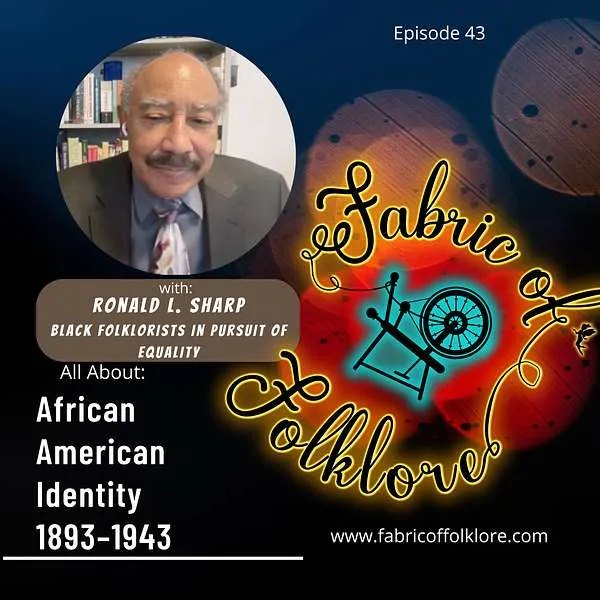
Ep 43: African American Identity and Cultural Politics Through Folklore with Ronald L Sharps
How does one go from slavery to equality? That is the question African Americans grappled with after their emancipation in 1863. The Emancipation Proclamation released Blacks from their enslavement, but they continued to experience inequality in all phases of American life —social, cultural, political, and economic. In episode 43, Dr. Ronald L. Sharps, Associate Dean of College of the Arts at Montclair State University, Montclair, NJ joins us to discuss his new book ‘Black Folklorists in Pursuit of Equality-African American Identity and Cultural Politics, 1893–1943.’ We talk about the folklore of African Americans After the Civil War and how they sought to solidify and create their identity by defining their own folklore. Through this pursuit of equality, African Americans developed movements to reveal in their rhetoric the soul of a race and a path toward civilization.
Book: Black Folklorists in Pursuit of Equality-African American Identity and Cultural Politics, 1893–1943.
Follow us:
Fabric of Folklore website
0:10
Welcome, welcome, folksy folks. Welcome to Fabric of Folklore. I’m your hostess, Vanessa Y. Rogers, and this is a podcast where we unravel the mysteries of folklore. Folklore is this beautiful thing that we humans often participate in without even realizing it. When we sing happy birthday and blow out candles, when we knock on wood to prevent tragedy, when we sing a nursery rhyme to our child, we are pulling on the threads of our collective expression of our cultural heritage. What sets this podcast apart is that we can’t help ourselves. We have to pull at that thread to find out more, to unravel the mysteries, to discover from where the folktale or superstition originated. We want to understand ourselves better, to understand our ancestors better, and to understand the values of our cultural of our culture better. When we educate ourselves on the origins of folklore, we’re not only better grounded in our own humanity, but we’re more likely to connect with others. We become more empathetic the more we learn, and that is the heart of this show, to bridge the misunderstandings and to find those connections. So if that sounds like a podcast that you are interested in continuing to listen to, make sure that you hit that subscribe button. Whether you’re watching on YouTube or you’re listening on your favorite podcasting platform, hit that subscribe button so that you get notifications every week when our podcast drops. And if you’re a time listener, if you are enjoying the show, make sure that you give us a review or give us stars. That is so helpful for indie podcasts like ourselves to be found by new listeners. We have a fantastic show for you today. We are talking with Dr. Ronald L. Sharps. He’s the associate dean of the College of Arts at Montclair State University in New Jersey. He formally served as the executive director of the Bannecker Douglas Museum and of the African American Museums association. He is the author of the new book Black Folklores and Pursuit of Equality, African American Identity and cultural politics from 1893 to 1943. So today we’re going to be talking to him about his recent book, which examines the folklore African Americans to experience inequality in all phases of american life, such as social, cultural, political, economic, and all in the pursuit of equality. African american movements interpreted folklore to reveal in their rhetoric the soul of a race and a path towards civilization. So thank you so much, Dr. Sharps, for joining us today. Thank you for having me. So, can you talk to us? This is going to be a double question. The first is going to be talk to us about the journey of writing this book. And what did you mean when you said a path towards civilization. Well, my journey toward writing a book comes from my earliest studies in art history. As a student of art history, the focus tended to be on fine arts. I wanted to investigate folk and popular art as well. So I wanted to understand the arts broadly, and I especially wanted to know how movements functioned and what purposes they served. So, going to George Washington University, I studied under John Blanch, was a folklorist, and Alan Gowens, who is an art historian in popular culture, I was introduced to material related to the Hampton Folklore Society. Hampton Institute, now Hampton University, established its folklore Society in 1893, but relatively little had been written about that society and its workings. I then wanted to investigate what it collected and what the Folklore society felt it had achieved over time. I found out that most of its collections had been published in Hampton’s newspaper or magazine called the Southern Workman. So I began to read not just the columns from the Folklore Society in that period article, but also any article that addressed any aspect of folklore from its beginnings, the publication’s beginnings in 1872 to its end in 1939. In reading that material, I found that individuals other than Hampton folkloris and Hampton students or graduates, they contributed articles to the periodical. And so I found that they had a different take. Some of those articles had a different understanding of folklore than the Hampton folk. So I decided to expand the search, look at those individuals, and even go beyond the southern workmen. I found that individuals who had interacted with Hampton but were opposed to Hampton’s interpretation of the folklore ultimately formed their own organization. And indeed, that as I searched to others, I found that groups started forming around the investigation of folklore and other goals. So that began my. And that was how you started getting into writing this book? Yes. So with that as background, I came to realize that people were out there, researchers were out there misinterpreting, I felt, what was actually taking place at Hampton. In what way? How did they misinterpret it? Well, there was the assertion that the Hampton Folklore Society focused on trying to make folklore look less absurd because they were ashamed. All right. I found that others felt the folklore was being categorized by Hampton as good or bad, but I concluded that was because the time periods for collection of folk, Lloyd Hampton, had been conflated. In what way? In the 1870s, when Hampton was founded in 1868, and in the 1870s, Hampton students largely were charged with collecting any information they could find on conjuring and conjurers in an effort to eradicate that type of folklore. It was steered by Hampton administrators, white administrators, that the race would soon die off, commit racial suicide if it continued the practice of conjuring. Was there death involved in conjuring? Why did they. There was a lot of death involved in conjuring. Can you elaborate on that? How did that. Well, there were conjurers in just about every community where they were blacks, although at a later point, Booker T. Washington would try to refute that. Nonetheless, that was the finding of the Hampton collectives. They used poison, and they use charms as part of conjuring. The school had been developed for nursing by one of the teachers at Hampton, one of the white teachers at Hampton, Alice Bacon, and she started looking at the conjuring law to determine when it was necessary for them to bring in a conjurer, to tell them the best way to stop the effects of some supposedly mystical action. But these mystical actions, as I said, actually revolved around poisons and charms. All right, so they emphasize that the consequences of conjuring were very real and that you did not have to believe in conjuring to suffer the consequences. Yeah. So there were substances that could be put in someone’s shoe, for example, that could ultimately lead to one’s not only illness, but death. Oh, wow. There are substances that people could step over or just have in proximity to them that could bring about death. And they found that as far as the conjuring goes, it was not something that a regular doctor, a physician, could cure. Usually if you brought in a doctor, the person would get worse, not better. And so that was one of the practices that they felt negatively about. Yeah, but they also used folklore. They also collected folklore as of the 1870s, for efforts to ameliorate relations between whites and blacks. They looked at folk song among black communities. Now, Fisk University had already begun the collection and performance of african american folk songs as a way to fundraise. And at Hampton, General Armstrong, who was the principal, had decided he would follow a similar course. But it didn’t stop with trying to raise funds. It was as much, if not more so, to improve relations between the races. But again, this was an aspect of trying to achieve the survival of blacks. Was it effective? Effective? To an extent. To an extent? Yes, definitely. They raised a large endowment for the university, and they still have one of the largest endowments for a black school, a black university in the country. And did it help with the racial relations between whites and blacks? It did, to an extent. Can you elaborate on how that helped? To the extent that it did. The mere fact that the white communities in the south would allow the education of blacks. All right, that’s the first thing. Second thing, the collection of funds in order to build up the campus. The third thing is that it allowed the collection of funds that could be used as scholarships for blacks who wanted to attend Hampton. So it definitely had a positive effect, even though they still suffered under pressure of Jim Crow laws at that time and the effort of some whites to close down the school at different periods. Okay. But those early efforts were every word pursued in an effort to ensure the survival of blacks, even up to 1892. In 1892, a Hampton graduate, Catherine Fields, organized a tribute to the generation of slaves that had become free during emancipation. The effort there resulted in a celebration in Hampton community’s largest church, hundreds of attendees, 200 of which were children, because they wanted to celebrate our freedom. They wanted to celebrate the culture, that is, the stories, the psalms, the saves of this freed generation. And they hoped that the celebration would help convey certain values or virtues of freed slaves so that the new generation, the young generation, the educated generation, would understand how those individuals survived slavery and how, with those same virtues, this new generation will survive. So survival was the emphasis prior to the founding of the Hampton Folklore Society in 1893. Now, in 1893, Alice Bacon, who had been responsible for that nursing school, made a trip to the Chicago World Fair, which opened in May of that year. May 1. At that event was an international folklore conference that was being held. Over 40 nations were represented at that conference, and the ideas that were shared at that conference were transported back to Hampton. She decided to Ellis Bacon, that is, decided to request permission to establish this society through the collection of folklore, following the guidelines that were shared at that conference. Now, one thing was happening during the latter part of the 19th century regarding folklore. Folklore was no longer being considered curiosities. It was no longer simply an investigation by philosophers, which philosophers in Europe had started investigating folklore even in the 18th century. It was instead a belief that every nation, every race, every people needed to identify who they were by looking at the attributes of their nation through the expressions of the common folk. It was believed that the common folk had the authentic expression of the nation. Now, that doesn’t mean that the elite in those nations were somehow freed of folklore, right? It was believed that all people in any nation still shared aspects of folklore, traditions, thoughts, expressions. But they were freed of some because of education. And these people would. The common people back to the common people could be investigated for their sayings, their songs and their stories, their dances, et cetera, and you would be able to identify, call out the attributes that make these people who they are. Here. It was steered however, that African Americans would fail to identify who they were in similar fashion. But it was believed at the same time that it was critical for african american folk heritage to be investigated, because with that investigation, folklorist in general could discover the early principles of the human species. Why African Americans? Because African Americans were close enough to savagery, that their folklore would be relevatory, but near enough to civilized folk, so that the discoveries could be understood. So is that what you mean by the path towards civilization? Only to an extent. Each person had to identify who they were as a people, as a group, whether it be the Italians, the Spanish. Right. And there could be not only any european people, but any peoples who were influenced by or colonized by Europeans. They always are thinking of the time. So we’re looking at definitely a 19th century framework here. But not only were they to identify who they were as people, but what path each would take towards civilization. No. So it was, how do you begin this journey to civilization? It was believed in general that civilization was. I’m going to put it was a state that all peoples would eventually find their way to. Big fear on the part of many, not just blacks, but many whites and other Europeans, about African Americans was that blacks would somehow not be able to identify who they were as a people and not find their path. All right. Now, that would hurt the investigations that they were doing to find first principles for the human species in general, as well as hurt blacks. It was believed that blacks would eventually join civilization, but unlike any other people, it was feared that they would join civilization not knowing who they had been, not knowing how they had gotten to where they are, not being able to make a direct contribution to civilization, because it was felt that each people, each group of nations and races would make a contribution to civilization. Now, as it turns out, when I started looking at other movements, in addition to Hampton, other black and interracial movements, in addition to Hampton and their collection of folklore, they cited this somewhat differently. Sometimes, like Du Bois talked about black scene to find their message in terms of the contribution. Right? So there are a lot of writers who talk about messages, throw this in. Marcus Garvey talks about finding their purpose. So I think Lobeson talks about finding their potentialities and their objectives. So they may use slightly different language, but all are following the same pattern. And it was the repetition of that pattern of thinking that I wanted to track in this book. Can we go back to the anomaly among humanity that was stated before as something that they were afraid that blacks would not know their history and they would be the only ones. Why is that? Rights were generally seen in the society as inferior right. But laws had been put in place after freedom from slavery to continue the race not being educated. All right. At the Chicago World Fair, Edward Tyler, anthropologist, wrote the book Anthropology in the 1880s. He had set a different direction and tone than had existed before the Civil War. Prior to the civil war, anthropologists generally insisted that all peoples had fixed characteristics. Blacks, anthropologists felt, would never be able to move beyond the state of savagery or barbarism at the best. Tyler, after the Civil War, agreed that there were these social levels that people existed at. Savagery, barbarism, barbarianism. Sorry. And civilization. But he determined that no race had fixed attributes as such, that any people can advance along this continuum towards civilization through education. So with education, blacks were sort of released from this notion that they were unable to evolve socially. And what specifically drew you to that time frame? The 1893 to 1943. Is it just because that’s when the Hampton Folklore society was really collecting, or what was it specifically about that time period in 1893? Yes. The founding of the Hampton Folklore Society was key. I looked at the founding in the sense that it was the first national movement by blacks to collect their folklore and interpret their folklore. Now, that’s not the first effort made. Prior to 1893, there were black military historians who in their writings, did include references to the folklore by blades. Now, there were other individuals who collected folk songs, for example, to create criminals. Again in the 1880s or earlier. So there was some collecting going on. There was. In 1890, there was an organization that was founded in Boston for the collection of folklore, but it did not. Was not sustainable. So by 1893, it did not exist. So there were some efforts on the part of blacks to collect folklore of their people prior to 1893. But 1893 began this much larger effort comfortably. It was a massive effort. And how did they do it? Did they have these meetings, like you were mentioning before, that was held in a church, or were they smaller? Well, you’re talking about they. You’re talking about the Hampton folklorists or with the Hampton folklores, they established an organization through the efforts of Alice Bacon that was embased at the school. Alice Bacon, when she got back from Chicago, in the Chicago world stair, she met with prospective participants among blacks who also worked at the school. Now, at that time, only whites taught at the school, but by their own regulation, their own rules. But you had people who worked in the accounting office and things like that. And so she met with those individuals who had graduated already from Hampton and were working there to get their input. Then she sent out some correspondence to whites who were in the fields of ethnography and folklore and blacks who were in the fields of journalism and education, et cetera. And some were clerics to get their endorsement. Then she immediately arranged to dedicate a column and the southern Workman magazine produced by Hampton for the publication of law that they would gather. They had developed only one rule, which was they wouldn’t collect anything that was already in print because they were looking for new material. Then they started holding meetings at Alex Bacon’s house, so, in her parlor. And there was a core group that operated at Hampton itself and would come regularly to those meetings. And then there were correspondents scattered throughout the south by enlarged the south, somewhere in the north, who would collect material and send it back by mail. And there were affiliated schools. So Hampton and its board members and teachers would go off, and former students would go off and establish other schools. So there was the Calgoon school, for example, in Alabama. There was Tuskegee in Alabama. Mountain bee was in Alabama. Tin school was in South Carolina. So they had these affiliated schools. And blacks who were at those schools, along with some of the whites who were teachers or administrators at those schools, would collect black folk law. Yeah. They met on a monthly basis. And then they, at the meetings, would not only present the folklore as a written presentation, but they would perform the folklore, which is something that did not happen at white folklore meetings, because you had the Chicago Folklore Society, and you had the American Folklore Society, which are already formed. The American Folklore Society, which was the largest of them, was established in 1888, the Chicago Folklore Society wake in 1891. But they didn’t perform folklore as such the way these people did. They took it very seriously. These things were documented, and they changed up topics. So you would have them talk one time about superstition or specifically conjuring and witchcraft, or they would talk about sayings, or they would present different stories, things of that type. Were there any notable ones that stood out to you that you were surprised at or you found specifically interesting? Well, I won’t say any stood out for me. One rhyme that they used, I found, really points up this issue of the dichotomy. Well, not dichotomy, the different interpretations, I should say, of folklore. One ran a see, my name is Rand. I work in the sand. I’d rather be a nigger than a poor white man. And Hampton presented that Ryan, and interpreted it as suggesting that blacks did not want to be poor, which would be an economic element, right? Later, Thomas Washington Tally, who graduated from Fisc University and became a faculty member at Fisc, would reiterate that same rhyme, and he interpreted that rhyme as me. Blacks were referring to a standard of beauty. Different interpretations. Right. But what was happening with the collection of folklore by blacks is that they. They all agree. Well, by. Well, I’ll say, by and large, not all of them, but most of the groups that I deal with agreed that the massive folklore for blacks had to be collected. You collect everything, and this was consistent with the broader folklore movements and the white folklore movements. Right. So you have to collect everything. You don’t doctorate. And through the collection of everything, you get the best picture of who people are. So you get the best picture of who blacks are as a group by collecting everything. Now, that doesn’t mean that they didn’t focus on particular types of folklore, because there was a focus on different types of folklore. What was that? Well, various group to group, Hampton looked largely at folklore that had relevant themes related to amassing wealth. That doesn’t mean it looked at the folklore and said, well, this will give you wealth. For example, they looked at superstitions related to hidden treasure as an alternative to working, and they showed through those superstitions how people failed to retain that wealth. Right. And there were a lot of superstitions related to wealth and hidden treasure. And they would have superstitions and sayings related to when you’re going to get money and not have money. Can you. Can you tell us some of them? What are. What were some of the sayings or the superstitions? Oh, trying to think. I know they revolve around. If one palm is itching, I can’t remember which one. If one palm is itching, then you will come into some money. If some other action takes place, you will lose money. So it’s to use the folklore to build a consciousness about wealth. Go ahead. And things to do and not do. They had folklore dealing with courting customs. Right. That suggested that, as a black man, you would want a woman who is concerned about keeping your place clean, because the home would be the center of civilization. So keeping a house clean, and the woman would want her bow to not have patches in his clothes, things like that, to show how responsible he is going to be. So there was a lot of courtship law that was collected. Just about all the law that they collected had a tie to making a living and securing a family. It was believed by Hamptonians that since the home is the center of civilized life, they must be prepared. So a black man should not marry until he has a home, till he has a house, right? So it was also believed that blacks should remain the major labor source in the south. Now, true, since emancipation, the percentage of blacks who were laborers in the south dramatically declined. And that was not from the exodus of blacks to other areas. Even on a national level, there was a decline. Whites wouldn’t hire blacks to the larger extent, and that’s why they declined. So it was regarded as essential that they become this major source for labor. Business and enterprise became major aspects of the folklore that they collected. With enterprise, they felt that business, schooling in business practices needed to be something asserted in all the high schools for blacks, what Hampton believed. So things are being dealt with not. Not just in terms of the folklore, but this is broader effort. So everything’s geared toward this movement toward economic equality. The Hamptonians looked at the situation this way. They said, well, how do we find out what is key to getting to civilization? And they concluded it’s not Christianity that’s insufficient to make your way towards civilization. So what is it? Well, it is commerce. If we look at what whites have done, they’ve gone the route of commerce through chief civilization. Christianity is important because with Christianity, they become a group committed to faith, and that faith will have to guide them as well and keep them strong, but it’s not sufficient. So the other aspect is we must be, through our faith, forgiving. Why? A forgiving people can demonstrate they will be a stable workforce. They also emphasize loyalty, and that is loyalty to whites. Okay. Loyalty to or masters, because that loyalty would demonstrate that, again, they can be a trusted workforce that has. And folklore that was collected addressed these issues. So if you look at the stories that blacks told about their own fence, well, you have. Sorry, my camera just dropped over. Dirty. I don’t know what happened there. Okay. All right. There we go. For example, Robert Russo Moton, who was the disciplinarian at Hampton. Now here’s an African American who listened to his father tell stories about his life in slavery. And afterward, Moton relates the story telling about how his father had become a body servant to his master’s brother in law when the master’s brother in law joined the confederate army during the civil war, and that he had stayed with him until the brother in law was. Killed in battle on the side of the south. On the side of the south, yes. Now, Molten’s father did not participate in the fighting per se, but that was his commitment as a loyal slave. And during the same time, Molten says that his mother carried the keys to the manor. So again, showing in both cases how trusted his parents were correct. When you look at the parallel story of a member of the American Negro Academy, which was the second group that formed to collect folklore, Alexander Cruml talks about his father saying that he had been kidnapped from the shores of Africa, and that when brought to America, he refused to work as a slave and ultimately just set up his own business without reprisal. That his father, throughout his life, honored the traditional ways of Africa. Wow. From his original tribe. Right? Because the American Negro Academy, which was founded in 1897, was organized with a different agenda from the end, they organized an effort to develop a cadre of what they call scholar philanthropists, and that they would become, these scholars, would become the leaders of the masses of blacks. And so the folklore they collected dealt not with money or material things per se, because they saw the path as political equality. So choose one of the political equality will get us to civilization, but not in terms of becoming politicians. That’s not what they meant by political equality. The leadership had become from a selfless commitment to the masses, and an informed body of people would have to become that leadership group. So these were black elites, educated at universities with a classical education, as opposed to Hampton’s industrial or manual education. And they saw. They resorted to Gogette folklore in terms of the stories of insurrectionists. Black insurrectionists. They looked at the stories of black clergy. They looked at stories related to Africa itself as proof that in Africa, the people were a self governing group. They were capable of managing government and leading people. Now, they also took their shots at Hampton. They said that if you look at the products produced in Africa, the handicapped crafts, et cetera, produced in Africa, they are superior to those produced in slavery because it happened. They were arguing that slavery was a bad school, but nonetheless, the school that prepared blacks for emancipation. And the ANA people said, no, they did not properly prepare blacks for emancipation. It was african ingenuity that prepared. They believed. Not that blacks needed to be loyal. They believed that blacks were imitative in the sense that they could imitate the best of any people out of. They just imitated people, period. Best of any people. They argued that the folklore showed not only that imitative quality, but that they were very flexible, and flexibility and imitation was necessary for people to achieve civilization. So there’s this dichotomy that’s set up, but the political equality that they sought was designed to achieve refined culture. So leadership alone is not sufficient. Can you talk a little bit about. You said in your book that they were trying to dispel white myths of black folklore. Can you talk a little bit about that. Several groups dealt with the issue of white myths about blacks. There was the NAACP, a socialist group called the Friends of Freedom and the Urban League. They all wanted and called for universal standards to be developed by which blacks would be known. But by universal standards, I mean all people, it would be to rely upon individual talent and the recognition of individual talent that would allow the race to move forward. Now, in the Friends of Negro freedom, for example, they made it clear that even the notion of loyalty, especially the notion of loyalty to whites, was not only not acceptable, it was immoral, because an oppressed people should not be advocating loyalty to their oppressors. And that affected the way in which they presented folklore. They largely, however, looked at folklore by whites about blacks, which was designed by whites to be derogatory, and they would turn it around. Can you give us some examples? Yeah. For example, they were looking at the supposed inferiority that was being placed upon blacks and their degradation as a people. And so they pointed out, well, our people still read the Bible, whereas whites read snappy stories and Saturday evening posts. So things of that is how they would turn around. But the boys would do a similar thing for the NAACP, the urban leagues. Charles Fingron Johnson would do a similar thing in the literature. So they coalesced around that. But they were all different. The liberal group among those three was the urban League. And they often compared folklore to show, compared african american folklore with european folklore to show that blacks conserved certain aspects of the colonial culture and to which they had been drawn, and slave culture through which they had been drawn. So they would look at medicines and say, okay, whites say this about medical treatments, and run blacks. Here’s the similar thing being run by white groups, same time. There’s a little difference here between their treatments. They do that to point out, well, there’s really no case for claiming that blacks were somehow inferior. And Johnson would do that categorically. So he’d look at medicine, he’d look at education, he’d look at different aspects of life, do those comparisons. But they felt it was important, not just Johnson, but each of these groups felt it was important to show how the black populace could have or should have good relations with lights. Mammy stories were often drawn in a similar fashion. What was a mammy story? Well, there were mammy stories, and some would regard mammy stories as fake law as opposed to folklore. Nonetheless, most of the groups turn to mammy law. Mammy stories they would try to show, especially in the cases of liberals, the urban League, that there was, if there’s, if you can have tolerable relations between a mammy raising white children and serving white families, then there should be no objection to a close relationship and then talk about marriage. But there’s close interaction with that same mammy outside of that context. See us in that other bananaswick within the context of service, there is no complaint. It’s only when there’s not service that, oh, I can’t stand the smell of this person. I can’t stand the behavior of this person. So they’ve tried to show, well, if you can have a close relationship in one circumstance, you can have it in the other. William Hannibal Thomas he tried to, but did not galvanize a movement for the collection of folklore. William Hannibal Thomas I deal with around the turn of the century, from the 19th to the 20th century. Okay, so around 1901, he’s writing his book, but he’d been operating in the 19th century as well. And as an individual, he felt that no folklore was worth collecting and preserving. Now, he collected a lot of folklore. He collected a lot of folklore. Get assessment from blacks, right? So he was using the folklore to make the same assessment that everybody else was making. But his assessment led to him concluding, don’t preserve it. Gimpton and the other groups were preserving the folklore because the folklore, he felt, was all pointed to the degradation of blacks, which meant for him, now he was a mulatto, and it meant to him that blacks should simply assimilate, if not amalgamate, intermarry with whites. So they should give up all that the folklore suggests that they were, which was degrading. Okay, and just assemble it fully. Now, I believe before that can fully happen, Whites had to clean up their civilization because blacks would mimic the criminal activity of whites. And so even though he was attacked for saying this, along with his whole body of work, it was because he felt there was too much criminal engagement by whites, and blacks would imitate it. However, he felt that a better human species would develop through assimilation and amalgamation, and the people would beautiful and strong. Now, he did feel that blacks were happiest in slavery. Why did he feel like that? Because they were shallow. They had, like, temperaments. They needed direction, and that’s why blacks attacked him. Matter of fact, Booker T. Washington had determined he was going to crush him. Du Bois and other writers called him a traitor to the black race. But again, there’s someone who used folklore to make an assessment about the race and find a path. That path was assimilation and amalgamation. And one of the things that happened during this whole effort was a shift from civil rights, economic equality, political equality, to social equality, or issues of social equality. Now, that shift took place by the NAACP, friends of negro freedom, and the Urban league, advocating social equality as the path to take towards civilization. But the gaudy movement, universal Negro improvement Association movement was underway at this time, and they opposed this appeal to social equality, and they did not. Why was that? Why did they not want social equality? Well, they felt that whites in America would never accept social equality. The way things are now changed that much, but the way things were then. And they felt that any path to equality needed to focus on commerce. Washington had said, booker T. Washington had said, and the Haptonians had said, but they needed a different plan because the focus could not be on labor. The focus needed to be on blacks preparing as investors. They had to be capitalists, right? Another side of right. But that would not be acceptable in white America. To the logic said, there will always be efforts to undermine such a goal. So Garvey insisted that blacks needed to establish their own nation. A nation building was the objective. Now, he distrusted american black folklore, right. He felt that black folklore in this country, including things like the spirituals, allow the pull of slavery to seep back into the soul of blacks. When he used folklore, he used it drew upon central american folklore, jamaican folklore, and african stories. By and large, he used the. We’re gonna put it, the used anthropology and history. All right. To make his presentations. He used references to science to make his case. So, for example, he would point out how whites from Poland believe certain medical myths to show does that much difference. Whites are shrouded in folklore to the same extent that blacks are shrouded in folklore. But he believed that black religious culture was the principal mark of character, the principal attribute for black Americans and for blacks in general. He believed that all people were, generally speaking, faithful people. But then, Lex, more so than other people. Right. And so did his adherence in general to be severed. So we’re coming to the end of our interview. There’s so much in this book that could be delved into deeper. But what do you feel like you got from all of this research? What overarching message do you feel like came out of all of this research that you did? It testifies to the fact that black Americans have been persistent in their efforts to achieve equality, that they look toward the expression of the common person to find a way to realize not only their pet, but their contributions to the civilization we need to make that all the groups, even William Hannibal Thomas, believed in the perfectability of civilization, that none of them ever felt that civilization as it existed in their present was satisfactory. And they all thought ways to support the oppressed as a lodge, because the oppressed lodge was operating on their level. So they believe that there was a kinship with all oppressed people. All right. And so part of their struggle was to better circumstances for all the oppressed. Go ahead, keep going. Now. They believed in the unity of humanity, and as the general folklore movements also believed in the unity of humanity. Indeed, certain 18th century philosophers had believed that without the unity of humanity, all moral structure collapses. True. But the effort was to by most of these groups look at the folklore in the context of sociology, because sociology at death tide had a goal, and the goal was to secure a better life for all people, make sure people go without hunger, make sure that all people have a secure home. So sociology, when it was born, was not value free, it had values. Sciences have changed now where sociology too often not totally, but too often becomes simply descriptive. Yeah. So I think that with the book I lend voice to those aspects of black efforts. And why do you feel like folklore is a good lens in which to look at these types of questions? Certainly not the only lens, but I do believe that it’s a good lens, I can suggest, and that’s because it readily allows you to sort of scope in on the essential qualities that we begin to look for in our group to move forward, not just African Americans, but any group. Just like those 19th century folkloreists contended, folklore as a field has changed now. It’s not goal driven in the same way that folklore is a field or sociology as a field was developed during the 19th and early 20th centuries. Well, thank you so much for enlightening us on this important topic. I really appreciate you coming on and talking to us. It was my pleasure. Thank you very much. And thank you folksy folks for joining us on this pursuit of equality journey. We will have show notes at our website, www.fabricofpoclore.com, and all the links to his book and to his bio on our website. And we want to hear from you. What did you learn today? What surprised you? We continue the conversation on our Facebook group and we love hearing your thoughts and your comments. You can comment on the YouTube video or you can comment on our Facebook group. We really enjoy the engagement with our audience members. If you enjoyed what you heard today, make sure that you hit that subscribe button or you review our show on Spotify or Apple Podcasts. That’s so very helpful. Like I said before, and if you want to continue to follow us on our social medias, you can find us on Facebook, Instagram, YouTube, Twitter, x, and a little bit on LinkedIn as well. So thank you once again for listening to fabric of folk for my name is Vanessa Y. Rogers. And until next time, keep the folk alive. Thank you.