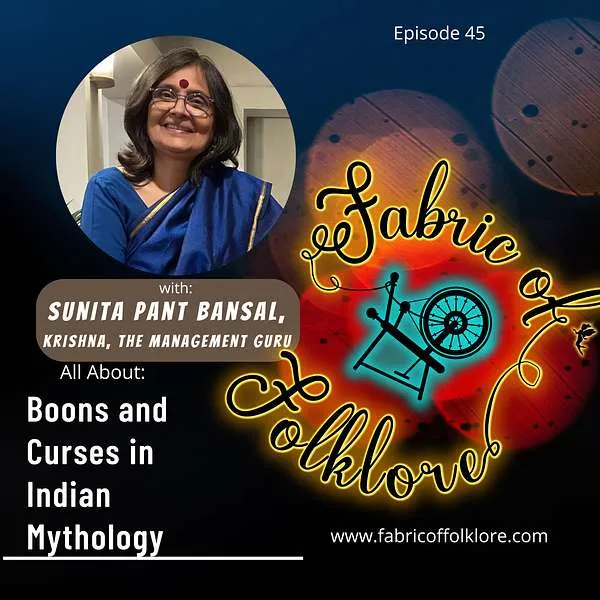
Ep 45: Boons and Curses in Indian Mythology with Sunita Pant Bansal
What can we learn from Indian mythology? Sunita Pant Bansal, author of countless books of Indian mythology and children folk literature, helps us understand the life lessons mythology offers. In episode 45, author of best seller Krishna, The Management Guru and Everyday Gita, Sunita walks us through the concept of her newest book on boons and curses in Indian mythology. The discussion highlights how mythology stories carry life lessons on justice, karma, impermanence, and diversity in viewpoints. We also dive into the idea of equality among individuals, irrespective of cultural or physical differences. As an example, in Indian mythology, everyone has the power to give blessings or curses, and even powerful figures such as gods can suffer. We explore how global mythologies showcase commonalities amongst us all. Don’t miss this one!
Links:
Sunita’s Website: https://www.sunitapantbansal.com/
KRISHNA THE MANAGEMENT GURU (PB) https://amzn.eu/d/hMgIBju
EVERYDAY GITA: 365 DAYS OF WISDOM https://amzn.eu/d/cMxByiy
The Return of Vikram and Betaal https://amzn.eu/d/2zRdFGb
Ramayan The Journey of Ram https://amzn.eu/d/dPrPZPQ
Mahabharat The Rise and Fall of Heroes https://amzn.eu/d/840k539
Puranas – The origin of Gods and Goddesses https://amzn.eu/d/6C5vDTk
Follow us:
Fabric of Folklore website
00:09
Vanessa Rogers
Welcome, folks. Folks, welcome to fabric of folklore. I am Vanessa Y. Rogers, your hostess. And in this podcast, we unravel the mysteries of folklore. This podcast is about discovering new and illuminating stories, folk tales, mythology, ologies, but more importantly than understanding, but more importantly, understanding where and how they came about. In Tuscany, there are towns surrounded by medieval walls, but archaeologists have recently discovered that artifacts suggest some of these towns might actually be older than they originally thought. Archaeologists dig to understand our roots and our history, and on this podcast, we’re folklore archaeologists. We’re attempting to understand our stories and our ancestor stories because having that knowledge helps to give us strength. It helps to connect us to one another, connect us to our past, and bind us in our humanity.
01:11
Vanessa Rogers
So if that sounds like a podcast that you want to continue to listen to, make sure that you hit that subscribe button so that you get notifications every week when our podcast drops. And if you’re a longtime listener, we really encourage you to give us reviews. If you’re listening on a podcast platform like Apple, you can even write out a review. And that is so helpful for indie podcasts like ourselves to be found by new fans. We’ve an incredible show for you today. Sunita Bansal has authored 29 books for adults and young adults decoding philosophy of mythology and hundreds of books for children on folk literature and scriptures. Her books sell in multiple languages globally. Sunita has also dabbled in writing articles, columns and stories, creating jigsaw puzzles and board games, and producing short films, even working with Walt Disney Studios.
02:04
Vanessa Rogers
Sunita’s latest bestsellers are Krishna, the management guru and everyday Gita. On the show, we’ll be discussing her upcoming book about curses and boons in mythology. So thank you so much for joining us today.
02:18
Sunita Pant Bansal
Thank you. Thank you so much, Vanessa, for calling me, for finding me out as you dug me out.
02:31
Vanessa Rogers
I was really inspired, actually, after the fairy tale flip episode where we talked about the flowering tree, which were just discussing before we started recording on the show because we haven’t had enough guests from India. We’ve had one guest from India and that was a really fantastic episode. But it’s such a rich culture and it’s so diverse and so I was really inspired to find someone from your country.
03:02
Sunita Pant Bansal
Thank you for finding me. Thank you for having me in this beautiful stage, I should say.
03:11
Vanessa Rogers
So tell us a little bit about your journey into writing and storytelling.
03:18
Sunita Pant Bansal
My journey into writing started very young. I was in school, grade two. I was about seven years old and I started writing. My writing started with writing poems and that was the school magazine. And then it kind of continued. We had very encouraging teachers, our english teachers, and they would actually encourage us, and they would give us extra marks for writing poems. So it used to be that if you were writing an essay or a composition, then the choice would be that if anyone who writes poem would get two marks extra. So that was quite an incentive. I started writing by writing poems in school, and then it was till about, say, till school. And after that there was a kind of longish gap. And I resumed writing at the age of 20 years.
04:12
Sunita Pant Bansal
And that’s when I started writing articles and columns and did interviews and so on. And that was on health. Generally, the topics used to be wellness, health of can say, mental health, physical health, and so on. But storytelling. The second part of your question is writing and storytelling. Storytelling. I actually started when I was about 28 years old, and it continues till now. So that storytelling hasn’t stopped. The other things, I’m not doing very much now, the particles and columns, but, yeah, storytelling continues. And India being a land of storytellers, I think all of us, the storytelling gene in us, all Indians do.
04:59
Vanessa Rogers
So were you writing for your college newspaper?
05:05
Sunita Pant Bansal
Not in college, because college was all studies, and when not studies, fun. And I was studying nutrition. So it was more of studies because there’s a lot of science and a lot of chemistry and a lot of kind of study stuff that we had to do. So whatever little time, we would prefer going out for fun, generally, watching movies and stuff. So, no, but in school, I started a little newspaper. Me and a friend of mine, two of us, we started a little rag, you can call it. At that time, it used to be cyclostyled, and we would just put news items like the school trips that go. So we would just kind of do a little bit of reporting there. So that was a little kind of newspaper, you can say, in school.
05:58
Sunita Pant Bansal
But the actual newspaper writing started when I was about 23, because while I was writing articles and stuff, then I got this offer from the Times of India, the largest newspaper of our country. And that’s when my editing also started. And that was the time I was kind of doing a little bit of. I mean, you know how newspapers are. But ours was a kind of a news magazine, a weekend news magazine. So there was lots of writing and editing happening, but that was articles and columns and interviews and that kind of writing. That’s when newspaper came into my life at the age of 23.
06:48
Vanessa Rogers
And then when did your love of mythology come about?
06:52
Sunita Pant Bansal
That also started young, but let me tell you why I started writing? Because that’s something I started writing at the age of 20. Why? To earn pocket money. Because the main aim of my writing was that it came easy to me, and it got me pocket money, the regular articles that I would submit to different newspapers and magazines. So it was good. So pocket money, pin money, whatever you may call it. So that was the reason I started writing, and it kind of became my vocation later on. It’s my passion, in any case. Now, mythology, when you say mythology again, started very early because my grandma was the one who would talk about mythology all the time. She would bring up these stories at the top of the hat, literally.
07:48
Sunita Pant Bansal
And she was into, she had this altar where she had all the gods and goddesses, and she would get them in the morning and would bathe them and so on, so forth. And I would sit with her and ask questions, and that’s when she would tell me stories. And I lost her early. I was young, very young when I lost her. But all the memories that I have are still very fresh, and they’re all full of stories and the experiences. That’s the germ of mythology that entered my system and then kind of later on bloomed and been kind of into mythology now for a very long time, like maybe 30 years.
08:37
Vanessa Rogers
So did you author any books about wellness? Because that was what you said you originally were studying, right?
08:42
Sunita Pant Bansal
I did. I did three books on wellness. One is diet and disease, one is healing power of foods, and the third one is cholesterol busting diet. And they did very well. They’re still selling, they’re still out, and I believe there is an ayurvedic university somewhere in Netherlands, and they have, I think, prescribed one of my books, disease, I think. And those books also going in multiple languages, and they’re still there. They’re very much there, though. I don’t really look at them anymore because I’m so engrossed in mythology now that I don’t really find out. But I do get off and on. I get a ping on Instagram telling me that they’ve read the book. I got a ping from a lady who said that she had translated one of my books in Farsi language, one of these wellness books. So that was very nice.
09:56
Sunita Pant Bansal
So, yeah, these are lovely moments in the life of a writer, I guess. Absolutely.
10:02
Vanessa Rogers
So what was your first foray into mythology books? What was your first book that you wrote?
10:10
Sunita Pant Bansal
You see, first book in mythology was hardcore mythology, because, you see there’s a lot of overlapping. Okay, now we have mythology and in our country, mythology is very strong, and at times it mingles with folktales. We have a lot of folk literature, folklore, and it kind of keeps overlapping every now and then. And then what happens is then it kind of gets connected with history somehow. So there’s a whole lot of overlapping that keeps happening. So at the age of 20, when I started my storytelling thing, at that point of time, I was more focused on doing folktales for children and bringing them out and kind of making them reach children.
11:09
Sunita Pant Bansal
Because what happens is that in our country, it probably happens in every country that a lot of western literature comes in and the traditional, old traditional folklore and that kind of literature kind of gets overshadowed by flood of western literature. That kind of just literally floods and it’s a deluge. So that I was seeing happening, because all through my life, the gifts and all I would get would be red Riding Hood and naladin and so on and so forth, the standard fairy tales. And I saw the same thing happening all around me. And that’s when I felt that what is happening to our stories? And they also have adventures. They also have brave warriors, even brave princesses and so on. So what happens to them?
12:04
Sunita Pant Bansal
So I started digging out the folktales at that time and started retelling them for children in simpler language, with removing the gore. That was my thing with the story last time, you guys were just discussing. So I preferred not to bring in the gore and I would kind of tone it down. The idea was to talk about punishment. It needn’t be gori. So I kind of started doing that in terms of mythology. And eventually I went on to hardcore mythology. And the first book that I wrote was Ramayan, which is our favorite epics in our country, the story of Ram, so that I did four year olds.
12:51
Sunita Pant Bansal
And again, the reason was that I felt that why is a four year old child in our country reading Jack and the beanstalk or all of these kind of stories when we have enough of our own? So for roles, I developed Ramayan, and it was quite a challenge because it’s a huge epic story is very long, and to break it down for a small child with that kind of attention span was challenging. And it kind of got a wonderful response. The response was so good that even today I keep working on ramayan stories or for different age groups.
13:35
Sunita Pant Bansal
And my last Ramayan that I wrote, like five years back was for young adults, and there it was, a thicker book, and I was talking about the symbolism and so on, because I think young adults should also understand that these stories are not just stories. They have a lot more to say. There’s a lot of subtext in our stories. So that’s how it’s kind of. All things are kind of infecting, overlapping, supporting each other, and so on. That’s what culture.
14:13
Vanessa Rogers
I know you said that was a long story. Is there any way you can tell, like, a very shortened version so that our audiences can hear a little bit of your storytelling?
14:25
Sunita Pant Bansal
You see, this story is about Prince Ram. He’s supposed to be one of the, you can say, avatars of one of our gods. Like we have in Hinduism, we have a trinity of gods. So we have Brahma and Mahesh. So we have Brahma as the creator, Vishnu as the preserver, and Mahesh as the destroyer. So this is the trinity, and that’s how the entire thing spreads from there. So one of the preserver, Vishnu, is the preserver. Now, he would take different of. Reincarnation is a very kind of simple word to explain, but the avtar is the right word. ACTUALLY. They would come in different forms, like Vishnu would come in various avtars, and there are very many recorded, but the most popular ones are ten of them. And out of those ten, one is Ram, Prince Ram. So Vishnu comes as Ram.
15:25
Sunita Pant Bansal
And Vishnu would take an aftar on earth only when there’s a lot of evil happening. So why he would come? Because his role is as a preserver. The role would be to preserve the earth. So if the balance is kind of a little skewered, like there’s more of evil and less of good, then Vishnu would have to come in any form and set the balance right. So setting the balance right would mean to destroy all the evil. So that’s how Ram was born. So the story, Ramayan is about a journey of Ram and how he was born, and then how the journey. And he’s born as a man, and he became a king. So his ROLE as a writer’s king, a writer’s husband, a writer’s son, all that is there in that story.
16:18
Sunita Pant Bansal
So through the story, we get to know how he behaved like a son, how he was a good brother, how when he got married, how he was a good husband, and so on and so forth. And now when his wife was abducted by the demon king, he went and fought and brought her back. And during that journey, he killed all the demons and kind of purged the earth. So that is the essence of the story, the winning of good over evil, which is a very standard format of stories that in the end, you say, ha. So it’s not that they live happily ever after, but the Aha moment is okay. So the evil is gone and righteousness prevails. So that is how the length is so much. Why? Because there’s so many little adventures that are built in, relationships that are built in.
17:17
Sunita Pant Bansal
And like, for instance, when Ram went to fight this demon king, he had to have an army, and he know, so there was an army of monkeys, and, you know, there are those stories how he got them to become his army. So it’s never ending. So it’s just like one point and there are multiple rays coming out from that and it becomes a huge web. So the essential story is not very long. It’s that this person was born and he had three more brothers, and he had to be exiled because of a curse. Because that’s how boon and curses. When we talk about boons and curses, and I’ll talk more about this story because how because of a boon which turned into a curse, that he had to be exiled.
18:07
Sunita Pant Bansal
And throughout his journey, the period of exile, how he fought and killed demons and so on and so forth. So that is how the whole story is. So there’s a lot of adventure. There are lots of stories about characters who were helped by Ram and, of course, the internal politics of their family, the stepmother, the mother, the stepmothers, the stepbrothers, and, of course, all that. So there is this politics, internal family politics. And there is this person who kind of faces everything very bravely. There is this person who’s a hero. He’s a real hero, can say all the superhero material that unflinchingly. He’s fighting the demons and saving his wife and all that kind of stuff. That’s what I’m saying. That why read about so many other western superheroes when you have very much a bunch of local superheroes here in mythology?
19:17
Sunita Pant Bansal
That was my reason I said that let’s talk about our superheroes and talk about what they did, superhuman things they did and how they saved the, not just saved his wife, but saved the world and saved a whole lot of other people. Isn’t long journey. He saved a whole lot of other people. That’s the stuff mythology is made of. And while these stories are going on, you get to know the culture. You get to know their beliefs. You get to know so much about the time, particular time. Like, if you read a country, you get to know so much about the people, isn’t it? Their culture? So that’s like a building block. It makes you understand the people better when you know, the kind of background they’re coming from. So that is mythology is all about.
20:11
Sunita Pant Bansal
And that’s why it’s so fascinating that it’s a kind of window to a huge kind of country people. So that’s what makes it so interesting.
20:24
Vanessa Rogers
Would you say that’s really what makes mythology valuable is that it’s a window into another culture and into another way of seeing the world.
20:37
Sunita Pant Bansal
You see. I’ll tell you, I’ll give an example, for instance, when you come to India and if you know about our mythology and you know about these major epics, the Ramayan that I’m talking about, and you see the temples and all, you will understand why people are worshipping certain gods and why we have so many. And so these are the things you get to know when you read a country’s mythology. Like, you go to Greece, you’d like to read about them, isn’t it? I mean, not just places to visit on a weekend, not like that. But you would like to know about the ruins when you see where they came from. What’s the story behind those ruins? So I guess you get to know so much about a country when you read its mythology more than history.
21:31
Sunita Pant Bansal
When you read mythology, you know more because mythology is kind of all about emotions, isn’t it? Mythology is so much more colorful and traditions, festivals and so on. So it’s the color that you add to history. I feel that you read about a country’s history, geography, whatever. But mythology actually adds the color. Life. Mythology is a vibe, I think.
22:01
Vanessa Rogers
Yeah, I love that description, that it adds color to the history. I think that’s so very true.
22:14
Sunita Pant Bansal
It’s all about emotions, isn’t it? Look at the wars in the world. They’re religious wars, weren’t they all emotional? And they were not logical, isn’t it? It’s all about emotion. Religion is all about emotion, isn’t it? So mythology essentially is a very emotional area. You use the emotions of a particular time. That’s what is so fascinating.
22:44
Vanessa Rogers
Do you have a favorite book that you’ve written or one that you keep coming back to? Favorite or a series maybe? Like, you had.
23:00
Sunita Pant Bansal
Very many books that the Ramaya that I told you that I wrote for four years old. I would say that in a way, it became my favorite because there were certain things that were challenging. Like, for instance, there was lots of people, even as a child, I would ask, because there’s a part in the story where everything is like. It’s towards the end of the story where she has been rescued and she’s back home and she’s in the palace and all that kind of stuff. And, in fact, she’s pregnant also. So it’s all good and everything. And then one fine day, Ram gets to hear some local gossip about somebody was talking about. Somebody was kind of reprimanding his wife and saying that, if you behave like this, I’m not going to take you back. Just like Ram did.
24:07
Sunita Pant Bansal
Ram took back his wife after she’d spent so much time with the demon king. So it was very typical gossip and which kind of bothered Ram, because he was a role model. Ram has been looked upon as a role model in every which way. So being a role model, a king for his people, he felt that if they feel like this about me and if this is not right, that I took back my wife, then I shouldn’t have done that, perhaps because I have to set an ExAmple. So he sends Sita away, and his brother goes and leaves her. Now, this is a problem that people face. Children face, people who don’t understand Ramayan face that. They ask this question, when he was such a great guy, he was so good and all that, why was he not fair to his wife?
24:59
Sunita Pant Bansal
How could he do that? And she was PregnAnt at that, all that kind of sTuff. So this is where I thought that for a four year old child. I would like to explain why. I would like to explain why did that. The reason in our mythology, the most interesting thing is that nothing happens without reason. So everything has a reason. If there’s a good Thing happening, there’s a reason. Bad thing happening, there’s a reason. So this time, the reason was that in Vishnu, Ram is an aftar of Vishnu, as I said before. Now, Vishnu, at some point of time, was fighting in heaven. There was always this FighT with gods and demons and stuff like that. So once there was this fight happening. Some lives back, because we also. Our culture also believes in reincarnation.
25:53
Sunita Pant Bansal
So some couple of lives back then, Ram was still as Mishnu. At one of those times, there was this war happening between gods and demons kind of went and hid in Brigu’s hermitage, and they hid there. And the king of gods tried to get them out. But the sage’s wife was a tough Cookie. She kind of fought against them. She said she did not allow the gods to enter the hermitage, and she kind of protected the demons. So the king of the gods, the leader of the gods, he went and complained to Vishnu that this is what is happening and demons are hiding there. We know. And so we got to kill them. And that’s when Vishnu goes and he to face the lady, the old lady, and she refuses. She was quite a fighter. She refused.
27:00
Sunita Pant Bansal
She said, no, they’ve come here and I’m supposed to be protecting them because they came asking for protection. So when somebody comes to ask for protection, I give protection. So what Vishnu does at that point of time is to behead her, kill her. So Vishnu kills her. And at that point of time, Brigo, the sage whose wife was killed, he walks in and he sees this and he gets very angry. And in our mythology, angry sages are prone to curse. So sage Brigu curses Vishnu. And he says that what I’m facing, like my loss of wife, I mean, separation from wife, so to speak, you will also have to be born on earth as a human and face this. So that was the curse.
27:50
Sunita Pant Bansal
So I explained to children in my Ramayan that is why in the Ramayan, the charitor who’s taking Sita and Sita’s brother in law, that charitor is the one who tells the story that this is what happened. And this is the reason why as Vishnu Savdar has to go through this separation. So this was inevitable, this was destiny. Because I didn’t want a child to read the Rama and have any kind of bias. Because that is the wrong footing then. So I think as storytellers, as writers, we have this responsibility not to create these kind of biases in these very young, impressionable minds. And when we talk of. That’s why I have reservation talking about blood and gore. Why?
28:48
Sunita Pant Bansal
Because I feel that when we are trying to say that so and so was punished, do we need to be so kind of explicit about how the punishment was? The idea was that you have to explain that, okay, this deed was punished, isn’t it? So you can actually couch it. You don’t have to go into the bloody details. So that was quite a challenge. That kind of made it one of my really kind of favorite books, which is very close to my heart. And the other, I mean, I’ve got lots of mean. Krishna is a management guru. And everyday Gita is doing so well. I’m so happy, I’m so grateful that it’s doing so well. But there’s another book that I wrote which is very popular folklore. It is on folklore. The name of my book is the return of Vikram and Veital.
29:51
Sunita Pant Bansal
And this is about a king, Vikram and Vetal is the know. He’s a spirit. So the original story talks about this king who takes this body, a dead body, and he’s kind of walking with it. And the ghost from the body speaks up and tells this king certain stories, and he says that you have to tell me why this happened. And he would kind of end the story with a kind of a question, a puzzle that the king had to answer. And if he would answer, then the ghost would go back to where he had come from, and then this would go on and on. So there were like 25 set stories in that old, you can say an old folk literature. It is Pithal Pachisi, we call it here, or 25 tales of Sprite. There are lots of names.
30:50
Sunita Pant Bansal
So that was one story that had always affected me because I felt that it talked about human relationships. It talked about the confusion of good and bad. And what is good for somebody may not be good for the other person. So the justice. What justice meant that when somebody kills somebody, saying self defense, so then what happens to the family of the person who’s dead? They would say that was wrong, that they killed this member of her family, but the person who had to protect herself or himself for that person, that was the right thing to do. So there’s this kind of confusion in terms of what is real justice. Because justice, at the end of the day, is perception at a particular point, isn’t it? Where you’re standing, your perception is at that point of time justice to you, isn’t it?
31:45
Sunita Pant Bansal
That’s how the judgments are passed. They look at any case in so many different ways to figure out why this particular crime happened. And criminal is not born criminal. Criminal becomes a criminal because of circumstances. So there’s a whole lot of story behind it. So I wanted to take this particular idea and create a book to explain this philosophy that justice is not black and white, and it’s a lot of gray areas, and it depends on your perception and so on. So what I did was I didn’t take the original stories because they, I felt were kind of boring, because they were like human stories KING whatever those emotions, the humans remain the same through millennia. The emotions remain the same, the relationships remain the same, but that the readership changes. The idea of reading a book changes.
32:42
Sunita Pant Bansal
For instance, now people would want something which has a lot of. What should I say? What we say is, okay, the loose translation would be spice. So you need to spice up the stories to make them more interesting and readable, because writing a book, not just for yourself, for the readers, for people to read. So I decided that I’ll use the basic theme and create a fiction around it. So what I did was I took up a lot of crimes, real crimes, and I dug it, and I discovered that you can find these interesting criminal cases, bizarre criminal cases, where the justice. The verdict was extremely bizarre and kind of unusual, and you can find them all across the globe.
33:33
Sunita Pant Bansal
So I picked up cases from India, from different parts of the country, and these cases, real cases with real verdicts, but those verdicts are very unusual, very bizarre. So I took them and created a story where I created a judge who’s going to be judging them, and this ghost who comes and who’s giving the cases to this guy. So while he’s solving these cases and reaching his verdicts, he’s also traveling inwards. He’s unraveling his own issues of life. Relationship. Because all the cases are based on relationships, because crime happens because of emotions. And obviously, emotions are heightened when there’s a relationship in the picture. So these crimes were like two brothers killing each other, or husband killing wife, or wife killing husband and so on. These kind of crimes, while solving, he kind of goes through a cathartic moment with every case.
34:41
Sunita Pant Bansal
He’s going through kind of cathartic till he reaches a point when he feels that. And he’s kind of, towards the end of the book, he has resolved his issues, his emotional issues, emotional baggage. He’s shed that, and he’s made peace with the people that he was upset with earlier, and he’s done all that. So he’s actually clean. His slate is clean. He’s actually now ready to go. Because what binds us to this world is our relationships, isn’t it? Somebody tells you that you’re going to die tomorrow. This is what happens in my book. If the ghost comes, says, I’ve come to take you. I’ve come to take your soul. Today is your last day. Then what happens? So many thoughts come into your head. There’s so many things that are unfinished. So that’s what happened, Guy.
35:36
Sunita Pant Bansal
So there are lots of unfinished things in his life which he kind of wraps up as he solves the cases also. And towards the end, he’s kind of wrapped up everything, and he’s free, so he becomes attached. And there’s a philosophical theme running through it, that this is what we need to do in our lives, get rid of all the attachments and point where we realize that everything is kind of transitory. This life has to end. Relationships have to end. So the life and impermanence of relationships. So it’s extremely philosophical. At the same time, real crime, which makes it interesting which makes it very spicy for people to read because these are well known criminal cases. So they are aware of those cases.
36:26
Sunita Pant Bansal
So that is how I kind of bring in the ancient wisdom, as I call it, kind of retelling of folklore, retelling of mythology. So that’s my favorite book. I can say the latest favorite.
36:44
Vanessa Rogers
Well, we’ll definitely link all the books that you’re specifically talking about in our show notes so that anyone in the audience who’s interested in reading these books can easily find them. Because you have so many, it’s hard to peruse through all of them. So you have written for adults, young adults and children. And this new book that you are writing is specifically for children, the one about curses and boons, is that right?
37:09
Sunita Pant Bansal
Yeah. This one is specific. Yes. I have been writing for. Actually, when I started storytelling, it started with children. And then while I was doing storytelling, there were other books that I created which I had mentioned also when I said hundreds and touching, actually thousand, maybe more. Those books were like stuff like concept books. And also because I like the idea of connecting things. So, for instance, if I am making a coloring book, because I had my own publishing house, so I had other clients, other publishers who would want me to develop books for them. So if I’m making even a coloring book, I would actually make a story, have a story in eight lines or 16 lines and have the artist make pictures and that there’ll be a one line story running through the book.
38:10
Sunita Pant Bansal
So like this, you can create hundreds and thousands of books because it’s not really difficult, honestly, to create books for little children. When you talk of, say, the primary, preschool to primary level, because those books are simple and at the same time, you can actually put in a story there. So that’s how so much of story writing has happened. Now, after that writing for children, I thought of to write for young adults because that was a kind of genre that suddenly came up and it was literally like one fine day you realize that. And I saw it with my younger daughter also, that it’s like she is a child. And then she says, no, mom, I’m not a child anymore. I’m a preteen.
38:58
Sunita Pant Bansal
So then she becomes a teen, and then suddenly, how can it happen overnight that you are in school and the next year you’re in college, you become an adult? No, it doesn’t work like that. No, because the mind doesn’t see dates. So there was always a gap. So young adult, the genre of young adult, when it came, it was quite a good area because that’s where the readers are not adults, but not children also. So you can actually talk to them, and you can talk to them in a simple language. At the same time, you can talk to them one one. So that’s the advantage of writing for that particular readers.
39:43
Sunita Pant Bansal
So that’s why I kind of redid all the mythology, the epics and the Mahabharat, the Puran, everything for that particular age group, because I felt that, okay, this is one great target area that I can actually talk to like a friend and discuss in their language. So that’s when I did a lot of writing for young adults. And, of course, adult writing was there always in the background with my other kind of nonfiction books that I had written. And so it’s kind of just overlapped. And I began writing for adults also on the side. And so now, also, I would have an adult project, and I would have a project for children running in tandem. That’s how I write. I always work on two projects in tandem because that’s how my brain relaxes. If I’m constantly one, this brain fag sets in.
40:44
Sunita Pant Bansal
If I’m working constantly one project. So what happens is one project would mean a bunch of books. So what happens is then I would keep it aside, and then I would pick up this other one. So my brain switches channels and it relaxes. So that particular portion relaxes. So I always work at least on two projects simultaneously. So, yes, so one of them is about curses and boons, and this is for children, because our mythology, and I’m sure mythology all across, it’s full of these boons and curses. Now, for us, boons and curses probably have a slightly different meaning. And in other stories that one reads, fairy tales, especially fairy tales, are full of them. You read about the witches and sorcerers, and it’s basically magic when you read. But in Hindu mythology, it is not.
41:45
Sunita Pant Bansal
So in Hindu mythology, it’s based on lots of things. And the fun thing is that anybody can curse anybody, and gods also get cursed. So it’s not limited to a particular kind of type of people, but it happens all through. So what happens is you please somebody, they’ll bless you by way of giving you a boon that you can cash later. So it’s like that. Or if you have done something wrong and this person gets very angry and he has the power to curse you, then he will curse you, which can happen immediately or it can again happen later. So this is how Boons and curses keep cropping up in the stories, but that this person did something wrong. And so he was cursed, and then that is why.
42:43
Sunita Pant Bansal
And it’s like a pivot to the story, kind of that person’s pivot in that person’s life. It turns in another direction because of a curse or a boon. So this is how it’s also, you can say, a way to take the narrative forward. Boons and curses also help in taking the narratives in whichever direction. So that’s a very fascinating thing about boons. And also, there is this theory. We have a theory of karma, the law of karma that we believe in, which is about boons and curses. Also, it shows karmic retribution, that if whatever you reap, what you sow, so if you’ve done something wrong, the result will bound to be bad for you at some point of time in life or the other. It may not be immediately. It could be later. I mean, I’m talking of life now.
43:44
Sunita Pant Bansal
So what happens is, through the stories, you get to see that this is what happens when you do this. This is the result. So if you do good, the result is good. If you do bad, the result is going to be bad. So through the stories, that is what we learn. We teach through stories that this is what happens. So you’d better be careful. What exactly do you want to do? You want to do good things? Okay. Then good will happen. If you want to do bad things, or if something bad happens by you inadvertently, then you’re bound to suffer the consequence, and that consequence may come today, may come later, may come in your next life, perhaps. So all these things are there, which are shown in Hindu mythology.
44:30
Sunita Pant Bansal
And so it’s kind of very interesting vehicle to teach this to very nice, friendly, colorful manner to people about the actions having consequences. So that is essentially what we keep getting at the end of the story. So that’s what I feel that we learn from any mythology, more so from Hindu, because we firmly believe in the law of karma and the concept of reincarnation.
45:08
Vanessa Rogers
But in your notes, when I was reading over the boons and curses, one of the things that you pointed out is that a curse doesn’t always end in a bad result, and a boon doesn’t always end in a good result. They’re not as black and white as you were saying. Right. Is that one of the main themes of your book?
45:30
Sunita Pant Bansal
Yes, it is. The main thing of boons and curses, per se. Now, for instance, to explain this, we will go back to Ramayan. Now, what happens in know, as I say, it’s not black and white. It doesn’t seem black and white. Now, in Ramayan, what happens is the story goes that Tasha, the king of Ayodhya, Ram’s father, now, he didn’t have any heirs to the throne, and he was getting older, and he had wives, but he didn’t have sons. Now, the sons are supposed to be the ones inheriting the throne. So he was kind of wouldn’t say depressed, really, but disappointed with life. And generally, he would go for hunting and so on. And what else could he do? I mean, kings, that’s their favorite pastime. Generally, hunting is one of the favorite sports of kings.
46:31
Sunita Pant Bansal
So he goes hunting one day, and now he had this power to listen to a sound and shoot. He was a good archer, Dashrath. So he had this talent, you should say that he could listen to a sound and he would know where the sound is coming from and shoot, and that would kill the animal. Now, he was as accurate as that. So he goes to this forest and hears a sound and he shoots. But the sound after that was different from what he was expecting. He expected animal to be a boar kind of animal, maybe killed, but it was kind of human kind of sound. So he rushes to see, and he finds that he had shot a young guy, a young boy. And he sees, obviously, he’s sorry for that.
47:24
Sunita Pant Bansal
And so he kind of says sorry to him and says, I’m really sorry, but this was a mistake. It was an honest mistake. I heard this, and this is what happened. And he says, no, don’t. The guy who’s dying, he says that. Don’t say sorry to me because I am dying. But you go and say sorry to my parents because I was the only child and my parents are blind, and I was taking them for a pilgrimage, and I was their only child or only son. So if you have to say sorry, you go say sorry to. So Dashud goes and says sorry to the old blind parents of this boy. And the blind parents, first they think that their son has come, but then they get to know it’s the king. And then he says that I shot and killed you by mistake.
48:11
Sunita Pant Bansal
So obviously, they can imagine their reaction. They were just not happy. They were very angry. And that was the time they curse him. And they say that you cannot understand what a parent, a father feels when he’s separated from his son. And you will go through this agony of separation, from this agonizing moment that I’m going through, that we are going through. You will also go through the same. So that was a curse. So dashad, of course, he feels bad, and the parents, they asked to be. The rest of the story is immaterial. So I will not go into that. But Dashat, he’s obviously very unhappy getting this curse. So when he comes home after some time, he realizes for the curse to come true, he has to have children. He has to have.
49:08
Sunita Pant Bansal
So that’s what gives him an idea to turn the things around. And then he consults his astrologers and Brahmins and so on. And they conduct kind of sacrifice, a fire sacrifice, to ask for sun to get this blessing for having a son. And he’s blessed with four sons now you see, now he was cursed. And how he kind of flips it and makes it into kind of a good thing for him because he wanted sons. So he gets four of them. So this is how things happen. That because of that, he got this idea, got this thing, the fire sacrifice done. And he has four sons. And then again in the same story, now that he has four sons, he’s happy that he has heir to his throne. Now another thing happens.
50:14
Sunita Pant Bansal
Now, once upon a time, ages back, his youngest wife had helped him in a war. He was hurt, he was injured, and she had looked after him. And so he had been very kind of pleased with that. And in gratitude, he grants her a boon and says that, okay, I give you a boon and you can take it whenever you can. Ask for whatever you want and I’ll give it to you. Promise. And so when after so many years, when Dasar’s sons are all grown up and ram is old enough to be declared as that, he would become the king, the next king. And that was the time when this youngest queen decides to take advantage of that boon. And she asks her husband, king, that send Ram, your eldest son, to exile for 14 years and put my son on.
51:11
Sunita Pant Bansal
So she takes advantage of that boon and Dashad has to do it because that’s the boon he had promised. He has to do it. So he sends his son to exile. And that’s when that curse comes. Curse that you will suffer. So dashad suffers the pangs, the pain and the pangs of separation from his son to such an extent that he dies. So Ram, of course, his journey is there and he comes back and he becomes king. That’s another matter. But Dasha dies. So that curse comes true of that old man. So you see how the curses and the bones and they are interlinked and they keep kind of taking forward. So it’s always that when you look at a curse, you say, oh, my God, this is a curse. This is bad. No, it can actually lead good. Right? Same thing.
52:09
Sunita Pant Bansal
You can say that his wife’s bone may be great for her, but it turned out to be bad for the husband and for the son. So this is what I meant when I said that it’s not so clear that Boon is good and curse is bad. They can keep flipping, and they can keep kind of, as I say, they shape the narrative. They take the story forward and that sense. And they also keep telling you about the karmic distribution. So Dashwith did kill a boy, and the parents were in pain. Now, if he suffered that was his way of paying back the debt that he had. So that is how the whole thing works. So that’s how the whole thing works. And that’s why it’s so beautiful that every time you read a story, this is what you get out of it.
53:14
Vanessa Rogers
One of the articles you sent me to read, one of the ladies, I believe it was lady, said that there’s a diversity of views among Hindu traditions regarding the application and mode of operation of the karmic law. What diversity in application or in viewpoint do you see.
53:40
Sunita Pant Bansal
Again, that person who wrote that, it’s their view. But the only diversity that you see in our culture, if you talk about even our religion, Hinduism, is the multiple gods and goddesses that we have and the different rituals that we have across the country, from north to south, east to west, you find diverse ways of praying. The different kinds of temples, the gods, festivals, the phenomenal diversity is there. But as far as the karmic law is concerned, that is there. It runs in the background, so it doesn’t matter who the God and the deity in the temple is. It doesn’t matter. In our heads, in the indian head, I would say, we know about karmic retribution. We know about reincarnation. When a person goes to a temple, they would be praying for, say, why would a person go?
54:59
Sunita Pant Bansal
Either they would be going to ask for something. They want something. That means they’re essentially asking for a boon, isn’t it? Or if they would want to probably get rid of their disease or something. They’re very sick. They’re dying. These are the reasons why people would go to a temple. And then there would be people who are going to thank their deity for whatever good has happened. They go for that reason. So, essentially, these are the reasons why people are going. So when people are asking for something good, say a job or money or whatever, we also know in our hearts that it’ll come to us if we deserve it. It’ll come to us if we’ve done thing good.
55:48
Sunita Pant Bansal
So the way people talk also would be that if you get, say, a lottery, then the most likely comment would be that you must have done something good in your past. So it is not that it’s something immediate, but the reason you’re blessed is because of something good that you would have done. Or a person gets a terminal disease, then they wonder, what could have I done so terrible in my past that I’m getting this disease that I’m dying? So everything is related to a karma reik. Doesn’t matter which God a person is praying to, which temple a person is going to. At the end of the day, Indians in totality. We believe in the karmic theory. We believe in our karmic. We believe that as you sow, so shall you reap. That is what we believe is.
56:47
Sunita Pant Bansal
So all the diversity aside, this is the unifying factor. This is the unifying thread that binds us together.
56:58
Vanessa Rogers
You said that there are different categories in the boons and curses. What categories do they fall in?
57:08
Sunita Pant Bansal
It’s like categories would mean that kinds, okay, kinds. Like, for instance, I told you about Dashrath’s boon. Now, Dashrath gave a boon to his wife, right? His wife saved him or helped him or looked after him, and he was pleased. And that was a gift to him. What did it result in? She asked him for something that made him die. So the boon that he gave to his wife killed him. So their boom would result in death. These are the ways you can say that you can categorize. And now there’s another interesting story of a boon. Now, there was this demon. Basmasur is the name. Now, this demon, he was blessed by one of the gods of Trinity, Shiva, that the demon could kill anyone by just placing his hand on somebody’s head. That person would turn into ashes.
58:20
Sunita Pant Bansal
That was the crazy boon that was given to this demon. And he was obviously very happy. He went around kind of burning People down to Ashes by his haNd. And he became very powerful because anybody who would kind of make him angry, he would just put his hand on top and the person would be burned to ashes and so on. So now what happened was, now this demon tries to do the same with Shiv, the God who’s given him the boon. This Personas would become so arrogant that he goes and he tries to put his hand on Shiva. Now, obviously Shiva would have died, would have been burned to ashes. But at that point, preserver God Vishnu, he comes to help. Now, he sees this happening. So he rushes to HelP.
59:09
Sunita Pant Bansal
And at that point of time, he takes the role of a seductress, Mohini. He becomes seductress called Mohini. And the moment Mohini goes to Bhasmasur the demon, he loses interest in Shiva because he is obviously seduced by this beautiful woman who comes kind of dancing to him. And he says to her that I want to marry you. So Mohini says that, yeah, sure, we can get married, but first you kind of match me in my dance moves. And she starts dancing and so say, yeah, sure. So he kind of matches her dancing steps and they’re dancing and it goes on for a while, for quite some time. And Shiva’s there now, he’s away, he’s safe. Now, the idea was that the SUr has to be killed before he goes around killing more people.
01:00:03
Sunita Pant Bansal
So Moini is dancing, and while she’s dancing and Pasmasur is imitating, copying her steps, what she does is in one of the dance moves, she puts her hand on her head, she places her hand on her head and Basmasur foolishly does the same. And he himself, he gets killed. He’s now burned to ashes. So this was this boon that results in his own death. They are, these are the kinds of things, boons and curses either which way, as I keep saying, the kind of boons and curses can be probably divided in these kind of categories. Now, as I told you about Dashat in Ramayan and that there his curse turned into a, he converted his curse into a boon by getting his sons right. By doing that, fire, sacrifice and sons are born. So there the curse leads to a boon.
01:01:01
Sunita Pant Bansal
So like it happens. Then I also talked about gods getting cursed. So that is another category. Whereas I told you that in Bhigu’s ashram, Vishnu was cursed by that sage Brigu and then he’s born as Ram. So that’s know God is cursed and then gods are cursed many times. In fact, there’s a great mount. Yeah, because you see, the idea is to show that even gods go through the same thing. The action giving rise to a consequence is something that happens with gods too. So nobody, that is what mythology is teaching us. Like, for instance, even in the great war of Mahabharat, the lady who loses her hundred sons in this war, she curses Krishna, God, who’s supposed to be the main can say the hero of that particular epic. She curses him that my sons are dead and the clan is dead.
01:02:13
Sunita Pant Bansal
So there will come a time that your entire clan will be wiped out, as today, mine has been wiped out on the battlefield, yours also will happen. So Krishna, who? God, that point of time, he gets this curse. And 36 years later the curse comes true and his entire clan, all, his whole cousins and all the relatives, everybody, they all die fighting with each other because of that’s another. So like this, the gods getting cursed and all that. Now there’s this cursing your own family, that’s another form of curse. Now there’s a story there when there is a sage who curses his own son in law. Because this son in law was King Jayati and he had two wives. One of them was the sage’s daughter and the other wife is actually the maid of the queen’s wife’s maid.
01:03:17
Sunita Pant Bansal
The king quietly on the sly, marries this woman and produces children. So when his father in law gets to know that my son in law has married the maid also and has children also, he gets very upset. So he curses his son in law to lose his youth, to suddenly become old. So it was like 1 minute in the blink of the eye, the king becomes old and he’s again cursing his son in law. So there have been curses in family where family members are cursed. So like this. There are all kinds of categories. Of course, Ayati, he manages to, one of his sons agrees to share his youth with his father and so on. So you see the stories within stories. I mean, the tapestry of our mythology is so rich and so vast that stories don’t seem to end.
01:04:27
Sunita Pant Bansal
If I mention one name, there’ll be multiple stories attached to that name. One person is in isolation. So if there is a character, he would have parents, there would be stories, siblings, their stories. So it’s really huge. So then there are conditional bones or curses. That’s another way of bones and curses. For instance, Ravan, the demon king, he was so arrogant that he would feel that everybody in his arrogance, he would expect people to kind of acknowledge his presence and bow in his presence and so on and so forth. He had that level of arrogance once he was flying his pushbuck. He had a plane pushbuck and he was flying through and he sees an upsara, a nymph. They are the seductresses in our mythology. He sees this beautiful woman and he expects her to pay attention to him and she doesn’t.
01:05:37
Sunita Pant Bansal
So he gets very upset. So he turns his plane around and he grabs her. She’s flying and these upsaras would be flying. So he just grabs and questions that. How come you didn’t pay attention to me to see me flying my grand plane pushbuck? And she says, I’m sorry, but I’m married. So he says that you can’t be married. You’re an upsara. You’re supposed to be pleasing multiple men. You can’t be married to one. And she says, no, I’m married to nephew. And he says, that’s bullshit, that’s rubbish. A little kind of tussle. And she manages to escape and she goes running to, flying to her place and tells her husband that your uncle did this to me. So the husband comes and he confronts his uncle Ravana, and he says, how dare you touch my wife?
01:06:30
Sunita Pant Bansal
She might have been an upset, but she’s my wife and I’m your nephew, so how could you do that? But of course, Ravan, being arrogant, says that no Apsiras can be anybody’s wives. Their job is to men and so on. So this guy, the nephew, he gets so angry that he curses his uncle and he says it, next time you try to kind of force your way on a woman, your head will burst into a thousand pieces. So now that was the curse he had. Now this was conditional. If he does something, then that curse will fructify. So that scared Ravan that he wouldn’t do that to any woman. And that curse helped ram’s wife. When Ravana abducts Sita and when he tries to force himself on her in his palace in Lanka, he wanted to do that, but he couldn’t.
01:07:30
Sunita Pant Bansal
So he kept on telling her, and you become my wife and you’ll be my chief queen. And this, that and the other. And she would continue to say no, but he could not actually force his way on her because he was scared of the curse. That kind of stopped him from doing anything to Sita. Now, that was something that saved Sita, isn’t it? So that curse on Ravan, which is a conditional curse, became a boon for Sita, helped Sita and it saved her from Ravan because he had so many wives. But he wanted Sita to be his chief queen in the palace and he was trying to entice her in so many ways, but she just did not succumb. But he couldn’t do a damn because of the curse.
01:08:23
Sunita Pant Bansal
So that’s how there’s so many curses that may be imitate, they may not be imitate or they may be conditional. Now, there was another curse that turned into a boon for other people. And many times we’ve seen this in mythology. Now, there were these two monkeys who were monkeys being monkeys. They were monkeying around and there was a sage who was trying to pray. And the sage called Sutikshna, he had two stones, and he would kind of treat them as gods, and he would pray to them every morning and so on. But these two monkeys would quietly take away those stones and throw them in the lake. So this sage got very tired of this thing happening on a daily basis, because then he would have to go into the lake and get those heavy stones out. So he decided to curse them.
01:09:22
Sunita Pant Bansal
But he thought that what’s the point of cursing these monkeys? So the curse that he gave to them was that anything that you throw on water now from henceforth would float. It will not sink. So every day, the monkeys would continue taking the stones and throwing them into the lake, and the stones would float and the sage would bring them back. And that was what was happening. Now, this particular curse helped. It turned into a boon very late when, while they were preparing for this in Ramayan, it is in Ramayan, these monkeys, they were part of Ram’s army.
01:10:05
Sunita Pant Bansal
Now, while they were standing in the indian border and looking at Lanka across the vast ocean, and they were wondering how to go know to reach that place to fight Ravan, who was staying on that island, that’s when these two monkeys helped, because they were the ones who created that floating bridge of rocks which connects India to know, today, Sri Lanka. So that floating bridge was made by. Because they were cursed. So Ram said that knew about the curse, said, let these two monkeys build the bridge, because whatever they would throw, it would float. And it made a fantastic bridge between countries. So that is how the curse becomes a boon. So it’s like, these are the various kinds of.
01:10:51
Vanessa Rogers
Yeah, that’s so fascinating. It seems to happen a lot in the mythology stories where one curse is someone else’s boon.
01:11:02
Sunita Pant Bansal
Yes. Again, it adds spice to the stories, I guess.
01:11:09
Vanessa Rogers
And what would you feel like the children? Since this is a book that is aimed at children, what do you feel like they can get from it from these stories and from looking at boons and curses in particular?
01:11:27
Sunita Pant Bansal
You see, it’s what I said, that actions having consequences. Because, you see, my work is about spiritual growth at all points of time, the spiritual evolution. But to children, you cannot explain this. So what you can explain to them is how any action has a consequence. And so that is, the boons and curses are primarily telling you that about the good of a good action being a boon and consequence of bad action being a curse. So that is the kind of a running theme right through at least this book. It will be the running theme also to tell them that nobody is spared. And also anyone can curse and anyone can give you a boon. So it needn’t be that. You have to be scared. You can’t be scared of a person that, okay, this person can curse.
01:12:30
Sunita Pant Bansal
So let’s not do anything wrong with this person. We can do wrong with that person because that person will not be able to curse. It’s not so through the mythology, they’ll get to see that anybody can curse and anybody can give you a boon. So everybody be treated in the same way. You have to watch your own actions as to where they are taking you. So it’s hands, you are in control of your actions, because everyone is the same around you, yourself included, you can also curse and also give a boon to somebody. So it’s that kind of universality that comes through these stories. And also, again, you reap what you saw is something which is very important to be learned. I think at the foundational stage, this is the stage when they must learn about this. That would be the Takeaway.
01:13:32
Vanessa Rogers
Well, this has just been so fascinating. Have we missed anything? I know that there’s probably so much more to cover, but is there any last thoughts that you want to impart?
01:13:44
Sunita Pant Bansal
Well, you see, apart from the fact that all my books, in all my books, that what I’m trying to say talk about is that. And the reason why I will be looking at the mythology of other parts of the world is to show the same thing, that we are essentially all living beings are the same. We have the same God particle in us, and so we should treat everybody the same way. I don’t talk about religion at all. I am more into the philosophy of the religion, the spirituality behind it. So I normally say that I like to explain the philosophy that is running behind a particular religious belief. Because to me, religion is something very personal. And whereas the philosophy is universal, how you convert it into your religion is your take. But the philosophy remains the same. So that is something which.
01:14:45
Sunita Pant Bansal
That is what my aim is in terms of writing these kind of books. And that is why I will be exploring other mythologies in future six months or so. To show that how you have same kind of. Similar kind of gods, you can say powerful people in different mythologies. And those similarities, I hope to show, and to show that the world essentially is the same, people are same, emotions are the same, everything is the same. Maybe we look, we behave differently, we eat different, we dress different, but that’s what all those are the only differences, superficial. But the God particle, as I call it, the soul is the same. And that is, you can say that’s a theme of our religion, Hinduism. In any case, that we are the same. The entire world is one big family.
01:15:52
Sunita Pant Bansal
So that is the reason why I’m interested in writing all this and exploring it as much as I can till however long I can. And that’s why I love your website, because it talks about folklore. And that’s something so dear to me because it’s so exciting to hear about other countries, and it also talks about how they live and what they wear, what eat and how their houses are and all those little things get to learn.
01:16:24
Vanessa Rogers
They add color.
01:16:28
Sunita Pant Bansal
Exactly. And spice. Coming from India. From India, I would say spice also.
01:16:34
Vanessa Rogers
Yes. Well, thank you so much for joining us on this show. This was such a wonderful conversation.
01:16:43
Sunita Pant Bansal
Thank you. Thank you for having me. And let’s hope to do some more such shows and discuss more. Such interesting. Absolutely.
01:16:52
Vanessa Rogers
Absolutely. And thank you, folksy folks, for joining us on this mythological journey through India today. All of our show notes will be at our website, ww fabricoffoclore.com. And like I said before, we’ll list several of the books that she mentioned in the show notes so that if you’re interested in purchasing them, you can go directly to the source and we want to hear what your thoughts are. What did you think? Are you familiar with the thoughts of curses and boons? Not necessarily being straightforward? Have you had a curse that turned out to better than you expected? We encourage you to continue this conversation on our we have. I pose questions and people can answer, and we’d love to hear from our audience. We’re also on the other social medias. We’re on Instagram and Twitter and YouTube.
01:17:49
Vanessa Rogers
So make sure that you are following us wherever you are. And until next time, keep the folk alive.
01:17:58
Sunita Pant Bansal
Thank you.