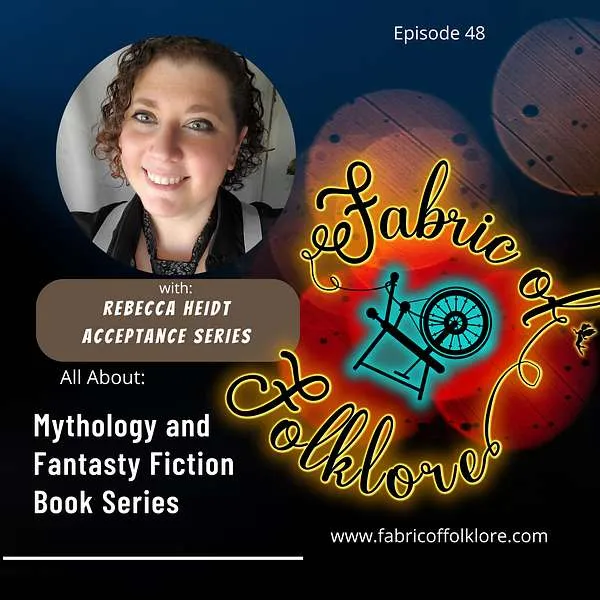
Ep: 48 Rebecca Heidt on Mythology and Folklore in her Acceptance Book Series
Is fantasy just the next step of folklore? Folklore is often a core element of fantasy fiction. Rebecca Heidt, an LGBTQ+ writer of the fantasy fiction “Acceptance” series, talks to us about how she uses folklore in her writing, as well as anthropology, history, spirituality and nature. In episode 48, Rebecca chats with us about her award-winning series, and her research into world mythologies. We discuss various mythological elements like nymphs and fairies from Greek, Roman, and Norse beliefs. We explore the symbolism of elements such as the tree of life in different cultures and unique celebrations, such as Midsummer Day. This is the episode where fantasy and folklore collides. Don’t miss it!
Find Rebecca here: https://www.rebeccaheidt.com/
Notes:
- 📚 Rebecca’s Writing Journey
- She shared her writing process and inspiration for the series.
- How she incorporated folklore into her writings.
- 🌍 Exploring Folklore and Mythologies
- Rebecca highlighted the cultural and historical connections in her stories.
- Discussed how different cultures share similarities in their folklore.
- 🔍 Research Process
- Rebecca emphasized thorough research, including using a Swedish community for clarification.
- Mentioned delving into interesting rabbit holes during the research process.
- 🌺 Flora and Spring Symbolism
- Flora’s role in charge of spring and the significance of flowers.
- Rebecca shared her passion for incorporating flora symbolism into her work.
- 📖 Acceptance Series and Folklore
- Explained that the series focuses on emotional and mental growth.
- Linked the series to unlocking personal growth through overcoming dissociation.
- 🌳 Tree of Life Symbolism
- Explored the presence of the Tree of Life in different cultures.
- Significance and symbolism of the Tree of Life worldwide.
- 🎬 Upcoming Projects
- Rebecca mentioned working on the next book, “Secrets of the Warrior.”
- Script completion and preparations for filming in progress.
Follow us:
Fabric of Folklore website
00:10
Vanessa Rogers
Welcome, folksy folks. Welcome to Fabric of Folklore podcast. I’m your hostess, Vanessa Y. Rogers, and this is the podcast where we unravel the mysteries of folklore. And I don’t know about you, but I love quotes, and I found a really great quote for today. Alan Dundees is hailed by some as the most renowned folklorist of his time. And he said, as a folklorist, I have come to believe that no piece of folklore continues to be transmitted unless it means something, even if neither speaker nor the audience can articulate what that meaning might be. And I love this quote so much because I really feel like it gets at the heart of what this podcast is about, because we know deep down that our folk tales and our traditions and our rituals that we have as a culture have importance.
01:04
Vanessa Rogers
But a lot of times we don’t know what those meanings or significances are. And the reason this podcast exists is to find figure that out, to discover what the meaning of our folklore is. Why do we tell fairy tales, what our jokes tell us about the larger culture? And do the chocolate covered strawberries that we eat at Valentine’s have a deeper significance? We want to better understand who we are as a race of humans living together on this planet in sometimes drastically different cultures. What commonalities do we have and what differences can we celebrate? So if that sounds like a podcast you are interested in following, make sure you hit that subscribe button so that you make sure that you get our notifications every week, whether you’re watching on YouTube or you’re listening on your favorite podcasting platform like Apple or Spotify.
01:54
Vanessa Rogers
So you get our notifications every week when a new episode drops. And if you’re a longtime listener, make sure you give us a review because that is so helpful for new listeners to find our show. We have a fantastic show for you today. Rebecca Haidt is a multifaceted LGBTQ writer of fantasy fiction acceptance series, which starts with a book, the beginning. Her passion lies in writing, painting, anthropology, history, spirituality, and nature. So our show is going to be about Rebecca’s award winning series, which required significant amounts of research into the world of mythology and folklore, which she incorporated into her writings. She’ll be talking about what folklore she discovered in her research and her writing journey. So thanks so much for joining us, Rebecca.
02:40
Rebecca Heidt
Thanks for having me.
02:43
Vanessa Rogers
So walk us through your journey. Walk us through your journey of writing this book series.
02:52
Rebecca Heidt
It was, I really honestly started writing it when I was younger, but I paused for real life experience. You know, like, they were like, go into the workforce and I’m like, I’m a creative. I don’t want to do that. I want to create art and beauty and whatever and live in this fantasy world. And they’re like, no. So I paused it and pretty much what happened was a bit like, when I was getting burnt out from the daily grind of life and corporate life, I sort of pulled out all of my stories again because I love writing stories. And so I went back to this one section I wrote when I was, like, 20. And then I started exploring that further. And so I was already exploring it.
03:43
Rebecca Heidt
And then COVID happened and the quarantine happened, and then I lost a bunch of family members. And so my escape was, you know, the fantasy world. You know, I grew up on Xena, I grew up on Buffy. I, like, would imagine that Pegasus was real and I would just fly around on Pegasus, you know, and, like, the world and, yeah, so that’s where my mind always went to. So I just, I translated all of the emotional, like, trauma I’ve been dealing with and emotional pain into a story with mythology is, like, everything anyone ever needed.
04:20
Vanessa Rogers
I assume it was a cathartic experience.
04:23
Rebecca Heidt
Yeah. Yes, it was.
04:27
Vanessa Rogers
And so how did, so you had the idea and then how did you start researching the mythology and the folklore that was going to go into it? Like, did you have some basis in it already from your background, or where did you get these ideas?
04:45
Rebecca Heidt
So I had the ideas about glowing eyes, and I really like the electric color blue a lot. There’s something about it and I don’t know how to explain. There’s something captivating, like a certain color green that’s electric and then a certain color blue that’s electric. And it’s just like, it captivates me every time. And so that was my, that was always my thing, was whenever I had a mytholog, like, in my head, I had a story developing. She always had glowing blue something. Always glowing blue eyes. Glowing blue. Something like that was her signature thing. So I was like, okay, I should write this. And then lost girls came out, the Sci-Fi tv show, and, like, you know, it’s fae and she has glowing blue eyes. I was like, well, I can’t do that anymore because for obvious reasons.
05:37
Rebecca Heidt
So I, like, had to switch it, you know? And so I went with green. I always wanted to do elemental. Like, I love nature. I’ve always been connected to nature. Like, I would be the five year old talking to plants. Like, I would be the one, like, just, like, petting trees and, like, talking to bird eggs. You know, like, I was the weird kid, and I’m okay with that because I love that space for me, and it’s such a happy space. Like, I was such, like, I felt the most peace in my life whenever I was just engaging with nature. So the nature was already there. So the mythology of it came very easily to me. So I was originally going to do fae, but there’s so much fae out there. There’s so much content about it.
06:24
Rebecca Heidt
So then I was like, okay, what’s an alternative? So it starts with one idea, then I say, okay, does. How does that exist in the world now? And then I’ll modify it according to my creativity or different ideas that come to my head. So it’s their nymph. They’re nymphs with elements. And then I researched which dove me into the nymph research, and that was like, I was like, okay, well, can.
06:51
Vanessa Rogers
You define what a nymph is because it’s different than a God or a goddess, right?
06:56
Rebecca Heidt
Yeah. They’re usually helpers. So a nymph normally is a helper based off of, like, a specific element. So, for example, the story is Hera has a tree on earth with golden apples, and she has specific nymphs. I can’t remember what type they are. I’m assuming they’re wood nymphs to guard the tree and the apples, for example. So, like, they’re specific to the area. So. So if it’s like a desert nymph guarding on oasis or something like that, it would be, there would be desert nymphs, like something connected to earth, but relating to desert. There were so many. There were so many of them. Like, for animals that communicate with animals, like bines and there’s storms, and there’s so many different. Like, they just protect nature. They protect nature.
07:51
Vanessa Rogers
And are the nymphs that you’re talking about, are they specifically greek nymphs, or are there nymphs found in other mythologies as well?
08:01
Rebecca Heidt
I remember reading there was other nymphs and other mythology. Mostly it’s greek and roman, honestly, because the nords don’t really have nymphs, but everyone has helpers, so they’re the helpers. You know what I mean? Like, Odin has the birds. Freya has cats. She’s, you know, so, I mean, they’re not. I think it’s culture related in literally that sense. But there’s still helpers everywhere in every culture. Yeah.
08:31
Vanessa Rogers
And are the helpers, are they loyal to their nature, or they, are they loyal to the gods and goddesses? That I guess, spawned them or created them, dubbed them. Yeah.
08:47
Rebecca Heidt
Yeah. So my understanding is they’re loyal to their mentor. So, like, even though there’s a fire nymph, I think from what I remember, the light. What? So the light nymph is the rarest one, and it’s harder to catch. It’s either that or the fire one, I can’t quite remember, but it’s one of those. But it’s like, I distinctly remember bright, white light, rarest. But it exists. Like, they’re, like. It’s like the unicorn of the nymph world, but they’re here for a reason. Like, and I’m assuming it has to do with. To bring light to darkness when, you know, darkest hour, you know, like, something relating to that. And even though it’s. It’s a fire nymphs nature to light fires and light step on fires, but that’s not the purpose. So, like, the nymphs are aligned with their purpose? Not necessarily.
09:48
Rebecca Heidt
Like, they’re mischievous sometimes because they get bored. I mean, if you were here forever, you’d be bored a little bit.
09:55
Vanessa Rogers
Yeah.
09:56
Rebecca Heidt
But, like, it’s about balance.
09:58
Vanessa Rogers
And when you’re describing them, they sound very similar to fairies in some instances. Do you see a relationship between nymphs and fairies?
10:10
Rebecca Heidt
I do, yeah. I definitely feel like there’s connection to. But they’re, like, bigger. Like, fairies are, like, you know, really tiny. Like, usually, keyword there is usually, like, in the world. Like, I’ve seen. Well, I don’t know if I say that, but, like, I’ve seen fairies, and they’re, like, literally a couple of inches. You know what I mean? And. Yeah. So fairies in, like, mythology speaking, like, they can be human beings, like changelings, like, actual people, but they’re also like tinkerbell, you know?
10:51
Vanessa Rogers
But fairies have that connection to nature. Some fairies have that connection to nature as well. And some fairies have a protection of the land type connection.
11:05
Rebecca Heidt
Right. Yeah.
11:08
Vanessa Rogers
And one of the things that you. When were having our conversation before we started this one, you said that you. One of the things that really struck you was that there are truths in mythology. Can you elaborate on that?
11:26
Rebecca Heidt
Yeah, I think that just, like, any story comes, you know, like, our first history is from oral history, because, you know, writing didn’t exist then, so it’s all by stories. Well, they have to originate from somewhere. And, you know, the Native American, they have these stories about how this guy existed. And, you know, there’s this. Or turtles. They have stories for everything, because that’s how they would, you know, explain everything. But I think there’s truth in that because they exist in other cultures. So if you think about it, the Romans and the Greeks, you know, the Romans sort of went everywhere, and then the Celtics went. You know, Romans went into the celtic, you know, so they.
12:05
Rebecca Heidt
All the stories are connected through culture or history some kind of way, but there are some that have never met each other across the world on completely opposite ends, and they’re similar. So for the example, I’m going to go to the tree life for this one because it’s the easiest one to do. Some. Some people, some cultures, like the Mayan, the aztec, and then so many, it just keeps going, like, big, like, oh, my gosh. Can’t remember what they’re called. Doesn’t matter. Moving on. So. So Aztec and the Mayans, and then all the other cultures, even in Hinduism, Buddhist, like, Judaism, Christianity, like, all of them have something resembling a tree of some kind. It’s not identical to the same tree. They all have different versions of it.
13:02
Rebecca Heidt
But some of them call the tree of life, some of them will call a tree of knowledge. They’re essentially the same thing. But I don’t think it’s our place to, like, fight. Which one’s correct? Like, no one’s correct. I think we’re all correct. You know, like. Like, why would the tree exist if it wasn’t true, if it didn’t? The belief, like, the belief in something makes it real, and I think that’s, like, imperative for mythology. So if. If someone has. So, for example, the goddess aset in Egypt was renamed, in Greece, Isis. They’re the same one, the same person. Like, the connection is there. It’s all about connection, and I think that, you know, like, fighting over who, again, who’s right, who’s wrong is the wrong way to do it.
13:58
Rebecca Heidt
I think we should marvel at the fact that these stories can not only exist through time, but also through culture and around the world in the safety past. Mm.
14:08
Vanessa Rogers
Yeah. And to you, what does it mean that there are parallel stories in different cultures that probably didn’t even, you know, cross over? What does that say to you? That there’s, like, a deeper truth. That’s why. Why is it important for us to acknowledge that there’s these connections?
14:33
Rebecca Heidt
Because there’s unity in there. We’re the same. So we get compassion, humanity, and a feeling of familiarity with different people that look different from us, from the similarities. So if I go over to someone who I’ve never, like, engaged in our culture before, and I started talking about true life or something they would like, oh, yeah, in our store, we have this. That’s an immediate point where we can get along. So that is the point where friendship comes from. That’s where unity comes from. That’s where. That’s why it’s important to remember, like, it’s humanity of it. So, for example, a lot of the Greek, I mean, a lot of the cultures would fight against each other because they thought they were better. I mean, still happening. They thought they were better than the others.
15:21
Rebecca Heidt
But, you know, they made the same pottery out of clay. Like, they made, like, it’s those cultural sames that we should have looked beyond.
15:34
Vanessa Rogers
So tell us a little bit about your research process.
15:36
Rebecca Heidt
Like, what?
15:37
Vanessa Rogers
How do your research?
15:39
Rebecca Heidt
So what I do is I. When I have an idea, I’ll google it, but then I will google it different ways to see if the same information comes up. So I’ll look for valid websites, like.org or, you know, dot, like Sweden. I spent a lot of time on the swedish website. So, like, actual government websites, you know, actual legit places, and I will find the information as many times as humanly possible. So I have to find the info at least four to five times in different sites for me to consist that it is more of the valid type because blogs are bots. I’m very thorough. Like, I even reached out to the swedish. Swedish, like, community and I was like, can you clarify this for me, please?
16:37
Vanessa Rogers
Yeah, yeah. And do you fall. I’m sure you fall down lots of rabbit holes. Did you felt any particularly interesting rabbit holes that you fell down?
16:48
Rebecca Heidt
Because there’s. There’s so many gods and goddesses out there, like celtic and just. And I don’t know them all. So as soon as I see a name, like, I’ll see, like, I saw Frey and Freya because they’re twins and. And then there was another one. There was, like, Suna and Manny and they’re twins. And I was like, who are these people? And then I would google them and then it would be like, this is who they are. And then the daughter and the son of Lola lot, and they’re like, who are these people? Yeah, it was. It was pretty crazy. So I started in Roman with Flora. I googled. I googled goddesses of spring flowers. Love that kind of stuff like that. The lovely feelings. And I started with Flora because I wanted someone else besides Aphrodite, because we all know Aphrodite. And then.
17:55
Rebecca Heidt
And then I was like. And then it listed other people and then I just followed it. Yeah.
18:02
Vanessa Rogers
So, tell us about Flora. Who is floor, and what was she in charge of? How is she different or similar to aphrodite?
18:13
Rebecca Heidt
So, Flora is a roman goddess. She’s in charge of spring. So the whole idea is flora, like flower. So my big thing is flowers. I love flowers because they’re natural beauty. They just. They bring sweet smell. There’s really nothing negative about it, except maybe the pollen, but that’s just, you know, science. So. But, like, so she’s the roman goddess of spring, flowers, beauty, love. And I didn’t personally ever hear a lot about her. So when I did research for book three and the Grey Friars Abbey, there was a blogger who was suggesting that some of it was in part for Flora. And I was like, well, who is this? Who is this person? So, she’s, very, She seems very relaxed. Like, she’s very calm, and, like. So, aphrodite. Aphrodite is, Hold on 1 second here. Go. Sorry. It’s my dog.
19:27
Vanessa Rogers
We have lots of pets that come in on our podcast.
19:33
Rebecca Heidt
Yeah. Okay.
19:34
Vanessa Rogers
All right.
19:34
Rebecca Heidt
Well, sorry about that. So, like. So, Aphrodite is really out there. She’s very promiscuous. She’s very into love and feeling and following where that belongs. And, you know, Rose is her color, sand, seashells, that kind of thing. And. And Flora is a version of that, but not as outgoing. Like, she’s soft. She’s the softer version of Aphrodite.
20:09
Vanessa Rogers
And are they from different mythologies?
20:12
Rebecca Heidt
Yeah. So roman. And then Aphrodite is greek. Yeah. So she’s. She’s the goddess of love. And I don’t say compassion because, I mean, love is compassion, but she’s usually seen as a very out there, more promiscuous. She likes to kiss a lot of people, you know, that kind of thing.
20:41
Vanessa Rogers
She loves, love.
20:45
Rebecca Heidt
Boys and girls, I’ll tell you what. Yeah.
20:48
Vanessa Rogers
Yeah.
20:50
Rebecca Heidt
So then I also found, like, Freya, who is also a version of promiscuous, and I like.
21:00
Vanessa Rogers
Okay, so let’s go through a little bit of your book. So, tell us a little bit about what the idea behind your acceptance series is, and then we can look at the different folklore mythologies that you found for each of the books.
21:15
Rebecca Heidt
Sure. So, my acceptance series is sort of unlocking an emotional and mental journey to be a better version of ourselves because of the way the world has made us all sort of dissociate from people and events and life. So it’s my way of, in a fantasy fiction setting, sort of reminding people that it’s okay to feel these feelings, and it’s like an emotional journey of growth. How do you feel the trauma? How do you kill? You know, the stuff you can’t really deal with, but you sort of should deal with it so you can be a better person. That’s at the base of the story. That’s what it is. And then it’s connected to my experience and my research of mythology along the way, because I’ve.
22:08
Rebecca Heidt
I’ve in, like, the darkest moments of my time, I would, like, stare and I’d flame up a candle and, like, just ask myself a bunch of questions about, like, history and mythology and, like, what they did with it. I mean, it was like, that’s a rabbit hole in itself, obviously. So it was what I experienced and then mythology behind it, as well. Mm. Mm.
22:33
Vanessa Rogers
And so in the first one, that is called the beginning book.
22:40
Rebecca Heidt
Yes, the beginning.
22:43
Vanessa Rogers
What are some of the elements that you incorporated?
22:48
Rebecca Heidt
So, acceptance. The beginning is, it’s the tip of the iceberg for the mythology world. It’s to, like, ease the readers into it. Before we got to book two, and it got all crazy because I didn’t want to get all crazy at first. So I lead up to her background and her life and her family, and then her discovery of her abilities, which is most. Boy, this whole thing’s a spoiler alert, so I guess that’s fine. Which is green fire, which is connected to, like, it’s a hereditary pass on from, like, family members. So hers is. So then I bring up. So I bring up that and. And her dealing with it afterwards. And. And so that’s the first. That’s the first foreshadowing that there’s a major mythology in it. And then book two, it’s where you really jump head first into all that.
23:57
Vanessa Rogers
And so in your notes to me, you said that they were non binary gods and goddesses. Which ones are you referring to?
24:07
Rebecca Heidt
So, I didn’t write them in my book, but I know that they exist, and I am probably going to bring it in later in my fourth book, which I haven’t written yet. But Dionysus is a big. Is a big one known, and it’s crazy because a lot of people, you see Dionysus and tv shows and stuff, but in actual history and mythology, it says that Dionysus is, like, both identifies, both female and male. So it’s. It’s because Dionysus is the party God. Mm.
24:44
Vanessa Rogers
He’s a God of wine and party.
24:48
Rebecca Heidt
Yeah. Desire. Yeah. Yeah. So one is. One is that. Look. So, again, Loki is predominantly male, but also he can identify sometimes as female. So, like, it really. It changes. And the question is, who came first? Which information is correct? I mean, no one. No one knows. It’s like oral history. Like, where did it come from?
25:21
Vanessa Rogers
And what surprised you in your research for book number one?
25:26
Rebecca Heidt
So I wrote green flames originally. It’s going to be blue, but I changed it away from blue. So I did green flames. And obviously, in the world, there’s no actual green flames. And I researched it very intensely, and I realized it was connection to the northern lights, because whenever I see the northern lights, I feel like it’s green flames in the sky. Like, it’s almost like the universe or the gods were talking to us through green light in the sky or something like that. So, like, that’s. I sort of connected it with that, and that’s actually where I got the idea. That thought actually gave me the idea of connecting her and her family specifically to, like, a communicator or an oracle. So that’s where that idea was born. Was like a seer or something like that. Yeah.
26:37
Rebecca Heidt
So, I mean, it all rolls together in some way.
26:43
Vanessa Rogers
And then you said in the book there’s something about dream connections. Is that what you’re talking. Doing about her being a connector? And what does that look like?
26:51
Rebecca Heidt
So what that looks like is, her ability to latch when she. When she feels like she means something specific. So, for example, the main character, Selena, was taught to sort of hide herself. Oh, I should have added, she’s bisexual, LGBT. Sorry. I should have said that.
27:19
Vanessa Rogers
So is this modern times?
27:21
Rebecca Heidt
Yes. Okay. Yeah. It’s urban fantasy fiction.
27:25
Vanessa Rogers
Okay.
27:26
Rebecca Heidt
Stockholm, Sweden, specifically. Yeah. So it’s. It’s not about her sexuality at all. She’s just living her life in that community, you know, in the world and stuff like that. So the issue is that she’s trying to hide her ability from people trying to find her and essentially kill her, get information and kill her. So she has to hide her abilities and all this power to save herself. But she didn’t know at the time. Her mentor taught her. So it builds up all this lack of connection to other humans. So when you feel so strongly or she feels so strongly about wanting to connect to someone, it’s almost like in your sleep you connect. So that’s what she did. She ended up connecting to somebody else on a mental and emotional level that she didn’t quite understand.
28:25
Rebecca Heidt
And so that connection was like, they could talk to each other. They can touch each other. They can interact with each other in their dreams until she says, okay, no, I’ve had enough. But when you want it, when you’re looking for someone. So, for example, in mythology, when you want to get a message to. Whenever the story wants to get a message to a God or goddess, bad enough, and you go to the statue and you’re like, I need a sign. Their sign comes in dreams, so they come and connect with you in a dream. So they’re like, I’m here. Here’s a message. Here’s the riddle. You figure it out. So that’s pretty much like. So she connected with this person, and she didn’t know anything about it, and it was like, okay, you figure it out. The book is her figuring it out.
29:21
Vanessa Rogers
Yeah. So you see this in Greek, like, with greek oracles. And do you see it anywhere else?
29:31
Rebecca Heidt
So, when it comes to seers, there’s one in Celtic. I’m going to say the name wrong, and I’m sorry, Ain. I think it’s called. It’s a I n e. I can’t. I don’t know how to say that, but. And then in Norse, that Freya is the seer of the future. Odin is the all seeing father. So he sees everything happening at all times around the world. So. So it’s the goddesses. Sorry, the God and goddesses that have that ability to see, have to explain it to people. So there’s usually a priestess or sometimes they like to throw in a random, like. Like a random virgin in there, and they’re like, okay, now you’re stuck in this thing, and they give them, like, psychedelics and then make them go to that other plane. Yeah, something that’s the oracle by force.
30:30
Rebecca Heidt
But there’s also, like, the maiden, the mother and the crone. So sometimes in Greek, there’s the fury, the past, the future, the present. And, I mean, it’s literally everywhere.
30:42
Vanessa Rogers
Yeah, yeah.
30:45
Rebecca Heidt
Everyone has. So the Egypt’s had the priests, and they used things to communicate how they do. And, I mean, everyone has their own version.
31:01
Vanessa Rogers
Why do you feel like we have that? Those versions of dream connectors oracles or seers. Why would that be important for cultures, do you think?
31:15
Rebecca Heidt
I think it’s a way to hopefully. Honestly, I think it’s. If you think the world as it is exists just alone like this, the world sucks. Let’s be frank. We sort of messed it up. So I think I actually did a paper when I was younger in college about the belief in a symbol, a belief in an idea. And it’s not necessarily. It’s not necessarily the symbol itself or whatever you’re believing in. It’s the power behind the belief that gives some power. So the example I gave in my paper was a lollipop. If I thought this was a magical lollipop and I believed it would be. So I think the connections we have with dreams, and I know some people will say, like, astral projecting in dreams or prolific dreams or.
32:19
Rebecca Heidt
And I think it’s just we need something to believe in beyond what we’re going through.
32:31
Vanessa Rogers
Because if it’s just this.
32:36
Rebecca Heidt
Yeah. So I’m gonna share a story. So when I was at. When I was in quarantine and during COVID and I lost four family members.
32:47
Vanessa Rogers
I’m sorry.
32:49
Rebecca Heidt
I know. It’s very unfortunate. Thank you. It’s not easy. Like, talk about dissociation. Like, that’s it, honestly. Yeah. So when I was, like, just bombarded with just all this bad stuff, and I literally was sitting on my bed listening to music, and I’m like, is this what life’s about? Like, is this really what we’re here to do? We just suffer and die and plague and, like, have to worry about bills all the time? Like, this sucks. Like, why did I choose to be here? And then. So the answer I got was, this is, like, the start. Quarantine is the start of a rise, like, us to go above all the din that’s happening from, like, the day to day. But it’s going to take a lot of effort.
33:34
Rebecca Heidt
So, I mean, I believe in that connection to gods and goddesses giving answer like that, the dream connection, you know, that kind of thing. So, I mean, that gave me the motivation to move on with the series. So there’s something in it.
33:53
Vanessa Rogers
Yeah. Okay, so then you moved on to book number two. Tell us a little bit about that one.
34:03
Rebecca Heidt
Sure. So the reality is, it’s exactly how it sounds. The beginning is when you have an idea or feeling, and it’s just a spark in your mind and your body, and you want to move it forward, and you’re like, yeah, I can do this. That’s the beginning. So the reality is the step moving into making it happen. So the reality, too, is. It’s crazy. It’s crazy. So book two is, like, literally her just being thrown into this new leadership role. She’s gonna be in charge of again. Spoiler alert, a rebellion. And she’s, like, mid twenties. She has no idea what’s going on. She’s been sheltering her whole life. She’s falling in love with this girl who’s breaking her heart over and over again, and she’s trying to pull this community together, and she’s trying to learn her abilities, but that’s not working.
35:01
Rebecca Heidt
And so she’s like, this sucks. Yeah. Yeah. So it. So the first half of the book is her dealing with that, and then the second half, and you learn about more abilities coming in from different lands, like water, earth, and then the vines, like plants, and, like, storm air, like, they start coming in a telekinesis. In a way, it’s like you start learning more about other people around the world in this community. And then she connects with her family, Oracle, candle, because she didn’t know how to do that. And then she talks to her ancestor, and it starts making a little bit more sense. And then she learns about the tree of life, and then she learns about the history. Why is there. Why is there a rebellion right now? Why is there war?
36:01
Rebecca Heidt
Yeah, she learns a lot, so it helps her grow mentally, but it also is, like, a lot for any human being.
36:10
Vanessa Rogers
So you mentioned the tree of life really comes into this one. So talk to us about the different versions of a tree of life. And you said sometimes it’s called the tree of knoWledge. Tell us about the tree of life, the tree of knowledge, and where we. Where we find it around the world.
36:30
Rebecca Heidt
So the tree of life is normally understood as the connection between, like, above and below. So in some books, it’s heaven or hell, if you will, or it’s just connection to the underworld. And, I don’t know, the non underworld, whatever that is considered. I don’t want to say heaven, but it’s, you know, Mount Olympus, you know, or something. Valhalla or something like that.
37:02
Vanessa Rogers
Yeah.
37:03
Rebecca Heidt
And other aspects of culture. It’s the thing holding up the sky. There’s the trees holding up the sky. So in aztec and mayan religion, they are like, they planted a type of tree, specifically they thought was considered a tree of life or tree, and all into four corners of their territory to hold up, like, to make sure nothing fell on them and keep them safe. There’s other religions that thought that there’s a tree branch in every single direction, a point of a compass, and there’s every single color known or not known on those branches. So it’s essentially a color wheel. That was the mind. Yeah. I was like. So they, like, that’s where I pull from, is that idea. And then there’s another story about how the true life is the connection between life. It’s the essence of life itself.
38:05
Rebecca Heidt
Like it’s the heartbeat of living. And then when we pass away, it’s the connection. To what? Reborn. Like the reborn of it? Yeah, it’s like everything. Some of them are plentiful with leaves, some of them are barren and a bunch of branches going out. And some of them are. They look like. I don’t even know how to describe it, but it’s like. I don’t know. And it’s like, round. So, like, they’re different in size, different in shape, but they all generally have the same idea. There’s a connect, like, coast with connection, whether it’s life, whether it’s to a different world, whether it’s like holding things up with its strength and its roots and stuff. It’s. It’s about. It’s all about strength and life, honestly.
39:01
Vanessa Rogers
Who calls it the tree of knowledge?
39:04
Rebecca Heidt
I saw it three times. I saw it less than life.
39:08
Vanessa Rogers
Right.
39:10
Rebecca Heidt
I can’t quite remember the specific which one it was. I remember.
39:20
Vanessa Rogers
Do you remember what knowledge that those cultures were trying to get from the tree? Was it kind of. Did it play the role of, like an oracle if it was called tree of knowledge?
39:33
Rebecca Heidt
Yeah. So, like, so for example, I want to say greek, if I remember correctly, the one that story I told you about Hera and that golden apple. Hopefully I’m not mixing it up because Lord knows so many stories. From what I remember, my brain is telling me that, you know, like, that’s knowledge. The apple was knowledge. So they were protecting people from not getting all that knowledge at once. So the fruits that it would bear, like, the ultimate knowledge of. I don’t know. I don’t want to say the universe because no brain can handle that. So just vastness, I guess. Yeah. So it has, it usually the knowledge part is connected to the fruit of theirs. So I think that the tree specific. In cultures that have fruits, they’re like, okay, that’s the knowledge.
40:27
Vanessa Rogers
Like in the Bible with the fruit, the apple from the tree.
40:31
Rebecca Heidt
Exactly.
40:32
Vanessa Rogers
The tree of knowledge.
40:33
Rebecca Heidt
Yeah.
40:35
Vanessa Rogers
Very cool. Any other significant folklore in that book? In book number?
40:41
Rebecca Heidt
In reality, I did some say oracle candle to the ancestor. I had her relive her ancestors life in ancient Egypt. I literally had her travel for time to Egypt so she can relive the event that caused the start of all of this. So the biggest thing. Well, I can talk about that in the book three, so never mind.
41:19
Vanessa Rogers
Okay, well, let’s go ahead and tell us. We’ll move on to book number three. Go ahead and tell us.
41:27
Rebecca Heidt
Okay, so the idea behind book three is that a lot of bad things happened at the end of book two, like, good stuff and bad stuff, she helped to reunite the community. They’re sort of banding together. So now she’s the majority and he’s the minority. Like, the villain is the minority. Before was opposite. Mm. But she lost her way a little bit because of some family trauma that happened, and she lost her connection to the Oracle candle. She lost her connection to the true life, true knowledge, because she had so much hate and vengeful feelings and couldn’t really process correctly. So she lost that connection that she had before. So the biggest thing I want people to remember is that peacefulness, inner peacefulness and connections to things that we enjoy and love and stuff are ever flowing. Like, it’s always back and forth.
42:31
Rebecca Heidt
Once you have it might disappear. Just like, you know, there was a story about Hercules, and he lost his strength for. I mean, it’s the Disney movie. You know, he lost his strength, and then it came back. So, like, things are not always consistent just based on the choices or the thoughts we have. So that’s. That’s book three. So I am reminding people that latria, knowledge, and tree of life and anything mythology related is always available for us if we want to. Like, if we want it, but want it in the correct capacity. So that’s the story behind book three. Is she. She. The tree wouldn’t let her in because she was revengeful. You can only access information if you are not. I don’t want to say pure heart, but, like, good intentions. I hate pure heart. I hate that.
43:27
Vanessa Rogers
Why do you hate that phrase?
43:29
Rebecca Heidt
Because human existence is back and forth. Like, no one’s gonna be pure heart because it’s so back and forth. Like, sometimes I get really angry over the. The dumbest thing, and, like, you know. Yeah. That doesn’t. So pure heart, I think, means I want this information so I can help and better other people out of. Out of compassion. I want to make their life easier. I want to ease their pain. But if someone says, I want to ease their pain and, like, by getting rid of their whole community, that’s not. That’s not. That’s not the same thing. So there’s a very fine line. And so these. So the idea is that the tree, and I’m going to talk about it more in book four is tree of knowledge knows. If you say something, I want to help this community by enslaving.
44:34
Rebecca Heidt
So that part you don’t say it knows. So, like, what is in your heart, because your mouth can say whatever it wants, but what is in your heart? And that’s what she has to go through to reconnect with it. And she does that through her dream connection. So she connects to the tree to work through all this stuff, and eventually, she does get to connect with it again.
45:00
Vanessa Rogers
The, like, intensive therapy sessions with the child.
45:03
Rebecca Heidt
Yeah. In five words or less. Yes.
45:07
Vanessa Rogers
Yeah.
45:11
Rebecca Heidt
Yeah. Because she’s the leader. You know, in the book, she’s the leader. So who’s the leader without you can’t help other people if you can’t help yourself. You know, like.
45:26
Vanessa Rogers
And you said that in book number three, you had to do a significant amount of research about an abbey that is found in Ystad, Sweden. Is that how you say it?
45:39
Rebecca Heidt
Yistad?
45:40
Vanessa Rogers
Huh. So tell us about this abbey and the history and why it interested you.
45:48
Rebecca Heidt
Yeah. When I first researched. When I first researched where I wanted to have it in Sweden, I like Google maps. I calculated how far the drive was first, and I said, okay, what’s the more populated area that would make sense for someone to be hidden in and would be enough things to do that I can occupy the story? So it was like, I started there, and then I chose the town, and I. And I went into it, and I said, okay, what kind of place can. Does there exist in this town that I can, like, put it? So it took me a while to figure out where I want to put the actual story, and I figured out the Grey Friars Abbey, because they adapted through time so. Well.
46:47
Rebecca Heidt
They started as a friar, and then they changed into a library, and then they changed into a distillery, and then. Yeah, yeah, I know, right? Like, they have a. They. It’s their adaptability that I was drawn to.
47:06
Vanessa Rogers
So it’s no longer currently a Montessori or friar or has any religious affiliations or does it still.
47:15
Rebecca Heidt
So it’s a museum that goes over the religious aspects of. I don’t know. They still use the church, the abbey. I meant to say that earlier. So the abbey is still in use today. Okay. And so they like, obviously, the structures and all the things aren’t there anymore, but not all of them. So they have, like, pictures. I like the simplicity of it.
47:44
Vanessa Rogers
It was so.
47:45
Rebecca Heidt
It’s beautiful. Arch, brick archways, simple glass. No, stained glass. Like, you know, the churches all have stained glass, and there’s a bunch of stuff and adornments. This one was. It was just so simple. It was so simple and beautiful. And I found a lot of. Found it rather beautiful. Like, it just found a lot of beauty in it. So then in their yard specifically, this is why I chose it. They have wildflowers, they have a ton of wurroses, and they have this outside, like, archway with a little, like, bird bath or some kind of water thing. I don’t know what to call it holds water. I don’t know, in the middle of it. And they have a peonies garden. I mean, it’s absolutely breathtaking. So the grounds. The grounds are really what got me. And that’s why I was researching flora and the flowers.
48:47
Rebecca Heidt
Yeah, it’s. It was the flowers.
48:51
Vanessa Rogers
The flowers, yes. It’s one of the oldest abbeys, right?
48:56
Rebecca Heidt
Yes. Yeah, it’s. What was it? Twelve or 13th century? Yeah. There’s, there’s another church, St. Maria Saint Mary. Again, my brain is like, blah. So, like, there’s another church down the road from it where the town guard is. The tower guard sits and he blows like the horn. And so I did a lot of research on that. Originally, I thought they were the same and they’re not the same because the Internet was making me believe it was the same. It is not the same. They’re two different things. So they’re in the same 12th, 13th century, both same idea with the archways and everything like that. But the church that the tower guard is in has a little bit more adornment to it, a little bit more decoration, because they’re different technically, religions, which is fascinating. Absolutely fascinating.
50:06
Rebecca Heidt
And, like, they protected, and they still protect the town from fires or, like, harm in any kind of way. They still have a town guard. They still have a tower guard.
50:20
Vanessa Rogers
Interesting, huh? That’s fascinating.
50:24
Rebecca Heidt
Yeah.
50:26
Vanessa Rogers
You also said that midsummer, they have a midsummer day celebration. Is that the same as like a summer solstice or what is it?
50:34
Rebecca Heidt
What is that? Yeah. So it’s actually Sweden. It’s in Sweden, it’s their national holiday. Unofficially, they’re, I guess, trying to make it officially their holiday. But the whole entire town and Ystad specifically, but in general, Sweden, I mean, they celebrate, it’s Sweden’s holiday, but in Ystad specifically, the whole town stops and they have a celebration. And it’s a celebration of feast, it’s food, it’s about spring and summer, it’s about flowers, it’s about love, it’s about happiness, it’s music. And they have the maypole there. So technically, May 1 is the maypole day, but in Sweden, the maypole day is for the summer.
51:40
Vanessa Rogers
The maypole is in different. In different celebrations as well. I had a guest who talked about the matacinas. They’re religious dancers from Spain and Mexico, and they do these dances, but in some of their celebrations, they have a maypole as well, which I thought didn’t really seem to fit. But I think that maypoles are found in other places as well.
52:12
Rebecca Heidt
They’re absolutely. And that’s another connection, too. These are completely different societies that never talk to each other. Well, that I know of. I mean, like, so it’s. They exist. It exists for a reason, but it’s the joy. It’s the festivities and that’s behind it. And a lot of these things. There’s joy. Festivities. Let everybody have their joy. Festivities, for real? Yeah, let everybody be.
52:38
Vanessa Rogers
And you. So this midsummer’s day, is that the one that’s connected to Freya?
52:43
Rebecca Heidt
Yeah. So it’s actually connected to a different. A couple different people. Freya is. She’s harvest. She’s a goddess of heart, one of the people of harvest, because, like, her and her brother, twins, and June. It’s in June. So it’s a Gemini and. Yeah, so Freya. And then there’s another one I saw was Litha Lysa. I know less about her because I’m a huge Freya fan. I love Freya, but it is connected to not just her, but, like, a couple of them because of the harvest, the flowers. And they wear the crown of flowers around their head. You see that on their actual government website. They tell you what kind of food. It’s like fish, herring, and it’s salmon and there’s breads and there’s. They love strawberries. Yeah.
53:46
Vanessa Rogers
And so do they. In today’s celebration, do they still recognize Freya, or is she not really a part of the celebrations?
53:55
Rebecca Heidt
That is a great question. I’m not exactly sure because I was asking questions to the Grey friar and not the historian society of your Stad specifically. But I did see in their website for the, like, where Sweden, like, the government mentioned, like. Like Freya specifically. So I think there’s a attachment to it.
54:24
Vanessa Rogers
Okay. And then, so you, in your series, you have three books, but you have a fourth one that you’re working on currently, correct?
54:32
Rebecca Heidt
Yeah.
54:33
Vanessa Rogers
And what mythology is coming up in that one?
54:37
Rebecca Heidt
I’m going to have the main character, Selena, go to the tree of life in person. So, like, they’ve all been visions or mental connections. Like, I’m going to physically have her go there, and then I’m also going to have some of these gods and goddesses come more to life. Like, I’m gonna actually have them exist. And the question is I’m gonna have. Because I really want to make a side story. Like, I really want to make a comic of that, the God of goddesses of death, so bad. And I think I’m gonna do that. So I want to do them justice, but I also don’t want them take up the whole story because they’re gonna have their own story, because mythology can do that.
55:26
Vanessa Rogers
Yeah. Yeah. And so what’s next for you? So you have this book, and you said you’re working on a movie as well. Is it on this book series?
55:37
Rebecca Heidt
Yes. So I’m taking the acceptance book series, and it’s being transformed into a feature film franchise. So in the end, it’s going to be four to five more movies, most likely five, because I’m going to take my time with them, and I’m halfway through the first one, which is called Secrets of. Sorry, no, it’s called Secrets of the Warrior. If I remember the title, that would be great. Secrets of the Warrior. And I’m writing. It’s already written. Script is done. I’m directing it, and I’m going to produce it, and I’m producing it with Sir Marco Robinson, who is the producer of the number two Netflix USC hit Legacy of Lies and undisputed films from UK. So we are in this together.
56:30
Vanessa Rogers
Cool. Well, that’s exciting. When should we look for the first movie? Will it be a few years from now?
56:38
Rebecca Heidt
My estimation is 2025. My guess is we’re gonna be. I haven’t started filming yet, but I’m. I’m getting the locations together. I’m talking to the people. I’m talking to actors. I already have music for musicians. Already done. Like, I’m, like, ready to go. I’m working on funding, so I’m gonna start crowdfunding and with poor investors and, like, the public to help us make this film happen for lgbt representation and fantasy fiction world, essentially. So that’s going to be coming probably in March. I don’t know when you’re hearing this.
57:26
Vanessa Rogers
I don’t either. Probably march, but you. Yeah. So we’ll add links up to your website, and then you have a link tree, I think, that will probably have these types of connections for what is coming up for you. So if people are interested in purchasing your book series and following your directing journey, they can definitely follow you there. Well, did we. Do you feel like we missed anything?
57:59
Rebecca Heidt
We talked about a lot. I mean, when I talk about mythology, it’s just like. I love it. Yeah. I’m gonna in the link tree, there is a Patreon website that people can follow along. I’m writing. It’s more of a blog that I’m using and they can follow. It’s free or you can subscribe to it for extra content. So I’m writing, like, my thoughts and my frustration and what I’m dealing with like taxes, hate tax, and like, nonprofits. Like, it’s really getting in there. So that’s where I’m putting all that in.
58:44
Vanessa Rogers
Cool. Cool. I’m sure there were going to be people who are really interested in this project because it sounds very fun. Well, thanks so much for joining us, Rebecca, and sharing your research journey.
58:59
Rebecca Heidt
Thank you for putting up with me.
59:03
Vanessa Rogers
And thank you folksy folks for coming on this fun fantasy fiction mythology intertwined journey with us. All of the show notes will include Rebecca’s links on our website, www.fabricoffolklore.com so you can find her links there and find out more about what she is up to. And we want to continue that conversation with you. We encourage you to connect with us on social media. We have a Facebook group and a Facebook page, and we like to ask questions on there and have people comment their thoughts. So what surprised you today? Did you learn anything? What mythology really speaks to you? Are you using mythology and your own writing journey or your own movie making journey? Tell us about what mythology you’re discovering in your own lives today. You can comment on our YouTube channel. We’re on Instagram.
01:00:03
Vanessa Rogers
We’re also sometimes on Twitter and on LinkedIn, so you can look for us there. And like I said before, make sure you’re subscribing so you get notifications every week. And I lost my train of thought. Thank you for listening to fabric of folklore. This is Vanessa Wyatt Rogers, and until next time, keep the focalized.