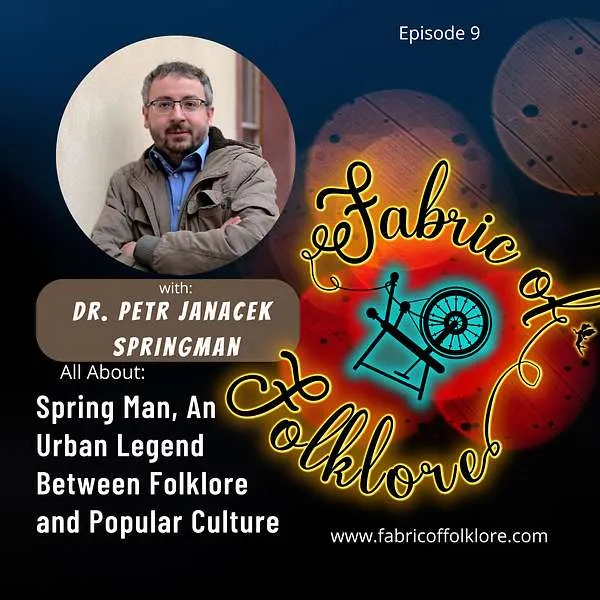
Ep 9 The Springman With Petr Janeček
Have you heard of The Springman? At one point this legendary character was more popular than Jack the Ripper. Also called Spring-Heeled Jack, this urban legend was sometimes a villan, sometimes a ghost and sometimes a super hero. It all depended on what country, the story was being told. Our guest, Dr. Petr Janacek, is […]
The post Ep 9 The Springman With Petr Janeček appeared first on Fabric of Folklore.
Follow us:
Fabric of Folklore website
00:00:23:12 – 00:00:53:10
Speaker 1
Welcome, folksy folks. This is a fabric of folklore, and I am your host, Vanessa y Rogers. And we explore on this podcast all of folklore. So not just the folk tales, not just the stories, but the the rituals, the customs, the traditions. And in my opinion, it is really important to understand folklore because it helps to connect us to one another.
00:00:53:24 – 00:01:23:03
Speaker 1
We learn about the wisdoms of cultures close and far, and and we are better able to understand one another and ourselves. And we’re putting on culturally tinted glasses of for which to view the world through different histories and presence. Folklore isn’t just interesting. It inspires and connects us to our own history as well as others. It is important and that’s why I love doing this podcast and I hope you will love it too.
00:01:23:12 – 00:01:53:21
Speaker 1
And of course we hope that you tell your friends so today we have a really incredible show and it’s all about exploring a well known urban legend on a European continent, spring man, and also spring Heeled Jack. And it’s representations, evolutions and cultural significance for the time. Our guest is Dr. Petter Janacek. Is that correct? Okay. He is an ethnologist and folklorist.
00:01:54:12 – 00:02:32:03
Speaker 1
He’s the deputy director of the Institute of Ethnology and Faculty of Arts at Charles University, and his research focuses on modern narrative folklore, such as rumors, urban legends, antidotes and comparative folklore, which is really what we’re going to be focusing on today. And his most recent book, Spring Man and Urban Legend. Between Folklore and Popular Culture, which was translated into English in 2021 foot, the original book was published in 2010, and what language was it?
00:02:33:12 – 00:02:38:11
Speaker 1
One in Czech and so thank you so much for joining us today.
00:02:39:17 – 00:02:43:02
Speaker 2
Thank you for inviting me to this incredible show. Thank you.
00:02:43:25 – 00:02:53:26
Speaker 1
And so let’s start off a little bit with your journey into this field. How did you get into ethnology and folklore? What brought you to this field?
00:02:54:22 – 00:03:21:12
Speaker 2
I’m from Prague, which is today, capital of Czech Republic, or Czechia, which is like bordering Germany and Poland. And it’s it was always a for a folktale. So I grew up with folk tales, but not the full folkloric ones, but but with nuance. And my father, he was working in a space industry, a Soviet spy in the big tent, and hee hee hee hee.
00:03:21:14 – 00:03:43:27
Speaker 2
I mean many photos, but also Edgar Allan Poe when I was like five or six years old. So it was a little bit weird. Maybe these these scary stories by Edgar Allan Poe. And later I become a big fan of Jonathan Taylor, Tolkien, Lord of the Rings, and The Hobbit. When I was a teenager. It was a big thing in my in my camp in the early nineties.
00:03:43:27 – 00:04:14:15
Speaker 2
And later I went into a whole lot for Lovecraft and the call of Catullus and all this or this horror and part of it, yeah, I was Lovecraft and then basically when I finished high school I wanted to study something similar to this. What is it like horror, mythology, fantasy? And we have a field called ethnology, which is called folklore or folklore sticks in the U.S., which I ended up there basically.
00:04:14:15 – 00:04:24:16
Speaker 1
So can you explain with what an ethnologist does or a folklorist? As in, is there a difference? And how how do they work together? What is what does that look like?
00:04:25:11 – 00:04:49:02
Speaker 2
Actually, a ethnology is something bordering folklore or folklore studies on the one hand, and topology on the other hand. So it’s a little bit fuzzy because in Europe you can say ethnology. I metallurgist and I’m studying folklore in the U.S. I would be folklorist in Canada also it’s a little bit messy, but basically at large it’s a little bit broader.
00:04:49:03 – 00:05:10:26
Speaker 2
And folklore studies, okay, it’s closer to anthropology studies of different cultures and different worldviews. But I think it’s it’s it’s not important. It’s labile, you know, So you can we can stick with folklore because it’s more international and basically you can translate ethnology as folklore or folklore studies of politics.
00:05:11:08 – 00:05:19:24
Speaker 1
Okay. Okay. That’s good, because it’s not it’s not a term that I was very familiar with before. So I was always really curious.
00:05:20:13 – 00:05:28:19
Speaker 2
It’s kind of European kind of survival. I believe they are, because I think at international level it should be called folklore.
00:05:29:10 – 00:05:52:14
Speaker 1
Okay. Can you put on your storytelling hat, if you will, and tell us the story of Spring Man or Spring Heeled? Jack, I’m not familiar with it over here on the the American continent. I’m not really familiar with the story. I think it’s much more common over there. So can you give us that? Yeah.
00:05:52:26 – 00:06:23:29
Speaker 2
Let’s start with Springfield. Jack. Okay. Much more important story. It starts in London on the outskirts of London, in England in early 19th century and basically around 1837, 1938, people started to tell stories about some mysterious urban phantom. Some some people tell it it was a ghost. Some people describe him as a criminal. Some real guy was attacking people.
00:06:24:07 – 00:06:51:05
Speaker 2
And the most most common trait of this mysterious urban, urban ghost or phantom was that it was jumping really high. He was he was jumping across fences, across even houses. And it was big. We can label it to buy. To date, that moral panic newspaper was why I didn’t go on it. And he was super popular, much more popular then than Jack the Ripper, for example.
00:06:51:09 – 00:07:13:26
Speaker 2
He was much later, but this being the logic it was, he started in so a piece of the 19th century in London, but he was popular all over the England, also in the Wales and Scotland. People are very afraid of this Springfield, Jack. And there was some kind of popular literature called Penny Dreadful maybe, you know, the series, the TV series, Penny Dreadful.
00:07:14:20 – 00:07:33:07
Speaker 2
And but there was also some kind of cheap print literature for basically working class. Some amazing stories later, it would be labeled as Pulp Fiction then in the US, but it was called Penny Dreadful because one one penny, it cost one penny and it was sort of the Athens oh of choice.
00:07:33:26 – 00:07:34:07
Speaker 1
Dreadful.
00:07:34:07 – 00:07:57:03
Speaker 2
Okay yeah yeah I it had full and he was in this this kind of media he was in in to dress well he was really big later there was other other phantom similar to him. Sweeney Todd maybe was in the movie. Some people saw the movie with Johnny Depp and a musical, Sweeney Todd both later and Jude and later the group.
00:07:57:20 – 00:08:10:18
Speaker 2
And but before Sweeney Todd and Jack the Ripper appeared in the end of the 19th century, there was basically an album of Springfield, Jack, and somehow we were supposed to go from there.
00:08:10:25 – 00:08:17:27
Speaker 1
It got it went Spink, Springfield, Jack and then Sweeney Todd and then Jack the Ripper. That’s the order in which they.
00:08:17:27 – 00:08:56:18
Speaker 2
Yeah, yeah, yeah, yeah, yeah. But somehow Sweeney Todd became like, immortalized by this musical and by this movie. Judas Priest is super alive even now. So it’s. But Springfield became somehow, somehow forgotten. He was basically I think it was much bigger thing back then and among not just the working class but older people and basically his stories about him stopped to stop to be disseminated in the beginning of the 20th century, before the First World War, before the World War One.
00:08:56:18 – 00:09:25:04
Speaker 2
Basically he disappeared and the Ripper stories remained, and Sweeney Todd stories remain. And he became a topic of like 14 researchers, people who were in this investigate the UFO, these paranormal phenomena in the seventies. So so he’s always second seventies and that’s it basically are now DA several books about on him Carl Bell he’s a historian cultural historian from UK.
00:09:25:04 – 00:09:46:21
Speaker 2
He wrote a book called The Legend of the Springfield Chick. So you can you can enable him. Now we have now some short movies and so on. So he’s little bit like, Oh, emerging again. Yeah, but basically so Springfield Jack is jumping phantom UK 19th century really British thing which was forgotten.
00:09:46:25 – 00:09:50:05
Speaker 1
And did he was he a serial killer like Jack the Ripper or.
00:09:50:05 – 00:10:20:16
Speaker 2
Oh no no, no. He was just assaulting people, especially women. There was something. Yeah, it was. He never killed anyone except fiction, but he was just, just basically gazing people and mugging people. Maybe some several muggings have been conflated in this fiction. And also not just single person, but like theories and conspiracy theories. There are some some, for example, very important people like nobles aristocrats posing as big deal, Jack.
00:10:20:16 – 00:10:53:18
Speaker 2
But it’s been made mysterious. Most of it was folklore, but just theories, just rumors, urban legend, even song and so on. And so, yeah, I and my book basically moved from the UK to the continent to the European continent because I discovered that there were similar stories also in other parts of Europe, not just the UK. And there had been much later there basically in the 20th century between the wars and and especially during the Second World War.
00:10:53:18 – 00:10:57:05
Speaker 1
Okay, so what did it look like in Europe? Did it did it change?
00:10:57:18 – 00:11:03:00
Speaker 2
Yeah, it changed a lot. Basically. Uh, I can show you map possibly is possible.
00:11:03:00 – 00:11:03:10
Speaker 1
Yeah.
00:11:03:24 – 00:11:04:13
Speaker 2
Okay.
00:11:04:21 – 00:11:14:04
Speaker 1
And we can put this map up for those who aren’t watching on YouTube, for those who were just listening will put the map up on our website. W w w fabric of folklore.
00:11:14:04 – 00:11:20:16
Speaker 2
Become okay. And you see it.
00:11:20:16 – 00:11:24:23
Speaker 1
Let’s see if we can add stream.
00:11:24:23 – 00:12:09:21
Speaker 2
It’s it’s a map of Europe and later you can see England, Wales, Scotland, the British Isles. And there was this was also Adam of Springfield Jack in 19th century but similar similar phantoms appeared also in the continental Europe. You can enjoy the many gentleman’s days of touring here and Saxony in the Czech lands that I’m based in and near the park and Bratislava castles, but also in Eastern Europe, in Russia, in St Petersburg, which was capital of Russia back then in the Oblast region, which is a region between St Petersburg and Moscow and also in Odessa, which is now Ukraine.
00:12:10:01 – 00:12:17:06
Speaker 2
So basically some similar phantoms appeared also in Europe, let’s say Central and Eastern Europe.
00:12:17:25 – 00:12:30:21
Speaker 1
So you were naming what they were called. Are these these are cities, right? These are countries that were. And so what countries you said and Russia, Czech Republic.
00:12:30:21 – 00:12:31:23
Speaker 2
Yeah. And Germany.
00:12:32:04 – 00:12:33:11
Speaker 1
And Germany. Okay.
00:12:33:13 – 00:13:01:09
Speaker 2
Yeah, yeah, yeah. Possibly these stories could be possibly elsewhere. But I found on this street three, three countries you can go Ukraine because of this. I said, okay now so basically it’s more like Eastern Europe, it’s eastern part of Germany. It’s great mystery how these stories are traveled from England, to example, Russia. I, I, I think it’s quite interesting.
00:13:01:09 – 00:13:24:28
Speaker 2
I think these stories have been brought by British, British sailors because just after the first floor war, they there was the October, the Bolshevik, the communist revolution in Russia, and there was civil war in Russia. Our big troubles. And there were several, uh, several armies from Western Europe and England, said some of the ships, Navy ships to St Petersburg.
00:13:25:03 – 00:13:53:03
Speaker 2
So possibly some of these sailors bawdy stories from England. The most boring joke to ask because the oldest stories that are in St Petersburg, which is the more the big port and also in Odessa, it’s it’s now in the Ukraine. It’s also a big part. Leibniz When these Western European armies participating in action, civil war all ended. So this is one of the possible routes how these stories spread to Russia.
00:13:53:03 – 00:13:56:02
Speaker 2
But it still remained a mystery. We don’t know, you know.
00:13:56:12 – 00:13:59:01
Speaker 1
And what does it look like in Russia? What does the story look like?
00:13:59:21 – 00:14:11:04
Speaker 2
Actually, I will show you different picture because, you know, it’s quite weird. They have this Springfield Chicken Museum. Really?
00:14:11:14 – 00:14:12:03
Speaker 1
Wow.
00:14:12:18 – 00:14:24:25
Speaker 2
So I will try to show you the picture. Okay. Yeah. And you see it.
00:14:24:25 – 00:14:44:26
Speaker 1
Yeah. So I’m I’m just going to describe it some I’m looking at a picture I with is a black and white picture and it looks like a phantom is kind of flying off into outer space and there’s two mannequins in front of the picture.
00:14:45:05 – 00:15:13:28
Speaker 2
Yeah, Yeah. Actually, it’s from the Museum of Russian and Soviet Police in St Petersburg, so it could be taken on in black and white. So sorry for it. As this is due to mannequins or figurines representing how sporting logic look in Russia in twenties doing it actual Russian civil war. Basically in Russia it wasn’t really folklore. They were real people who use this folklore, these stories about being used to scare people and to help people.
00:15:14:20 – 00:15:40:06
Speaker 2
Basically, they must have only gangs of young people. I would like to show you in the sky view the other picture after the Bolshevik Revolution, there was big scarcity of food and there was big criminality, a lot of crime in the streets and a lot of gangs, especially young people. It’ll being just people on the streets. And some of some of these gangs put an interesting idea to death as this kind of ghost as being guilt.
00:15:40:06 – 00:16:16:09
Speaker 2
Jack. So they put a sort of black black paint on their on their face. I can see it on the mannequins or black on their faces. They’ve lost some kind of shrouds like that. People positively they roamed around cemeteries, especially the five big cemeteries in the St Petersburg. And they they waited for superstitious people, peasants, people from the countryside who went to this big city and basically this gave them a living death or on death as this kind of.
00:16:16:13 – 00:16:34:23
Speaker 2
So in Russia it was a little bit different just playing music they call it Brigadoon cheeky. In Russian it means like lipase, possibly some someone who reaps paprika when chicken. They’re very guarded, mostly in folklore, as undead as ghosts are living that. Yeah.
00:16:35:05 – 00:16:39:14
Speaker 1
And then these peasants that they would scare were they taking their money or.
00:16:40:00 – 00:17:07:24
Speaker 2
Are they they taken money or valuables and anything And it seems it was all U.S. think because some of these people were captured. So in this it is very difficult. It historical situation. Some people use folklore actually to commit the crimes. It’s very it’s very bad picture but behind the mannequins there is some small painting which shows some to scared peasants on the street.
00:17:07:29 – 00:17:40:17
Speaker 2
And these this this disguised people jumping out. In Russia there have been also folk songs about this despite frequent chickadees spring you’ll check. I will show you the other picture. Yeah because it it in twenties it became kind of problem not in Saint Petersburg but also in Odessa in other parts city. So basically the police stepped in and according to the Russian sources, I’m not sure if they captured some of these people.
00:17:40:17 – 00:17:52:05
Speaker 2
So I’m showing the picture of this one, one of these gangs using these folklore stories about jumping ship yachts, being jacket. So if you if you want to describe it.
00:17:53:02 – 00:17:55:13
Speaker 1
So this is this is a gang that I’m looking at.
00:17:56:01 – 00:18:03:17
Speaker 2
Yeah. Yeah. Actually this people bought this photo after after this gang was captured. It was very young people actually.
00:18:04:07 – 00:18:16:00
Speaker 1
Yeah. So it’s not what I would imagine as a gang. It’s let’s see, there’s about ten people in the picture. They’re all young boys. Are they all boys?
00:18:16:14 – 00:18:19:10
Speaker 2
Yeah. Yeah, boys. And in the front there are some girls.
00:18:19:10 – 00:18:47:29
Speaker 1
They very they all look cold. They’re all very, very heavy jackets and hats or scarves around their head. And there’s, they’re sitting as if for a portrait. So it doesn’t, it doesn’t really look like what you would think of as a mug shot or anything. But they all look, I mean, like adolescent to young teenager.
00:18:48:15 – 00:19:10:17
Speaker 2
Yeah, I’m not sure about the age because the police record doesn’t doesn’t record of age, but I think it would be like teen age is like 15, 16, 17. The leader of the gang was the tallest guy, Ivan Gallegos. Then he has a nickname in Russian Vine casually troop. It means Veronica believing that Ivan delivering that.
00:19:10:17 – 00:19:11:28
Speaker 1
Yeah so wow.
00:19:12:20 – 00:19:34:24
Speaker 2
And yeah it doesn’t look like mug shot because you know it was they may have been kids but they stole a lot that they the police found it found about I don’t know, like 100 fur coats coats from or many, many jewelry, a lot of jewelry and so on. But I think the main reason most which they are a scarcity of food, it was not like criminals.
00:19:34:24 – 00:19:40:11
Speaker 2
They just wanted money to to to live basically and established times which.
00:19:40:13 – 00:19:40:19
Speaker 1
Just.
00:19:41:05 – 00:20:03:21
Speaker 2
Possibly street kids and but they committed committed some some tough crimes possibly because the leader even ball goes and was shot and his aide had their medals they had been shot. Most of them have been sent to two working labor camps in Siberia. Good luck. And most of them returned after few years.
00:20:03:21 – 00:20:05:01
Speaker 1
So they did.
00:20:05:16 – 00:20:33:08
Speaker 2
Yeah, they did, actually. To the girl in the middle. It’s it’s it was lover of the lead didn’t even Margot’s in it and she was later conductor and conductor in Saint Petersburg. Also she left lifted a very great age so so it also episode in their life possible possibly. But it’s interesting how they used folklore or superstitions about living that to scare people and to commit crimes.
00:20:33:09 – 00:20:35:03
Speaker 1
It’s quite smart actually the.
00:20:35:14 – 00:20:35:20
Speaker 2
Yeah.
00:20:36:09 – 00:20:41:01
Speaker 1
I’m not I’m not condoning crime, but that is a very smart way of doing that.
00:20:41:18 – 00:21:03:22
Speaker 2
Yeah, but I think they didn’t have anyone out. They didn’t even have guns or knives, anything. So but, but, you know, after the Civil War that the Soviet Communist force was really high. So they shot shot two of them for for warning, possibly. But I think they had been mostly street kids just just taking a risk and trying to survive in this very difficult times.
00:21:04:24 – 00:21:08:02
Speaker 1
So can you tell us about what it looked like in in some other countries?
00:21:08:15 – 00:21:43:24
Speaker 2
Yeah. So we can move to Germany. I don’t have a picture, but in Germany destroyed have been much later after the Second World War in the fifties. Okay. And fifties it was in eastern Germany, region of India and Saxony and we don’t know how they looked like. The white color is very prominent in Russia, but these German ghosts were much more aggressive.
00:21:44:12 – 00:22:06:27
Speaker 2
The main main topic of team of these stories have been their assaulting women, even sexually assaulting women, and then using knives or razor blades or razors. Some people said to have razors on their gloves, on their hands. Everyone is a blade close. It’s it it’s it was it wasn’t like that. It was also a whispering logic in the UK.
00:22:07:08 – 00:22:38:06
Speaker 2
And it was very brief period in the early fifties due during so-called also very troubled times. It’s interesting. These stories are usually restored to doing some historical table times in in UK it was industrial revolution. People from the countryside were moving to the cities. It was very hard working conditions for these people during this very harsh capital stage of capitalism in the 19th century.
00:22:38:12 – 00:23:07:00
Speaker 2
And some people brought possibly their ghost stories to the city. In Russia, it was it was communist revolution, civil war, very hot of times. In Germany fifties the Second World War ended. Everything was an era when there was a lot of man death because of the war or they were prisoners in Russia or so on. It’s where a lot of women, single women or women living alone in the countryside, which we try to vulnerable.
00:23:07:22 – 00:23:37:25
Speaker 2
And suddenly the Soviets, because the Soviet Russians occupied this part of Germany in the fifties, also called Eastern Germany, it belonged to the Soviet bloc and suddenly the Soviet discovered the uranium that in this mountain region, uranium you make, you make a nukes, a bomb of uranium, basically. That’s why they wanted my country and also this part of Germany, because there was no uranium in Soviet Union at the time.
00:23:38:02 – 00:24:28:28
Speaker 2
So if they wanted to have nukes, they need Czechoslovakia, which republic, and just part of Germany, because we there was we, we knew that there was uranium deposits since the late, early modern times. They didn’t know how to make nukes, but they use it for for, I don’t know, something for medical medicine. Okay, so uranium so and so we had Soviet industry ordered thousands of people moved to this mountain region, isolated mountain regions, mostly villages, not so many men there and people from all around Germany, but also from Russia and other parts of Europe came into to to mine this uranium fodder for the Soviet war industry.
00:24:29:05 – 00:24:55:07
Speaker 2
So and then you can imagine there were a lot of people from different countries, most possibly not speaking German or not speaking local dialect of German. Yeah, they got really good money for mining uranium, so they go down and they can attack someone. So in this in this atmosphere, these stories about spying, you Jake some jumping phantom attacking people appeared in the fifties.
00:24:55:07 – 00:25:09:25
Speaker 2
Yeah so it was really brief period like five years and then this uranium fever. This uranium fever and it ended also. So it’s it’s connected with this forgotten period of German postwar history, let’s say.
00:25:10:05 – 00:25:14:16
Speaker 1
And and we think it came from Russia at that point. Is that where we were thinking.
00:25:15:16 – 00:25:54:11
Speaker 2
That’s what we do now? I think it’s a actually it came from my country, from Czech Republic or Czechia or ideological Slavic. I back then, because stories these stories were really popular in Czechia during the war. During the war and after the war, many German speaking people were forcefully expelled from my country and also from Poland. It was political decision, decision by the allies, by the winning, winning nations to move German speaking people, including my some of my ancestors actually from these Eastern European countries to Germany.
00:25:54:11 – 00:26:23:18
Speaker 2
So I think this gentleman speaking, people from my country went to Germany, from from Czechia, brought these stories because it was five. But but how these stories came from Russia to my country, I don’t know. I think I think in my country this these stories appeared actually in the same around the same time as in Russia. After the First World War.
00:26:23:25 – 00:26:51:29
Speaker 2
So I think there was also, like the British connection somehow, because there were some people working in in the UK or or maybe more possibly its wartime experience in war, in trenches in this in this no man’s land. People from various nations and countries met during the First World War. And I think this was there was a lot of talk, a lot of going on actually in the trenches.
00:26:51:29 – 00:26:59:03
Speaker 2
So this wartime experience possibly brought this to my country and possible. Was that possibly Russia? Yes.
00:26:59:11 – 00:27:06:28
Speaker 1
So is there more folklore that happens during traumatic times? It seems like there seems to be this theme throughout your research.
00:27:07:07 – 00:27:29:04
Speaker 2
Yeah, definitely. Definitely. Because in my country, most of these stories were told during the Second World War, during the German occupation. Do not the occupation of my country now. And if you ask almost anyone in part or my country about this spring, you’ll go to spring. A man we call him Barrack means being a man in my language.
00:27:29:10 – 00:27:50:01
Speaker 2
And what is it? Okay, It’s it was during the Second World War and it’s a and it’s interesting in my country he’s these stories are not regarded as like ghost stories. But now this man is regarded as first Czech superhero like Batman of Superman and.
00:27:50:02 – 00:27:57:25
Speaker 1
Now why was he or was he a villain or was he doing good like a Robin Hood?
00:27:58:07 – 00:28:28:02
Speaker 2
Actually, I was actually, you have to distinguish between folklore of the period and popular culture. Now, we have, like, I don’t know, two movies, several cartoons, several comic books, graphic novels. And he’s fighting the Nazis. Actually, they made a cartoon, a very nice cartoon called Spying Man and the SS, our Spying men under SS in 1946, just one year after the war.
00:28:28:15 – 00:28:53:21
Speaker 2
It was it was made by you see Tank. It was it was called Walt Disney of the East. Yeah. He was doing cartoons and he was like, more like more arty movies. But he was really popular in Europe back then and he mood is very sharp. It’s nice. You can watch it on YouTube, I believe Spiderman of Barrack and the SS and it’s about it’s about a cartoon in a little bit in Walt Disney style.
00:28:54:00 – 00:29:02:28
Speaker 2
Uh, and it’s about a chimney sweeper and a chimney sweeper in Prague. And he starts to fight the Nazis and the collaborators are Nazis.
00:29:03:24 – 00:29:05:29
Speaker 1
So he was good. I mean, he.
00:29:06:09 – 00:29:35:17
Speaker 2
In this movie, in that movie, but this movie became really popular. And after that, many novels and comic books and cartoons appeared. But I looked into the memories of people really remember these stories from the Second World War. There are not many of them left, but few years ago we have many people who remember it. And let’s say 70, 80% of these stories where we have been afraid, very afraid of this man.
00:29:36:13 – 00:29:41:18
Speaker 1
And also he’s been involved for for film to be a good guy rather than a criminal.
00:29:41:25 – 00:30:09:29
Speaker 2
Yeah. Yeah. Actually I think this idea yeah it popular culture to this yeah you will something now he’s very popular he’s like Batman like like Nocturnal Avenger of the metropolis. He’s like Spiderman. He’s jumping and. But, uh, I think this idea came from, you know, it was. It was this. My country was occupied by the Nazis. There was quite a few blackouts.
00:30:09:29 – 00:30:34:27
Speaker 2
There was no freedom. But suddenly stories about some guy or a ghost was roaming freely while jumping around. He. He was dangerous. He could attack you, but somehow an artist couldn’t stop him. Yeah, I think people made a connection in this. In this period of. Of of oppression and oppression of the Nazi occupation based on one was really flee.
00:30:34:27 – 00:31:16:24
Speaker 2
He can move anywhere. The Gestapo an SS couldn’t stop him. And from this came the idea. Okay, maybe he’s fighting them. Maybe they’re chasing him and he’s dangerous. Yeah, you should avoid him. I can attack you. But he’s really torn into side for the occupation forces. So especially in the late, later part of the war. Uh, uh, when, uh, when the uprising against the occupation forces started in Prague in May 1945, people really started to to portray him as some kind of partizan or assistant fighter, but it was minority.
00:31:17:11 – 00:31:29:16
Speaker 2
So there is one speaking man in popular culture. It’s a first Czech superhero, actually, a few few years before the first super alert, a Superman. Superman appearing.
00:31:29:17 – 00:31:30:00
Speaker 1
Well.
00:31:30:17 – 00:31:58:15
Speaker 2
Superman, I believe, was created in 1938 and Czech Spring Man appeared in 1919 after the First World War. And if you go to the to the UK, to your jackets even 100 years before so so does my country. And basically I was drawn in to this because my late mother taught me a lot about this spring, man, because he she remember the war.
00:31:59:03 – 00:32:27:10
Speaker 2
She was like 17, 18 during the end of the war. Yeah, she was from the baker’s family in the, in the like the mountain region in the countryside. They have a bakery. But in the end of the war, even so, even a very young girls have to work in the Nazi war industry at 17. So she she was forced to move to some nearby city.
00:32:27:10 – 00:32:28:09
Speaker 2
There was a factory.
00:32:30:09 – 00:32:58:10
Speaker 2
I don’t know where they did some kind of some kind of fuel for bombs, for fire. And she was she wasn’t she was 17. She was living there in big rooms with like, I don’t know, 20 other girls of the similar age, 15 to 20. They were allowed to go home only if only during the weekends. And she she and they talk a lot about displaying them and that early fire these girls because they’ve been there alone.
00:32:58:20 – 00:33:23:29
Speaker 2
And she always told me stories about about spring when she was more on the superhero side actually she said okay he was dangerous maybe, but we were really, really, really thinking he was really fighting the Nazis because we cannot we are just the girls, 16 years old and so on. And she was very clever. She knew it was folklore.
00:33:24:12 – 00:33:51:11
Speaker 2
She knew that that, that, that it wasn’t possible because there were stories that he could jump really high. Not jump not jump over the fences, but over the course, even tramps and bosses, even big houses. And she always said, okay, it’s it’s it’s just stories. It wasn’t possible, but she always said, I think there was some kind of technical intervention, which people are really clever.
00:33:51:11 – 00:34:25:04
Speaker 2
She said. So maybe someone in someone created some jumping device, maybe jump one, I don’t know, few inches or or two meters, possibly. People just just exaggerate that they are people made my this is jumping over. How is it? So she believes it’s also evil it was some people would do jumping and but the rest of the stories like these fighting Nazis it was folklore but still you can meet very old people in my country will remember this and they swear it was real.
00:34:25:22 – 00:34:31:08
Speaker 2
This guy existed. He invited Nazis, but we have no proofs now.
00:34:32:03 – 00:34:54:24
Speaker 1
It’s so you don’t think that something similar was happening in your country as in Russia, where someone was trying to emulate a like the gangs were pretending to be the dead? Was anything like that happening where you where your grandmother was as well, do you think or do you think that it was just a story that was passed?
00:34:55:21 – 00:35:22:09
Speaker 2
A very good Western? Actually, I think it’s not possible because in Russia, you know, there was nobody there was civil war and there were a lot of street crime. And during the Nazi occupation, actually, there was very actually it was lowest crime record in history because there was Gestapo, the Nazi secret police people are really afraid as and and if you commit any crime, it will be very hot if you will, you get shot or you get to the concentration camp.
00:35:22:09 – 00:35:51:15
Speaker 2
So it’s not possible. It’s impossible. I also checked Czech police records from that period. I also checked Nazi Secret Service records because because they monitored rumors and stories. Which are people talking? No, it was pure fabrication. It was beyond their level of recognition. It was just stories. But it was very important for these people because it was some kind of hope in these bleak times.
00:35:51:20 – 00:35:58:03
Speaker 1
Yeah. I was going to ask, was there a psychological need to create these stories to have something else to focus on?
00:35:58:26 – 00:36:17:22
Speaker 2
Yeah. Yeah, it was, especially during the last few weeks of the war, it was really helpful. And there was even something like Masses to area people there of, I don’t know, interested in some in some public place square and some unsheltered explained man, it’s over here. He’s fighting the Nazis and people just turn around and it was like mass hysteria.
00:36:17:28 – 00:36:44:27
Speaker 2
Nobody saw anything. It was maybe they saw some moving shadow and something, but it was it was important it was also important psychologically because it gave people hope. I’m not I’m not able to fight Nazis. Too many of them. There may be people fighting, not the Nazis, the resistance and the partizans in the woods. Yeah, but it was hard for many people, for ordinary people to do it.
00:36:44:27 – 00:37:14:09
Speaker 2
It was. And this pain, guilt spring to mind was some kind of psychological, maybe safety, while for my comrades how to get out of steam. Because you can joke publicly and the time tell jokes about Adolf Hitler or Nazis. Yeah right. But it seems talking about spraying men was allowed in pubs, cafes. Somehow the Nazis think it’s okay.
00:37:14:14 – 00:37:37:18
Speaker 2
Oh, maybe they didn’t understand it. They wrote in the newspapers about this during the war. Also, they also like Nazis and the ship, and they wrote about it. So it was really important. But they wrote about it jokingly. But some superstitious people believe in jumping guy and it was some kind of like, funny stories or local stories after the war.
00:37:37:18 – 00:37:42:07
Speaker 1
These these stories during the writing. Is it the Nazis that are doing the right? No, no, no.
00:37:42:26 – 00:38:14:03
Speaker 2
Local writers, Czech writers, especially the sci fi, the sci fi writers of that of that of the time. And it was censored. They put in, for example, that old that is it’s sad this guy is displaying man is fighting the police or the army. But it got out in newspapers. It didn’t work out. And so but it was important because in that three so most important nationwide newspapers they run a topic on on the spying man.
00:38:14:07 – 00:38:28:06
Speaker 2
But as a joke, some kind of funny stories in this modern age. Some people believe in this nonsense, but actually thousands of people, maybe tens of thousands of people, maybe even more believe in that nonsense.
00:38:28:27 – 00:38:31:03
Speaker 1
Or they wanted to believe. And so they you know.
00:38:31:24 – 00:38:33:00
Speaker 2
They wanted to believe. Yeah. Yeah.
00:38:33:14 – 00:38:38:26
Speaker 1
But in your description, it also said it made its way to the United States. How did how did that.
00:38:40:14 – 00:39:14:12
Speaker 2
Yeah it’s I’m not sure about it’s called the Baltimore Phantom in Baltimore and it was a brief period of activity of I think this this was some prankster, some old guy who know the original British stories about spring music and Scarface and I think there was some cult, some in Massachusetts somewhere in some city there was a phantom called a Black Flash around his period in forties and it was like a local, just single city, single person few weeks or a few days.
00:39:14:20 – 00:39:22:02
Speaker 2
So it made its way to the United States, but it was evidently the British connection.
00:39:22:17 – 00:39:24:27
Speaker 1
Okay. But it was very small and it didn’t last very long.
00:39:24:27 – 00:39:33:17
Speaker 2
Yeah, yeah, it was very small. But I think the latest, because I have to say it, iteration of this object was was in India in Delhi. Don’t.
00:39:33:21 – 00:39:36:23
Speaker 1
Oh why. Well actually in Delhi.
00:39:36:27 – 00:40:04:02
Speaker 2
Yeah it was maybe the old maybe possibly also British connection but very late 2001 I believe in Delhi there was a mass hysteria about so-called monkey man. Monkey man. They call him Monkey man. And there was public hysteria about some jumping phantom in the streets of Delhi in some one specific district. And the difference is that the guy looks like monkey.
00:40:04:14 – 00:40:30:27
Speaker 2
So it wasn’t ghost or. Oh, and I found even some Indian psychologists and psychiatrist wrote about this as a prime example of more than mass hysteria. So but I think the core is not history, it’s folklore. It’s these stories about jumping ghost or jumping Phantom. They just lay blame monkey man, right? They even had a local name in the Indian language.
00:40:30:27 – 00:40:55:04
Speaker 2
In the Hindi language. I don’t know it now, but. But it was 20 years ago. It’s possible. It’s a bit repeated elsewhere because I one student, she did the fieldwork in Indonesia, in the Pacific, and they have they have also these stories about jumping ghosts, attacking people. It’s connected with the tourists from Europe or U.S. or Australia.
00:40:55:04 – 00:41:02:03
Speaker 1
Oh, so the the monkey man or the jumping man is attacking tourism or tourist? No, no, no.
00:41:02:16 – 00:41:38:03
Speaker 2
They are tourists. Are these these monkey monuments, you know, Oh, people don’t come to us. So maybe it’s, um, maybe it’s some maybe for a critique of colonization or post colonization and kind of. Yeah. And it’s very it’s very it’s actually it’s very elaborate. In Indonesia, they have stories that these, these jumping ghost are killing people and extracting their blood to fuel batteries, to fuel batteries for, I don’t know, come at us and so on.
00:41:38:03 – 00:42:07:08
Speaker 2
So it’s like really bizarre and but it’s it’s it somehow it’s in every country and every nation is little bit different but the quality mean the same it’s usually real people a little guy jumping and doing something. Yeah during the troubled times he cannot be caught. And in my garden this fight is fighting the Nazis. He says it’s don’t fight or Superman in Russia, it’s some kind of criminal activity.
00:42:07:19 – 00:42:17:03
Speaker 2
In Germany, it was also criminal. And the original Springfields in the UK, it was very multifaceted. It has many, many, many versions.
00:42:17:17 – 00:42:34:09
Speaker 1
So you originally heard about it from your grandmother. What was the impetus for you to really focus in on your research on this particular story? Why? Why did you want to shine a light on him?
00:42:34:09 – 00:42:58:24
Speaker 2
Yeah, maybe when I’m singing about it now, maybe it was one of the reason I went into the folklore out study of folklore, because it was because she believed in it. But it was clear to me that it’s it’s. It couldn’t exist. And I discovered some comic books about this man. And I always to do it. When I was a kid, I always wanted to read a book on Spaceman because.
00:42:58:26 – 00:43:08:11
Speaker 2
Well, yeah, because, you know, first superhero, scholarly book, academic book. Yeah. So did he really exist or is just fabrication?
00:43:08:17 – 00:43:14:15
Speaker 1
And maybe you need to make a companion comic book. And here you for your academic book.
00:43:14:27 – 00:43:47:21
Speaker 2
Yeah, I saw that there are several comic books and several movies. Yeah. So it’s, it’s done actually about Oh, great. But when I was when I was in the high school at the university, actually at the university, I just go there’s not no such book. Yeah. There was some research in sixties on this by folklorist there was Milosh Blatz, he was folklorist also in part, and he did some research on this, but it was stopped because my country was invaded again by the Nazis, by the Soviet Union in 1968.
00:43:48:19 – 00:44:14:10
Speaker 2
And the Soviets stopped this kind of research on folklore, especially modern folklore, because I don’t know why I think it would be very, very good for Soviets. You know, it was I think, the Nazis, not the Soviets, but actually the Soviets as well. When the Soviets invaded back in 1968, during the so-called Prague Spring, so old cartoons appeared, which depicted spring when battling the Soviets.
00:44:14:25 – 00:44:37:28
Speaker 2
Oh, wow, they’re destroying Russian tanks and so on. So maybe that was the reason why this research was top down, because actually, yeah, because he was the resistance fighter in doing this time cell. So that’s Yeah that’s, that’s, that’s, that’s great. It should be better book. But many people helped me a lot. Yeah. And I know Hallberg he’s my colleague from Germany.
00:44:38:03 – 00:45:16:05
Speaker 2
I knew nothing about his German visions and he contacted me because he, he knew my previous book, which was published in Czech, and he contacted me because he’s he’s a local collector of folklore in eastern Germany. And he independently discovered these stories. And also he didn’t know that it was in fact in Czech. Yeah. So we got connected and now and I also like them later, I met some colleagues from Russia who were not really interested in this because in Russia they don’t regard it as a folklore, they regard as a history because they have a religion which was cold, but they said, okay, it’s not folklore.
00:45:16:20 – 00:45:38:14
Speaker 2
We think it’s a folklore. It’s it’s real saying. It’s really historical. Yeah, but we can give you false give you a source just for this. And they’ve been very kind because it’s very tough in Russia, you know, especially now but even few years ago. But everybody kind even the police provided me these pictures. We have seen the beginning of this show so well.
00:45:38:23 – 00:46:00:04
Speaker 2
And it’s keep keep I it’s possible that that some are just playing my underwear in us but we don’t know now but it’s possible that many more instances of this we don’t know nothing about. For example fans from France could be connection between Eastern Europe and the UK. Possibly.
00:46:00:13 – 00:46:09:18
Speaker 1
But have you gotten have you been contacted by people after the book was published about other instances?
00:46:09:18 – 00:46:39:06
Speaker 2
Few people about the book was published, like in late December last year. So so several people, mostly for UK, contacted me. But I’m looking forward to people, for example, from Sweden, Europe, Italy or Spain or France, because I’m I’m sure it was that as well. It wasn’t just recorded by folklorist, it because even in the UK to Spanglish it wasn’t, it wasn’t regarded as folklore until seventies.
00:46:40:01 – 00:47:08:07
Speaker 2
It was some kind of hysteria or something this photo and rediscovered and now it’s now it’s folklore. Now there are two books on spring. You’ll get the UK that is also very nice book which is called The Law of the Land. The Law of the Land, which is basically a collection of England English legends written by two English folklorists, and its subtitle is called The Law of the Land.
00:47:08:07 – 00:47:35:05
Speaker 2
And the subtitle is from Spring Hill Jack to Witches of Wall Boys. I don’t know nothing about, which is a lot of boys on which is English. Richard But there’s music because it was subtitled. So now UK for boys regard this as very prime example of English legendary and folklore so much in Scotland or Wales, but it was much more in big industrial cities like London or Sheffield or Manchester.
00:47:35:15 – 00:47:44:11
Speaker 2
But it’s folklore and I hope. Even colleagues in Russia discover later that it’s folklore because I think it’s 4:00 in the car. It’s folklore.
00:47:45:18 – 00:48:01:00
Speaker 1
Now, how how were you able to do your research? You did some interviews of some of the older individuals and you contacted some other folklore. Was there any other sources that you used in order to get information for your book?
00:48:01:13 – 00:48:25:26
Speaker 2
Yeah, my student helped me a lot because I teach folklore courses at the university in Prague, so they helped me a lot. Talk made interviews by many old people. I also used media like the newspapers and social media, and these homes for retired people. Very helpful. Some people live in these these these patriarchate. It holds it’s very tight.
00:48:25:28 – 00:48:42:23
Speaker 2
People, elderly people. And they conducted some kind of, I would say, the communal interviews with many of them and many actually many people sent me letters. These old people reminded minded and it was usually okay it’s 70 or 80 years after the war.
00:48:43:02 – 00:48:43:14
Speaker 1
Right?
00:48:43:15 – 00:49:12:17
Speaker 2
And during the seventies and eighties, there was no single moment. I, I think about this particular moment. I think you completely forgot it. But when I asked them or they they see me on TV or something, they say, Oh, speaking about it was really important. It was really private. And they say it was really important. It was as important as Adolf Hitler and the Holocaust, and it was everywhere.
00:49:12:17 – 00:49:15:13
Speaker 2
Yeah, but somehow we forgotten after the war.
00:49:15:13 – 00:49:18:03
Speaker 1
How and it was important because it gave them hope.
00:49:18:21 – 00:49:47:07
Speaker 2
Yeah. Yeah. It’s interesting because people usually remember the bad things, you know? Right. And it was kind of good thing. But they, they, they remember and they told me very detailed stories exactly when and where they had stories about us being men and eventually like 7 to 8 years. So it was definitely very important for them. But it’s important to note most of them about teenagers, young people back then, right?
00:49:47:19 – 00:49:57:21
Speaker 2
Yeah, And most of them have been steady people. It was really open folklore. If you ask people in the countryside, in villages, they didn’t know, they don’t know nothing about it. Oh.
00:49:58:00 – 00:50:03:17
Speaker 1
It was I’m assuming the crime rate would be a lot lower in this in the rural areas and in the cities.
00:50:03:19 – 00:50:29:26
Speaker 2
Yeah. Yeah. And actually it was yeah, it was generally safer to be in the cities because in cities you have you had blackouts, you have got a few you can go out after the dark and there was also bombing, right? Yeah. So, so you had a fight. It was very tense of what happened there. And then maybe there’s a psychological reason because you are expecting some attack, but in countryside you have been safe.
00:50:29:26 – 00:50:57:00
Speaker 2
Basically, you have to openly fight the Nazis to have some some some taboo. So maybe that’s one of the reason. But this this pink and or spindle just are really industrial. It’s in the UK. In Britain originally what was IBM saying of up are bouncing around cities it’s connected with these fancy factories right. Really are they let out.
00:50:57:01 – 00:51:10:22
Speaker 2
It’s very important. Yeah. Yeah. Or viaducts or beaches. Yeah. So it was it’s very modern. It’s not a ghost in the graveyard of some some ghost in the woods. It’s really in the city intermingling with the people.
00:51:11:01 – 00:51:29:29
Speaker 1
And is that different than a lot of folklore because I imagine that a lot of legend would have come from the rural areas originally, but this one really is in the city. So is that a difference in that? You see that from other folklore stories?
00:51:30:05 – 00:52:04:10
Speaker 2
Yeah. Yeah. I think that’s one of the reason why my colleagues didn’t regard this folklore, because folklore for them is like these these real stories. But I think it’s a new strand of folklore or new evolution of folklore or generally it was possibly some ghost stories or some legends about some jumping ghost or demon. But in this, in this industrial media, in the cities, it became moralistic story about guy who put Spanx on his feet or some jumping device.
00:52:04:10 – 00:52:31:05
Speaker 2
Because for example, in my country it was a working class folklore. Everybody was working class folklore, and these people actually were not superstitious. Most of them, for example, even didn’t believe in God either. But I’ll tell you that in my country, many of them, and they said, okay, there is a jumping figure jumping around. They say, okay, it’s going to be ghost because ghosts are not to heal.
00:52:31:21 – 00:52:36:09
Speaker 2
So they just kept inking as an okay, it has to be mechanical. It’s mechanical.
00:52:36:13 – 00:52:38:12
Speaker 1
It’s they’re very logical about it.
00:52:38:12 – 00:52:52:21
Speaker 2
Yeah, yeah, it’s logical. And, and especially during the time doing the Second World War, these, these steel springs became quite a new technology used in cars for example. So they saw it in the factories, right.
00:52:52:23 – 00:52:53:08
Speaker 1
Yeah.
00:52:53:21 – 00:53:22:20
Speaker 2
Especially, you know, these steel springs now we can imagine so or something like that. But in the forties this was like I don’t know, nanotechnology or artificial intelligence. Now it was really super new technology and they were not really sure what it’s capable of. They, they put it into cars and tanks and so on and suddenly and they think, okay, so maybe someone invented some jumping device to jump really high.
00:53:23:01 – 00:53:41:10
Speaker 2
So now we have these jumping devices. Actually, we can use it for fun, but it right, it didn’t exist in the forties though. So I think it’s folklore or some kind of realistic folklore. In 19th century or before the industrial revolution, it would be ghostly or a legend.
00:53:41:22 – 00:54:07:17
Speaker 1
Whenever the folklorist that came on the show, Dr. Brunner, says that there’s always folklore that happens around new technology. And he told us stories specific to like the microwave oven and also the computer. And he said there’s always apprehension around new technology, which is why people often times will create folklore around these new things that they’re unfamiliar with.
00:54:08:10 – 00:54:54:00
Speaker 2
Yada, yada. A great idea by Simon Bowen. I remember the microwave stories. Now we have 5G and these kind of conspiracy theories and stories or cell phones out. So possibly the idea actually it is not my in my book, but I could consider it. I think it’s not. But I’m a source of these stories of people. They came from the UK but this new technology was of it and handsets kind of yeah so it’s because in every country it was different there in in Germany during the uranium fever they told the stories that these are these ghost jumping girls are glowing in the dark like radioactive.
00:54:54:04 – 00:54:54:20
Speaker 1
Wow.
00:54:55:15 – 00:55:20:01
Speaker 2
Yeah. But actually it was it was even even the UK, Spain, New Zealand. It was this guy Black Death. Yeah. And they discovered a phosphorous like fluorescent paint. Right. There’s some guy who painted himself to shine. So it was realistic. Even in 19th century, they didn’t say it’s from some kind of a, I don’t know, a ghost or something like that.
00:55:20:05 – 00:55:40:28
Speaker 2
It’s a real guy posing as ghost or flaming skeleton. It was very it was also in my country. The guy put the mask over the skeleton like a skull mask by fluorescent paint, shining paint, some kind of apes like a skeleton and attacking people. They also slowly. So it became uranium in the fifties.
00:55:41:02 – 00:55:41:27
Speaker 1
Yeah, right.
00:55:43:21 – 00:56:24:07
Speaker 2
But originally it was possibly somehow a fire or a fire from the budgetary or possibly the Catholic countries there. It was always a fire, but originally it was demonic or of hellfire. Later it became a fluorescent paint. More realistic. It’s not the ghost someone is posing as ghost scaring us and later became uranium possibly and so and but I actually a Columbine the same it’s some very really elemental kind of being which couldn’t be called it was moving really between jumping and even flying somehow you cannot gasp gas really.
00:56:24:16 – 00:56:29:03
Speaker 2
It’s something very elusive, actually.
00:56:29:03 – 00:56:38:27
Speaker 1
So we’re getting to the end of our time. Is there anything else about this, about your book that you feel is really important that we didn’t cover today?
00:56:38:27 – 00:56:42:11
Speaker 2
Possibly. I can show the cover of my book, if I may.
00:56:42:19 – 00:56:43:03
Speaker 1
Yeah.
00:56:43:24 – 00:56:57:27
Speaker 2
And I would be really glad if if some of these listeners are that spring when it’s my book in English. You can you can you can buy it anywhere. But if anyone knew something was.
00:56:57:27 – 00:56:59:01
Speaker 1
Going to link up for it.
00:56:59:20 – 00:57:36:16
Speaker 2
Yeah. If anyone knew any story about Spring Bend, I’ll speak live. Jack Spring music anywhere in the world, especially in the US and Canada. I will be really, really glad to hear it because there’s a lot of research to do and every single snippet or face even single mention is very, very important for this because there is a big book on International Spring Eagle Jack in preparation now, like, I don’t know, like five or six people involved, mostly UK people, but also me, some, some colleague from the Netherlands.
00:57:36:23 – 00:57:45:19
Speaker 2
So we are interested in these stories about jumping Ghost and Jumping phantoms all around the world. We found a monkey man in 2001. So.
00:57:46:13 – 00:57:48:11
Speaker 1
And why do you feel like this work is important?
00:57:50:01 – 00:58:21:21
Speaker 2
I think it’s important that because it showed it for boys in life. Even though spring music died out, he was being replaced by Jack the Ripper in popular consciousness and popular culture. But later it appeared in Russia in doing not the occupation in my country, in Germany 20 years ago in India. So it’s something which keeps returning somehow and we are really eager to to to know why, because, you know, it’s not really a good story, actually.
00:58:22:18 – 00:58:55:22
Speaker 2
This idea that some guy in an institute I’ve I something is jumping or possibly attacking people it could it became better story for example in Prague when he’s fighting the Nazis a superhero. Yeah but the real core narrative column this is not really interesting but somehow people found it interesting and make new new meaning for this so that’s that’s that’s that’s that’s fascinating because it’s not good timeless folktale like Cinderella or something like that.
00:58:55:22 – 00:59:17:21
Speaker 2
It has a clear heroine it’s it’s clear plot it Yeah but there’s this very kind of you cannot guess but they are it’s very strange very elusive now but somehow we still don’t know how people all around the world found it interesting and important, especially during the troubled times. I believe.
00:59:17:21 – 00:59:25:15
Speaker 1
So. And so your work is really in invested in trying to find the why to why these stories are continuing.
00:59:25:15 – 00:59:55:03
Speaker 2
Yeah, we know when possibly we know when when it started during the industrial revolution in in England in the 19th century. But why now do I. Because we are collaborating with psychologist and sociologist, for example, because doing double times like war or war or occupation or even that uranium fever, this story started to reappear. It gave people hope on one hand.
00:59:55:03 – 01:00:23:03
Speaker 2
On the other hand, they are really scary. So I think it would be very interesting to know what social function these stories have. And I people think that’s really important because every single one of my people I interviewed, they’re old people. But somehow it was they it was crystal clear that when they talk about this being human, some of them even describe him.
01:00:23:12 – 01:00:50:20
Speaker 2
They they saw him. And it’s very it’s very interesting. Border between fantasy and fiction on the one hand and some reality on the other hand. Even in my neighborhood in Prague, I met a very old lady who she she died few weeks ago, but she insisted that she saw him and she showed me the exact place, how he looked like it was a real person was jumping really high.
01:00:50:27 – 01:00:54:18
Speaker 2
And he had light bulbs. Light bulbs all around him to shine. Yeah.
01:00:54:21 – 01:00:55:11
Speaker 1
Oh, wow.
01:00:56:09 – 01:01:21:03
Speaker 2
So it’s so and so. So it’s interesting. You can meet, I think in India, there were hundreds of people who saw them on. And so it’s it’s also very interesting because it’s not just a narrative. It became a reality some people can pose as in Russia, as this kind of phantom. So this is also very interesting. It’s not just relative, it’s social practice.
01:01:21:03 – 01:01:22:16
Speaker 2
It could be social practice.
01:01:22:16 – 01:01:24:29
Speaker 1
Right? Right. It’s social practice in some places.
01:01:25:12 – 01:01:25:29
Speaker 2
Yeah. Yeah.
01:01:27:12 – 01:01:51:11
Speaker 1
Well, thank you so much for joining us. This is this is just been a really fascinating topic that I knew nothing about. So I’m I’m really grateful that you were able to come on our show. And I will definitely add your email so that people who who can contribute to your research can contact you so that you can you can continue this fascinating story.
01:01:51:11 – 01:01:55:17
Speaker 2
Again, amazing. Be amazing. Thank you. Thank you. Thank you for inviting me to the show.
01:01:56:13 – 01:02:35:03
Speaker 1
And thank you, folks, folks, for joining us on this fascinating journey today. All the references we made, the links for the pictures, for instance, and maybe if you have a link for the songs or some of the cartoons, if there’s available on YouTube, we can add those as well. And so people can can look at that. Once again, that website that will put everything on is WW w dot fabric of folklore dot com and we want to hear from you have you heard of the legend or what version did you hear when you heard it and did you have questions that we didn’t answer?
01:02:35:12 – 01:03:13:19
Speaker 1
And please let us know in the comments on our YouTube page or on our Facebook page community group that is there for you so that we can really explore the areas of interest that you are interested in exploring and and make sure when you’re listening or you’re watching either on YouTube or in your your preferred podcasting platform that you are subscribed and liking and, and giving reviews if if that’s available to you, because that helps us to become more seen and more visual to other people.
01:03:13:24 – 01:03:31:04
Speaker 1
And that will really help us to, to grow this show so that it becomes better and better for you. So if you’re looking for someone to share it with, make sure you share it with your neighbor. The next time you run into them at the mailbox, you can tell them all about the crazy spring when spreading across Europe.
01:03:31:19 – 01:04:03:13
Speaker 1
So thanks again for joining us on Fabric of Folklore as we unravel the mysteries of folklore. Until next time, keep the Folklife.