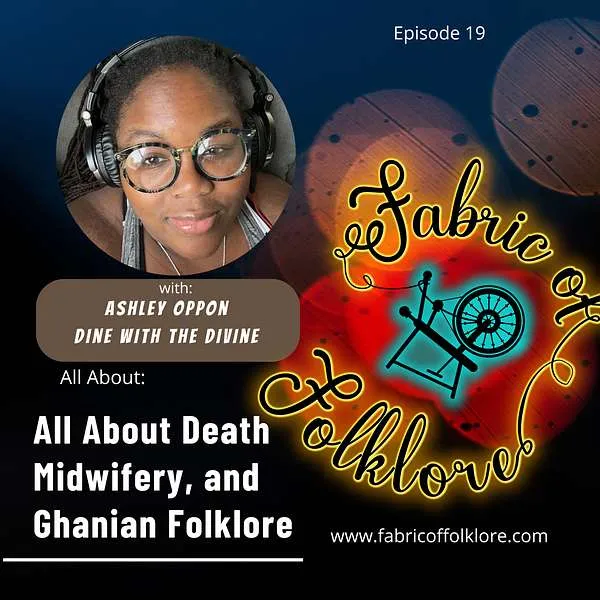
Episode 19: All About Death Midwifery, and Ghanian folklore
Episode 19 All About Death midwifery, and Ghanian folklore. You have probably heard of the Anansi folktales from Ghana, but have you heard the term death midwife? Our amazing guest, Ashley Oppon, who joined us on episode 19 talked to us about both. She is a Shamanic Practitioner, Death Midwife, an oncology RN at Sankofa […]
The post Episode 19: All About Death midwifery, and Ghanian folklore appeared first on Fabric of Folklore.
Follow us:
Fabric of Folklore website
00:00:00:00 – 00:00:29:27
Unknown
Welcome, folks. Luiz Welcome, welcome. My name is Vanessa Rogers, and I’m your hostess of Fabric of Flow for the podcast, where we unravel the mysteries of folklore. And folklore is mysterious, but is also part of our everyday existence. From our rumors or jokes to the stories we tell ourselves about who we are and where we came from. And in this podcast, we enjoy folk tales, we enjoy their stories, but we really want to understand their context and understand the history.
00:00:30:02 – 00:00:55:25
Unknown
And so we’re striving to better understand ourselves through the eyes of our parents, the eyes of our grandparents, through the eyes of our ancestors, even behind them. And so if that sounds like a podcast that is interesting to you, definitely hit that subscribe button right now because you won’t want to miss a single episode of this journey. And today, we have a fantastic show for you today.
00:00:55:27 – 00:01:23:11
Unknown
Our guest is Ashley Open. She’s a shamanic practitioner, a deaf midwife, and in oncology, R.N. at Sankofa Healing Santa Sanctuary. After studying for five years to become a shamanic practitioner practitioner, she works healing and helping others working on their spiritual lives with her death work. She hopes to make the dying process a safe space for grief and healing.
00:01:23:13 – 00:01:58:17
Unknown
She’s also a fellow podcast hostess, and she hosts Dine with the Divine, a podcast that focus on culture, mythology and history. And we’re also going to be talking about Ghanian. Some Ghanian folklore and folk tales. So just a fantastic show all around. Thank you so much, Ashley, for joining us. No problem. I’m super excited and I want to get started on understanding it a little bit about how you came to be where you are on your journey.
00:01:58:17 – 00:02:20:12
Unknown
So we’re going to start with the and how you became a shamanic practitioner and death midwife because I know the term shamanic practitioner is something I’ve heard, but Death Midwife is an entirely new concept to me. So explain it like you’re explaining to it. Kindergartner.
00:02:20:14 – 00:02:49:24
Unknown
No problem. So. So since I was young, I was always really interested in religion. I started with that. I was. I grew up Catholic, going to church with my dad, and I always really loved the ritual around it and all like the colors and how every color meant something different. And the holidays and everything like that. I was always super like into that.
00:02:49:24 – 00:03:15:06
Unknown
So and then I just started thinking like I had a lot of magical thinking was obviously like I would collect rainwater and I would say it was was special and I could do things with it. Like I was just like, what kind of the way I really your rainwater? Oh, I don’t know. But I was convinced that I really could take rainwater in a shell like I used to love to collect shells.
00:03:15:09 – 00:03:31:11
Unknown
So I used to go collect all these, like, random clamshells and collect rainwater. And then I would, like, talk to the rainwater and I’d be like, This water is now magic water. And like, I just convinced myself that it was and like, I don’t know, I would put it in places. I would put it in little jars and little cups and keep it places.
00:03:31:15 – 00:04:14:20
Unknown
I don’t know. I love that. I love that. And I also was really I loved reading about different religions. I was just like fascinated by the way people believe and like what their stories were. I love stories, so I love reading stories. I love learning about different cultures and their stories. Because you do find throughout and I’m sure you have found this with this podcast, that there are a lot of similarities between a lot of cultures which like, you know, they may have been on other sides of the world, but a lot of their origins are sort of like, yeah, folktales are similar.
00:04:14:20 – 00:04:41:06
Unknown
For instance, like Cinderella story throughout, like almost every culture has a Cinderella story, right? So like, I loved learning about all that stuff. So then I go back and I do it. What was the first religion that captured your interest outside of your own Catholicism? Yeah, Buddhism, I, I always say I always seem like I used to be like a just the tip really person.
00:04:41:11 – 00:04:58:28
Unknown
Like I like always. It’s like I was constantly, like dipping my toad, everything in like one week I’d be like, I want to be a Buddhist. And my mom’s like, All right, Like, like every week and one week I was like, I think I’m going to be a Rastafari. It’s like, That’s great. Like, I just change all the time.
00:04:58:28 – 00:05:33:14
Unknown
But Buddhism was a Buddhism captured me first. I remember there’s there’s a book, and I think it was by the the Buddhist monk. I forget his name, but he’s Vietnamese and he recently passed away. But he wrote a book, I think like something about how Buddha and Christ were like similar. So I remember reading that book when I was maybe in like eighth grade or something and thinking, Wow, this is so interesting and learning about Buddhism and like, how it was all about kind of being in the middle.
00:05:33:14 – 00:05:49:04
Unknown
Like it wasn’t about being like living a life of excess or saying you had to have nothing. It was all about being in the middle. And I love that. Yeah, I love that concept of just like you just have to like, do good things and then you’re going to get to a place where you’re going to be so enlighten.
00:05:49:04 – 00:06:10:16
Unknown
You’re going to understand so much that you’re And I also kind of believed in reincarnation a little bit that you’ll never have to reincarnate, like you’ll just be fine after that. So I always thought those concepts are really interesting. And even a story of Buddha I found really interesting, like so that was the first one. Then there was like a whole bunch of others that I really loved.
00:06:10:16 – 00:06:28:14
Unknown
And then I got a little older and I kind of fell away from a lot of that. I didn’t really look at stuff. And it was also because, like when I got older, I wanted to be like, for lack of a better word, like more normal, like none of my friends, like about any of these things like me.
00:06:28:16 – 00:06:47:23
Unknown
So I was like, I’m not going to look into this. And I kind of went into a place of like, whatever. I’m just going to kind of forget about it. Then when I was like 2020, I broke up with like my first love boyfriend and I was like, devastated. And I was in this store and I saw this like pack of tarot cards.
00:06:47:23 – 00:07:13:04
Unknown
And I was like, I need to find out if my boyfriend’s coming back like this. So, okay. Yeah. And I got really into reading Tarot. At first I was probably reading really badly, but it was fine. I started practicing and then at a point I just kind of was like, There’s something more than I wanted to study. So I started learning about shamanism.
00:07:13:04 – 00:07:35:03
Unknown
I heard it once, somewhere. I really think it started with a dream, honestly. But I heard the word shamanism. I didn’t really know what a shaman was at all, so I started looking into it and I was like, Wow, this is really interesting. And again, finding out it was something that was in every culture that it was just different in every culture, but it was there.
00:07:35:03 – 00:08:06:21
Unknown
And these core beliefs were things that I also understood and was like, Oh wow, this is really interesting. And shamanism is all about kind of a deep spiritual healing. So I was like, This is what I want to learn about. So then I went on like a journey of learning about all of that and so, yeah, so okay, so then at some point you became a nurse and an actual R.N. in Yeah, yeah, right.
00:08:06:23 – 00:08:39:15
Unknown
So it, it just weaved in, inside the the learning of this shamanic practice practitioner, is that right. Yeah. Okay. And I feel like you said that shamans are called different things in different cultures. What other names have you heard them called? Because in my experience, I’ve only heard it referred to in the Native American. And it’s, you know, a Native American tribes.
00:08:39:18 – 00:09:19:06
Unknown
But I am I do assume that there are other people like that in other places. Yes. So in many, like indigenous American tribes, there sometimes are called holy men holding women, medicine men, medicine, women. I know in South Africa, they’re called sangoma, as they are. I’m trying to think of the other names that I know most. The thing that I do know is that most cultures and I wish my fiance was here because he could tell me the name of his culture.
00:09:19:06 – 00:09:39:11
Unknown
I can’t remember it. I’m he he was explaining to me like this concept, which is it happens in most cultures too. And it’s like there’s a difference between somebody they think is a quote unquote witch or something like that. And somebody who’s known as more of a healer like this is somebody who you get to help you with a spiritual issue.
00:09:39:13 – 00:09:59:06
Unknown
But like and it’s usually different than what they would deem like a witch or something like that. So it’s usually more of a spiritual healer concept that people identify a quote unquote shaman depending on what it is in their culture. AS So I can’t remember all the names, but those are the ones that I remember. Holy man or woman, medicine woman.
00:09:59:08 – 00:10:30:12
Unknown
And then what about a death midwife? What is what is that? Yeah. Okay. So that’s another interesting thing. So my like, you know, like we’re we’re going to talk about later to my dad’s from Ghana and when I was growing up we went to a lot of Ghanian funerals. Now in my particular tribe, in the Ashanti Tribe, our funerals last for seven days.
00:10:30:14 – 00:10:59:24
Unknown
They are big events, funerals are basically as big as weddings, sometimes a bigger deal in our culture. So it was never since the time I was young, it was never something that I was like super afraid of death. And I thought that it was normal to have like all this fanfare around it. Like we have different colors we wear on different days, we have different ceremonies.
00:10:59:24 – 00:11:22:02
Unknown
We do. There’s a lot of partying, there’s a lot of crying, too. But there’s a lot of like, especially when the person is older. If they’re young, it’s a little different. But when they’re like an old person, it’s something that we kind of it’s like a celebration of their life. So I was used to that style of funerals.
00:11:22:02 – 00:11:42:00
Unknown
So when I got older and I remember the moment I was like 16, I think my choir teacher at school had passed away. I wasn’t in choir, but I was in band, so a lot of my friends were choir. So I remember me and a couple of my friends went to the funeral, though not the funeral the week we went to the week.
00:11:42:00 – 00:12:12:23
Unknown
And I remember being there and everybody was like very silently crying and I was like, This is very odd because most West Africans and this is for most of West Africa, when we are emoting like at funerals, there is throwing on the ground, there is sobbing, there is wailing like it’s like a scene. Like I think I went to a funeral for somebody else I knew later in my life and a couple of my friends with.
00:12:12:26 – 00:12:31:08
Unknown
He was somebody we worked with him with me, a couple of my American friends, and he was from Sierra Leone. And the way they were scared, like the back to the way people were wailing. And I was like, Oh, guys, this is nothing. His mom threw herself on the casket as they were wheeling it down. I was like, This is normal.
00:12:31:08 – 00:13:01:23
Unknown
It’s going to be fine. Don’t worry about it. Oh, so it was really. Yeah. Oh, sorry. I think. Okay. Sorry I couldn’t see you for a second. Yeah. So this is, like, totally normal in, like, our culture. Even when my grandmother died, my dad, when he went back home, he was approached my old women in the in the town that didn’t want him to.
00:13:01:25 – 00:13:22:24
Unknown
Do they want the Does my dad want them to come and cry? Because that’s the thing, too. It’s like the more people are crying for you, the more important you are. You were talking about the men and women who were approaching your father to see if they could come to the if they if he wanted them to come to the funeral.
00:13:22:24 – 00:13:46:14
Unknown
And we loudly. Yes, exactly. So, yes, it’s a thing women will come and ask you, especially all women, if they can come and cry. So this is just like a normal thing. So I say all this to say that when I found out that, like in this culture, it’s very different. It was the first time I went to an American funeral when I was a teenager.
00:13:46:16 – 00:14:19:20
Unknown
I was like, It’s like I feel like I was I literally thought I was like, is everybody sad or like, what’s what’s going well, it’s just like, where’s all the yeah, like we’re all the food, but I like feeling like I was. You’re used to that. So I would, I, I got older, I became a nurse. I worked in a lot of different places, but then I worked hospice for a while, which I really enjoyed.
00:14:19:23 – 00:14:42:09
Unknown
But I realized, like, people have this view of death for obviously because it’s sad. Like we all understand that. But at the same time, I feel that in our culture everyone’s so afraid to talk about it that it gives it so much fear and then we all just like it, corrupts us a little bit. I don’t think it’s healthy to never talk about it.
00:14:42:16 – 00:15:07:09
Unknown
And then when people pass away, you don’t know what to do. You don’t know what they wanted because we never were allowed to speak about it because it’s so bad. It’s like, well, unfortunately it’s something that happens and it’s something that’s going to happen to everybody. So we it’s more important that we talk about it, that we get our grief out and communicated to each other so that we can find ways, healthy ways to move forward in life when that person is gone.
00:15:07:12 – 00:15:23:12
Unknown
We’re never going to move on. You’re never going to get over it. But it is important to find a way to keep going when somebody that you love is gone. So when I found out and I always wanted to do something with it, not like I liked hospice, but then I stopped working there and I started working oncology.
00:15:23:12 – 00:15:52:05
Unknown
So I still see a lot of death, which is okay. But I was like, I really want to work with this concept of helping people deal with death, helping people be okay with talking about it, but not in like a corporate health care sense. So I found out about death, doulas and death, midwifery and basically the concept there is a death doula is somebody who’s literally guiding somebody through the dying process.
00:15:52:05 – 00:16:26:25
Unknown
And that can be in a multitude of ways. It could be start with helping them at the beginning with what you call advanced planning, like trying to set up how they’re going to run their will, where they want their things to go, dealing with how they want their funeral to go and talking to them before they die. And then it can go to helping somebody, being there, being a companion during the dying process to helping families, planning funerals, helping them do eco friendly funerals if they want, and just helping them grant the wishes of the person who was.
00:16:26:27 – 00:16:52:26
Unknown
That sounds like sister. So you needed this service because it’s so hard to talk to elderly parents about what they’re wanting is just so hard to broach that topic because it’s especially when you’re you’re close to that person as a third person party, I would say that that would just really help move that conversation in the right direction.
00:16:52:28 – 00:17:20:18
Unknown
Yes, absolutely. That’s why I think it’s becoming more popular, especially during COVID. People were dying. Younger people were dying, and a lot of people were like, Wow, I never had to think about my death before. But now it’s hitting me in the face, seeing all these other people pass away. So it is incredibly hard to talk to the people that you care about, especially or people that you have close ties with about what’s going on.
00:17:20:18 – 00:17:47:20
Unknown
What do you want me to do with all your stuff when you die? Like, what do you want for your funeral? Do you want a religious ceremony? Do you don’t do you not like how you in? And I found that especially in different minority communities such as? Like the LGBT community, having people, especially for trans people not being dead named when they have a funeral, having the proper name, having the proper gender address, different things like that are so important.
00:17:47:22 – 00:18:05:00
Unknown
And you know, it’s really important that people get that down. But it’s so hard to talk about because nobody wants to talk about it because it’s sad and like, you know, like, I don’t want to be sad either. Nobody wants to be seven like these things help and cause so much less pain at the end when you’ve already figured it out.
00:18:05:00 – 00:18:30:14
Unknown
And we all know how to respect and honor this person in the best way we know. How do you break that? How important is how do you make it feel less sad in the process or less? I don’t know. Just awkward, I guess. MM. Yeah, I’m I think it starts with everybody realizing that, like, number one, it’s okay to be sad.
00:18:30:18 – 00:18:57:16
Unknown
It’s okay to talk about our feelings and just be like, This is a sad subject and I don’t want to think about the time when this person is not going to be here, but I do want to make sure that I’m I respect this person, whether they’re here or not. And that’s kind of the biggest idea. So like, yes, it’s super awkward, but with parents, it’s like, look, unfortunately we all know what’s going to happen, but don’t you want me to do what you want?
00:18:57:20 – 00:19:17:03
Unknown
Like, you know what I mean? Let’s let’s get this down on paper at least. And a lot of people are very like, Oh, don’t talk about death, because it brings it forward. I’m like, Well, everybody’s going to die anyway. Like, honestly, that’s the truth. So it’s like, we might as well start that conversation in the gentlest way possible, you know, just starting like, well, what would you want?
00:19:17:03 – 00:19:47:12
Unknown
And do you want to be buried? Do you want to be cremated? What is it just to start this subject so everybody gets what they want in the end. And so your shamanic practice, practice, you set it for five years. What what all does that involve? Yeah. So it’s just learning. So the, the beginning of it is really working through a lot of your own issues and your own pains because you can’t go around talking about how you’ve healed everybody else unless you start to really help yourself.
00:19:47:12 – 00:20:08:08
Unknown
So it was, it was really hard because I had to face a lot of my own issues that I didn’t think were problems. Like, I realized a lot of things about myself and how I kind of was pushing a lot of things to the wayside about myself. I was very angry about certain things that had happened in my life that I was like, No, I’m over it, I’m over it.
00:20:08:08 – 00:20:47:02
Unknown
And I wasn’t at all. So broaching those things was the first attempt, the start of it. Also, it’s like learning about different things in the world, different elements, different ways. You can help people spiritually connecting a lot with like different spiritual concepts. So it’s a lot of that. And then after you work with yourself, then you start to learn how to work with others, how to work with other people, and how to deal with their issues, and constantly also make sure that you’re keeping yourself in a middle ground, keeping your ego at bay instead of you know, thinking you’re doing it.
00:20:47:02 – 00:21:08:01
Unknown
But yeah, learning just how to deal with other people and how to help them spiritually. So it just it takes a long time. I had to stop a few times because I was just overwhelmed or like I was like, Oh, I can’t process all this information. But after a while it sunk in and it’s been a really good process and it’s like an ongoing process.
00:21:08:01 – 00:21:46:02
Unknown
You’re we’re always learning about how to help people better. And so the who comes to you like what religious what systems of beliefs and do people bring to you? So people bring all sorts of different systems of belief. I’ve dealt with people who consider themselves Christians. I’ve dealt with people who consider themselves Hindu, Jewish, Muslim, like people who just consider themselves or people who are agnostic.
00:21:46:02 – 00:22:10:12
Unknown
I don’t really know if I even believe in all this, but I’m having this sort of problem. So maybe this can help, you know, different religions, different kind of spiritual powers, people who believe in, you know, indigenous beliefs of different countries, Norse beliefs, dramatic beliefs that kind of thing. Like, anybody can come see somebody because they’re having a spiritual problem.
00:22:10:15 – 00:22:35:21
Unknown
So some people will go see somebody of their own faith, which is great too. But I’ve had people from like all all different walks of life come and need some sort of and how do you walk someone through a belief system maybe that you don’t necessarily know a whole lot about? So I usually ask them to. First, let’s start like, explain why you’re here.
00:22:35:21 – 00:22:54:17
Unknown
What is the thing that brought you? Nobody comes because they don’t have a problem. So like, what’s the thing that brought you? And then I also like to ask them, how do you deal with this system, Norm? Like, how do you deal with this problem in your belief system normally, like who is who you are going to or what you believe in?
00:22:54:19 – 00:23:11:02
Unknown
And they I usually let them explain it to me. I love a good research project though, so I love to look up, you know, like what Maybe they believe because I find it really interesting. But yeah, I let them explain to me what what how would you normally deal with this is is working for you, is it not?
00:23:11:02 – 00:23:39:10
Unknown
And then we kind of talk through it and like I’m assuming it’s families. You are coming. Is it or is it just usually individuals or is there like a mixture? It’s usually individuals. When I do like shamanic work, it’s usually individuals who are coming to me if they have a certain specific problem. But if I’m doing like death midwife work, it can be families, it can be people individually.
00:23:39:12 – 00:24:09:06
Unknown
And in that case too, I work with whatever system they work with too, whether they need a rabbi or priest or whatnot, like all faiths. But what is the best part of your of this work and also the hardest part? Yeah, the best part is seeing people realize that like they can kind of take back their own life when it comes to fear, especially when it comes to the death work.
00:24:09:09 – 00:24:29:11
Unknown
When you see that people can take control. One of the biggest things, especially I learned, like when I was working hospice and I see this in oncology too, if people the loss of control is the hardest part for people to deal with sometimes, like I am this person who always did this by myself and now I can’t and I need a lot of help.
00:24:29:11 – 00:24:47:03
Unknown
And this is really frightening. But when people say like, Oh, I can actually take control of how I’m going to die, I can actually look at this and be like, No, no, this is what I want. This is how I want it to be. That gives that empowers people a lot and makes them feel really good in a time when they’re going through a lot.
00:24:47:03 – 00:25:16:13
Unknown
So I love that part of it. The worst or the challenging part is number one, I don’t love I don’t like getting to know somebody. And then they pass away. Sucks. That’s not great. But I try to remember like that. I’ve helped them and also in my shamanic work trying to help people who just aren’t ready for that kind of help and seeing them kind of struggle with that.
00:25:16:13 – 00:25:43:07
Unknown
That is always hard for me because you want like we all want to like everybody, but that’s just not possible. Yeah, like, and somehow people just aren’t ready for that. It’s like age with any practice. Sometimes people just aren’t ready for to go through what they need to go through to get to where they have to go. So sometimes with people we just have to say, okay, you come back on your own time and I’ll be here for you at that time.
00:25:43:07 – 00:26:14:10
Unknown
Okay, So let’s move on to your podcast, which is called Dying with the Divine. How did this podcast arise? What made you want to start this podcast? Yeah, so I, I love Won’t Like You. I love folktales, I love mythology. I, I’m a history not I know. Me neither. Me I terrible things. I’ll be like, I don’t know sometime in the 1600s maybe.
00:26:14:10 – 00:26:39:29
Unknown
I’m not sure. But like I love love history and I love mythology. I’m obsessed with mythology. So I decided, okay, well, I talk about this stuff all the time and nobody really wants to hear about it, so I’m just getting started. I like this. I was younger and like when I said I was really obsessed with religion, I also obsessed with history.
00:26:39:29 – 00:27:02:22
Unknown
I used to read like about every thing. American history, I think pretty boring. But like, like indigenous history is interesting. Like, but once you get to cult, like, the colony is boring. But before that, I love it. Yeah. Like, and I love everything around the world. Just like reading about different cultures. I love it. So die with it.
00:27:02:22 – 00:27:27:10
Unknown
Divine was just kind of like my passion project of like I want to talk to other people about these stories and share stories of extraordinary people and extraordinary mythologies and folktales from different parts of the world. And like you said at the beginning of how I guess understanding these folktales and even understanding different mythologies from different cultures helps you understand that culture, like, you know, different what we think of certain cultures.
00:27:27:10 – 00:27:48:05
Unknown
And then you hear the story, you’re like, Oh, wow, that makes a lot of sense. Like, I get, you know, why certain people are in certain ways and why maybe this might be sensitive to a certain people, but this is it. And how they dealt with their everyday problems. And I try to connect a food with every story because food is a big part of everybody’s culture.
00:27:48:05 – 00:28:13:15
Unknown
Everybody, Right. You know, you’re a lot of our cultural foods connect to exactly like what we believe in and the different rituals and different holidays of different cultures. So that was something that I was like, I want to include that because that’s fine. But yeah, so I just talk about different subjects, whether it’s it’s culture, whether it’s a concept, whatever.
00:28:13:15 – 00:28:50:18
Unknown
I go in there and we, we chit chat about it. So is it always an interview or is it sometimes like a monologue or how does it work? So I usually always have an interview, so I always have somebody with me. I usually interview them and then we talk about a certain subject. Maybe it’s something that came out like I try to do, like a little educational kind of segment, like a topic, and then we go into and we talk about a story so we can talk about like last week I talked about Mary Magdalene, we’ve talked about Queens, we talked about mythological figures.
00:28:50:21 – 00:29:08:05
Unknown
It just depends on the person. And I like to find out a little bit about them. So I try to connect it to them, whether it’s something that they do in their business or their personal life or it’s from their culture, and I try to connect it all. So tell us something that has surprised you about your podcast.
00:29:08:05 – 00:29:44:24
Unknown
The thing that was unexpected, something was unexpected. How how much? We don’t know really, really great stories of people. Like there’s so many really amazing people and amazing things. People have been through in this world that you’re like, What? Like how did this happen? This is amazing. And also the the how some of these stories endure throughout time, like some of these really.
00:29:44:24 – 00:30:11:25
Unknown
Yeah. Interesting stories of mythology and folklore that have gone through through time and to the point that people don’t know where the story came from, but they know that this story is from here. And this has just been the story forever. And I just find it so interesting that through oral tradition and through all wars in different places, being colonized by whomever, the lot of these stories have survived.
00:30:11:25 – 00:30:32:11
Unknown
And I just find that it actually sometimes gives me goosebumps to think that, like, man, these are the people who who told these stories thousands of years ago. I’m telling their story, and I’m sure you may feel the same way, too. Like I’m telling the story of somebody who 2000 years ago may have been sitting in front of a bunch of kids in a campfire telling the same story.
00:30:32:11 – 00:30:59:22
Unknown
And like I get to help those people continue that tradition. And yeah, it’s so cool. That’s amazing. So do you have a favorite story that you’ve heard on your podcast that you maybe didn’t know about? Um, let’s see, One of my favorite stories is, Oh, well, this is a story of a real person who lived. Her name was Olga of Kiev or all of Kiev.
00:30:59:22 – 00:31:23:16
Unknown
Excuse me. We say the Ukrainian way. This woman, she was born in like the early 1900s and she got revenge for after her husband was killed on this group that lived next to her group. So she was part of this group called the Kievan Rus. And next to her group was this other group. And they killed her husband during a war.
00:31:23:19 – 00:31:50:24
Unknown
So she got revenge on them like three different times and basically wiped out their whole group. And as terrible as it is, it’s actually a crazy, amazing story of endurance. And at the end of the story, more stuff happens. But she ends up actually becoming a saint. And she is a saint currently. Yeah. In the Catholic Roman Catholic Church and in the Eastern Orthodox Church, this woman is a saint and it’s just like an insane story.
00:31:51:00 – 00:32:15:22
Unknown
And one of my other favorite stories is I haven’t told this story, but yeah, but I will is a story of like share is odd because when it comes to folktales, she’s like one of the first people I think of. Shirzad is the woman who told 1001 Arabian Nights like that story is basically her narration and just hearing her story about about her is so cool.
00:32:15:22 – 00:32:38:16
Unknown
So like, that’s a story that I think I will be telling soon the author herself. So. Yeah. Okay. Yes. Yes. She was the one who just the story of how she ended up telling these stories is an interesting I didn’t realize it was a woman who you had and she did. She was she the one who wrote it into a book?
00:32:38:19 – 00:33:00:08
Unknown
I’m not sure if she wrote it, but she is credited with telling the stories. And it’s like, yeah, it’s a really interesting story. On why she was even telling the stories in the first place. It’s it’s pretty cool. And in there you have like Ali Baba in the 45 and the original Aladdin story, which is actually to me way better than the Aladdin.
00:33:00:08 – 00:33:24:14
Unknown
It’s like really interesting. And actually the original Aladdin story originates in like Western China, not in Persia. So it’s kind of interesting. Like so I learned about that. Yeah, this is so cool. I just read the blog recently and it kept saying China and I was very confused. I was like, I thought this was about Arabia. I don’t understand why, you know, why are we talking about China?
00:33:24:17 – 00:33:55:15
Unknown
And so, yes, because I was listening to it and I was like, I don’t understand what’s happening. I guess I had bit that moment as well. And and the story that you had before, Olga of Kiev is Olga of and she have two daughters that were sort of an age at eggs. No, no, she no, she didn’t. She was one okay.
00:33:55:15 – 00:34:25:09
Unknown
One son that. Yeah. She, she, Yeah. And she was into it. She was a real she was a person who lived and her story is she is her body actually was buried in Kiev but then in like the 1200 some time the Mongols got there and they like, destroyed it. But now there is a church currently sailor in the in the Roman Catholic Church and the Eastern Orthodox Church and I think in the Greek Orthodox.
00:34:25:09 – 00:34:55:28
Unknown
How fascinating is that? Yeah, I know. It’s a cool. Yeah. All right. So let’s move on to your guardian and I can hear how you say how do you say the the group in Ghana that your your father is from. Yeah. So the Akan people are like kind of a big group, but I probably will end up seeing Ashanti a lot because that’s our tribe’s name is the Ashanti people.
00:34:56:04 – 00:35:22:07
Unknown
The Akan people are like kind of a big group, but Anansi stories are from the bigger group, so you can kind of use them in, okay, a little bit. And so your father is from Ghana, and when did he when did he immigration what did he came here in the seventies to go to school, To go to college, and then he just ended up staying here.
00:35:22:07 – 00:35:55:16
Unknown
And my mom is originally from England and she came here. And so all of your parents were from out of the US and they and they ended up here? Yes. Yeah, my mom’s from England. And then my whole well, my grandfather, my mom’s dad, he is from Jamaica. So that’s you have a you have a lot of of space too to roam in your history, finding of your own, of your own history.
00:35:55:18 – 00:36:29:15
Unknown
How fascinating. And so what was I guess tell us a little bit about their experience immigrating into the US, how how their culture shock went and how they found the US and if you know what they liked about it or just give us that kind of an overall experience of their immigration. I’m sure my dad, I know from his stories he taught my dad like how to seem like he was having a great time.
00:36:29:17 – 00:37:01:05
Unknown
He gave me every school and then just did he travel all around the U.S.? But he ended up living in Harlem for a while during the seventies, which is actually kind of scary. But he made it, so it’s fine. And my dad’s best friend actually ended up being here, too. So like, they’ve they’re besties together ever since. But my mom actually came here on vacation and that’s when she met my dad.
00:37:01:05 – 00:37:30:00
Unknown
And one thing because my mom grew up in England, she was like, Wow, really loved how much the sun shown here. Like the sun was shining and it didn’t rain every day. She was like, and it was cool and like. And then she had like, a boyfriend. It was my dad. So then she just decided to stay. And actually at that point, my grandfather had moved back to Jamaica because he was like, Well, I’m old now and all my kids are grown and out of the house and I want to go back to the sunshine too.
00:37:30:00 – 00:37:52:08
Unknown
So he went. So he went back to live in Jamaica. So my mom, like some of my mom’s other siblings, still lived in England, but she was like, All right, I guess I’ll just hang out here. I think the one being that like for like weeks my mom said and my dad had said, like, it’s not as, like, easy to find like a big community in America.
00:37:52:08 – 00:38:18:28
Unknown
People are a lot more like individual, like they kind of stick to themselves. Like towns and stuff aren’t usually big communities the way they are in these other places. And more so I found my dad would say that, like the community aspect of it was very different. But my dad, when he was living in New York and when he lived in Washington, D.C., they both lived there for a while.
00:38:19:00 – 00:38:35:04
Unknown
Well, actually my mom and my dad and they were living in Washington, D.C. but my dad had a big found his kind of a lot of kind of people there that he would hang out with and then some of his cousins and actually ended up moving to the D.C. area. So that was good for him. Both my parents.
00:38:35:06 – 00:38:56:12
Unknown
Yeah, they just decided to stay. I think my dad really he missed home in a way, but I think it helped. A lot of his family was here, so it made it a lot easier for him. And my mom seemed I think she she like, missed home a little bit, but she always like, I found like there was more to do here than it was like in her small town.
00:38:56:19 – 00:39:19:19
Unknown
Who did the cooking? Do you have more Ghanian food or Jamaican food or more English food? Who who was in charge of the kids in English food? Yeah. You know, like, so we never had like a lot of English food because my mom is like English food. It’s like, weird. I don’t know. And I shouldn’t say that. No offense to anybody, but it’s like, very simple.
00:39:19:19 – 00:39:35:17
Unknown
But my mom always cooked a lot of, like, Jamaican food, and then my dad always cooked a lot of Ghana and food. So that’s what I mostly grew up on. And then my mom, like, would learn how to make like certain other things. So she’s like, Well, I don’t want you to go to school and like your friends think you don’t eat American foods.
00:39:35:19 – 00:40:03:00
Unknown
Like she’ll make like, spaghetti. I mean, thought that like, lasagna is like, so that was like my mom’s big thing was like, trying. But mostly she made a lot of rice and keys and furniture, and that makes my mouth water. Yeah. And like, God knows how to cook no American food, so he only cook. So how do you feel like the immigrant experience affected you as a first generation American?
00:40:03:05 – 00:40:28:18
Unknown
I assume that you were born here anyway. Yes. Yes, I was born here. I think I was lucky in a way to like see the world a little bit differently. I always my parents were really big on me, like knowing where I came from and being really proud of it. So I feel like I was always like, This is how you do this and this is how we do this.
00:40:28:21 – 00:40:50:03
Unknown
But they also like wanted me, obviously to like I was American, like, so I grew up here. So I did things the way Americans did, and I feel like I introduced them to a lot of different things. But I feel like I carried a lot of pride. My I still do my whole life about like, well, this is where like my family’s from and this is like who we are and this is like our tradition.
00:40:50:03 – 00:41:25:09
Unknown
So I think it’s been something I have fun with introducing to other people. It’s, you know, once in a while I didn’t really get a lot of flack about it. But, you know, like I get comments like, Oh, your dad talks funny, you know, they like little things, but it wasn’t too bad in that way. But I just think it gave me a really good sense of like being proud of like being where I’m from and being almost like a representative of the United States of like this is who we are know.
00:41:25:11 – 00:42:02:01
Unknown
So I really like it. Tell us one of your favorite Ashanti stories and folklore stories. Okay. Sure. So so in a lot of Ashanti folk Tales, a big character is an anti the spider. So when I was growing up, I always heard Anansi the Spider stories. My dad told me my dad is a really good storyteller and he, like, he knows a lot of these stories just out of his head, like he just remembers them.
00:42:02:01 – 00:42:24:11
Unknown
So I loved and I like some of these stories I wish I could remember off the top of my head, but sometimes I can’t remember all of them. But I love hearing stories, so basically I’ll give you the gist. So Anansi the Spider is a spider. He’s a small little animal. But the thing about him is that he’s a trickster, so he he’s he’s out here causing problems.
00:42:24:11 – 00:42:49:07
Unknown
A lot of the time. But he also is really, really smart. So a lot of the stories about Anansi the Spider are him tricking people or but it’s usually like at the end for like the better good or he gets for tricking people. So it’s not like he’s not just like outwardly and never learning his lesson. He’s just usually trying to get out of doing a lot of work.
00:42:49:09 – 00:43:22:04
Unknown
He’s trying to get what he wants the easiest way possible, and 90% of the time it’s just him acting like bigger animals or like bigger gods. So he is a big he’s one of the best characters. Like when it comes to thinking about like, well, I’m a small person, I can’t do much. But hearing his stories kind of is supposed to encourage you to be like, No, even though you may be a small little animal or a small person, or you feel like you’re not at the level that other people are at, it doesn’t mean you can’t be.
00:43:22:04 – 00:43:48:00
Unknown
Yeah, this really big person and you can use your smarts and your cleverness to like get what you want. One of the first. So one of the most popular stories is the origin of Anansi, the origin of stories of Anansi. Is that right? And I yes, that is a really popular story about how he liked this little rundown of that one store.
00:43:48:02 – 00:44:09:00
Unknown
So Anansi decided, okay, so also, I don’t know if I said this, but in the Empty is the keeper of stories that is literally one of his titles. He has all these stories for all the Ashanti people. He keeps them all so the way he want. One day he didn’t own the stories to begin with. Naomi, who is the Sky?
00:44:09:00 – 00:44:30:22
Unknown
God owned all the stories, and Nancy found out that he had them and he really, really wanted them. So he’s like Naomi, really, can I please have you stories? And I’m like, No, you’re a small little spider. I’m not giving you home this big responsibility. And he’s like, Please, please, we’ve let me have it. So Naomi is like, All right, I’m going to give you a couple of task tasks to do.
00:44:30:25 – 00:44:57:26
Unknown
And if you can do them, I will help you out. So he had to capture the four most dangerous creatures in the world. So one of them was a snake, a big python. Another one of them was a leopard. Another one of them were some hornets and another one of them were some fairies. So Anansi goes home. He plots with his wife on how he’s going to do this before he leaves.
00:44:57:26 – 00:45:15:06
Unknown
He’s actually like, Oh, you want me to get those four creatures? I’ll do it, but I’ll also bring you my mom. I don’t know why he needed to bring his mom, but he said he was so, you know, he’s like, Fine, I’ll bring my mom. So he goes and him and his wife plot how to get the python.
00:45:15:06 – 00:45:30:16
Unknown
And what they figure out what they’re going to do is they go they go by where the python lands and they make a big stink. Like they start talking really loud and arguing like, oh, no, no, they got a big stick. And they’re like, Oh, he’s longer than this stick. And then Nancy’s like, No, he’s not. And his wife’s like, Yes, yes.
00:45:30:16 – 00:45:46:05
Unknown
So the python comes out and he’s like, Well, I what are you guys argue about? They’re like, Well, how big are you? We want to see if you’re as big as a stick. And he’s like, Oh, way bigger than that thing. So he stretches himself out and then they end up tying him to the stick and they carry him off.
00:45:46:07 – 00:46:02:28
Unknown
So then the next was the leopard and the Nancy goes, he makes a big hole in the ground. The leopard falls into it, and he’s crying, asking Nancy, please, please help me. And Nancy’s like, Well, I can’t help you because you’re asking me if you get out of that hole. And he’s like, No, no, no, I’m not going to eat you.
00:46:03:03 – 00:46:22:00
Unknown
So he starts to help him out. But then he hit he bounced him on the head. He doesn’t kill him. He just wants him on the head. And he passes out. And then Andy picks up his body and drags them over to the Tania, make him then the third animal for the Hornets. So Nancy and his wife get some water.
00:46:22:02 – 00:46:38:10
Unknown
And they sprinkle it on where the Hornets live. So the Hornets come out and, oh, I’m in L.A., pours a water on itself, The Hornets come out and they’re like, Nancy, what are you doing? He’s like, Oh my God, it’s raining so hard. And they’re like, What you think? Didn’t you feel the rain? And they’re like, Oh, yeah, yeah, true, true.
00:46:38:16 – 00:46:57:11
Unknown
He’s a come in this. He has a big gourd. So they’re like, Come in my gourd and stay in there and then I’ll protect you for the rains. You guys don’t get beat down in the rain. And I was like, Oh my God, that’s hot. So they put it all going this gourd. And then Nancy captures and closes the gourd and takes them over.
00:46:57:13 – 00:47:27:10
Unknown
So then the last one is these fairies that he has to capture. Now, they’re the hardest ones to get. He figures out a really good plan. So we have these dolls. They’re called Acuna dolls, or people know them as fertility dolls. The folklore with that actually is that if our if somebody wants to have a baby, they take one of these fertility ball fertility dolls and they treat them as a baby, literally feed them, put them to bed, everything, and it will have that person be able to get pregnant.
00:47:27:12 – 00:47:53:26
Unknown
That’s why they call them fertility. Yeah. Yeah. It’s pretty cool. So that’s been like a long, traditional thing. So he uses one of these dolls, puts it up against a tree, covers it with like sap from a tree, and these and puts some we call yam. It’s yams look like baked potatoes, but like they’re kind of harder. They look like logs, and you can strip it and eat it.
00:47:53:26 – 00:48:18:03
Unknown
It’s a starchy food that we usually eat with soup and different stews. So he crushes it up and puts it next to this fairy tree with this doll covered in sap. So the dolls see the food and the doll, I mean the fairy see the doll and the food and think that the doll is a person. So the fairies come over to the doll and they’re talking to the doll and they’re like, Oh, can we have some?
00:48:18:03 – 00:48:40:06
Unknown
And he has strings. So he’s moving the dolls head like the doll saying, yes. So they start eating, then the doll, the fairies like, can we, can I invite my sisters? And the doll moves its head like, Yes. So the very invite her sisters, they all start eating. Then afterwards the fairies like thank you so much. But the doll doesn’t speak because it’s a doll.
00:48:40:08 – 00:49:10:24
Unknown
Then the fairies like I said, thank you. Don’t move. And then the fairy gets mad. So she slaps the doll and her hand gets stuck. Then the other fairies try to help her, and then they end up getting stopped. Then Nancy catches all of them and takes them to Naomi. Then he goes get some. You said he was going to do that and he gets his mom and we all go there and Naomi is like, Wow, I really did not expect this to happen so easily.
00:49:10:26 – 00:50:05:05
Unknown
He gets them all together. And I was like, Okay, great, you can be the Keeper stories. And then from that time on, he was the keeper of stories for the whole tribe. And I think there’s a significance to this story. Is, Erica, is there something that people take away from this story besides just entertainment? Yeah. Number one, the fact that Anansi Nancy was able to best all these animals and like these like these bigger entities than himself, I think is something that people really love to take away from Nancy stories and actually, Anansi stories are throughout the African diaspora, in the islands in southern United States, in parts of like places like Ghana, different places
00:50:05:05 – 00:50:38:11
Unknown
throughout where the slave trade happened because of a Nancy’s prevalence in like body and culture, the stories kind of persisted because people were going through a lot at that time when these, you know, and they remember these stories. And I think it helped them cope, you know, like, yes, we’re in this terrible predicament and we’re away from where we wish we were, but we have these stories about this little spider who got through so much and ended up being a god of sense, Like that’s how important he is to.
00:50:38:11 – 00:51:05:15
Unknown
The Ashanti people is that he’s literally a god. He keeps all of our stories and our history in his own head. So I think that gave a lot of whole stories that kind of developed here in the States amongst the enslaved people. Once they once they got here, did they did that story at all evolve to kind of represent their and their experience?
00:51:05:17 – 00:51:30:06
Unknown
So actually, yes, I can’t remember off the top of my head of the stories, but especially in places like Jamaica where outside of Ghana, those are there’s the biggest concentration of Ashanti and Akan people. They were mostly in Jamaica. So a lot of the stories told in Jamaica have to do with the culture of the island and the things they had on the island.
00:51:30:11 – 00:51:53:17
Unknown
So when they retell the stories, they may have to do with different foods or they may have to do with different drinks that they have that were, you know, indigenous to Ghana, but they had once they were in Jamaica. So the story started to change a little bit. There are stories that involve you know, they talk about Master said this, Master said that in different parts.
00:51:53:20 – 00:52:22:12
Unknown
So yes, he brought the stories with them. But then I think to be relatable, they ended up doing a lot of those things so that they could still keep telling them and everybody would understand whether they like the corporation, that it wasn’t just the male spider, but also his wife and also his mother. So is there, you know, a deeper meaning there that there is also two strong females involved in this story?
00:52:22:15 – 00:52:46:19
Unknown
Yeah. So a lot of not only Akan culture, but a lot of West African cultures are matriarchal like a lot of things are passed down through the lives of women. And so like while citing like property and land and names or all those things. Okay. Yeah, yeah. Names, property, land. A lot of those things were passed down through female wives.
00:52:46:22 – 00:53:12:02
Unknown
Even if you married, it’s similar like in like Jewish tradition, like if the if your mom’s Jewish, but your dad isn’t, you’re still Jewish. Technically, that’s how they see it. So it’s kind of like that. Like if you had somebody from two different tribes that got married, you really identified usually with the tribe of the woman more than the man, because the woman is technically the one who gave birth to you.
00:53:12:04 – 00:53:51:12
Unknown
So I think having a lot of help from women was a big theme. Also in there is a and again, I’m terrible with dates, but in particular in Ashanti culture we have a a woman named Yassin too, who was basically like I always compare her to like the Joan of Arc of like Ashanti people. She was a mother who basically defended we have a another folk folktale kind of from Ashanti people is there’s something in the Ashanti Kingdom called the Golden Stool.
00:53:51:15 – 00:54:09:27
Unknown
It is literally, literally a stool that this guy Osei-Tutu, who’s our first Asante Hani, which is the King, it came down from having this stool and it’s very sacred to us. We can only bring it out. I think it’s once or twice a year. They bring it out. It’s protected by like two people at all times. It’s it’s a big deal.
00:54:09:29 – 00:54:32:15
Unknown
So yeah, So when the British came and when they invaded Ghana, I think it’s like 1700 years, terrible. Who wanted to sit on the stool, which was like a total insult. This, the stool is supposed to represent like our people. And basically if somebody takes it or destroys it like it’s supposed to be, the end the Ashanti people.
00:54:32:18 – 00:54:48:18
Unknown
So they wanted to sit on it and we were like, You can’t sit on it. And they’re like, But why not? We’re like, Not because it’s really secret. So they super disrespected us. So we had like started a whole war with them about it, and all the men went to war and Joss on to who’s the Queen mother?
00:54:48:18 – 00:55:13:08
Unknown
Oh, and they kidnaped the king. At the time, she was a queen mother, so she was ruling and she was encouraging all the men to go to war. She actually told the women in the different towns, if a man doesn’t want to go to war, you got to like kind of bury him. Like you going to make fun of it, to make him feel like what you should do, you should be fighting for his people.
00:55:13:10 – 00:55:38:08
Unknown
So she did all this. She taught women to fight. She she gave them weapons. So I think in the culture, it’s been very like I think in the past maybe women were a little subservient. But as things went on, I think people became a more matriarchal culture and women became really important to all these stories. And women were the primary providers in terms of cooking and taking care of the family.
00:55:38:08 – 00:55:58:23
Unknown
So I think that’s one thing Ashanti people are really good at is recognizing that women were really important in their roles. So like, they really need to be a of the culture part of the story because there was nothing going on without women being there. That’s just really amazing because, you know, women do that all over the world with a lot of time to just not recognize.
00:55:58:23 – 00:56:31:11
Unknown
So that’s that’s wonderful that that’s part of Ghana and culture. Is there anything else you feel like we haven’t covered that you feel like we should talk about? I no, I feel like I know your dad. Feel like, well, thank you so much for joining us. I really appreciate you coming on the show. Absolutely. Thank you so much.
00:56:31:11 – 00:56:54:00
Unknown
Thank you for having me. And thank you. Vocal Blues. Have you heard of the story of Anansi or have you heard of the terminology of death Wife for shamanic practitioner, let us know what you thought about the show and what your thoughts were in general on our Facebook page. We have a community page where you can share your thoughts and who you want to hear from next.
00:56:54:02 – 00:57:25:13
Unknown
And so that’s called fabric of folklore, community. And then it’s a Facebook page and all of the links that we talked about today, I think we just talked about a couple but they will be up on the our website WW w dot fabric of folklore dot com and as always one of the best ways that you can help a burgeoning podcast like ourselves is to comment like share subscribe and review us give us all of the stars A thousand star.
00:57:25:13 – 00:57:49:17
Unknown
Is it possible? And if you give us a review, I shout out your name on the podcast. So definitely give us one of those reviews and thank you for coming on the show and thank you for unraveling the mysteries of folklore and the fabric of folklore. Once again, my name is Vanessa y Rogers, and until next time, keep the folk alive, right?