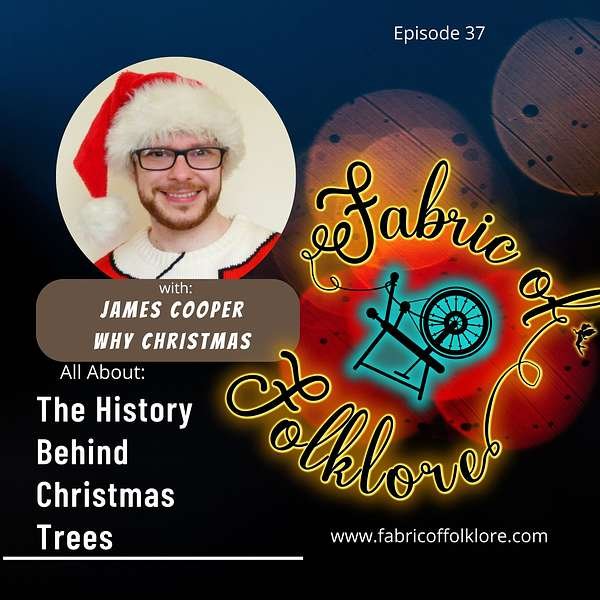
Episode 37: The History Behind the Christmas Tree and other Christmas Traditions with James Cooper
Ever wonder where the idea behind the Christmas tree came from and what a tree in your house has to do with the birth of Jesus? Did you know that some Christmas traditions today can be traced back to ancient Rome? James Cooper, a Christmas fan and expert from the UK who runs whychristmas.com, one […]
The post Episode 37: The History Behind the Christmas Tree and other Christmas Traditions with James Cooper appeared first on Fabric of Folklore.
Follow us:
Fabric of Folklore website
Transcript
Vanessa Rogers
·
00:45
Welcome, folksy folks. Welcome to Fabric of Folklore. I’m your hostess, Vanessa Y. Rogers, and this is the podcast where we unravel the mysteries of folklore. This podcast is about connection. It’s about reveling in our differences and celebrating our similarities. This podcast strives to explore these expressions of our humanness, like folktales and legends, folk songs, nursery rhymes, and holiday celebrations. Each of these elements make up a piece of our puzzle. And when we fit these puzzle pieces together and see them as a whole, we have a better understanding of who we are as a community and where we came from. So, as an example, I was reading a nursery rhyme book to my kids, and I came across a nursery rhyme I’d never heard of. It was called Tweedle Dumb and Tweedle D.
Vanessa Rogers
·
01:30
And of course, I knew those names from the movie Alice in Wonderland or otherwise, the Lewis Carroll’s through the Looking Glass, which was written in 1872. But I was curious which one came first, the nursery rhyme or Lewis Carroll’s book? And so, upon further investigation, I found that in the 18th century, before Carol created the characters in his novel, the words Tweedledum and Tweedledee were used commonly to refer to people or situations that were virtually interchangeable. And it’s these small aha. Moments that help us to fill in these gaps. Understanding these little bits of history are fun, but they also help to enrich our lives. They help us to feel connected with our past. And in this podcast, it’s about bringing our current lives more meaning through understanding our culture, our folklore, and our history.
Vanessa Rogers
·
02:20
So if that sounds like a podcast that you want to follow, make sure you hit that subscribe button right now, whether you’re watching on YouTube or if you’re listening on your favorite podcasting platform so that you get notifications every week when our podcast drops. And if you are a time listener, thank you so much. And I would encourage you to give us some stars. Give us all those stars and write us a review because it helps new followers and listeners to find our show. So we have a very Christmassy show for you today. We’ll be talking about the history of Christmas trees and how and when they became part of the Christmas tradition, as well as mistletoe and other greenery that we find at Christmas time.
Vanessa Rogers
·
03:02
We’ll also be talking about the differences between the traditions in the UK and the US, and we’ll touch on some different traditions in other countries as well. Our guest, James Cooper, is a Christmas fan and expert from the UK who runs the website whychristmas.com. So thank you so much, James, for joining us today.
James Cooper
·
03:25
Well, thank you for having me, Vanessa. It’s a pleasure to be here.
Vanessa Rogers
·
03:28
Well, let’s get started. In asking about your website, how did you even get started on this website?
James Cooper
·
03:34
Right, well, it all started back in 2000, which seems like a lifetime ago now. It’s sort of half of my lifetime. I was just starting to get into designing and building websites because it was sort of the infancy of the web as we know it back then. And I had some friends who were elementary school teachers or primary school teachers, as we call them over here, and they were just starting to get the web in their school on that. And they came to me and said, why can’t we find a child safe and friendly site that’s got information about Christmas, that we can let the kids find out about Christmas? Because back then the only sort of children’s based sites were the likes of Disney and Nickelodeon, and they had some information, but they were really trying to sell their stuff.
James Cooper
·
04:12
So being a big kid and loving Christmas myself, I thought, oh, that would be a bit of fun to learn about, a bit more about Christmas. And I’ll build this little site for a little primary school. It was actually quite a big primary school in north London where I lived at the time. And so I made this site for one little school and I told some people about it and it sort of did its thing for a couple of years with just odd schools looking at it. And then Google got hold of it and now, 23 years later, it’s the biggest source of Christmas information on the web. It gets 20 million visits every December and it takes up most of my December and I love it.
Vanessa Rogers
·
04:47
Well, that’s wonderful. So why the title? Why Christmas?
James Cooper
·
04:52
Because they wanted to know, why do we do this at Christmas? Why do we have trees? Why do we give presents to each other? Why do we send Christmas cards? Why is it on December the 25th? So I was trying to come up with ideas, and it was my dad, actually. You came. Well, why don’t you just call it why Christmas?
Vanessa Rogers
·
05:10
Oh, I love that. And so what do you think is special about Christmas?
James Cooper
·
05:15
Well, I’m a Christian, so to me, Christmas is really important because it celebrates the birth of Jesus. But through running the site, I’ve just learned so much about Christmas and everything that’s involved with it that, yeah, sort of the whole of Christmas is special to me now, because the more I learn about it, the more interesting it becomes.
Vanessa Rogers
·
05:36
Absolutely. And that’s what I find on this podcast in general. The more you learn about something, the more interesting it becomes. Those little tiny puzzle pieces just make it just so much richer. All right, so we’re going to be talking about Christmas trees today on your website. So I was reading through your website, and you said that, I believe it started with the pagans, and then it went on to the Romans. Can you talk to us about how.
James Cooper
·
06:03
Yeah, there are lots of different thoughts about how Christmas trees really started or how the use of greenery at what we now call the time of Christmas started. It certainly goes back thousands of years to pre christian times, to the winter solstice in the northern hemisphere, when it was dark and cold and miserable and snowy and you couldn’t do much. Yet there were some plants that stayed alive, and people obviously thought they’re a bit special. So there are early records. The very early records are fairly sketchy about what people did because they didn’t write stuff down. The Romans were the first people to write things down, really. So we know that the Romans, during their midwinter festivals, gave each other branches of trees. It’s just as like a sign of peace.
James Cooper
·
06:50
They weren’t like Christmas trees as we think it was more like sort of branches of eW or laurel and things to decorate their house with. And certainly it seems similarly up in germanic and northern Europe, you have people bringing greenery into their houses during the winter to brighten. There are several theories. Some people just think it sort of brightens it up and reminds you that spring is coming and it’s a bit of color in the darkness. But some studies have also been done that things like fir trees have some anti insecticide in them. So if you’re all living in a crowded house in the winter, it’s quite good to keep the bugs down. So it could have helped with that. And, of course, Christmas trees smell nice, so there’s that as well.
James Cooper
·
07:37
So there’s lots of different reasons why people brought plants into their house over the winter.
Vanessa Rogers
·
07:43
And how far back are we talking?
James Cooper
·
07:46
Well, the Romans sort of. So we’re looking at around the year a few hundred years before that. And we don’t have much records from other cultures around that time because they just didn’t write things down. But we know sort of when Christianity and the Romans sort of started to spread out to northern Europe, that these sort of wintry greenery type things were being done. So you can imagine it probably went on for a few hundred years before that as well.
Vanessa Rogers
·
08:16
And then what is the paradise tree?
James Cooper
·
08:19
Right, okay, the paradise trees, they date to medieval Europe, and they were part of what are called the mystery plays, or the paradise plays. And they often took place on Christmas Eve because that was the day of Adam and Eve, the saints day of Adam and Eve. And they were plays that were put on outside large churches and big towns that told Bible stories to people who couldn’t read the Bible, because back then you had to learn Latin to read the Bible. And the only people that could really get their hands on the Bible were the likes of priests and monks. So most people telling stories was the way that you did it. And paradise trees represented the tree in the garden of Eden.
James Cooper
·
08:56
They were often just either lumps of what we’d call a Christmas tree today, or bare twigs or things, bits of wood put in the shapes of trees. And they put apples on them because it represented the tree in the garden of Eden. And a bit like you’d put a post up on social media now to advertise the fact. They’d parade round the town with this tree going, there’s a play on at the church, come along. So they were the sort of the first, what you could call vaguely Christmas type trees.
Vanessa Rogers
·
09:26
Okay. But this would be. Was Christmas always celebrated on December 25.
James Cooper
·
09:35
In the western part of Europe? Yes, in the eastern part of Europe it was the 6 January, because they put Christmas and epiphany together, epiphany marking the time when the wise men came to visit Jesus. And also it was the feast of Jesus’s baptism. And epiphany means revelation. So the eastern church took all of these things to sort of represent the revealing of.
Vanessa Rogers
·
09:58
Okay, okay. So it depends on where you were, eastern or western Europe.
James Cooper
·
10:04
Yeah.
Vanessa Rogers
·
10:06
And then when was that first recorded Christmas tree? Yeah, when was the first recorded Christmas tree?
James Cooper
·
10:15
Okay, that’s a really good question, and there’s kind of some arguments about it. Estonia and Latvia disagree about when it was. Talon in Estonia says it was 1441, and Riga in Latvia says it was 1510. Both of these trees were put up in town squares by an association called the brotherhood of blackheads that were sort of a precursor to sort of rotary club and business gatherings of unmarried businessmen who got together to have a drink, basically. And these trees, we don’t actually know that they were real trees. They might have been more like maples because maypoles that you dance around, because the word used in tree could also just mean mast or big pole. So it could be that they just, again, a bit like the paradise trees.
James Cooper
·
11:13
They got a big lump of wood and nailed some lights to it and danced around it having a drink. And then it was supposedly set fire to it at the end. There’s also a picture from 1521 in northern Germany of a tree, a real tree, being paraded through the streets with a man riding a horse behind it. And the man on the horse was dressed as St. Nicholas. So that’s sort of around the sort of late 14 hundreds, early 15 hundreds. Christmas trees were sort of becoming what we think of them.
Vanessa Rogers
·
11:47
So the maypole. But that was generally used in May, is that right?
James Cooper
·
11:53
Yeah. It’s sort of a spring fertility thing. But it might have been just an excuse to have a drink, frankly, yes. What’s now Germany and what’s now Estonia and Latvia were sort of two rival big old merchant empires. So the customs could have traveled across the sea between the two. So, yeah, nobody’s quite sure where it started.
Vanessa Rogers
·
12:20
And then you mentioned a Yule log, and I don’t know if that’s common. I’ve heard the word yule log and I’ve seen yule log cakes, but I don’t really know much else besides those references.
James Cooper
·
12:35
Okay. Yeah, that’s another big northern european thing, especially scandinavian countries, Germany and over here as well, and parts of northern France. The eulog was supposedly a big chunk of wood that you bought into the house to burn through the twelve days of Christmas so you didn’t have to go out and collect firewood. And that during. While you were having the days off over the twelve days of Christmas, so you could just keep it going. Some people say it goes back to ancient times, but the earliest records of it are sort of around the same time, the 1215 hundreds. So not actually that old in terms of really old things, but still quite a big thing. So burning the tree at the end of it would be similar to the customs of eulers. It was like burning something at Christmas.
James Cooper
·
13:21
And still, in the baltic countries, like Montenegro, they have massive bonfires outside their large churches on Christmas Eve. Before the Christmas Eve service. And so you all have a massive bonfire and you go around and have a bit of a party on Christmas Eve and then you go into the church for the midnight mass service.
Vanessa Rogers
·
13:41
Wow. And so is the bonfire continuing during the service?
James Cooper
·
13:45
No. Well, some people keep an eye on it and then you might come out and light some fireworks and have some more good times, basically. Yeah. They can get kind of wild at some of these bonfires. If you look them up on YouTube, they’re quite spectacular. Some of them.
Vanessa Rogers
·
14:01
Yeah, I would imagine. And so this eulog, did it come from a very specific kind of tree? I can’t imagine a log that would actually go for twelve days.
James Cooper
·
14:10
Well, you get some pretty big trees. Yeah. It depends what part of France you’re in. Part of Europe. In the UK, it was traditionally a oak tree, but it’s basically wherever you can get a big tree from.
Vanessa Rogers
·
14:29
Interesting.
James Cooper
·
14:30
And that’s where the French got the idea for the yule log, as in the chocolate thing that we eat. So that came from the custom. It was like, well, we can make a swiss roll and put chocolate all over it. And the parisian chefs decided to make something nice out of it. I prefer a chocolate one to a real one. And where I am in the southwest of England, rather than having a yule log as such, the custom down here was to have eight, was to have bunches of twigs all bound together with twisted strips of bark and things to create a big bundle that you put on the fire on Christmas Eve.
Vanessa Rogers
·
15:12
So it wouldn’t go for twelve days?
James Cooper
·
15:15
No, it was a big fire to do with Christmas.
Vanessa Rogers
·
15:21
And I always had it in my head that eulogs had a pagan history. But you were saying that you probably think that it’s much.
James Cooper
·
15:32
Anything pre Christian is pagan. So if they were doing it before Christianity went to a country, it’s pagan. So anything can be classed as pagan, really. And lots of things that are to do with Christmas often have pagan bolted onto them just because they’re like an old custom that we don’t know where it comes from.
Vanessa Rogers
·
15:53
Yeah. So when did the Christmas tree actually come into the house?
James Cooper
·
16:00
Okay, the person that we can possibly blame for that, although it’s possibly a legend, is in the 16th century, the german reformation preacher Martin Luther. There’s a story that he was walking through a forest one night in the winter and saw the stars twinkling on the trees and thought it reminded him of Jesus coming down from heaven to earth. So he supposedly cut down a tree and brought it into his house to remind people that God came down to earth. But I mean, basically, probably somebody just thought a tree looking in a house was nice, and then a legend got bolted onto it later and was he.
Vanessa Rogers
·
16:40
Said to have decorated it or just.
James Cooper
·
16:41
Like, put it in, supposedly some candles, but that was as far as it went. And possibly some of the very early Christmas decorations were like apples and nuts and things, fruits that you could get around, things that you had at Christmas that were colorful, that you could put on the tree.
Vanessa Rogers
·
17:02
And then there’s a couple of more legends. One is the St Boniface legend in Germany.
James Cooper
·
17:07
Yeah, well, St Boniface actually originally came from a village in Devon, which is about 50 miles from where I live. And he was a missionary from the UK. He went over to Germany and the legend goes that he was over there walking through the woods and witnessed some people who were about to sacrifice a young boy to an oak tree. And he stopped this and said, it’s terrible. And he cut down the oak tree and then suddenly a fir tree sprung up from the roots of the oak tree and he decried that. This was a sign of Christianity and things, but fairly legendary, shall we say.
Vanessa Rogers
·
17:52
And is it told around Germany?
James Cooper
·
17:55
Not particularly. I think the people in Devon have got more hold of it than they have in Germany, because St Boniface was a good local lad that they like to tell stories about.
Vanessa Rogers
·
18:08
And then there’s another one that you mentioned on the site about a forester.
James Cooper
·
18:14
Yeah. This is another german one, which sort of has similar aspects to the Martin Luther, is that a forester decided was with his family one night, and there was a knock on the door and it was a poor little boy standing on the doorstep. So he bought the boy em and put him in one of his son’s beds and looked after him. And in the morning, the family were woken up by a choir of angels, and the little boy had turned into Jesus. And Jesus went into the front garden and tore off a branch of a fir tree and gave it to the family as a present. Yeah. But it’s very interesting because in Germany you have what’s called the Chriskind, which you’d think would be the Christ child.
James Cooper
·
19:00
And it does represent the Christ child, but it’s sort of a little angelic being with blonde hair and wings and little blonde girls often dressed up as the Christkind at german Christmas markets and things. So it’s kind of a bit confusing. Yeah. And in sort of historically catholic areas of Germany, the Chris kind is the gift bringer at Christmas. And in the protestant areas, it’s Sinterclass. St Nicholas who’s the gift?
Vanessa Rogers
·
19:35
Oh, interesting. And so the Chris kinned, is that how you say it? Chris Kinn?
James Cooper
·
19:41
The Chris kind? Yeah. It means Christ child, but it isn’t what you’d think of as a baby Jesus. It’s very confusing. And you ask germans about it and they go, yeah, we know it’s od.
Vanessa Rogers
·
19:53
But they still like it. Yeah, because it’s tradition. Okay, so when did we see decorating really start?
James Cooper
·
20:04
It seems sort of late 15 hundreds, early 16 hundreds. There’s a record from Strasbourg of a tree being decorated with apples and some sort of paper cutout shapes of paper and some little edible waffles and things like that. And it was really around that sort of northern german area that trees started to be decorated and then they spread slowly across Europe.
Vanessa Rogers
·
20:33
I would imagine if were decorating our Christmas trees with food, there would be rodents that would be living in those trees.
James Cooper
·
20:44
Yeah, but you probably had them anyway back then and you might have had a cat or a dog that took care of the. Yeah, I don’t know.
Vanessa Rogers
·
20:54
So how did they evolve? How did the decorating evolve? Because at one point, baby Jesus was on top of the Christmas tree. Is that right?
James Cooper
·
21:03
Yeah, it was the baby Jesus, which then turned into the angelic we have. That’s how the angel gets on the top of the tree. And then some people put a star on the top of the tree because they thought angels were too sort of, or the Christkind was too catholic, so they put the star on the top.
Vanessa Rogers
·
21:18
Of the tree.
James Cooper
·
21:22
And then in the sort of the late 18, middle 18 hundreds, when glass blowing became more popular and they could do more shapes with it. And that’s when you started to get glass decorations. And of course, the classic red bull ball looks like an apple because that was the original Christmas decoration. So if you’ve got red bull balls on your Christmas tree, that’s still representing the very early apple decorations.
Vanessa Rogers
·
21:50
And so this Christmas tree celebration seems to have started in Germany. But did it spread pretty quickly throughout Europe?
James Cooper
·
21:59
To parts of northern Europe? Yeah, into parts of northern France, down into Austria, in Switzerland, just sort of. That area really stayed and some up into Denmark and Scandinavia. But it wasn’t really very widely popular until sort of the mid 18 hundreds, when printing press came around and people could see pictures of trees more widely distributed. And that’s especially when it came into the UK. The first tree in the UK was set up in 1800 by Queen Charlote, who was the northern german wife of king english king George II. And she put up a branch of a U tree for a children’s party in 1800 in Windsor Castle. And it’s interesting because that region of Germany just used the branch of a U tree rather than a full tree. So she was importing her local custom in.
James Cooper
·
22:56
And then from that, the rich families that went, their children went to the party. They thought, oh, the queen does it. That’s a fashionable thing that we’ll do. So it sort of became an upper class, rich, sort of continental Christmas novelty to do. Then, in 1848, an illustration of the Queen Victoria and Prince Albert’s royal tree was printed in a big London newspaper. And that’s when they really took off, because five years earlier, in 1843, when Charles Dickens a Christmas carol is published, if you read through a Christmas carol, there is not a mention of a Christmas tree in it.
Vanessa Rogers
·
23:44
Interesting.
James Cooper
·
23:45
So it’s really when the royal tree became the fashionable thing to have. And that tree was a tree standing on a table. It wasn’t on the floor as we think of them today, but of course, they had big ceilings in the castle, so they could have a big tree standing on the table. But that was when Christmas trees really became a thing in the UK and not just sort of an upper class novelty.
Vanessa Rogers
·
24:11
And what about America? When did we adopt it?
James Cooper
·
24:14
Yeah, well, some people from northern Germany and the Netherlands and Belgium had taken the tree customs over to them, sort of in Pennsylvania in that sort of area. But it was sort of seen as most Americans as just like this weird. Well, they’re a bunch of german immigrant type thing. And again, it was the same picture that was published in 1850 in the New York papers that made Christmas trees popular. But in possibly one of the earliest photoshop jobs ever, they removed Queen Victoria’s crown and they took off Prince Albert’s moustache in the american version of the drawing.
Vanessa Rogers
·
24:59
So did Americans recognize who those people were supposed to be, or were they just in and.
James Cooper
·
25:07
No, they did know it was the royal tree, but, I mean, I don’t know why they did that. Whether they thought Americans would take to it more if they didn’t look so royal, I don’t know. But, yeah, that’s how it made its way stateside and really became a thing.
Vanessa Rogers
·
25:21
Okay. But prior to electricity, people used candles.
James Cooper
·
25:27
Yeah. And not a great idea because you can imagine greenery. Lots of Christmas trees have sort of fairly flammable SAP coming out of them. Candles, children, animals. Not such a great idea.
Vanessa Rogers
·
25:43
Yeah, I would imagine there would be a lot of fires.
James Cooper
·
25:48
Yeah. Well, there were in 1885, a hospital in Chicago completely burnt down because of Christmas tree. And in 1908, an insurance companies got together in the USA and tried to get a law through congress that banned candles on Christmas trees.
Vanessa Rogers
·
26:08
Oh, my goodness.
James Cooper
·
26:09
They were fed up of paying out for all the insurance claims of Christmas trees causing fires.
Vanessa Rogers
·
26:15
But it didn’t work. They couldn’t get it to go through.
James Cooper
·
26:17
No. There’s also the story of the famous scottish designer Charles Rennie McIntosh. He was dressed up as Santa for his kids in the early 19 hundreds, and his beard caught a light from a candle on the Christmas tree, and he had to run out the front door and jump in the fish pond to put himself out.
Vanessa Rogers
·
26:38
Well, I’m glad he was okay. So when did electric lights come into fashion then?
James Cooper
·
26:50
Right. Edison invented the first Christmas lights in 1880, and in the late 18 hundreds, early 19 hundreds, they actually put catalogs out where you could rent lights and a generator from Edison’s company, and they would come and decorate your tree or your house for Christmas and then take them away again after Christmas. And they cost an absolute fortune. It would have been about $2,000 a tree back to light your tree up in our money.
Vanessa Rogers
·
27:21
Okay. Wow. So it is only like, maybe towns or very wealthy people that would have done that.
James Cooper
·
27:29
Yeah.
Vanessa Rogers
·
27:29
Okay. And then the tree skirt at some point becomes into fashion.
James Cooper
·
27:35
Yeah. Again, that starts over in Germany as sort of a way of catching the needles. Today, we think of tree skirts. They go sort of up around the tree like that. But the original tree skirts were more like fancy tablecloths that you put the tree on, either on the floor or on your table, and it was quite fashionable. Rather than putting the presents underneath it, you’d either put some food underneath it or you’d build a little Christmas village, sort of an alpine or germanic little Christmas village underneath your tree, because it looked like they were in a forest.
Vanessa Rogers
·
28:11
I had a question that I forgot to ask you in southern places. So, like, for instance, where I live in Texas, we don’t have pine trees. And I imagine that Italy and other mediterranean countries probably would not have had evergreen, or maybe they have a different type of evergreen tree. What did they do?
James Cooper
·
28:37
Well, Christmas trees didn’t really become a thing in much of southern Europe till the 1940s, 1950s. And by then it was either people locally, buying locally, growing more heat tolerant evergreens, or they just imported them. Yeah, it’s funny that. And then, of course, you had artificial trees so you could stick one of those up.
Vanessa Rogers
·
29:01
Yeah. We have Christmas tree farms now, so there must be some trees that can survive our. But, yeah, I was always curious about that. Okay, so my son is in elementary school, and he came home telling us about the Christmas pickle, which is a tradition in Germany. And I am curious if this is an actual tradition or something that was just recently made up. Do you know what I’m talking about?
James Cooper
·
29:29
Yeah. It supposedly started sort of in the 1890s, early 19 hundreds. And the legend was of the people selling the pickles that they said that in Germany, it was this great tradition, that it was the last ornament put on the tree. And whenever a child found the ornament, they’d get a special prize. Only you ask people in Germany about the Christmas pickle, and they don’t know what you’re talking about. What it actually seems to have been is that american sellers like Woolworths, who were some of the first people to import german glass Christmas decorations, they imported all shapes and sizes of different fruits and vegetables with the. Mainly the early ones, and nobody bought the pickles. So some enterprising salesman invented a legend to sell these pickles.
James Cooper
·
30:25
And there is still one factory in Germany that makes pickle decorations, but they are purely mainly for the american market because nobody in Germany knows what they are.
Vanessa Rogers
·
30:39
How funny. What about the Germans here in America? Is it something that they do or is it.
James Cooper
·
30:46
Yeah. I had an email last year from people with german ancestry in the States, and they wanted to know whether the german pickle was real, because their grandparents had told them that it was a real german traditional, and it had obviously been passed down to them that it was by the person who’d bought them. And I was sort of a bit sorry to dissuade them that it actually wasn’t.
Vanessa Rogers
·
31:06
So just a german american tradition that is kind of made up. That’s fun.
James Cooper
·
31:12
It’s a fun thing. Yeah.
Vanessa Rogers
·
31:16
I’ve seen Christmas pickles that talk now in stores. So it’s continuing.
James Cooper
·
31:24
Yeah. Well, I mean, the Germans have some other things. You can see just behind me, that little figure, the right hand side of the two little figures next to my ukulele, that’s what’s known in Germany as a prune person. Him there. And they are little figures. I’ll go and get him. He’s made out of prunes. And they are sold in german Christmas.
Vanessa Rogers
·
31:43
Markets like fresh prunes. Is it dried? Oh, my goodness. He’s made out of prunes. Wow.
James Cooper
·
32:01
And he has a walnut for a head.
Vanessa Rogers
·
32:03
How long does he last?
James Cooper
·
32:06
Well, I think that I got this guy off ebay, and I think he’s from sort of the late 70s, early eighty s, and they can last about. Apparently you just have to scrape the mold when the sugar comes out off the prunes. But they apparently last fragrances. You get some where their tummies are made of figs, dried figs as well. But my one’s just an all prune guy.
Vanessa Rogers
·
32:28
And what about, like, when you’re keeping it in the attic or basement or wherever you’re keeping it, how do you keep little critters from.
James Cooper
·
32:36
I just keep him in a box that doesn’t touch him, so hopefully he stays nice and safe.
Vanessa Rogers
·
32:42
How interesting. And this is a popular thing in.
James Cooper
·
32:45
Germany, especially around Nuremberg. In Bavaria, yeah. It’s sort of like a good luck gift that you’d buy if you went to someone’s house for, like, Christmas drinks or something. You might take them. A prune person as sort of a fun gift.
Vanessa Rogers
·
32:58
A prune person. And so it can be male, female, child.
James Cooper
·
33:02
Yeah. Historically, the original ones were made to look like chimney sweeps, which is thought was, because in Nuremberg, in the 16 hundreds, there were child labor laws that allowed orphans to be sold as chimney sweeps. And it’s thought that the children first made them to earn them some money, and they were dressed like chimney sweeps, but now they come in all shapes and sizes and different costumes and things.
Vanessa Rogers
·
33:25
How funny. Okay, so when did tinsel become a thing?
James Cooper
·
33:31
Okay, yeah, tinsel came around in the. It was invented again in Nuremberg. They’re a big Christmas town in 1878, but it started as more thin strips of foil that were called icicle. And in 1880, angel hair was even made from spun glass, really thin sprung glass that you could put out. But it was more sort of the post war period, where we got sort of plastic tinsel as we know it today. And one of the biggest tinsel factories in the world is about 50 miles away from me in south Wales. They make miles and miles of the stuff every year in every thickness and colors and everything.
Vanessa Rogers
·
34:19
So it’s still widely used?
James Cooper
·
34:22
Yeah. It’s gone out of fashion, I think, because people think it’s a bit cheesy and things. I actually hang it outside my house rather than lights, because it’s easier than stringing lights up. But I don’t have any on my tree, I must say.
Vanessa Rogers
·
34:37
Yeah. I mean, we use an artificial tree, so I don’t use it because it would be very difficult to remove it all, because it gets all stuck in the branches. We instead use. I don’t even know what it’s called that goes round and round the Christmas tree. What is that?
James Cooper
·
34:53
Not bunting garland?
Vanessa Rogers
·
34:55
Is that a garland? Yes. Yeah, we use garland instead of tinsel. But there is a Christmas spider folktale. Is that right?
James Cooper
·
35:05
Yeah, it comes from eastern Germany, Poland, and it’s very big in Ukraine. And the legend, a bit like the earlier one with the farmer, was that there was a poor family who couldn’t afford to decorate their tree for Christmas. And they go to sleep on Christmas Eve and then they wake up in the morning and a spider’s come along and has wound a web all over the tree and it sparkles in the candlelight.
Vanessa Rogers
·
35:33
Oh, that’s lovely. And so it was a nice spider?
James Cooper
·
35:38
Yeah, I think it’s a very friendly spider. And in those countries, in East Germany, Poland and Ukraine, you get spiders and spiders webs as popular decorations that you put on your tree to remind you of that story.
Vanessa Rogers
·
35:50
Oh, and is the spider decorated with a bow or does it just look like a Halloween spider?
James Cooper
·
35:57
It’s normally just sort of like a little web that’s got a little spider in one of the corners?
Vanessa Rogers
·
36:01
Something like that. Okay. And you would put it on your tree?
James Cooper
·
36:05
Yeah, I haven’t got one, but, yeah, I should get that, because I do collect weird decorations from around the world, so I need to add that to my list.
Vanessa Rogers
·
36:14
Yes, absolutely. I feel like I need one now, too. I’ll just keep some of my Halloween decorations and put it on my Christmas tree.
James Cooper
·
36:22
Double use.
Vanessa Rogers
·
36:24
Exactly. I saw this, I guess it was a picture of someone’s front yard, and basically they kept out their giant skeletons and they made their giant skeletons start decorating their house with a Christmas tree and Christmas lights. So they just, like, made it one long season, which is brilliant in my mind, because it’s difficult putting one decoration up and taking one down. And then if you can just combine them all into the three months, the more power to you. Okay, so when did big Christmas trees start in, like, town squares or in front of the White House or in front of. Does Buckingham palace have a giant Christmas tree?
James Cooper
·
37:16
Not outside it, no. The big one in London is in Trafalgar Square. And that’s given every year from Norway as, like, a thank you present for the aid that the UK gave to Norway during World War II. And it comes over on a boat every year from Norway and then comes up the Thames on a barge and then is put into place in sort of the last week of November ish.
Vanessa Rogers
·
37:44
And so do other places in the UK have the giant Christmas trees?
James Cooper
·
37:50
Yeah, most towns and cities will have a tree and a tree lighting ceremony. Not quite as cheesy as all in. All, the Hallmark films. But, yeah, they happen.
Vanessa Rogers
·
38:00
And so when did that tradition start?
James Cooper
·
38:04
Sort of when? Christmas. That would be sort of like some big places did it in the early 19 hundreds. But sort of most towns having their own one would have been in sort of the post war period, sort of the 1950s, 60s, when it was easier to get hold of big sets of lights and do displays like that. Really?
Vanessa Rogers
·
38:30
Which you were talking about how Edison’s light would be very costly, but I would imagine it would still be very costly today for cities to put those light displays on because of the amount of electricity.
James Cooper
·
38:45
I mean, leds have helped because they’re cheaper to run, but certainly there have been some headlines over here already about some councils not doing trees this year because they can’t afford either the electricity or the insurance of having a tree in case someone climbs up it and does something stupid and things.
Vanessa Rogers
·
39:04
Oh, I hadn’t even thought about that. Is that a common thing that people do, try and climb up a giant?
James Cooper
·
39:11
Not very. But you got to have yourself covered, haven’t you? That’s the problem.
Vanessa Rogers
·
39:17
Oh, man. Okay, the town squares. Do most of the trees come from Norway or.
James Cooper
·
39:28
No, they just come from local trees. Yeah.
Vanessa Rogers
·
39:31
Okay.
James Cooper
·
39:31
The one in London, the one in Trafalgar square, is sort of like a symbolic gesture from Norway every year to say thank you. But that’s sort of the only one that is. And I was watching a hallmark, I love cheesy hallmark Christmas films, and I was watching one the other day and you could tell when it was shot. It must have been shot in late November, because they walked past the tree in Trafalgar Square and the tree was up, but it wasn’t decorated yet, so it must have just arrived. And they thought, quick, we’ll get some filming done while the tree is there.
Vanessa Rogers
·
40:04
Now, some of these trees are. They’re just topping off the very top of these really giant trees. Is that right?
James Cooper
·
40:13
For some of them, yeah. Which seems a bit sad, but some places want a certain height and the only way to get that is to get a bigger tree and cut it down to size.
Vanessa Rogers
·
40:24
Yeah. But my understanding was some of them are still planted in the ground. They’re just lobbing off the top. And so the tree itself is still in the ground. Would it sprout out from the top if that was the case?
James Cooper
·
40:41
No. Well, I think there’s one use hits, really, when you do that to them.
Vanessa Rogers
·
40:45
Which is a shame.
James Cooper
·
40:46
I mean, most trees are cut, it’s just cutting it a bit higher.
Vanessa Rogers
·
40:50
Yeah. So I don’t know if you remember the story? During 2020, there was a story that came out of the Rockefeller Christmas tree. And I remember it in part because one of my friends wrote a book about this little owl. I think it was called a sea weight owl. I’m not sure what kind of owl that is, but it was a tiny owl, and they didn’t realize when they wrapped it up that there was an owl in the Christmas tree. Are you familiar with that story?
James Cooper
·
41:27
No, I’d not heard that story. No, it didn’t make it over here.
Vanessa Rogers
·
41:32
It evidently took three days for the tree to transport. I’m not sure where. Let me see. I wrote it down.
James Cooper
·
41:39
Okay.
Vanessa Rogers
·
41:39
It says, in 2020, a tiny saw wet owl named Rocky was found in the Rockefeller Center Christmas tree. The owl was discovered by the workers transporting the 75 foot Norway spruce from New York to New York City. And so it survived the three day trip. And then once they put the Christmas tree up, then they realized that this poor little owl had been in there for three days. And so he was rescued and he lived and he was survived. And it was this wonderful pandemic story that people needed, a light hearted, beautiful Christmas story. But anyway, so he got his own book. I’ll try and find the title of the book, but my kids love that story. We read it every Christmas. They love Rocky, the owl that survived.
Vanessa Rogers
·
42:36
But it kind of brings to mind that these trees have to come from somewhere, and they’re giant trees. I don’t know where we get our giant trees from because we’re not very close to. I don’t know. I don’t know where we get our giant trees. But do you know how far people have to go to get these giant trees for their.
James Cooper
·
42:59
To be honest, no, it’s a bit of a mystery. I mean, it’s like, most things to do with Christmas sort of seem to come from miles away these days. I guess it’s just another business to do with Christmas these days, isn’t it? You might get. I mean, I know there are some local tree plantations around here that you can get a local tree because I’m sort of quite out in the middle of nowhere forests around here that have tree plantations as well. But, yeah, if you’re a big town and city, it’s got to come from somewhere.
Vanessa Rogers
·
43:30
So when did artificial Christmas trees come into play?
James Cooper
·
43:35
Okay, probably earlier than you’d think. There was the early 20th century, sort of around the edwardian period, and they were sort of fashionable to have an alternative Christmas tree. The earliest ones were made from colored ostrich feathers that were put together in the shape of a tree and they were, like, dyed green or red. And around 1900, there was a fashion for white trees. So if you think, like, white trees are sort of the thing that you see on TikTok and all that these days, it’s been around for 120 years.
Vanessa Rogers
·
44:11
Wow. That’s so interesting. Yes. I love the white trees. I love it when they decorate them like a snowman. I think that’s so cute. So, 120 years. Wow. I would never have guessed that.
James Cooper
·
44:26
Yeah. And they became more popular after the second world War because of the invention of more plastics and distribution. And you can get better molding and things, but during the second world War, foil ones made out of bits, scrap bits of metal, were popular because the tree plantations weren’t available because we either imported them from Germany, which we could no longer do, or they were being used to grow food. So people had to make their own artificial trees. And often in cities, it was the bits of metal that the bombers dropped to distract the sky beacons from finding the bombers that fell to ground. And people collect these bits of metal up and put them together as.
Vanessa Rogers
·
45:14
Wow. Wow. That is so fascinating. I wonder that must have happened more in Europe. It probably wouldn’t have happened.
James Cooper
·
45:23
Yeah. It’s certainly around London and the big cities in the UK.
Vanessa Rogers
·
45:27
Certainly. Wow. So I have this friend and she has a artificial Christmas tree that she keeps up year round, and what she does is she decorates it for every single holiday, and she decorates it so fully that you can’t see the greenery. Is this becoming a trend or is this just something that a few people are doing?
James Cooper
·
45:50
I have heard of it on a few things, but I don’t think it’s that popular. People have told me I should do it, but then I think I get bored of it, to be honest. But decorating it for every holiday sounds like quite a good idea. But then you have to have lots of boxes of different decorations that you.
Vanessa Rogers
·
46:05
Have to put on and take down. Yep. You have to really be into decorating. Okay. So there’s other greenery as well. Holly and Ivy and mistletoe. Can you talk a little bit about those traditions? Yeah.
James Cooper
·
46:23
I mean, again, they’re all sort of Christmas greenery that was traditionally bought into houses because it grew in northern Europe. And sort of when Christianity came along, often sort of new christian meanings were sort of bolted onto the existing plants to sort of make them more ok for the newly christianized people to use. So Holly is a good example, because in Scandinavia, the translation of holly is still Christ thorn, because the prickles were meant to represent the crown of thorns from Jesus was put on him when he died, and the berries represent the drops of blood from his head. And in medieval times, it was tradition that holly was the male plant and ivy was the female plant of the same plant, because they didn’t quite know how. Flowers.
Vanessa Rogers
·
47:15
Yeah. Interesting. And then mistletoe. When did it become a thing to kiss under mistletoe?
James Cooper
·
47:24
Right, yeah, mistletoe. Mistletoe is a bit of an Od one, because all the legends say that it was cut by the druids and it was a sign of peace and things like that, but nobody really knows. It seems to have been used as a sign of sort of friendship in some nordic countries, but nobody knows to quite what extent. The custom of kissing under the mistletoe actually only goes back to 1784, which is quite late in terms of Christmas things. And it was a song in a musical called two to one. And people kissed under the mistletoe in that. And again, in a Christmas carol in 1843, there was mistletoe hanging at the Fezzleweeks party, which would have been in the late 17, early 18 hundreds when scrooge was a youngster. So, again, that mirrors into that.
James Cooper
·
48:22
Previous to Christmas trees in the UK, you had a thing that was called a kissing bow, which was like some hula hoops put together in the shape of a ball, or either just one put horizontally, that you wrapped up in greenery and you hung apples from it, and a sprig of mistletoe. So that was sort of like a precursor to the Christmas tree. And they were known as kissing bows. So they seem to date from the late Tudor period, but they were certainly around. They were very popular in the georgian times before trees came along.
James Cooper
·
48:51
But my favorite fact about mistletoe is that if you translate the two words that make mistle and toe, it can be translated to poo on a stick, which makes it unromantic, because missile comes from the word missile means dung in Anglo Saxon, and tan means tan, which translated into toe means twig or stick. And that’s because mistletoe is a parasitic plant that grows often in apple or oak trees, and it gets there by birds, either eating the berries of mistletoe and then wiping their beaks and the seeds into a crack in the plant and it grows, or their poo goes into a crack and then grows. So, yeah, that’s where the word comes from. But when you tell people that, it kind of takes the romance out of it.
Vanessa Rogers
·
49:54
So I know it’s a parasitic plant. But is it now harvested or, like, farmed?
James Cooper
·
50:01
Yeah. Yes. It can be really hard to get growing. So if you’ve got trees that will take it. Lots of farms do it. And there are a couple of trees that I can see round me. If you go out in the winter and they’ve lost all their leaves, and there are like, these big balls of things high up in the plants, and they’re clumps of mistletoe.
Vanessa Rogers
·
50:21
Oh, wow. But does it kill the tree as it’s growing on it?
James Cooper
·
50:26
Not really, no, because it only takes some of its nutrients. Normally the trees are bigger and robust enough to grow through it.
Vanessa Rogers
·
50:34
Okay. So it’s not so parasitic that it’s dangerous to the trees. All right, so let’s talk a little bit about some differences between Christmas in the UK and in the US. So what are some things that you see?
James Cooper
·
50:53
Okay, do you know what that is?
Vanessa Rogers
·
50:58
Oh, I am familiar with it because I have some british friends that brought them for Christmas one year, but most Americans are not. Except for maybe if they watched Harry Potter. But I don’t know that they actually pulled them apart in Harry Potter. Did they? I don’t remember.
James Cooper
·
51:14
I’m not sure. Yeah, no, this is a Christmas cracker, and I’m trying to convert Americans as I can to them. Some Canadians know about them, but not many Americans. Yeah, this is a Christmas cracker. It’s sitting next to your plate on the dinner table at Christmas, and it has two ends and you and another person. I haven’t got another person here, so I’ll do it myself. You get hold of both ends and you pull it and it goes crack or bang. And then in your cracker, I don’t know what’s in here. You have generally a rather rubbish toy. I have got an exceedingly lousy little plastic magnifying glass. You have a. You have generally a terrible joke, which is, where does mistletoe go to become famous? Hollywood.
Vanessa Rogers
·
52:15
A great dad joke.
James Cooper
·
52:17
Yeah, they are classic dad jokes. And then you have a paper crown. And so the tradition is that you sit wearing your paper crown without a Santa hat on while you eat your Christmas dinner, and you look a bit of an idiot, and nearly everyone in Britain will be doing it.
Vanessa Rogers
·
52:37
And what does the crown represent? Does it have.
James Cooper
·
52:41
Well, it’s to remember. Well, it’s either because they’re sort of like party hats or some people say it represents the Three Kings. Yeah. Crackers were another british victorian invention. There was a man called Tom Smith, and Tom Smith’s are still like the name in crackers. He was a victorian candy seller and he’d gone over to Paris and saw how they wrapped some of their sugared almonds in very fancy paper and materials and packaging. And he thought, oh, I could do that. So he came back to London and started doing it. And then the legend says that he was sitting by a log fire one day and the log fire went crackly bang. And he thought, oh, I could put a crackly bang in my suite or gifts for when you open them, it will make them more exciting.
James Cooper
·
53:27
The real story is that his factory was next door to a firework yard and he went down and nicked them from there. So, yeah, in the late victorians and edwardian times, you didn’t have just Christmas crackers. You could get wedding crackers and birthday crackers and Easter crackers. And you also got very specific themed crackers, like you had sets for bachelors where all of the things in them were things that a bachelor would need, like a sewing kit or a little book on how to woo a lady and things like that. Very of its time, shall we say.
Vanessa Rogers
·
54:08
Wow. But all those other crackers went out of fashion and really, it’s just the Christmas crackers.
James Cooper
·
54:15
It’s just Christmas, yeah.
Vanessa Rogers
·
54:18
Okay. What do you do with all these little crappy little gifts that you get in them? Do you put them.
James Cooper
·
54:25
Put them in the bin?
Vanessa Rogers
·
54:29
How funny. Yes. I always see, especially in british shows, everyone wearing a little crown at Christmas. It is definitely not caught on here in America. But maybe one day, maybe after this airs, people will find crackers. I don’t know if we can even purchase them. I’d have to find a. Yeah.
James Cooper
·
54:55
I’ve heard some people say they’ve seen them odly in Walmart and places like that, but I don’t think it’s very common at all.
Vanessa Rogers
·
55:01
Okay. And so there’s other foods that we don’t have, like minced pies and figgy pudding. Right.
James Cooper
·
55:09
This is a minced pie. Yeah.
Vanessa Rogers
·
55:13
Okay.
James Cooper
·
55:16
Yes. Normally, figgie puddings, come Christmas Puddings, you probably sort of got the big cannonball things that they drop out in, like a Christmas carol with the flames coming off the top of them. That started as like a medieval porridge that was sort of halfway between porridge and meatloaf. Yeah. But with added alcohol and nutmeg and cinnamon and dried fruit to prove that you were rich and could afford such things. And then as they became cheaper, the meat went out and more flour went in and it turned into the sweet that it is today, which is kind of like Christmas cake, but sort of more dense and stodgy. And mince pies are kind of their little cousins.
James Cooper
·
56:02
Again, these started with minced beef or lamb and spices and fruit in them, and again, the meat came out of them and now they just have, it’s still called minced meat, although there’s no meat in it anymore. And it’s basically dried fruit and spices like cinnamon and nutmeg and.
Vanessa Rogers
·
56:19
Okay, okay, so wait, what’s the difference between figgie pudding and Christmas cake?
James Cooper
·
56:25
Right. Christmas cake is. Christmas pudding is a pudding which is denser. Trying to think what an american.
Vanessa Rogers
·
56:34
Okay, but we don’t say pudding. Pudding in England means just a dessert. Right? In general, yeah.
James Cooper
·
56:40
Yes. A cakey, stodgy dessert. Yeah. Your use of pudding would be. We’d call that a dessert.
Vanessa Rogers
·
56:50
Okay.
James Cooper
·
56:51
It’s really weird how these words work.
Vanessa Rogers
·
56:53
Yeah. Okay, so the Christmas cake is. What is it?
James Cooper
·
57:00
It’s a cake. Like a fruitcake? It’s basically fruitcake with marzipan and icing on the top.
Vanessa Rogers
·
57:06
Okay. But it’s dense still.
James Cooper
·
57:10
Yeah, it’s still quite dense, yeah. Okay. Christmas cake started life as twelveth night cake in the Tudor and Stewart times. Your big parties were on twelveth night, the evening of January the fifth, because that marked the end of the Christmas celebrations. Then during industrial revolution, when people had to work over Christmas, you got Christmas Day and Boxing Day, which is the day after Christmas. The 26th is known as Boxing Day over here. And it’s a public holiday. You got those two days off, but then you had to go to work. So the things that happened after Christmas sort of got amalgamated into Christmas. So during the victorian times, twelveth night cakes became smaller and became Christmas cakes.
Vanessa Rogers
·
57:53
Okay. And does twelveth night start on Christmas Eve? Is that when it starts?
James Cooper
·
58:00
Christmas Day is the first day of Christmas, so you count the twelve days after that.
Vanessa Rogers
·
58:05
Okay. And are these good? Are minced pies good? Figgy pudding Christmas cakes. They’re tasty. One of my husband.
James Cooper
·
58:20
That’s what they look like.
Vanessa Rogers
·
58:22
Oh, yummy. But are they crunchy?
James Cooper
·
58:30
The pastry is a bit crunchy. The center is very soft.
Vanessa Rogers
·
58:33
Okay. But it has lots of spices and things in it.
James Cooper
·
58:36
Yeah.
Vanessa Rogers
·
58:37
Okay, so tell us about Boxing Day.
James Cooper
·
58:42
Okay, Boxing Day.
Vanessa Rogers
·
58:43
Yeah.
James Cooper
·
58:45
Boxing Day is the 26 December, also known as St. Stephen’s Day, and the Carol good King Wentzler slass who went out to find a pizza. No, he didn’t. On Boxing Day, the good King Wentzel slash looked out when the snow was on St. Stephen’s Day. And when the carol over here, King Wentzelus on the feast of Stephen, when he went out roundabout and the snow was deep and Christmas Eve, and it gets translated to pizzas over here. It was traditionally assigned as a day of charitable giving. It was the day after Christmas. And it’s known as Boxing Day because the charity boxes in churches, when rich people put their Christmas gifts in on Christmas Day. The charity boxes were opened on Boxing Day to give to the poor around the church so they could buy their food to have their Christmas celebrations.
James Cooper
·
59:43
And it was also the day when landowners would give tips to the people that worked for them and things. It also used to be, until about 510 years ago, our version of Black Friday, all of the big sales were the Boxing Day sales, and you’d have all the people queuing up from stupid o’clock in the morning to get into the big department stores to get the cheap sales on the day after Christmas. But as soon as Amazon came along, basically, we have Black Friday now, although we don’t have Thanksgiving and the Boxing Day sales are very much less than they used to be. It’s all Black Friday now.
Okay. Because to me, Black Friday makes more sense because it’s prior to Christmas, whereas I guess Boxing Day, you’re buying for yourself, not for other people.
Well, yeah, it was shops more, getting rid of the stuff that they hadn’t sold over Christmas, ready to get the new stock in for the new year. That’s where it came from. Whereas Black Friday was getting rid of the pre Christmas stock to get the Christmas stock in.
So is that why it’s called Boxing Day, because you’re putting out all the boxes?
No, it’s because of the charity boxes. Yeah. Lots of people think it’s because you take your Christmas gifts back to the shop that you don’t like in the box that you got them in. But no, it’s because of the charity boxes.
So do most people get the 26 off as well?
Yeah.
Okay. So I know that the UK, there seems to be a decline. I think it’s happening in a lot of the world, but there’s a decline in Christianity. Do you see a difference in how Christmas is being celebrated with that decline?
Yeah, it’s definitely, even since I was a kid, become more of a secular holiday, much more commercial. I mean, it was commercial when I was a kid, but I think with the advent of more tv channels, the Internet, more online shopping, that sort of stuff, it’s really become a commercial holiday now, more so than a religious one. And sort of the religious bits might be bolted onto it. And I think that’s sad, really. On my site, I try to explain the religious connections to it and the Christmas story, because lots of people don’t know the Christmas story. They just think it’s a time of giving presents and drinking and eating too much.
Yes, absolutely. Okay, so let’s talk about some of the southern hemisphere celebrations. How does Christmas look different in places where it’s not winter?
Okay. It depends what historical countries they’re connected to. In places like Australia, New Zealand, South Africa, that have traditional connections to the UK, it’s very similar. They will have artificial Christmas trees, they’ll have Santa, they’ll have fake snow. The main difference is the food. They’ll have less big roast turkeys and hams and more barbecues and trips to the beach and things like that. I’ve got some relatives in New Zealand and apart from the food, it’s very similar. My relatives in New Zealand get together and have their main traditional british turkey Christmas dinner in July when it’s cold over there now.
Okay. That’s something I didn’t ask about turkey. You all eat turkey. That is a common over there.
Turkey is the Christmas dish. Yeah.
Interesting. Oh, so I guess they’re farmed there. Now.
Turkey is another weird one because obviously it comes from the Americas and it came into Europe through Spain in the late 15 hundreds and then up into the Netherlands, because the Netherlands was a spanish colony then. And then across into Norfolk, which is in the east of England. And still lots and lots of turkeys are bred in Norfolk and Lincolnshire. And the reason it’s called turkeys is that they came into much of Europe through Constantinople, what’s now Istanbul, in Turkey and people. There are two theories. One theory is that they thought it was a guinea fowl, it was a type of guinea fowl, and it was just a different type of one. And guinea fowls came in via turkey, and guinea fowls were called turkeys. So this different bird were just called turkey birds, like the other turkey birds were.
So that’s kind of how they got their name and the latin name for turkey. Let me just look this up, because the latin name for turkey is great, because I can never remember what the latin name is.
Where is it?
Yeah. In 1758, turkeys were given the official latin name melagris galapavo. And that is a mixture of Latin and Greek, and it translates as guinea fowl, chicken, peacock. Only turkeys are neither guinea fowls nor chickens nor peacocks, but they just didn’t.
Know what to call them.
Yeah. And in most of Europe, they’re actually not called turkeys. They’re called Indians because they thought that for them, guinea fowls came Via turkey, but they came from Indians, so they were known as India birds. And in Portugal, they’ve got it right because they call them peruse, which is actually where they come from.
Oh, my. Interesting. So, you know, our family doesn’t actually do a turkey, for know, because Americans, we do a big Thanksgiving turkey, usually. And so a lot of families will still do a turkey for Christmas, but we changed it up. My dad’s side of the family was german Americans. And their tradition was to do lamb. And so I just kind of incorporated that for our Christmas. Since we already did big turkey at Thanksgiving, we just do a lamb, and then my mom’s side of the family likes to do ham, so we just do both. So we don’t even do turkey for Christmas. And I know a lot of families do it here, but turkey is really big on Thanksgiving, so it’s not as big for Christmas.
Yeah, we don’t have Thanksgiving, so turkey is our Christmas thing.
Right.
In much of eastern Europe, fish is the main Christmas meal, and most of Europe eats their main Christmas meal on the evening of the 24th. The UK is a complete outlier as having our Christmas meal on the 25th.
Okay, so do you do a lunch or do you do a dinner?
In general, my family has the main meal at lunch. Some people would have it at 03:00 or just after 03:00 because of the queen’s speech. Some families have the tradition that you watch the queen’s or now king’s speech, which is about 10 minutes long, and then you have your Christmas dinner. My family is normally about 01:00. That’s the tradition that we have.
Okay. And fish. So it’s a salted fish. Right, that they have.
It depends where you are. In places like Poland, it’s carp.
Okay. So it just depends.
Yeah. It’s mainly the eastern european countries that had big catholic origins because Christmas Eve, when you ate the main Christmas meal, was a fasting day in the catholic calendar. So you weren’t allowed to eat meat, but you could eat fish in Italy as well. It’s known as the meal of the nine or the twelve fishes. And you have nine or twelve different fish dishes.
Oh, interesting. And are they different fish or are they.
Yeah, no, lots of different seafood. Octopus, calamari, that sort of thing.
So you better really like fish.
Yeah.
What about other countries around the world? What unique traditions do you see in other places?
Okay, Sweden is a good one. Talking of Christmas Eve afternoon in Sweden, on Christmas Eve afternoon, about a third to half of the population will sit down and watch an old Disney special from the 1950s.
What is it?
But basically back in their late 50s, early 60s in Sweden, they put on this Christmas special called Donald Duck and his friends say Merry Christmas, basically to keep the kids occupied while the parents were getting the Christmas meal ready for the evening of the 24th. And of course those kids grew up and had their kids and their grandkids and they still wanted to watch these Disney cartoons. Sweden, Norway, Finland and Denmark all have Disney cartoons on Christmas Eve and they’re all slightly different versions from when they came into their countries originally and they’re mostly the same cartoons. It’s like the Santa’s workshop one, which is a Mickey Mouse one, and then the Donald Duck one building a snowman.
And they then every year it’s got new bits advertising, like the new trailers for new Disney films and stuff are put into them, but it’s a really big thing.
And so are they speaking in their language or are they speaking in English?
They’re all dubbed.
Yeah, they’re all dubbed. Okay. Wow. I know. My husband’s family always watches a Christmas story on Christmas day. Is that something that the UK does?
We’ve got some of our own things. Yeah. When I was a kid in the early eighty s, there was a half an hour cartoon called the Snowman, which I don’t know if you’ve heard of, which is about when a snowman comes to life on Christmas Eve and takes a boy. Sorry. No, it’s a different one. It’s not frosty. No, it’s just called the snowman. And the boy goes out and they fly off to the north Pole and he dances around with the snowmen in the North Pole with Santa, and then he comes back and then the snowman melts and it’s all really sad and that’s put on every Christmas. The Muppet Christmas carol is quite a big thing over here as well, because of course it’s the best version of a Christmas carol.
It is, I agree. That’s my favorite Christmas movie too. Okay, so what are other countries? Arabic countries. You said that there are some interesting things.
Yeah, in lots of countries, the new year celebration, especially countries that aren’t christian, the new year celebration is more important than the Christmas celebration. In not many arabic countries is Christmas a thing at all. Iraq, it’s only been a national holiday for two years. It’s not a national holiday in Turkey. They have new year as their big festival. And also, that’s similarly in Russia and places that were historically communist after the second world War. The new year celebrations are still a bigger deal than Christmas because during the communist time, they didn’t want any religion. So again, they shifted the celebrations to the new year. And you have grandfather Frost, who’s a Santa lookalike and dresses in blue or white, who gives your presents on New Year’s Eve.
And a lot of orthodox churches still celebrate Christmas using the orthodox Julian calendar rather than the gregorian calendar. So their Christmas is on the 6th and 7 January rather than 24th, 25 December. So they get new year first and then Christmas. But this year, to break with Russia, Ukraine have officially moved Christmas to December the 25th rather than January the 6th and 7th. So that’s quite a big deal. For the last few years, there were two wings of the ukrainian orthodox church, and one had moved to December to become more with Europe and western, but one still held onto the russian dates. But this year, all of them are going over to December the 24th, 25th.
Okay. Wow. So they’re saying, goodbye, Russia. I mean, it’s kind of like a hatch.
It’s quite a big deal because the Russian Orthodox Church actually started in Kiev, so for them to formally break away with the russian Christmas is actually quite a big deal, politically and socially and religiously.
I would definitely imagine that. Okay, you did say that is Christianity the main religion in Ukraine?
Yes, orthodox.
Orthodox, right. And then, so you were saying that in a lot of countries where Christianity is not the main religion, there’s New Year’s celebrations. Is that more common across other countries? In lots of other countries as.
Yeah, it’s. Especially the arabic countries and India, Japan, China, that sort of thing. The japanese Christmas is a weird one because it comes in the middle of their midwinter fest, in the midwinter holidays. And in Japan, Christmas is more like our Valentine’s Day. It’s thought of as a romantic time where you and your partner will go and look at the twinkly Christmas lights, and then you’ll queue up to get your pre booked bucket of KFC because that’s what you have for Christmas in Japan.
That’s so funny. I lived in South Korea for a little bit, and I was going to say that. That I had been told from my korean co teachers that it was a romantic holiday, that you just went with your spouse or your boyfriend on a date. They didn’t say anything about KFC, but that would not surprise me because KFC was very huge in South Korea.
As well in Japan. It came in the mid 70s. Basically, KFC went in to support the american troops that were still over there, and they came up with a marketing campaign which, because the japanese sort of slogan you had, kentucky for Christmas, it sort of sounded good. It was sort of like a pun in Japanese, so the Japanese took it to heart. And also the emoji, which is called shortcake, which looks like a slice of, like pound cake with white icing in the middle and a strawberry on the top. That’s japanese Christmas cake. So everybody with a phone is walking around with japanese Christmas cake in their pocket and they don’t know it.
Oh, that’s too funny. All right, so we’ve covered quite a bit, and we are coming to the end. What have we missed?
Yeah, another odd one from around the world in Spain. Most kids in Spain will get their presents on the 6 January, but not because that’s when they celebrate Christmas, because that’s when Epiphany is. And their presents are bought by the wise men.
Yes. Okay. This is something that happens in southern Texas, too, with mexican families been down in you. Can you walk us through?
It’s basically because that’s when a celebrate epiphany, which is when the church celebrates the magi, the wise men visiting the baby Jesus. And of course, they brought their gifts with him. So it kind of makes sense that the three kings, the wise men, are gift bringers. So in Spain and Mexico and lots of south american countries that have connections to Spanish and Portuguese, they have their presents at Epiphany on the 6 January.
And so they don’t get them at all on Christmas day. They just get them.
You might get sort of od bits of candy and things like that. But all your main ones will come on the 6 January. And in the Netherlands and Belgium and parts of Germany and France, you might get your main presents on the fifth, 6 December, because that’s the feast of St. Nicholas, who, of course, is a Santa. And then you only get small gifts at Christmas, but your main gifts come from, as they call him, sinterclass, St. Nicholas on the fifth, 6 December, and then Santa, who is not the same person as cintoclass, although they might sound the same. They’re two different people. He comes on Christmas with, like, small gifts. So, yeah, it’s all very.
And so. But they’re two separate people who look similar.
Yes.
Okay.
And the name comes from. St. Nicholas was the gift bringer who was especially popular with the early catholic church because St. Nicholas was a bishop in what’s now southern Turkey in sort of the third, 4th century, he was known as a very generous man. And there are lots of legends about him giving gifts. And he became a midwinter gift Bringer. And stories went around Europe. And then when german and dutch settlers took Sinterclass over to America, his name got changed from cinta class to Santa Claus.
And now they celebrate Santa Claus or they have Santa Claus in their traditions as just how it’s funny how these traditions just continuously evolve and change and then we adapt things like the Christmas pickle. But that’s wonderful. Anything else? Any other funny ones?
Well, yeah, also in Spain, in Catalonia, they have a rather unusual decoration on the eigth of December, which is the feast of the Immaculate Conception. They start giving gifts to something which is called the pooping log. And imagine Thomas the chanken gin, but in wood form as a log with a smiley face on the end and wearing a red hat with a blanket over his bottom. And you feed him from the eigth of December to Christmas Eve, candies and nuts and fruits. And then on Christmas Eve you sing ring song and you hit him with a stick and you can put your hand out under the blanket and he poops out all of the goodies that you’ve given that you can then eat over Christmas. And then when you find some garlic or an onion, that’s the end of the goodies.
And the pooping log has done his job.
Oh, my goodness. So is this something that is reused over and over? Like, is it a solid thing?
Yeah, it’s a lump of wood that looks like Thomas the tank engine, basically. I tried to import one from Spain a few years ago, but it was going to cost the earth. So I made myself one of getting the lump of wood and I drew a smiley face on the front.
And have you used it? Have you done?
Oh, yeah, I have it under my tree every year. And get od questions from people who come to my house. What the heck is that?
And do people eat the candy from his?
Well, I do. I don’t know about other people, but I know where it came from.
But the garlic, how would the garlic. Are we just talking about, like, small garlic cloves?
Well, yeah, I think the parents put it into sort of when they pull in the sweets out to say, that’s.
The end of the sweets, you’re done, cut off. How funny. So that’s kind of a little bit the opposite of like an advent calendar.
Well, yeah, you could say it’s a.
Reverse advent calendar instead of you eating them every single day. You get it all in one go.
One go. Yeah.
How funny. Anything else?
No, I think that’s sort of the novel ones. Really? Yeah.
But those are good. Those are good novel ones. All right. Well, thank you so much for joining us, James. This was a pleasure.
Thank you for having me. It’s been a pleasure. Yeah.
And thank you, folksy folks, for joining us on this very Christmassy episode. Do you have a Christmas tree at home? Do you get a real Christmas tree or do you use an artificial Christmas tree? We encourage you to continue the conversation, whether that is commenting on the YouTube channel, or you can join our Facebook group where we ask these types of questions and encourage you to continue this conversation and tell us what you think about the episode. What did you learn about? Do you have a Christmas pickle? Do you have, what was it called? That poops out?
Yeah, a pooping log.
A pooping log. Do you have a pooping log or do you need one in your house? I feel like now I need one in my house. We want to hear from you. We love hearing from our audience members. Do you have an interesting tradition in your family? We’d love to hear about that. So if you’re enjoying this show, make sure that you show us some love and subscribe and follow and comment and do all the things. Give us stars, a review, we’ll love you forever. And you can find us on most of the social medias. We’re on Instagram, Facebook and Twitter x whatever it’s called today. And if you know someone who loves Christmas trees or fun Christmas traditions, make sure you’re sharing this episode with your friends and family so that they also get to enjoy the fun of interesting Christmas traditions.
And once again, thank you for listening to fabric of folklore. I’m your hostess, Vanessa Y. Rodgers. And until next time, keep the folk alive.
Sync with audio
00:53