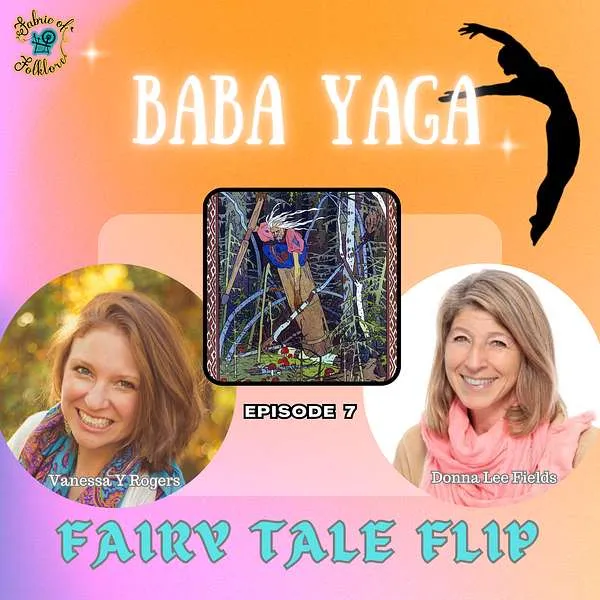
Fairy Tale Flip – Ep 7: Baba Yaga, Villain or Heroine
What do you know about the evil Baba Yaga, the most famous of the Russian fairy tales? Baba Yaga is one of the complex characters, and therefore one of the most fun and fascinating to discuss. In episode 7 of Fairy Tale Flip, Donna Lee Fields and Vanessa Y Rogers discuss the deeper meaning of this ambiguous child-eating witch who lives in a hut with chicken legs. We discuss the significances of her hut lit with skull lanterns deep in the forest. We explore the hidden meanings of the forest, Baba Yaga’s frightening physical characteristics of iron teeth and long nose. We delve into other mythological figures, goddesses and trickster characters that share similarities with Baba Yaga. We look at the symbolism of death and rebirth, agism, finding one’s own hero’s journey. Its such a great episode!
Further Reading
Baba Yaga by Andreas Johns
The Witch Must Die Sheldon Cashdan
Baba Yaga (the version read for this session)
Vasilisa the Beautiful and Baba Yaga
BABA YAGA STORY TIME on YouTube
- 📚 Overview of Baba Yaga Stories (03:01 – 15:00)
- Discussion on the general plot of Baba Yaga stories.
- Vanessa provides a synopsis of the chosen Baba Yaga story.
- Comparison of different variants of Baba Yaga tales.
- 🧙♀️ Character Analysis of Baba Yaga (15:01 – 45:00)
- Discussion on Baba Yaga’s physical characteristics and symbolism.
- Comparison of Baba Yaga to other mythological figures and trickster characters.
- Analysis of Baba Yaga as a mirror for human duality and morality.
- 🏡 Baba Yaga’s Hut and Symbolism (45:01 – 1:05:00)
- Description of Baba Yaga’s hut and its features.
- Symbolism of the hut in relation to death, rebirth, and duality.
- Historical and cultural context of Baba Yaga’s hut.
- 📖 Historical and Cultural Context (1:05:01 – 1:30:00)
- Discussion on the historical origins of Baba Yaga tales.
- Comparison of Baba Yaga to various godde
Follow us:
Fabric of Folklore website
Donna: 0:02
We are live.Vanessa Rogers: 0:03
I think we might be live. Alright. I’m trying to get Instagram going. Hi, everybody. How is everyone doing this lovely Thursday morning? What’s the weather like where you are, Donna?Donna: 0:21
It’s very hot. I’m in Valencia, Spain, and it’s already very hot. Summer has arrived, Vanessa.Vanessa Rogers: 0:28
Yes.Donna: 0:28
So my poor dog is out, too. Yeah.Vanessa Rogers: 0:32
We had the most beautiful spring. It was really mild and it was lovely. And then it’s like our switch turns on in Texas and it just becomes an inferno. And it’s like walking into an oven, but a humid oven because were in south central Texas. And so it’s very humid here. And so the other day it read that it was 100 degrees, but it felt like 112 because of the humidity. And I was like, what is happening? Why is it so hot?Donna: 1:06
Yes. And actually, that plays right into the story that we’re going to be reading because it’s about, you know, children being put in ovens. Oh, how horrible. What a horrible connection. But I just had to say that.Vanessa Rogers: 1:18
No, that is a great connection. Thank you for that. All right, why don’t you introduce us, and then we’ll get started into this fun fairy tale flip.Donna: 1:29
Okay. I’m so excited to be able to do the introduction. Vanessa usually does it so beautifully, and she’s trusted me to do it, so hopefully I will do it well, as well as she does. I’m Donna Fields. I have my own podcast, which is called Doorways to learning, which is actually on hiatus for the moment because I’m going through a lot of paradigm changes, which we’ll go into another time. And I have this absolute pleasure to work with Vanessa y. Rogers, who has the podcast fabric of folktales. And we decided to just join and talk more, even more about fairy tales, which we are both passionate about. So in this.Vanessa Rogers: 2:04
Yeah, absolutely. And today we’re going to be talking.Donna: 2:10
No, no, go ahead, Vanessa. Go ahead.Vanessa Rogers: 2:13
But actually, I just realized one of.Donna: 2:17
Okay, so what I was going to say is the fabric of what we really love doing in the fairy tale flip. And fairy tale flip is all about taking a fairy tale and flipping it on its stomach and looking at its belly and seeing what has been hidden, what we probably intuit, and what children absolutely intuit when they read fairy tales and just articulating it. And so today we’re going to be doing one of the Baba Yaga tales, and you’re going to hear both of us sort of humming and hying because there’s so many versions and it’s very easy to get mixed up, but all of them are valid, and we’re going to talk about the general overlapping ideas in all of them. How’s that, Vanessa?Vanessa Rogers: 2:55
Yeah. Yeah. No, you did great. It’s actually fabric of folklore, but it’s fine. My podcast, fabric of folklore, but yes, that is a beautiful introduction, and yes, baba Yaga, I’m really excited about this one because she’s such a complex character, and there’s so many theories about what she symbolizes and who she is. And I’m just really excited to get in to this episode with you. And I’m going to give you a synopsis of the story that Donna chose and the one that we put up on our YouTube channels so that the listeners could get an idea of Baba Yaga if they hadn’t heard Baba Yaga’s story before. And I was just telling her before we hopped on, I was making sure it was the correct one because there’s so many variants, and so it often gets jumbled in my head. So the version that Donna told was there was a girl, and she has a, an evil stepmother, as many fairy tales start off with. And the evil stepmother sends her into the woods, and she finds Baba Yaga’s hut. And, but the girl is kind, and I think someone actually tells her she needs to be kind in some of the variants to live if meet Baba Yaga. And so she oils the gates that is very creaky so that it doesn’t creak anymore. She feeds the barking dog. She goes in, and she feeds the cat, who’s about to attack her. She feeds her some little scraps as well. And so she’s being kind to all of Baba Yaga’s servants. And after she feeds the cats, the cat tells her she’s going to eat you. Baba Yaga is planning on eating you. You need to escape. And how you can escape her magic is by taking this comb and this towel, and when she’s coming up behind you, throw them behind you one at a time, and it will deter her. And so the girl escapes, and none of the servants, Baba Yaga’s servants, actually stop her because she’s been so kind. And she throws a towel behind her, and it turns into a river. Baba can’t fly over in her mortal and pestle flying saucer type thing. And then she throws the, behind her, and it turns into a forest, and Baba Yaga is boarded, and the girl survives. And so that was the original story that you told that did I get all the elements right. In that story, you did it really well.Donna: 5:46
And the reason why I chose that story, by the way, is because it’s the most generic because I actually used VasILa the beautiful in my thesis. And I love that story, but it had a lot of elements that didn’t really overlap to the. To as many of the others as I wanted. So I used this one. But it has the basic elements of Baba Yaga and how the heroine, there’s also some with heroin, with heroes, with boys. But of course, you and I probably like the heroine a little more because it sits with what, the message that we like to open up and looking to.Vanessa Rogers: 6:26
Yeah. And there. And this story is generic, but there are tons of different variants in this one. One of the variants I read was that the girl is actually the daughter in law of Baba Yaga, and Baba Yaga sends her to her sister, because there’s variants where Baba Yaga has multiple sisters or multiple daughters. And it starts off the variant that I had read. She’s trying to kill her daughter in law because she doesn’t like her daughter in law. And so she tells her to go milk some cows, and it turns out that the cows are bears. And then she tells her to go shear the sheep, but it turns out the sheep are wolves. But each time, her husband, Baba’s actual son, stops her and warns her not to follow her mother in law’s instructions. And then Baba Yaga, in a last ditch effort to have her murdered, tells her to go to her sister in the woods. Her also named Baba Yaga, who will murder her. But she escapes. And so Baba Yaga, the original, has more respect for her, which I thought was a really interesting twist. Have you read that one before, Donna?Donna: 7:41
No, I didn’t read that one. What I do find interesting is that you found that she has a lot of sisters. And in the version that I read, the stepmother is one of Baba Yaga’s sisters. And I had never known that Baba Yaga had sisters. And it just sort of encapsulates a lot of the evil that’s going on in fairy tales. So if it’s okay with you, let’s talk about first the general idea of Baba Yaga as an evil character in the fairy tale. Can we start there?Vanessa Rogers: 8:10
Yes, but I think I didn’t do a good enough job of describing her. Should we describe her first? Because I think that is a really important element to seeing her as evil.Donna: 8:22
Sure. Sure. Go for it.Vanessa Rogers: 8:25
Well, I loved when you were telling the story in the YouTube channel version, because you talked about her iron teeth, which is an element that I hadn’t heard about before. And sometimes in some of the stories, she even files her teeth down into points so that she can eat her prey easier. And I should warn people that are parents who might be listening. With young children around, this might not be the best episode to listen to with young ears, because Baba Yaga is not a kind character. So just fair warning. Baba Yaga, one of her characteristics is that she eats children, and so that’s one reason why she has really hard teeth and she sometimes sharpens them. She’s described as basically the hag of hags, right. She’s the gold standard of hags occasionally. I mean, like, she’s. She’s a really long nose. She’s very wrinkly. She has gray hair. Her breasts are so long that sometimes she has to hang them up. What are some other characteristics that you like about her?Donna: 9:39
That I like about her or that.Vanessa Rogers: 9:41
You hear about that I hear about her.Donna: 9:44
I mean, baby Naga is the archetype of the evil witch, but they really do spend a lot of time describing her physically, which is not normal in other fairy tales about witches really is. Their actions are more important than the physical. So I love that you’re focusing on the physical and part of what this is. And people need to know also that this is a slavic character. This has a lot. She emanates a lot of the slavic culture. And so in the slavic culture, either many years ago, many hundreds of years ago, or maybe still in the smaller villages, baba Yaga symbolizes what women shouldn’t be, what is not acceptable in women. But we need to take that with a grain of salt. So anything in social media that might try to help form our ideas, we need to decide if that fits with our own beliefs. And so baba Yaga is the character that women shouldn’t be, why? Women shouldn’t be ugly. Women shouldn’t be defiant. Women shouldn’t be very strong. Although she goes to an extreme, I really do admit that. So, yes.Vanessa Rogers: 10:59
All right, tell us about how she’s perceived as evil.Donna: 11:04
Well, my whole thesis. I’ve talked about this before. My whole thesis is the witch is actually the heroine of the fairy tales, because the witch helps people move forward. And I thought, baba Yaga’s just gone too far. Baba Yaga is just way too extreme. And then I’ve been thinking about it and realized that she does exactly this. She is sort of. She is a mirror for people. And actually, Sheldon, I was just looking at a book that I really appreciate. I don’t. You must have seen this. The witch must die. ShELdOn CALdoN, for people who aren’t watching the YouTube, he is brilliant about breaking down witches in general. And the other one that’s about Baba Yaga specifically, which is absolutely beautiful, is the Baba Yaga, the ambiguous mother and witch of russian folklore. And that one’s by Andreas Johns. And so, basically, I was thinking about it. What they say is that baba Yaga is basically a mirror for us. So if you don’t mind, let me just set this up in context. We live in a dual world. We live in a world of duality. And what I mean by that is that everything we do is an opposite of something we aren’t doing. So if we’re sitting, we’re not standing. If we have a disease, we are not healthy. If we’re healthy, we might not have a disease. If we didn’t have war, we wouldn’t appreciate peace. Peaceful solutions. Without darkness, we wouldn’t appreciate light. Without community, we would. Without this urge, the human urge that we need to be. We are communal. We would be very solitary and probably wouldn’t procreate as much as we do right now. So we live in a dual world, and baba Yaga represents a lot of that duality. And what she does, and I’d love to talk about this to see if you have thoughts on it or if this leads you into thinking some other elements of the story, is that she holds up a mirror to the heroines. She holds up a mirror to us. And what she does is shows children that they are not these sweet, lovable children that they think they are. They have another side. All of us have a darker side. And what she does is holds up this mirror and says, this is your. I am your darker side. I am all the shadows that you don’t want to admit to. And so you can either join me and I will eat you up, or you can find the goodness inside of you, which is what the girl in the version we read did. And she got out of the situation by being kind and generous and recognizing the humanity, even though these were animals. And even the gate becomes a sentient being, and she helps the gate feel better. So the context for me is this duality. And I think Baba Yaga does exactly what I’ve said in all the other, is that she pushes us to find our best. So I’m not sure if you’d like to comment on that or if that leads you to something else that you were thinking. Vanessa.Vanessa Rogers: 14:05
Yeah. No. And I think that leads into that. A lot of people see her as a trickster character. So when I was looking at tricksters, you might think of Loki and norse mythology, Anansi in Ghana mythology, the coyote. In a lot of the Native American, a lot of native american mythology, she is an agent of change. So, yes, in all the stories, Baba Yaga is the epitome of unkind. Right. She is not kind in the least, but her character serves as a way for the main character, the heroine, most of the time. But sometimes you mentioned there are princes involved or males to change their life, usually for the better. Right. So you were talking about the shadow, which I felt was really interesting because one of the psychologists, many people, we’ve mentioned him before, Carl Jung talks about Baba Yaga and he says the trickster is a manifestation of another psychological archetype, the shadow, the dark and unknown aspect of the individual and communal personalities usually rejected or suppressed. The shadow appears in dreams, visions, religious tales and legends representing what one fears or at least finds unpalatable in oneself. And so I think that is exactly what you have been saying, that she’s kind of the mirror and she’s the dark to the light, but without darkness, there is no light or we don’t appreciate the light. And so it’s really interesting that she is so demonic even. I’m not even sure if that’s the correct word. But she’s more evil than most wicked, evil witches in a lot of fairy tales, in part because, you know, she’s seeking out children to eat. In some of her stories, she commands black geese to go find her children to bring to her so that she can eat them. So it’s really interesting looking at her as this catalyst for change instead of just this straight up villain. Yeah, I love that.Donna: 16:43
Yeah. And the other. And to further that thinking, the witch must die, I found fascinating because I don’t think the witch has to die. And the fact is that in most fairy tale, and Baba Yaga doesn’t die in any of the versions, she doesn’t die as far as I understand. And the witch does die in most fairy tales or she disappears or something, baba Yaga is, oh, she is always present. And what does that mean? Psychologists like young would say probably that it presents a moral issue, that morality is not black and white, that there are always questions. And so the fact that baba Yaga is so evil and yet she lives, she always finds a way to survive. Just kind of it reminds us that our lives need to be studied in the gray areas, because it’s so satisfying to have a happy ending. And you and I know, as Americans, we love happy endings. It satisfies the psyche. It satisfies our emotions. Everything is perfect. We can go on. Whereas in real life, most of the time, not everything is perfect. We have to find compromises and feel comfortable. So I find that fascinating in the baba yaga versions that there isn’t black and white.Vanessa Rogers: 18:01
Yes. And we should talk about how. So in your version that you told, when the heroine leaves, her stepmother is no longer there. The evil stepmother that sent her out into the woods. Right. She has left, and she ends up happily ever after with her father, who realizes that her evil stepmother was bad. And so that is the happily ever after for that heroine. And in some versions, she becomes her own person, even without, you know, most fairy tales, they end with a marriage of sorts. But in this version, sometimes she gets married, but sometimes she finds a trade and just becomes her own person, which I think is really fascinating for a fairy tale because most of the time, heroines of her age are of marriageable, and so they of marriageable age, and so they should be married. So what you were talking about that she, what were talking about, how she is a catalyst for change and inviscilla the beautiful. I’ll just give a little brief description of this one, because this is the first story I had heard from Baba Yaga, and it also starts off, and I get them to confuse. It starts off with another evil step mother. But the girl, Vasila, has a doll from her mother in her pocket. And it’s basically, it seems to kind of hold her mother’s soul in some ways, because the doll is always giving her messages of what to do and how to not get eaten. So the evil stepmother sends Vasila into Baba Yaga’s hut to get fire for the family. And so the doll leads her to Baba Yaga’s hut. And as Baba Yaga is asking her questions, the doll kind of, like, shakes her head or alerts her to when there’s danger so that she can get around angering Baba Yaga too much. And in the end, baba Yaga sends the girl away with fire. And some versions, the fire ends up overwhelming the evil stepmother and evil stepsister. And in some versions, they have, they’ve just left. And so in the end, Vasila is lives happily ever after because of what the interactions she’s had with going deep into the woods and finding fire and coming back out of the woods, a.Donna: 20:42
Stronger female okay, so that’s perfect, because what we also need to recognize, which we may forget, is that going into the forest means change. The forest means a death in some. In some sense, a death of your identity, a death of your previous life. And it was especially in the Baba Yaga versions, you go into not only the forest, but into her hut. Most of the heroines go into her hut, which is, you know, the scariest place you could possibly go because of all the things happening. And it’s on a chicken leg, and we’re going to talk about the chicken leg later. And both of us, it’s very hard to study baba yaga without reading so many versions. And so what I wanted to just go back really quickly to the version that I was reading. In the YouTube version, the stepmother is actually at the house still when the girl goes back, but she has become so confident. She was not confident when she left. Her stepmother ordered her to go into the forest and ordered her to go to Baba, and she did nothing to change that paradigm. But coming back, just the fact that the stepmother saw her, she went pale and ran, and the girl found a way to explain to her father what had happened, and the father chose her this time instead of the stepmother. And I think I even mentioned at the end of the YouTube version, what was he thinking, believing his wife over his daughter in the first place? But at least in the end, he believed his daughter. But it was her, Vanessa. I mean, I think you’ll agree that it was a whole paradigm change. Going into the woods, conquering her fear of this evil witch, finding the goodness inside of her, and going back and saying, you know what? This is my home, and that’s my father, and this is the life I want. And she did.Vanessa Rogers: 22:28
Yeah. Finding her fire, I feel like that’s a symbolism for something, right? Finding her fire, not no longer being the victim.Donna: 22:36
Nice. Very nice. So what, there’s also, if we can, we talk about the slavic tradition in Baba yaga a little bit. Did you do any research on that? Because I just found what I found was fascinating about the obscenities and about the, you know, what you were saying is about her big breasts and sometimes the graphic nature of her body and how she had to care for it. Did you. Yes.Vanessa Rogers: 23:02
Please talk about this, because. And this comes from the book that you were researching from the Andrea Johns. Is that the author’s name?Donna: 23:10
Yeah. Yes.Vanessa Rogers: 23:12
Okay. Yes, please talk about that, because that was really interesting reading.Donna: 23:16
Well, just some of the things that I found, which I found fascinating because I’ve never studied the slavic culture except reading Tolstoy when I was in college, which is, you know, Tolstoy is dreamlike, but he doesn’t talk about this part. And that children were, I think this is in the chinese culture as well. Hopefully that’s correct. Where the. Sorry, I’m just trying to make sure I get this right. In the lullabies, there are a lot of wishes for children’s death. And why is that instead of, you know, lullaby, sleep well and I love you, they would talk about, sorry, I’m getting a little bit of loss thinking about this because it’s so strange. The women will call the baby. No, I’m sorry. The babies will liberally call the mother and the nannies whores. And excuse me for saying this on this program, but females, and that was very common. Maybe it is still common in the peasants, in the peasant lifestyle, which she is.Vanessa Rogers: 24:18
She quoted it from 2004. So that was more, I mean, still recent with we know within 20 years. So I don’t know about modern day today, but yes, it was. It’s seem like it was still modern enough.Donna: 24:34
Right, right. What I was saying, there’s a lot of correspondence with some of the asian cultures where if you spit on the child or call them, you know, if you call them evil, it’s actually trying to save them. But there is a tradition in the slavic culture that they did think a sick child who had evil spirits in them. And so there was this, I think it was sort of a survival instinct where you kept your heart away from a sick child because you probably lose that child if there wasn’t as much medicine a hundred years ago. But it really was very blatant and pretty harsh.Vanessa Rogers: 25:14
Yeah.Donna: 25:14
And.Vanessa Rogers: 25:17
I read that when you sent it to me, and I was trying to look into more russian culture in relation to Baba Yaga, but I wasn’t able to find what I really wanted. I did an MBA program international business, and I did study Russia slightly. And I do remember that part of their culture is that, especially to Americans, they seem cold natured, they seem standoffish. And you see this a lot in places with weather such as theirs. There’s a correlation with how harsh of an environment Russia is in the personalities of Russians. Now, they do say that when you are family and you’re close knit, that there’s very strong ties. And so that harshness, you know, is only so thick. But to strangers, Russians are extremely. Can be very cold, it seems. And so that was really interesting. You know, in their lullabies, they would you know, wish for their children’s deaths. And I wonder if it’s you like what you were saying, a coping mechanism. Like, I want to be able to steal my heart because I know that there’s a possibility that you might not make it because children didn’t make it a lot of times. Right. I don’t know the statistics in Russia, but I’m assuming that they were high infant mortality rate, high children mortality rate. And so that would be very difficult to deal with as a mother. And so, yes, I thought that was really interesting.Donna: 27:09
Yeah. And the whole idea of living in the harsh environment, it is much colder, and there wasn’t medicine. And if you were poor, you didn’t have access to clothes or homes, even homes that would keep you alive all the time. And I think Baba Yaga’s hut reflects a lot of that. You go in, I mean, it’s scary. It’s a scary hut, and it’s standing one chicken leg. But the chicken leg has three clause. And some people actually believe that is reflection of UFO’s that peasants believe landed there. That is a big juxtaposition. But there is some history to that, which I think is fascinating.Vanessa Rogers: 27:49
There’s history to the UFO’s.Donna: 27:51
There’s a history of UFO’s in the slavic condition. Yeah. They believe that these three really, they reflected the three legs of a UFO landing. The landing gear. I mean, that’s one. That’s one. The other part of it is that animals. There’s a tradition about animals, and if you’re living in the forest, you need to be very careful about animals. And so this is baba Yaga living on animal. Now, a chicken is not a wild animal. It’s not necessarily going to kill you. But this is a scary looking chicken leg, and it’s a manifestation of more of the fears that peasants had to. That was part of their reality. Where would you like to.Vanessa Rogers: 28:42
I looked into the chicken leg house, too. Let’s describe her. Let’s describe her house, because her house is really interesting. It’s made of. So you were describing it. It stands on a chicken leg. Sometimes in a lot of pictures, I actually see two chicken legs. So I guess it depends on the variations, the different variants.Donna: 28:58
Yeah.Vanessa Rogers: 29:00
And the. The house is animated, and the chicken leg is. Can move. Right. It can turn. And the windows are the eyes. Right. And the door, I believe, is the mouth. Is that. Yeah. Yeah. And so. And then around the house is basically a fence of bones, human bones, and lots of skulls filled with that are now transformed into lanterns with light in them. Right. So walking into the place where baba Yaga lives, you are walking past human bones with lantern skulls. So it is incredibly frightening without it being on a chicken leg. And then I found that in ancient times, in Russia, there were houses that were placed on stumps with cut roots to protect the tree from rotting. And that was in the finnic. I’ve lost where it was, but it’s in a very specific area that they do this. And a lot of times those homes that they put on these stumps that had the roots weren’t actually homes, they were storehouses. The baba yaga’s house always is described with a furnace. And this confuses me a lot because she kind of feels stuffed in there. She’s kind of like cramped in there. And yet people always walk into her house. Do you have a better concept of that, Donna?Donna: 30:50
I don’t have a better concept of the fact that she’s cramped in there, and yet people find ease to get in. But the way you just described the house is very similar to northern Spain and Galicia. I forget what they’re called, but they’re very famous. They’re the warehouses that are placed on top of stumps and it helps the air come through and keep all the grain fresh throughout the summer and the winter. So there is a tradition of this that’s fascinating.Vanessa Rogers: 31:21
Yeah, yeah. I thought that was really interesting, too. And then it also moves. Right, and so you were talking about the death element. I had read that Baba Yaga’s house is almost like a. I read a couple of things. One is that it’s like going into death and rebirth, and then also. So rebirth as in, like we’re talking about Vasila coming out, a new person, right? A stronger female, her own person, no longer a victim, but also heroines of the menstruation age, rebirthing from a child into a woman. And so seeing the hut as a rebirth for female hood.Donna: 32:21
And that’s perfect, Vanessa, because to reinforce that whole idea, there’s a lot of slavic traditions, the burial practices, is to place ashes of the dead on these small hut shaped structures, and they were often on short poles. And so it reinforces the idea of death and rebirth. Exactly what you’re saying.Vanessa Rogers: 32:41
Yeah.Donna: 32:41
And there’s also, if you don’t mind me just continuing 2 seconds more, the whole idea of the movement of the hut on chicken legs, it also is. It’s speaking about the juxtaposition of stability, which is what we usually think of in a home, and instability this home is exactly that. It’s two opposing forces. It’s a solid structure that moves.Vanessa Rogers: 33:06
Yes, yes. And that’s what. Exactly what you were talking about before is the DualiTY. Right. There’s all. There’s DualiTy in our lives, and in one place is the DualiTY together, which is, you know, a difficult concept for us to hold. Not black, not white. Right. So it’s hard for us to kind of stand in that ambiguity.Donna: 33:36
Yeah, I like that. There’s so many things. There’s so many things in Baba Yaga. There’s. I don’t know if you’ve read this, and I don’t remember this when I was doing my thesis on Bacilla and the beauty that some people believe the baba yaga is blind. The way she interacts with heroines is she usually smells them or she usually listens for them. And it’s another element of the birth and death theme, because what they say, a lot of times, if you’re studying mythology and spirituality, the spirits find human smell kind of disgusting. And so Baba Yaga usually is smelling for humans, even though she wants to eat them. She is listening, and she. Well, I don’t know. What do you think? Have you read anything about her blindness? And do you think that impacts anything of the story?Vanessa Rogers: 34:29
I didn’t read anything about her blindness, but I. I did read something about her nose going. When she gives knowledge, and some descriptions of Baba yaga. Her nose is very long, and she’s hesitant to ever give any sort of answer to any question that anyone gives because her nose will get longer. I. I only read that one place, so I don’t know. I mean, maybe that’s just one story, but I thought that was really interesting. Did you read that?Donna: 34:58
No, I didn’t. But, you know, we’re going to have to study Pinocchio, then, because obviously, that’s a theme in fairy tales, and that means a lot more than we know right now. Another one of those things. We need to flip the belly and.Vanessa Rogers: 35:09
Find out what that’s all about, what that actually means. Well, so since we’re talking about historical references, let’s talk about the history of Baba Yaga. I found that the first writing written form, baba Yaga, is from the slavic russian folk tales. No, it’s a russian grammar book in 1755 that was talking about russian folklore. But obviously the stories are much older. It was just the first written record of Baba Yaga. There was woodcut art, at least from the 17th century as well. But they think at the very least, that baba yaga stories come from the pagan traditions from pre Christianity, which I believe in Russia was in 10th century, are really bad with timelines. And so these stories are very old. Did you do much research into the historical reference?Donna: 36:16
Yeah, I knew you were going to ask me that, and I did read it, but, you know, it’s not one of those things that I really like, and so I don’t retain any knowledge of it. So I really appreciate your research. And I was just looking for my book in it just. It goes on and on. I’m like, okay, you know, it’s long history, baba Yaga, but I like getting into the meat of the character. So good on you, Vanessa, that you have this history written down.Vanessa Rogers: 36:40
All right, well, so what I. So, you know, we’ve talked about this in the past. A lot of these stories come from pagan traditions. But then once folk tales and fairy tales, they’re living, breathing stories. Right. The reason that there’s so many variants is because it changes with the storyteller every single time. Right. Depending on the times for the teller, the audience. Right. So stories are meant to be changed based off of what is happening and the context that’s current. Right. And so it goes to show that when Christianity comes into Russia, they changed the narrative because they wanted to change more into perspective of what the christian values were as opposed to what the pagan values were. Right. So once Christianity became the official religion in Russia, the clergy wanted to try and suppress folk tales and folklore. And a lot of times they just incorporated it into their own. Their own version. Right. And so Baba Yaga’s roots can be traced back to pre agricultural culture, but Russia took a long time to actually change from pagan traditions into Christianity. It was one of the holdovers in Christianity. So we can actually look at it as more historically accurate than a lot of folk tales that we have seen, such as, for instance, the smith and the devil that we talked about last time, where a lot of the versions that we saw were really had a christian element to it. But they think that the Baba Yaga stories held truer to the original versions. Obviously, I’m sure over the millennia, the thousands of years, it has changed, but they feel that it actually has a little bit more truth to what it was once in the pagan times. So I thought that really interesting.Donna: 38:56
Yeah, because when they turn into. When they have a lot of christian references, I have problems with it because it really dates it, then it really places it in specific times. And this one, as you say, it really still retains a lot of the peasant and pagan beliefs. And maybe a little further on, there’s also some Jack Zeitz, who is one of the eminent scholars of fairy tales. He says that baba Yaga symbolizes the feudal system, and it talks about the greed and the brutality of aristocracy and how baba Yaga is either representing aristocracy or she is. You know, she preys on aristocracy, which isn’t. It’s not literal, but it does give you that sense that there’s. We talk about duality again, that there’s opposing sides. And the other thing that I think is interesting is that you’re saying that there are different versions and that it’s personalized by even the storytellers. And there is a tradition in the. With the peasants about Baba yagawa. The storyteller would use one of the names of the little girls who were listening to make it more personal. So there are very specific messages that in the slavic tradition, they wanted to.Vanessa Rogers: 40:11
Pass on, which I would find incredibly frightening. I don’t know about you, but if I was in the audience and a storyteller used my name to talk about going into the hut of Baba Yaga, I would not enjoy that.Donna: 40:26
No, no, I think I would agree with you. I would agree with you 100%. But they were trying to make a point, so.Vanessa Rogers: 40:32
Okay, so I know that you probably did some research into the nature element and the goddess element. Did you look at that at all?Donna: 40:43
Trying to think, if I can put this in respect the nature element. I really just went as far as saying that going into the forest is the death of your personality. As I was saying before the animals, it’s very important that the humans who are also animals, as I remind my neighbors all the time, excuse me, a little transition. That humans are interacting with the animals of the forest. And then it’s really important that they’re, in the version that I was reading in the youtubers, that they’re respecting them, that they’re recognizing them as sentient beings. So not just the gate, but the. Sorry. Not just the cat and the servant, but the gate as well, and the dog, this ferocious dog, that she came just by her kindness.Vanessa Rogers: 41:29
Well, I saw, in my research, I saw her compared to at least five different goddesses. And so she was compared to Persephone, the greek goddess of the underworld, who is kidnapped by Hades and ends up marrying Hades. I saw her compared to Hecata, who is also. She’s the crone of the daughter, mother Crone version in the greek mythology. So I don’t know. Hecata’s story quite as well. But she is the crone in that female trilogy. I saw her compared to a female spirit of mother earth from old russian Slavic. There was one that was also the goddess of death called Yagya Baba. And then I saw, oh, there was another one, a hindu goddess of death that she was compared to. I mean, so many goddesses. I was like, everybody had a different theory about what Goddess Baba Yaga represented. There was one that I really liked from a german mythology, Frau Holly, I think it was. She is the goddess of weather. And it said that when she changes her blankets out for winter, she shakes out her blanket and it snows. And the reason that she is constantly compared to these goddesses of nature and of death is because nature is unpredictable. It’s untamable, just like Baba Yaga is. And so she is this representation of the untamable mother Earth. You can’t control the weather, you can’t control nature, you can’t control Baba Yaga. She’s going to be who she’s going to be, and she’s the epitome of a female who has decided that this is who she is and no one’s going to make her do anything that she doesn’t want to do.Donna: 43:57
I think that was an incredible breakdown of possible correlations with other goddesses. The only one that I would object to was the first one, Persephone. And sometimes I’m very protective of Persephone, and other times I’m really dismissive of her because she was obligated to marry Hades and live there, sometimes nine months of the year, sometimes six months of the year, depending on where you are and how many, you know, how long winter is. But she was just either tricked into marrying Hades or she was just really oblivious and did things that she didn’t need to do. And Baba Yaga is her own woman. Baba Yaga lives there. No one’s obligating her to live in the forest and no one’s obligating her to act as she acts. She is really her own character. And she is pretty beautiful in how persistent she is in her evil choices. I’m not as familiar with. I’d love to dive a little deeper into the whole Persephone sometimes, but just thinking about her now, Baba is so much more interesting. That’s so much more depth to her, believe it. Or that’s how I see her.Vanessa Rogers: 45:06
Yeah. Yeah. And I think that the reason she has a lot of, well, one of the reasons I think she has so much depth is because of the variants that you see, she, there’s variants across, you know, so many different countries. She’s even found in Poland. There’s a character that is very similar and also has a similar name to her in Japan, Yamamba. She’s strikingly similar to Baba. She is portrayed as having repulsive physical features, a taste for children. She’s morally ambiguous, alternatively described as a monster cannibal or an agent of change and transformation and a guardian of heroes. So those are all very similar elements that are found in a japanese folklore tale. I was really interested to hear find if there were other characters found in other places. And that one was the closest that I found. There’s another one in Poland. There’s another one in Czech. That’s a milder version of Baba yaga. And she is compared, she’s often compared to Jahi, a female ruler of minstrel power. And she’s mild and demoted to a cottage in the woods, which makes sense if she’s in charge of menstrual power, because a lot of times, you know, really ancient times, women went to a house when they were on their menstruation and were all together by themselves, not with men. Right. That would, that would kind of make sense, right.Donna: 46:44
They also got a lot of, I mean, if you’re going to look at in the spiritual format, women together, menstruating is incredibly powerful. And you can, they really did, they were more active at night because it was when the messages from the universe could come in. So they really were respected. It wasn’t as if they were being banished. It was that they were being honored. So hopefully we can say that. And again, I just would like to take, make sure that people will pause when the emphasis is on Baba Yaga’s physical features, because I just find, I mean, there are women who, humans that have non standard features, that are also beautiful people. But if we just look at their physical features and be repulsed by them, then we’re missing a lot of the beauty of being humans. And so if we take the literal description of baba Yaga and encourage children to be scared of a woman with big breasts and be scared of a woman with long nose and be scared of a woman who screeches, for instance, not very pleasant, but we just want to, I would hope that we let children get out of these stories, what they will, and also help them expand their thinking about what the message might be and what they. The shades behind it.Vanessa Rogers: 48:09
Well, and I think that when you’re talking about the physical features, I think it’s important to note that, you know, the ageism for, especially for females, right. You don’t see this type of description for men. A lot of times, this horrific vision of what a male looks like when he ages. But you see women, right, like women are this, like, idyllic beauty in their maidenhood, and then they’re even, you know, appreciated for their ability to give birth and give life. And so in motherhood, there’s still, you know, there’s still value in them. But once they’re past that stage of life, what value do they have except for as a hag or crone? And so, yeah, I think that is definitely a representation.Donna: 49:06
Yeah, I love it. I mean, my own reaction, I can see when I was just, I was on the metro today, and I never go on the metro. I have my own car. But today I didn’t. And I realized that I was looking at these women, and if they were overweight, I was immediately judgmental. Or if they weren’t, as you say, this beautiful, the model that we see in social media and on the movies, etcetera, I became very judgmental. Where did that begin? I think it’s important that I recognize it. I think it’s important that I reflect on it. And I would love us all to be a little more reflective. And I just love the fact you brought up that it’s usually women and not men where these physical ideas begin. Men are, woman is reviled. We’re an overweight man. How many actors do we see who are overweight? And we think that they’re hysterical or beautiful or wonderful.Vanessa Rogers: 49:57
Yeah. And I, and I think we’ve talked about this in the past about, you know, the purpose of what fairy tales are like. What purpose do they hold in society? And they, like you were talking about before, they’re mirror images right there for us to be able to see what the world is seeing what, how we see the world. Right. And so when we look at a fairy tale, it is so that we can view the eyes through society and decide whether or not that is how we should be viewing ourselves. Right. Do we want to see old women? Do we want to see the aging of women as horrific? Or do we want to see women in their wise states? Because, you know, at some point in our history, women, old women in ancient tribes were seen as the wise women, the holder of tradition, the holder of knowledge. Right. They were revered, they were respected. And it would behoove us to gravitate towards that type of thinking again.Donna: 51:14
I think we’re going to have to spend some time in the future talking about the tarot cards and the archetypes and tarot cards where you have the maiden and you have. There’s something in the middle, and then there’s the crone. And just the word crone has a negative connotation. And yet, in the tarot tradition, the crone is the wise woman. The crone is the one who is more passive and more peaceful and who has wisdom to give. And so I think that would be a wonderful place to start in one of our future sessions.Vanessa Rogers: 51:40
Yes, absolutely. All right. So did we miss anything? I know we didn’t talk about evil stepmothers, but we can save it for another time, unless you want to talk about it today.Donna: 51:49
I think we have done an incredible job of wrapping up baba yaga in a very short time, so it’s a start for people. I really hope that they choose any version. Although I think Vanessa and I both like the sola, the beautiful.Vanessa Rogers: 52:02
Yeah, I really like that version. And then there’s one about a frog princess or princess? Frog princess. Frog. Frog princess. I don’t remember that one. Seemed interesting, too. I need to look into that one further.Donna: 52:16
How about if we put it in the show notes and encourage people to read all of them? All of them?Vanessa Rogers: 52:20
Yeah, just read all of them. So we should talk a little bit about this summer months, at least June and July 1 of the decisions that we. The structure that we’ve been doing fairy tale flip in is that we’ve kind of created it to be a little bit like a book club because we want the audience to be involved. We want you all to be able to have a say in what stories we are choosing. And so we decided for June and July, instead of having new suggestions, we’re going to. The only word I can think of is regurgitate, rebirth. Renew. Reintroduce some of the stories that were not chosen for June for you to choose from. So I honestly don’t have the list in front of me. Do you remember the ones that we chose? Donkey skin.Donna: 53:27
I love the donkey skin. I shouldn’t say that, but yes.Vanessa Rogers: 53:31
Oh, donkey skin. The night and the fairy and enchanted Mora were the ones that were going to put up on our polls for the audience to choose from for us to do in the month of June. So those will be the three that you can choose from for us to do a deep dive into, and we’ll put up those links as well.Donna: 53:54
Perfect. Vanessa, it’s been so much fun, as usual. Just loved it.Vanessa Rogers: 53:59
Yes. Any last words.Donna: 54:03
No, I can’t wait till the next session. I hope that people understand baba yaga a little more or just are more confused. And so you’re going to do your own research. That’s my hope.Vanessa Rogers: 54:11
Because baba Yaga is confusing. I mean, that’s the beauty of this story, is the complexity and the ambiguity and the duality and all of the things. So that’s what made it so much fun. We didn’t mention please subscribe either. If you’re watching on Donna’s channel, doorways to learning, or if you’re watching on fabric of folklore, the Facebook page, or on the Instagram page, make sure that you’re hitting the subscribe button on the YouTube channel. Or if you’re listening on the podcasting platform, you can hit subscribe button so that you get notifications. Because we do this podcast once a month, at the end of the month and we encourage all of our listeners to be a part of it. We want you to feel like this is your podcast that you can contribute to, you can ask questions of, you can give comments to. We love the interaction with the audience because that what makes us fun, the conversations that are had from the fairy tales. So thanks again for listening to fairy tale flip episode seven. And we can’t wait till June number eight.Donna: 55:20
Have a wonderful month until then.Vanessa Rogers: 55:23
Until next time, keep the fairy tales alive.