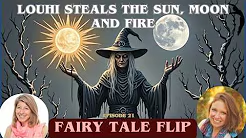
Louhi Steals the Sun Moon and Fire- Fairy Tale Flip: Ep 21
Can you imagine the fear of losing the sun every winter? Would it ever come back?
In episode 21 of Fairy Tale Flip we journey into the snowy landscapes of Finnish mythology to explore the enigmatic sorceress of Louhi from the Kalevala. Together we unpack the cultural and historical significance of Finland’s national epic and how it helped shape Finnish identity and independence.
We dive deep into Louhi’s character—her motivations, her power, and the consequences of her actions—challenging the traditional “villain” label and examining her through multiple lenses. Along the way, exploring the powerful symbolism of fire and light, the stark geography that informs Finland’s folklore, and the ever-present tension between darkness and illumination—especially in the shadow of the winter solstice.
We also draw fascinating parallels between Louhi and other mythic and modern figures—from Demeter to the Grinch—revealing common archetypes that echo across cultures. The conversation widens to consider themes of colonization, wealth distribution, power dynamics, and how ancient stories continue to reflect contemporary issues.
At its heart, this episode is a meditation on storytelling itself—how myths preserve cultural identity, how they help us navigate cycles of loss and renewal, and why the return of the light still matters.
Tune in for a rich exploration of myth, meaning, and the enduring power of stories to transform how we see both the past—and ourselves.
Chapters
00:00 Introduction to Finnish Mythology
01:03 The Epic Kalevala and Its Significance
04:11 Geographical Context of the Story
05:16 Cultural Beliefs and Animism in Finland
09:32 The Role of Fire and Light in Finnish Folklore
11:34 Parallels with Modern Stories
12:22 Historical Context of Finnish Literature
16:39 The Importance of the Kalevala in Finnish Identity
19:14 Character Analysis: Louhi and Vainamoinen
24:46 Transformation and the Nature of Power
32:04 The Duality of Female Characters in Mythology
34:20 The Complexity of Female Characters in Mythology
37:26 Power Dynamics and Female Leadership
40:28 Themes of Abundance and Hoarding
43:18 The Symbolism of Light and Darkness
46:14 Reflections on Winter Solstice Myths
49:18 Cultural Interpretations of Light and Shadow
52:13 Empowerment Through Storytelling
55:27 Controversies in Mythical Narratives
58:21 The Role of Perspective in Storytelling
Follow us
Fabric of Folklore website- http://www.fabricoffolklore.com/
Youtube channel- / @fabricoffolklore8449
Facebook Page- / fabricoffolklore
Facebook Group- / fabricoffolklorepodcast
Instagram https://www.instagram.com/fabric_of_f…
Twitter- / fabricofolklore
Linkedin- / fabric-of-folklore-podcast
Apple Podcasts: https://podcasts.apple.com/us/podcast…
Spotify: https://open.spotify.com/show/5eCrObj…
Transcript:
Chapter 1: Introduction to Finnish Mythology
Welcome, welcome to Fairy Tale Flip, episode 21. Is that right? I I think so.
Um, this is Fairy Tale Flip. I am Vanessa Y. Rogers.
I host a podcast called Fabric of Folklore and Donna Lee Fields is my co-host and she has a website called
Scaffolding Magic that is for educators and we come together once a month and we dive into fairy tales. However, this
month we are diving into mythology, a Finnish tale uh from the epic Kalavala,
which is a significant literary uh story from Finland called Lohei Steals the
Sun, Moon, and Fire. and Donna is gonna give us a little short rendition of the
story and then we’re gonna talk about this amazing winter solstice story.
Yeah, this is a big one, Vanessa. Um I called Vanessa a few minutes ago and said, “Oh my goodness, this is a huge mouthful we’ve taken on.” Because Loey,
Chapter 2: The Epic Kalevala and Its Significance
which is this really interesting witch, uh is part of this epic poem that’s now one of the most important pieces of
literature in the Finnish culture. And the Finnish culture we’re going to go into it has not existed as long as we think it has. It’s really only been about a hundred years or more because
it’s been it was invaded by different other people, other cultures and stuff.
So Loi um hopefully Vanessa is that what you discovered? Is that the pronunciation? Loey.
Yeah, like uh L O W low key. That’s how I pronouncing it.
Right. The only thing I know about Finnish is that the pron the s the stress is always on the first vowel. So it has to be Loey. So that makes sense.
Anyway, um this is part of an epic poem and the Calavella is a tale about the heroes of Finland, about real and
mythical heroes. And Loey appears in this tale. She’s just one little chapter of of part of this epic poem. And the
the Kala is is this I think it’s maybe a thousand or more pages. It’s a poem and and we can compare that to Homer’s The
Odyssey. In any case, it it talks about up to the arrival of Christianity and the departure of magic, which is very sad. I’m sure Vanessa, you feel that
way, too. And so, the Calavella has a lot of different tales in it. It talks about the adventures specifically here
of the sage Väomin. And I’m sure if there’s someone who’s Finnish who’s listening, you’re going to cry at that pronunciation. So, excuse me. and how he
uses his magic to accomplish great deeds like creating the canell which is the harp of the Finnish people and it’s a
traditional five string lap harp with a very distinctive sound and it’s also it’s still used in Finnish schools. We
need to know who he is because he is very important to the story of Lowey. Um he persuaded a blacksmith to forge the
sampo and the sampo is critical in Finnish history mythology. It’s a magic mill that grinds wheat from one side,
salt out of another, and gold out of a third side. And this was a bone of contention between two two people. And
in the end, it really did destroy one of those cultures. We we might get into that in the end. So the sampo, the mill is a bribe for the witchi by Voyen.
Um, and is the leader of the pohal. And if you listen to Vanessa’s retelling of this tale on her YouTube channel, which
is a beautiful retelling, the Poha is a magic land north of what we now know as
Finland because he wants to marry one of Loe’s daughters, which are always known as very beautiful, probably very intelligent also because she is a real
cracker. So anyway, Loe’s powers are vast. She has great magic. At one point, she steals the sun and moon and locks
them away. And the tail goes into a little more detail. Vanessa is going to fill in anything I haven’t said. But what we want to know is why and what does all that mean? Okay.
So, I’ve been pronouncing it pola for the the magical realm of the north. How did you pronounce it?
Chapter 3: Geographical Context of the Story
Um, po, but I you know that might be a little bit of a Spanish pronunciation.
And you’re right because it’s po. They do pronounce the J as a J. Okay.
Oh, okay. So when I looked it up, it looked like it was pronounced as a Y. So I’ve been pronouncing it with a Y sound. I think that’s correct. Yeah.
Okay. Yes. And so the only elements that I would So they um also there’s she
steals fire as well, but we’ll we’ll talk about that. So where do we want to start? I I always like to start with
geography because I feel like it helps to grind to ground us and and so we have a better understanding of where we are.
Is that okay with you?
I think that’s really important in the story because why is it so important that she steals the sun and the moon?
It’s it’s heat and light that she’s stealing. And why is this so important?
It’s very important for where these we are geographically located in the story. So please go ahead.
Yeah. So Finland is located in northern Europe. Um, it is very cold. The mean
Chapter 4: Cultural Beliefs and Animism in Finland
yearly temperature in the north is 27 degrees Fahrenheit.
The the capital city, Hillsen Forest, Helsinki, Helsinki.
Oh, of course. Um, I I was just trying to read it and wow, that’s really different pronunciation than it looks
like. Um the the uh temperature mean temperature of Helsinki is 38° F.
Um and even in the southern districts of Finland, there’s seven months of winter.
In the northern realms of Finland, they lose the sun for one to two months
depending on how uh high up how north they are. And so this story is really relevant to the people of Finland
because this is a reality that they experience every winter. The sun disappears for an extended amount of
time and and it’s the story is of basically will the light return? Will
the sun ever return? Is the sun promised? Um, and so I think, you know,
living in these places prior to having knowledge of the science of of why the
sun would disappear would be incredibly frightening. I I cannot not imagine living in a place where the sun just
disappears and then you wonder, will it come back? Will we ever see the sun again? I mean, even even I live in
the south and sometimes I’m just like, “Oh my gosh, how much long much longer are we going to have to endure this cold?” And it’s not cold, you know? Like we’re all gearing up because we’re about
to get some ice in in Texas. We’re all worried that we’re going to lose electricity cuz um
the uh the towers don’t seem to be able to handle ice. So anyways, everyone’s stocking up and the grocery stores are
currently being the shelves are bare. But anyways, back to Finland.
Um the the country is about the size of Montana or New Mexico. Uh but there’s only about 5.6
million people, which is quite sparse.
So there’s not a whole lot of people probably because it’s such a cold place to live. Um, the people of Finland they
believe have been living there for 9 to 10,000 years. They believe people began inhabiting shortly after the ice age.
Um, and the religion prior to uh the conversion to Christianity was strongly
animistic. And we see this time and time again in almost every single culture we’ve talked about. this has been uh the
type of religion that they’ve had prior to Christianity coming in where they believe uh in spirits inhabiting
the the world around them. So the the forest, the trees, the the stones and one interesting element, um I don’t know if you came across this, the Cyo lakes.
I don’t know if that’s how you’re supposed to pronounce it. Um they’re very deep lakes that are clearfed and they often don’t look like they have any
sort of inlet. Um they are believed to have an underneath lake that leads to
another world, another realm. Often times oftent times it’s like an underworld where the dead and spirits
live. And so that was a belief of that religion. And also the and this is part
of the story as well. um they believe that fire is a part of the sun. It’s a little piece of the sun. And so uh we
see this element in the story. Um I she didn’t talk about it when she was giving
the summary, but at one point Donna, she means Donna when she says she Donna. Yes, it was Donna. At one point
Chapter 5: The Role of Fire and Light in Finnish Folklore
she steals so Lohi Lohi steals the sun and the moon and then she goes and she steals all of the embers out of
everyone’s hearts and she so she takes their fire as well. And so then this the sky god Uko, he’s even like, “Wait,
what’s happening? Why is why are my hallways so dark? Why is everything so dim?” And he takes his fire sword and he
hits it along the the edge and he creates a little infant fire. and the um
the bard that Donna was speaking about who is basically the hero of the story,
he calls down that fire and this fire is wild. It’s like a toddler. It’s it’s referred to as like infant fire and it
basically just like starts fires everywhere and they have to go and catch it and they have to tame the fire. But
um this is a part of their their belief system that the the fire was a part of
um the sun. And so having that fire in your hearth in your home is like having um a piece of the sun in your in your house.
Okay. So Vanessa, that’s really interesting. I wanted to make a comment about just that part where it says um she stole the fire from the hearse and left all their homes cold and cheerless.
Now, did that remind you of any of our children’s stories today by any chance? Okay. Stealing fire.
Okay. I thought immediately of the Grinch who stole Christmas. He goes around and takes all every single um piece of Christmas, the the fire, the
wood, every single ember from the from all the little houses. And this was what I thought we were going to do in the beginning. If you remember, I thought we
were going to talk about paganism and we’re going to present some stories about how the church has actually um manipulated a lot of the traditions and
the myths and the lore of pagan pagan beliefs into what is now known as Christianity. Now, the Grinch who stole
Chapter 6: Parallels with Modern Stories
Christmas, you could say it’s a Christian tale. It was published in 1957. But the point is that there are so many elements of pagan stories that are
now sort of borrowed borrowed or you know placed into Christian um Christmas
thinking. So anyway, I just want I thought that was a really fun little that’s a really great connection. It it is very much like the the Grinch who
just goes in and steals every every last piece of Christmas out of people’s homes, but she’s basically doing the same thing, right? She’s she’s stealing their warmth. She’s stealing their joy.
She’s she’s creating a a sense of cheerlessness in their in their homes
and um so yeah that’s that’s a great parallel.
Yeah. Although I have to say towards the end Vanessa I am going to refute the idea that she’s stealing all these things and she’s creating all this you know like darkness and negativity
Chapter 7: Historical Context of Finnish Literature
because there is a positive side to her as you know that I always find the positive side of the witch. So we’ll get to that later. and I cannot wait to hear
I cannot wait to hear your rendition of Lohee.
Um, okay. So, the the history I’m just going to go into a very short element that you mentioned already. Um, so
Finland was basically ruled by Sweden for 600 years. And there’s it’s a great
point of contention in Finland. The Finnish language was really repressed.
the Swedish language was the this um forced the people and it was the language of the elite and anyone who was
anyone spoke Swedish. Um at one point uh during the the Napoleonic wars Sweden is
lost to Russia and so Russia gains control for nearly a hundred years um
from 1809 during in to 1917 and this is the time period that the Kavala is
recorded and um it becomes incredibly important in the uh independence the the
uh the push towards independence uh for the Finnish people, this this work of uh literary
collections of these ruins. Um, and so this uh
I guess this movement is really spurred on uh by this collection of stories and
poetry that uh creates the mindset that the Finnish people should have their own autonomy in their they should be able to
rule themselves. And so they are able to get their independence in 1917 at the start of World War I.
No, no, that’s beautiful. And it’s really important to know also that I I used to go to Finland a lot. I loved Finland. I wanted to live in Finland and somehow I came to Mexico because the
universe was saying you’re not going to do really well up there. It is cold. It is cold. Anyway, I think Finland is magical. Just the whole thing. You don’t have to go to Puol up the land in the
north to find magic. The whole country is magical. What I just wanted to say is that um Swede the Swedes and the Russians still have a huge impact on the
Fins. And one of the reasons why the Kala is so important to them is because we all know in for different cultures
when you get your identity back or when you get it for the first time you hold on to it um vigorously vis viscerally.
So uh the people I used to go to Ulu which is on the very easternmost side of Finland and it shares a border with Sweden and so everybody on that side
pretty much everybody is bilingual Finnish Finnish and Swedish and on the other side people are very aware of the
Russians. There isn’t um people are not bilingual in Russian not necessarily.
It’s not taught in the schools. There’s a lot of um mistrust there and today there’s a lot of I wouldn’t say fear
because I don’t like that word but they’re very cautious because Finn it’s so close that the Russians could and may
come back you know decide that they want Finn Finn back.
Yeah. And they do share a territory um that what is it pronounced? Are we talking about the the water the body of water or no?
Kelia Kelia is a piece of it’s a piece of land that was divided between Finland
and Russia and I don’t know who I don’t know the history behind that. Um but that piece of land has been divided uh between the the two countries.
There’s always that thing hanging over them. So when I when I started teaching there, one of the teachers um one of the principles, the directors asked me to
read the cala. It was very important to her that I read it. She wanted to make sure that I knew about the history of Finland.
So you’re pronouncing it different than I’m pronouncing it. I’m pronouncing it Kavala and you’re saying Kela.
You’re absolutely right because I just said the stress is always on the first vowel. So you’re absolutely right. Kala.
Chapter 8: The Importance of the Kalevala in Finnish Identity
Okay. So let’s talk about the Kavala a little bit more. Um, it was a it’s
associated with IAS Lrret, I believe. I don’t you know, all of these pronunciations are we’re we’re not finished, so we apologize in advance.
We’re trying our best. I looked up how to pronounce these things, but you know, we I’ve never lived in Finland or even
visited, but I would like to one day, but it’s warm. I don’t want to go when it’s cold. Oh um and it so the first
publication comes out in 1835 and the um the gentleman is a doctor who turns to
into a folklorist and originally he’s actually collecting enchantments of medical uh medical enchantments and his
first publication is is just about um the the folk healing remedies and then
He begins collecting uh the ruins uh from the countryside. And then there’s
another doctor as well that is also attributed with starting this collection. His name is Zacharias
Tobilius and he starts in he first publishes in 1822 but he spends the last 11 years in
his bed. And so he c he’s he basically has everyone come to him and he he has
all of these um merchants and fishermen and countryside people come to his bed
and they recite their poetry and he’s collecting it from his bed and then he
uh he he publishes it and then um Lunret is the one who takes up the torch and continues his collections.
And the the stories are printed in in the 1800s, like I was saying before. Um, but they believe that the stories could
be as old as 3,000 years old. They they’re just incredibly old and they
could even be older than that, but um it’s it’s hard it’s it’s hard for them to trace, you know, exactly.
Okay. So, but just so just to add a couple of um little more facts there, Elas, he he wrote the book, Elas Lonro.
Hopefully, that’s his the pronunciation of his name. He wrote it from the traditional rune songs of the Finnish.
Chapter 9: Character Analysis: Louhi and Vainamoinen
Um but he really was very selective on what he chose to include in the kal kala va.
And again, it’s always what we’re looking for. I’m looking for both two sides of any character development and
you need to really do a little bit of searching because she’s usually portrayed Loey Loey excuse me Lowi
the witch we’re talking about the witch the source yeah she’s she’s usually very negative portrayal especially in his rendition of
the story of the epic poem but if you look deeper you’ll find that she actually could be considered a heroine um okay very tangent very tangent.
Vanessa, I’ve got to send you this link.
I was just looking at this woman who I I used to teach um the Odyssey. And so I found a translation that I thought was pretty decent, pretty readable, pretty
digestible. But there was always something that bothered me and I wasn’t really sure what it was. And I realized that when I found that there was a woman
who translated recently, she looked at Penelopey, the the the female protagonist. She looked at Homer himself
and his really dubious choices. So, I’m going into this because it depends on how you look at the characters. It
depends what gender you are. It depends how um empathetic you are as a translator, as a reteller of stories. You know this, you’re a storyteller.
You’re going to bring to the highlight um what you think is important and how you think it’s important depending who you are. And so with Loey,
she is portrayed as a negative witch because that’s how people usually like to think of witches, but you can see her from another side. And he chose to
portray her as negatively. And so hopefully before we finish, I might be able to convince you that there’s a positive side to her.
Yeah. And I think that, you know, in in today’s modern retellings, there’s a lot of retellings
based off of like a villain. And I think that that’s really important to consider and I think in this story in particular
because she is just kind of a compound of evil composits. Um, but it’s really from
the hero’s perspective and I I’m just calling him the bard because I wasn’t sure how to pronounce his name. The magical bard who sings things into
creations. But what what did you how did you pronounce his name? Are we talking about Lonrot?
No, no, no. the the bard, the one who sings sings. No, no, no.
Oh, for goodness. You want me to say that again? And if I say, you said it so nicely. It was so beautiful. Väamoen.
Okay. Um, yes.
And so the story is entirely from his perspective, but it would be really fa fascinating to see what the the story
would look like from her perspective. I would I would love a retelling from that perspective. But it is
I would like Go ahead. Sorry, Vanessa.
This this story is really has such a strong influence not just across um Finland but even across the world. J.R.
Tolken was said to have been highly influenced from this from this epic and
Max Miller and Jacob Grim uh both spoke highly about this epic being uh one of
the world’s best uh collection of stories. So although we’re kind of poo pooing on this collection in some in
some ways, this is an incredible work that is we’re really grateful was
collected even if there are uh you know there are perspective issues,
right? And the Finnish are known to be sort of unassuming people. They’re very very they’re introverts in general and they would admit that as well and so
their mythology doesn’t come to the forefront most of the time and so Tolken finding it and taking certain elements out of it is quite an honor but also he
knew that nobody was going to really identify it in the moment because nobody really is familiar not many people are familiar with Finnish mythology and what
I wanted to say about Venoman the the bard who tells the story is it’s really important that you just said that
because he is he saves her but he also becomes her enemy and so it’s going to be very tainted his view of what’s going
on. He stole the sampo that he made for her. He he tried to steal it back and so she he became her enemy and she actually
this is one of the ways that she is a heroine. She saved the Finnish people from him from his sort of narcissistic
um control over what he wanted everything to look though. SO gave an incredible wealth, unlimited wealth and
that is never good for any population or person. So she was trying one of the reasons she might have stolen the sun
and the moon and the fire is to tap down the greed of the entire population. Why
don’t we go there? How about if we go there? Okay. Yeah.
Okay. I I want to hear this because that is that was not my my uh interpretation of the story. So I want to hear I want to hear this.
Chapter 10: Transformation and the Nature of Power
All right. So let’s start there. Let’s talk about what’s her name first of all because Okay. So let’s start there.
Let’s talk about what her name means and then we’ll go on from there.
Okay. Um so it’s derived from the word lobby. I don’t know how to pronounce it.
L O V I. And it means a crack or gap in the earth. So she literally means uh an
entrance to another world and she is the ruler of the magical realm of Polyola which is the northern realm um and is
not really of our world although you can travel there uh I guess with magical elements.
Okay. So that’s really important to me because she is actually an instigator of transformation. You come into this gap.
Her name literally means a gap. And so when you’re interacting with her, you are going to have some sort of transformation, either negative or positive. You can be you can decide
which one it’s going to be. She steals the sun and the moon. Why does she steal the sun and the moon, Vanessa, in your story? What do you say in your retelling?
She steals the sun and the moon. Okay, so there’s a a whole battle scene that happens prior to our story. So basically
there is a contract that is made between the blacksmith, the bard and Lohi and
she requests the sampo to be created and so the blacksmith creates the sampo uh
but she keeps it for herself whereas they believe that it is something that should be shared amongst the entirety of
the world. It is not something that should be hoarded. it should be something that should be distributed equally. She holds it only for herself
and her the people of her land and they uh don’t believe that that is something that um she should be able to have
because it is something of such immense power and so they go to try and steal it from her. There’s no negotiation I I
guess um prior to this and then they have a battle and in the battle the
sampo is destroyed and it is broken into hundreds of pieces but it is it’s still
uh the even all of the broken pieces that fly flow up into the shore because
it’s in the water when it’s broken. It uh gives wealth more equally distributed
amongst the world. And so even its destruction doesn’t destroy the abundance that it gives but it pro pre
it prevents people from hoarding that wealth to themselves.
Okay. So it’s a perfect point. So I know when I was reading your notes, it’s obviously from the research which says you know Lowi
uh didn’t want to share abundance with the rest of the people and in my perspective what she was doing was saving the people because it became such
a bone of contention the sampo that pe you could you know we are all sparks of the divine if whatever hopefully you believe this we are all literally sparks
of the divine and we all have um abundance and infinite wealth because we are sparks of the divine and the divine is abundance and wealth. However, we
have not learned yet as the human people um how to use that wealth to use it um
evenly balance in a balanced way. We use it selfishly most a lot of the time and this is a great example of it. People
were fighting over the sampo and using all of its wealth to better themselves and then it started being a bone of contention as I said before and it it
was almost the downfall of both people the the po the northern people and what’s now the Finnish people. So what she was doing
was spreading you know her the destruction of the sampo meant that it was spread around and not one piece had more power than the other and it also
had less power than everything together so that people had to consider be more discerning about the wealth that they were earning.
But she doesn’t do the distributing. She she keeps it to herself and it’s it only becomes distributed once it’s destroyed in the battle.
Right? So we have to decide was it destroyed or did she let it be destroyed? You know that’s a whole perspective. Mhm. Yeah.
Okay. So that’s one thing. She did hold it prisoner in a mountain. We also want to look at the blacksmith. So again I’m
going back to her as a figure of transformation. A blacksmith also is a figure of transformation. She asks the blacksmith to make the sampo for her.
And the blacksmith is symbolism of blacksmith is spiritual growth. It’s using fire which is a mystical element
in itself. Um a blacksmith is usually known as a symbol of creation and strength and also societal innovation.
So a blacksmith could be seen as the bringer of order to chaos. In other words, she deliberately asked a
blacksmith to make the sampo. She’s a figure of transformation asking another figure of transformation to help the society. but it got out of control and that’s where the battle began.
How does that sound?
Yeah, that’s a a a really interesting perspective.
All right. And then we have um I do mention so we’re talking about
Lohei and and the perspective of um changing the perspective. There is
something that is interesting. So, and this is a point of contention with uh scholars because
Lrret kind of merges two individual females together.
Lohi and then there’s another woman called Lovatar and and in the story in the Kavala they
they are one and the same but some people argue that they should actually be two separate women. Um and Loviartar
is um important because she is at one point impregnated by the wind deity and
then she gives birth to nine diseases and plagues and at one point in the story we didn’t really talk about it but
during during the time of darkness uh plagues start to run rampant through the
the Finnish people. Um, and but because she’s impregnated by the the wind deity,
she is referred to repeatedly as a harlot, which you know people
a lot of times when people want to put women down. This is a common way that that they uh refer to women
taking disempowering women, you know, by calling them names. And so this is our chance, Vanessa, to give her back her power that she she was very happy to to
take for herself. But you know, taking the sun away, the this is another reference to another Greek Greek myth.
She took the she stole the sun and the moon and the fire and the crops began to die. Farmers couldn’t farm. Everything is dying. It’s like the Greek myth with Deita and Pphanany.
Chapter 11: The Duality of Female Characters in Mythology
That was I immediately thought that too.
Okay, so these are recurring themes which I love. But again, is it do we say Deita was evil?
Actually, we don’t. Which is really interesting. In Greek myth, we never considered Deita to be evil. And yet, she’s a grieving mother.
She’s Thank you. She’s a grieving mother. She did it on purpose. So, could we see that there was some there was some purpose behind what Lowi was doing
also? And I’m going to go back to this different translation of Homer by this woman. I’ve got to find out her name.
I’m so sorry. Apologies to the author because she’s incredible. We say Pphanie, excuse me. Yeah. Praphanie in
the Homer in Homer waiting 20 years was crazy. You know, waiting for her husband 20 years, but she was Penelopey. Thank you.
Yes.
But she was actually genius in keeping these these suitors at bay for 20 years.
Yes. There’s there’s another thing because you brought up the the word harlot that term there were her maidervants
that were in the male translations they were always lovers of the suitors. They were always willingly giving their body to the suitors and having fun with them.
In fact in the in Greek their the term was slaves. They were not her maidervants. They were slaves. Slaves
had to do what with anyone who money had wanted them to do. So in other words, they had no consent.
They had no consent. And so this is always the translation or the interpretation of someone who’s writing it down. Yes.
And Okay. So So you and I are both reacting to two different interpretations of our research, which I find fantastic.
And it also makes you wonder also who are this who are the poetry singers? I’m not clear because they call them ruin
songs. I’m not sure if they’re sung or if they’re recited. I don’t know how they were um
told in story form. Uh but I’m I’m curious who the tellers were because in
some cultures tellers are are women, but it it seems like a lot of the tellers
Chapter 12: The Complexity of Female Characters in Mythology
were were males. So even if um Lra is is taking down these these stories, if the
primary uh original sources that he’s getting these stories from are also males, then they’re also going to have
these these perspectives that are from right from their own uh their own livelihood and their lives. I think
that’s a really important point and we’re not going to know because history will usually give the patriarch patriarchal version and names and we
know very well even in classic literature that many female authors used male names just to get just to get um published, right?
So, we’re not going to know.
That’s why it’s up to us to stress our good points here. I I found a good quote from a scholar who focuses on mythology
and folklore and she says, “Many ancient crone goddesses were demoted when their people were conquered or converted into
hags, evil stepmothers, forest dwelling witches, and other villains of fairy tale and legend. Thus, we often find crone goddesses appearing as evil or
threatening figures. And the power she represents can still be threatening today to those who are uncomfortable with women of power.
That’s exactly what I’m reading right now, Vanessa. One of my notes is that we can see her as a leader. And how many
men are intimidated by a female leader leader? Unfortunately, many, but we can see her as charismatic and a determined
leader who often outsmarts the male heroes heroes in the Kalavala. Um she’s,
you know, she’s a force of nature but feminine strength and a lot of people see her as independent power which also men are intimidated by. A lot of women
are too, but she challenges that patriarchal norm and and she is the most powerful woman in Finnish mythology.
And she’s different than other villains that we come across in part because her actions are not purely selfish. They are
for the people of her land and her world. So she’s not just acting out of
greed, selfish greed. She is acting um for in terms of what she believes is
best for her people and her her land and her realm.
That’s right. When we talk about the sampo, she went to battle because the the heroes, the men, the patriarchs were trying to use the sampo to further their
needs. And what she was trying to do was get it back because it wasn’t good for her people. So what you’re saying is I absolutely agree with she was not being
selfish. She was being self I wouldn’t go so far as saying selfless, but she was being a leader. Mhm. Um yeah. Go ahead.
No. No. I agree. She wasn’t being cruel per se. She was just um
she was just fighting for her own her own land. And I I actually had to look this up because at one point I was like,
Chapter 13: Power Dynamics and Female Leadership
but I can understand why she would be angry if they stole something from her.
Um there is this this element that we haven’t really talked about when she has this contract. She fulfills the
contract, but she doesn’t really create a recip reciprocity. She doesn’t create a relationship with the people that of
her contract. So I she marries off her her daughter in the contract um I believe to the to the blacksmith. Um I
think that is part of the the deal. He creates the sampo and he she
marries off her daughter to the to the blacksmith, but at one point she tries to back out of it. Um, so it it seems
like she’s not really um she’s not really interested in having
a relationship, which is what these alliances are intended to do. And so that’s part of where
it’s perceived that she is villainous because she’s not willing to
have these relationships with the other world, the Kavala, the land of the the normal people,
right? The who are now the Finnish people. Yeah. Again, it’s um she made a she made a pact with the blacksmith and then
the other heroes got involved and took advantage of the contract and so she backpedalled but for very good reason.
And um one of the things we can see is that when she she took the sample back, let’s let’s go to the sun and the moon.
When she stole the sun and the moon, who is it? The vinyl men and the the bard was actually the one who had the beard that was burned and his hands were burned. Was it him or was it the blacksmith?
Um, it was the bard.
It was the bard. So, let’s look at the beard. The beard is a symbolism of power and wisdom and maturity and it was
burned, which is a really strong indication that what the the b that the storytellers are saying is that he was
in the wrong. His wisdom was obliterated. He was wrong in trying to get the sampo back. And it’s a shift in
ancient divine authority. So again, she is the instigator of spiritual transformation. And we see right here with his burnt hand and his burnt beard that that she was changing the dynamic.
She was changing the paradigm. I love that.
So let’s talk a little bit about the themes of the story. Um because I think they’re they’re really important and I
kept making references to what’s happening in our world. And one of the the ones that we’ve talked about several times is circulation versus hoarding.
And we see this even more evident today than in any other time period. There’s
Chapter 14: Themes of Abundance and Hoarding
so much inequality of wealth. The the wealthy have so much more wealth than
the rest of the people of the world and they continuously want to hoard that
wealth. And so when I was reading, what are they going to do? How could they not spend that in one lifetime?
Yeah. How why why do they need more wealth than they already have? Right.
And so this is this is a theme of the story of someone in in this the original telling.
Uh Lohi is the one who is hoarding the wealth and the the heroes of Kalvala are the ones who are being depicted as kind
of the Robin Hoods, right? They are they’re wanting to steal the sample but for redistribution. they’re wanting it
in order to uh provide it to to the to the world. Um but this
contrast between abundance and power and how those who have the abundance hold
all of the power, they monopolize the power. Um I think is super relevant to what is happening in our world today.
Yeah, I love that. And as you’re speaking, I realize that that’s um they’re trying to they’re focused on the sampo and she steals the sun, she steals
the light, she steals the heat and keeps it to herself, which means that she is putting everyone else in the darkness in
shadow. And shadow is about ex introspection. Shadow is a moment when you need to go inside and think, I don’t
see anything outside. Um there’s no heat, there’s no light. What is there inside of me? She’s literally giving her
people the opportunity to become more introspective and more knowledgeable about who they are, whereas what they’re doing is simply focusing on wealth.
I know you’re laughing because of course it’s completely different side of it, right?
I just I I love how you’re able to to turn these stories like this.
It’s it’s it’s a it’s a great skill that you have.
I believe it though. I mean, I believe what I’m saying.
I mean, yes. And I But it’s it’s really um it’s just very imaginative that you’re
able to take these these stories and and and turn them like this. I I really like that that you’re able to do that.
Well, thank you. But I mean it’s just you know Vanessa it’s how I see the world as well when you’re saying that she is now blamed for creating how many
um diseases in the world after she her daughter she has nine nine daughters of of petulence and plagues.
Chapter 15: The Symbolism of Light and Darkness
Oh my goodness. Okay. So again it’s all a perspective. So I am now reading this book called the anatomy of the spirit
and it’s all about how our bodies and I believe this for most of my life anyway.
our bodies manifest what our emotions are, you know, doing to us inside.
Illnesses are really just um our body telling us there’s something you need to focus on. You either need to become more introspective, you need to be more kind,
you need to stop, you need to forgive someone, etc., etc. We need to change our emotions and our physical ailments if we have them will change as well. And
so when she says, you know, nine diseases came to the planet, when I say disease, disease, you know, unease. Um,
it all depends how you look at it. A disease can be the best thing that has ever happened to you if you take it. I know you’re going to laugh, but I really
this um the disease can be the best thing that happens to you if you go in and find out where it came from, and then you can heal yourself from it. So, she is my hero. She’s my heroin.
I love that. And but it’s interesting, you know, because when we first were discussing whether or not to do this story, you originally didn’t want to do
this story because you didn’t see the complexities in her to start. Yeah.
What what what made you change your mind?
I think when I saw all of your notes, I thought, “Oh my goodness, this is just so heavy.” And then it just kept I think this happened in the last time also. The
your notes that you sent me, and I know you don’t do this intentionally, but I just have fun with it. It was just saying how horrible she was. And I said,
“This she can’t be this horrible. She can’t be. There’s another side to her.” And so I just I looked deeper. I just looked deeper.
Well, I love that. I love that. Um Okay.
And so obviously there’s a lot of symbology and themes around the winter solstice, which is really uh what I was
interested in exploring. Um because you know there’s there’s not a ton of tales that talk about um the winter
solstice. There are more that now that I started doing this research I found a few more. Um but I I really like this
story because there’s this fear that this the light will never return. And if the light never returns, all life on
earth perishes. And I just can’t imagine living in a time period when this was a
a a true fear. This is kind of the emotional core of of mid winter. This the story really uh personifies the the
fear that went along with uh what happens during the wintertime.
Yeah. And I’m wondering because we don’t live in the far north. I’m wondering if there are more myths than we think there are about the win the summer the winter solstice.
Chapter 16: Reflections on Winter Solstice Myths
Yeah.
Because it is a scary time and the only way to get through it is to tell, you know, to sit by a fire
and tell stories about the sun. Um, now we have technology and I look at reals sometimes. My one big vice is looking at
reals on Facebook. I’m sorry. I’m sorry to admit that, but it’s true. And one of the rules that comes up is for instance in in the uh Slavic countries you have
parents who have flashlights they put on their children’s heads um take them outside and go spend as much time during
the day outside as they can even though it’s completely dark. They have the flashlights. So in other words, it’s a way of showing them that life goes on
even though it’s completely the sun is not there.
It’s very challenging though. It would be very challenging for most people.
Yeah, one of the themes I came across is the yearly arc, descent, trial, and return. The light is stolen when the
days shrink and people enter a time of not enough light and not enough warmth or certainty. And then there’s the
trials and quests. The heroes heal plagues, chase wildfire, face northern dangers, forge keys, and mirroring the
work of patients and the mutual aid needed to survive in the winter. And then there’s the return, the real sun
and moon are released. The world brightens once more. And this matches the solstice hinge where the days stop
shortening and very slowly life returns to uh brightness.
But you know, Vanessa, you’re leading right into why we always have light in the winter holidays. Even in Texas, where it’s not going to be dark for very
long, much longer in Christmas than it is in the summer, we have light. You have Christmas lights. You have Hanukkah lights. You have um what are the like light everywhere. I I see malls. Sorry.
U logs.
Ugs. um you go to the mall in Florida, you know, in the middle of the day when it’s it’s you’re sweating because it’s
so hot and yet there are lights everywhere because it’s to remind us that even though it’s winter, lights coming back. So, it’s just become a
tradition now, but it was for a real important really important reason to remind you the light will come back.
And prior to electricity, even where we live in in the south, it would have been very important here as well.
I mean, now that we have electricity, it kind of changes everything. We have the ability to have light all day long,
24/7. But, you know, prior to that time period, the candles and the ule log, having that
cosmic light in our own homes would have been incredibly uh important. And we still continue with that tradition uh
because it brings beauty and joy and cheerfulness into our lives when sometimes uh the winter makes us feel
sad and dark, right? Because again, we’re not it’s a global c culture. We’re not taught there
Chapter 17: Cultural Interpretations of Light and Shadow
are little pockets of people who are we’re not taught to sort of embrace the shadow. We’re not taught to embrace the
darkness because shadows are about going inside. It’s our hidden aspects of ourselves and most of us don’t want to
know. When we do, we become fuller people. But it’s about transformation. People are afraid of their dark side.
People are afraid of the dark. People are afraid of spiritual transformation.
A lot of people, not all. I’m not. I don’t think you are, Vanessa. But it’s the darkness. It’s this it’s the physical, the literal, and the
metaphorical darkness that that scares us. And that’s why um it’s so scary that Lowi steals the sun and the moon. How
dare she? She does it again. She does it to get people to become um to become
friends with their darker side, which is and also the fact that we have electricity kind of prevents us from
slowing down. Whereas in the natural order of the world, the winter was a time for reflection as you were
saying before and slowing down. It was a time for sitting around the fire and telling stories and not being so busy.
But we don’t slow down anymore. We don’t take this we don’t take this winter time
um to be reflective or or stop and tell stories by the fire. We just keep going. And it’s to our own detriment.
And we need to sleep more in the winter.
I mean, there are no lights and we’re supposed to be sleeping. That’s our biology. But we don’t do that either.
The electricity keeps us awake and that’s not healthy for us either. So, good points. Good points.
All right. So, where have me go ahead, please.
I was going to say that I I was going to mention three other stories that I found that are tied to the winter sto
solstice. Um if so the first one is the raven steals the sun. Have you heard of this one?
Sounds familiar.
Okay. So it’s an Inoit tale. Um and basically a selfish wizard cuts a hole.
A male wizard. He cuts a hole in the sky and he steals the sun and the moon and he seals the world in darkness. Um
people start to suffer and the raven who is a trickster character and he’s not a a generally a hero. He does things only
when it benefits himself. But he finds himself in darkness and he doesn’t like it. And so he finds a way to make his
way into the world. He loses a feather on purpose and it ends up becoming a
baby. Uh it ends up becoming a baby. And so he has disguised himself as a a baby of this wizard’s household.
Chapter 18: Empowerment Through Storytelling
and he’s able to steal the sun and the moon back from this wizard family that has stolen it into another realm and he brings it back uh into the real world.
And this cycle happens every year where the the raven has to refree the the sun.
And once again, this is the Inowits live in the very northern areas of the globe.
And so they deal with pure darkness for a month to two months depending on where they are geographically.
Okay. And just one point, you said wizard. He’s called a wizard in the story. A wizard is usually have a pos has a positive connotation. He’s not
called a sorcerer. He’s not called a warlock. He’s not called a necromancer.
He’s called a wizard. So right there we have a man who is given more credit for his evil deeds than the witch does.
Very true. What a good point.
Thank you. Okay, what is the other story?
Um, Maui snares the sun. And you know, actually, when I was talking to my daughter about this story, she asked me,
“Is the story about Maui?” So, I don’t wonder if she heard a story about Maui that I didn’t know about cuz this was new to me. I had not told her this
story. So, maybe she learned this in school. Yeah. I don’t she’s in a dual language program and they use folklore as part of their
curriculum. So, it’s possible that she she learned it in in her in school. But basically, the story goes that the sun
races too fast across the sky, leaving very little daylight during the the daytime for people to get any work done.
And so Maui and his brothers go chase the sun and they snare it in nets and then they beat it so that it will move
more slowly so that they can lengthen the day and and that’s how they’re able
to fix the problem of the two short of days. They’re able to lengthen the day by beating the sun. This seems like a
very male solution, right? Cuz do we have to say that Lowry does not beat the sun? She simply takes it and puts it in a mountain and later it comes back whole and healthy.
Yes. There’s no there’s no violence.
No. No, not necessarily. Okay. Very interesting.
Okay. And and this one is funny. This this one I found very humorous. It’s an African tale. Um it’s a bush man uh who
is referred to as the sun man because when he’s born he has the sun in his armpit.
And so his job is to go into the middle of the village and hold up his arm to provide light for all of the villagers
to see by. And it’s he grows as he grows old he becomes lazy and he sleeps more but I guess not lazy but he he needs
more sleep. And so he will nap in the middle of the village and this the children will come and they’ll lift up
his arm so that people will get more light during the day.
And at some point, the mothers of the village, and I’m not sure why they don’t do this, but they have their children lift up
this old man, bushman, with his arm up so that the sun is is shining. And then they start spinning him until he flies
Chapter 19: Controversies in Mythical Narratives
up into the sky so he can provide light for all of the villages, not just the one village. And so that is how the
distri distribution of light uh occurs uh when it was only originally in one village from a man’s armpit.
Well, I love that. I could say a lot of things about that story, but the only thing I’m going to say is, you know, of course the children. Empower the children. Let them take and get involved.
Empower the children. Yes. Yes. Yeah.
Um there was one other thing I was going to mention. There is a controversy around uh Polyola, the the mythic
northern realm, because there are elements of racism uh when referring to
Polyola because people think of it as the the world the land of the Sammy and
the Sammy um are the nomadic people of Finland. they are they would uh herd
reindeers and I don’t believe that they are nomadic anymore. I think you know just in our in our modern world it’s
difficult to be nomadic. Um but that was their original I think it was just recently that they
probably stopped that. Um, but so a lot of the stories when they’re referring to the people of the northern realm, they’re referring to the Sammy and
they’re doing it in a distasteful way um with using language that um is derogatory.
Yeah. And and if we have any Finnish listeners, please correct me if I’m wrong, but I do seem to remember that there’s still a lot of prejudice.
There’s a lot of um segregation between those two peoples. even though they might be considered Finnish, um they’re not considered to be of the same elk, no
pun intended, or yes, as the rest of the Finnish people. So, that’s very interesting. We’ll have to delve into that another time.
Okay. What have we not What have we not touched on? What have we not talked about?
We have touched on so many things. I’ve enjoyed this so much more than I thought. I really was dreading this as I often do for some reason, and then I get really into it. I love talking to you
about these stories. Love it. I think I think it’s because you don’t like the original story. And so once you once you’re able to grasp onto a perspective
that you en enjoy then is able then you’re able to connect with it. Maybe I think that’s a good that’s a good interpretation. Yeah. Next to it. Yeah.
I think she’s amazing. I mean I wouldn’t have done everything she did but she’s amazing.
Well maybe maybe you need to rewrite her story and that and tell it from tell it from her perspective. She needs her own version.
Just like this female author did a different interpret translation of Homer. Oh my goodness. I have to talk to some publishers. Emily Wilson. Emily
Chapter 20: The Role of Perspective in Storytelling
Wilson, please read the translation of the Odyssey by Emily Wilson. And I’ve got to get it, too, because I love
I love the Odyssey. I think it’s absolutely incredible tale of life. And I think Odysius made a lot of mistakes.
So, don’t consider him a complete hero.
That’s right. And and I think that the Odyssey is very interesting and I would love to read her perspective as well, her and her translation as well because
he isn’t um written to be perfect. He makes a lot of mistakes and it seems to be acknowledged that he’s making a lot
of a lot of mistakes and and I like that when a hero is complex and there is he’s
not just good or bad. there’s, you know, good and bad in all of us and it’s uh basically the perspective of the
storyteller and how how we are going to perceive whether or not a person uh is morally neutral, good or bad or chaotic,
right? But but exactly what you’re saying, he’s a hero. We consider him a hero, but you’re very comfortable with his faults. And yet with a woman, we
don’t seem to be able to forgive her faults as easily. Yes. Yes. Yeah.
So, that’s something we really need to be aware of. That’s true. Yeah. Okay. All right.
All right. Well, thanks so much for listening, everybody. Make sure you hit that subscribe button if you like what we do and you want to support us. Make
sure you’re commenting. Um, if you’re watching on YouTube or uh if you or are listening on a podcast platform, make
sure you you’re following us because it really helps us uh to when we gain followers and we’re able to put out more
more content just like this. So, make sure uh you are hitting the like button, subscribing, and let us know what
stories you want us to dive into because this is a lot of fun. And when people give us suggestions, we always find um
really interesting things to talk about as well.
Agreed. Completely. Yeah. So, thank you, Vanessa. This is fantastic as usual.
Thanks so much for listening and keep the fairy tales alive. Thanks, everyone.