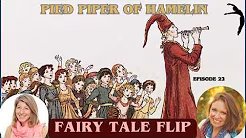
Did you know that the Pied Piper was based on historical records? In episode 22 of Fairy Tale Flip, we dive into the mysterious tale of the Piper and his alluring music and what really happened in the medieval German town centuries ago. We look at the different theories proposed over the years including the possibility of it being an organized migration, a children’s crusade, a plague or disease or even a Mongol invasion? We also discuss the morality lessons wrapped inside this enigmatic story including honoring agreements. We also explore themes of the story including the different types of authority, short vs. long-term thinking, and marginalized truth-tellers like jokers. This was a fascinating discussion you definitely don’t want to miss!
Chapters
00:00 Introduction to the Pied Piper
10:15 The Role of Poetry in Storytelling
13:17 – Historical timeline begins (the 1284 event)
22:00 Theories Behind the Disappearance of the Children
26:44 – Moral lessons: Honoring agreements / paying the piper
28:53 The Importance of Integrity and Accountability
30:04 – Short-term vs. long-term thinking / ethical practices
35:50 The Symbolism of the Pipe
41:06 Historical Context of the Pied Piper
49:22 The Children Left Behind and Their Significance
51:35 – The Piper’s appearance as an outsider (Browning version)
52:25 – Would you share this story with your children?
Follow us
Fabric of Folklore website- http://www.fabricoffolklore.com/
Youtube channel- / @fabricoffolklore8449
Facebook Page- / fabricoffolklore
Facebook Group- / fabricoffolklorepodcast
Instagram https://www.instagram.com/fabric_of_f…
Twitter- / fabricofolklore
Linkedin- / fabric-of-folklore-podcast
Apple Podcasts: https://podcasts.apple.com/us/podcast…
Spotify: https://open.spotify.com/show/5eCrObj…
Celtic Impulse – Celtic · Kevin MacLeod
Provided to YouTube by http://incompetech.com
Celtic Impulse – Celtic
℗ Creative Commons Attribution 4.0 https://creativecommons.org/licenses/…
Leod Provided to YouTube by http://incompetech.com Celtic Impulse – Celtic ℗ Creative Commons Attribution 4.0 https://creativecommons.org/licenses/...
Transcript
Chapter 1: Introduction to the Pied Piper
Welcome, welcome to Fairy Tale Flip. My name is Vanessa Y. Rogers. I’m the hostess of Fabric of Folklore. And this
is Donna Lee Fields, hostess of Doorways to Learning and Scaffolding Magic, where she has lots of educational tools for
anyone in the education field. And we come together once a month and we talk about different fairy tales and kind of
understand, flip them on their head to understand their underbelly, to understand their historical context and
their symbology and meaning back then and today and how they they still have meaning for us today. And today we’re
going to be doing the Pied Piper, which is a really fascinating fairy tale or legend. I’m not even sure what to call
it. uh because there’s as we’re going to talk about more in depth, there’s a lot of actual historical records that uh are
connected to the story that we know today. So, Donna is going to give us a summary of the Pied Piper and then we’ll go into it.
Yeah, I’m really excited about this, Vanessa. I was just telling you before we pressed record, I I don’t even know how I came up with this cuz I haven’t thought of this story in ages, but you
asked me which one I might be interested in doing this month and I said, “You know that story with the children being let out of town and never seen again?
It’s the pipe piper.” So, we both liked it.
Well, and also the funny thing was when I went to my storytelling group that I go to once a month, one of the storytellers told this
tale, and I I was just like, “Oh, serendipitous.
There’s got to be some spiritual meaning. There’s some meaning.” And and we’re going to be talking about the historical um theories related to this
story, which I didn’t expect. And that’s where I really got excited. So So I know Vanessa wants me to give the summary.
So, I’m being a good girl and I’m going to give you the summary first and then we’ll get into all the other um theories and and symbologies and um details and
stuff. So, the the pipe piper is about a town that’s really in Germany called Hamlan and it was a town of honest
people. The story goes honest people who as time went by became very rich. And Vanessa, I’d love to tie this into our
talk from last month with Lowi the witch and the so and how the enormous wealth that the people earned from the so
caused corruption and greed because it happened in this story too.
And as the town became rich, it also became infested by rats. And they’d always had rats, but suddenly there were rats everywhere who ate they ate all
their food, their clothes, and even parts of their homes. So the town’s people went to the mayor and begged him to do something about it. Him, it wasn’t
a female mayor at the time. And he hired a pied piper who promised to rid the town of rats. And the mayor was ecstatic
and the people were ecstatic. And he promised to pay the pi piper 50,000 florins or different denominations of
money, even gold. Some story, some versions say enormous amount of money.
Let’s just say an enormous amount of exchange of energy. And so the pied piper played his pipe, enticed the rats into the river, they were all washed
away, and in the morning there was not a single rat in town. But when the pi piper went to ask for his recompense,
the mayor would not even give him a fraction of the money. So at dawn and he said, “You will regret that decision.”
That’s a scary sentence in itself. At dawn the next day, he started playing his pipe again, and only the children of the town heard him, and he magically
drew them up into the mountains into a cave, closed the cave, and they were lost forever. So, that’s the story.
That’s interesting because I have not read a version that includes the town becomes wealthy. I always love that you
find different tellings than I than I find. Um, but that that was new information for me. So, what I’m curious
about is which version of the story did you record because I haven’t heard it yet.
Well, I’ve actually done a recording of the Robert Browning poem and which I really like because it’s very
illustrative and descriptive and it’s really cleverly written. He writes a lot about how the rats are kind of taking
over and you see the rats in the baby cradle and nibbling on cheese and jumping off of men’s hats. Uh and then
um I don’t know where the other tail came from. you know, a lot of so I think
the one of the recordings the most popular one was from the Grim Brothers tales, but it’s very bare bones. And so
a lot of people took that and they embellished quite a bit. Uh, and so my version is very embellished from the
Grim Brothers version, as most fairy tales are.
It’s interesting. I was I was going to write you last night and ask you which version you were you were going to read and the last one I expect you to read was the Browning version. It’s
absolutely beautiful. It’s poetic. It’s in a poem um stanza and usually like the Grim’s version but there’s also one by
Gerta which you probably also know plus other ones. Why did you decide on the Browning poem?
Well, I just liked how descriptive it was and how colorful it made the the story. It made it really come alive. It
was longer than a lot of the ones I had had come across. Um, and I I liked how
it described uh the um the Pied Piper clothing as well and his his look. Very important.
Yeah. And how he really stands out as a foreigner.
And so this is um really important to our audience, our listeners as well because we want fairy tales for our children and the children we know around
us to be interested in. And I love the storytelling you do by yourself. And I also love the ones you do with your children when they’re actually listening
to you. Would they have listened to you if you had read them the Brownings poem?
I don’t know because, you know, I was thinking about this recently because I was reading a book, what was it called?
The Lion Women of Tran.
And it takes place in Iran during the period of when prior to when uh the
government is taken over. Um and so during the time period when women were free to dress and they were becoming
career women um and there was a lot of upward mobility for women and uh and
then it obviously turns into um an authoritarian government that makes them
dress a specific way and is really constricts women’s freedoms. Um, but in
Iran they really value poetry. That’s one of the things that they really push in their education because it’s part of
their history. And so they memorize poetry and they recite it for each other. Um, and I think that’s really
fascinating because I really feel like poetry has gone out of favor in in
America or if it is in favor still. I’m not in those circles. I I’ve never really um I’ve never been good at
writing poetry and uh and sometimes when it’s being read to me, it puts me to sleep. It’s
hard for me to pay attention to and it might just be because I’m not used to it. It’s not something I’m accustomed to
paying attention to and the the rhythmic element of it is is is harder to to
grasp in my in my opinion without like pictures to to keep me engaged. Um so I
I don’t can’t even remember what the the question was. What was your original choosing Browning about choosing Browning over the Grims?
Yeah. And and the grim story is just so bare bones. There’s not a whole lot of meat to it.
No, the Grim’s the Grim’s version has a really important element. They added the rats into the story which is fascinating
in itself and very symbolic, but I just wanted to stay on Browning for one minute because I read the ver the poem
first and I thought this is not what I remember the story to be. This is just so whimsical. And it turns out, yeah, Browning wrote it for, I think, his
manager’s son. Yeah. It was designed to be light-pirited. And I thought, so why is that such a disconnect for me? And I
went into what Browning is usually known for. And that’s how because I did poetry. I I majored in poetry in college, so I was into this kind of
stuff. And I understand what you mean by falling asleep to poetry. I don’t fall asleep to poetry, but it can be overwhelming because every word is so
specifically chosen that you need your brain needs to process, right?
Yeah. It really requires like two or three readings before you really are able to grasp it because the first
reading is just kind of like words here and there and then the second reading is like you you’re getting more of the meaning and the third reading is more of
the like more of the indepth elements of the story. So I I think it just requires more attention.
So were you able to read it a couple of times? The story of the pied piper by Browning to get some more of his meanings.
Yeah. Um, yeah, I did I read it a a couple of times.
Okay. Yeah. Because you again what I usually think of Browning is that he has these dramatic monologues and they’re usually, you know, very Victorian, very
dark, but this particular poem, we can recommend it to our listeners, I think, because it’s it’s very light and has a lot of descriptive language.
Chapter 2: The Role of Poetry in Storytelling
Yeah, it’s definitely not dark. I mean, the the ending is not a happily ever after. And in fact, when I was
practicing telling the the my children this story, I asked my two youngests, I said, “What do you want? Do you want me
to tell you the ending with the happy ending, or do you want me to tell you the ending with the mysterious and slightly sad ending?” And they said,
“Happy ending, happy ending.” But my older son, he really wanted the mysterious ending. So I ended up telling
them both both endings because there’s a lot of fairy tales that have the variant. It is where the children are
returned to the town because of the apologetic mayor and they give the pied piper more than he asked for and so the
the children are returned. And so that’s what version was that? I don’t know where the children came in newer fairy
tale books that are Oh, yeah.
less like less traumatic, right? It’s a Hallmark version. It’s got to turned out well, right?
Yes. Yes. We And you know, I think it’s interesting. I I as you get older, I think your your stomach is able to
handle more of the uh the mysterious or the the sad ending. I think it was it
didn’t feel traumatic for my older son, but the the younger children, they they want that that happy ending. And the
interesting thing about this story um is that it doesn’t resolve. And normally I’m one of those people who really wants
a resolution. I don’t really like cliffhers, which is really what this story is. It’s just a cliffhanger that no one really knows the what actually
occurs. Um, but I it’s almost like a mystery when you read the story,
especially when you’re comparing it to the historical elements and the records that are going along with it. It’s just
becomes this not a murder mystery because there’s no murder. We we hope except for maybe the rats. The rats are murdered, but we already know who who
murdered the rats. But the children, we don’t actually know what occurs with the children, but it’s it’s, you know, it’s just a mystery what happened.
That’s right. And there are theories.
So, we’re going to go into the theories, but one thing I think it’s really nice for our listeners to know is because you did the Browning version, he wrote the poem for his manager’s son to illustrate
the little details of the story. So the very reason you say you like the story is the the very reason he wrote it so that your children can listen to it and
illustrate and our listeners children or their neighborhoods children can illustrate elements of the story which I think is beautiful.
Yeah.
So should we go into the history?
Let’s go into history because I found that was absolutely fascinating. Now there are two things um with the Grim’s version they added the rats. No.
Well, actually, my timeline has it being added earlier. It has it being added in 1559,
Chapter 3: Historical timeline begins (the 1284 event)
and the Grims Brothers published in the 1800s. So, the first mention of rats comes
about 300 years after the original event. So, still significantly later.
Okay. So, they also added for and I haven’t seen this exactly, but have are you familiar with the number 130
children? Yes. Well, and that is because that was in the historical record, right? So, in if you go to Hamlan, there
are plaques that say 130 children disappeared. Now, of course, some of that could be for tourists, you know, to
draw them in. But there are historical records. So, should we go into the historical records?
Yes. So, I’ll just start with the first date. It we believe that the occurrence occurred in 1284. So this is medieval
Germany. I’m not sure this the stretch of when medieval times began and ended, but it’s do you do you know?
Yeah, it’s like the four the 400s to about the third the 1600s.
Okay. So the alleged disappearance of the Hamlet’s children occurs on St.
John’s Paul’s feast day. And so they’re they’re feasting and the the pi piper is
um and then so we only know that because there was a town record 100red years
later that plainly states it is a hundred years since our children left.
And that’s um the first document. But then uh about okay so 1284 1300 a
stained glass window is installed in the town church. It does not exist anymore.
It was destroyed at some point but the stained glass window is documented and
it has it depicts a colorfully dressed piper leading children in white away.
Right. Okay. So, no, I want you to keep going because I have them not as a timeline, but rather the causes. So, why don’t you keep going on the timeline and then I’ll add my causes.
N 1370, Monk Heinrich of Herford has this Latin verse that is really interesting because
it’s written in the back of a chronicle, the golden chain, and it’s handwritten
in a different handwriting. And so, I it seems like it’s just notation to himself. Um but this is what it says
here follows a marvelous wonderer which transpired in the town of Hamlin in the dasis of mind in the year our lord 1284.
A certain young man 30 years of age handsome and well-dressed so that all who saw him admired him because of his appearance crossed the bridges and entered into the town by the westgate.
He then began to play all through the town a silver pipe of the most magnificent sort. All the children who heard his pip pipe in the number of 130
followed him to the east gate and out of the town to the so-called execution place or Calvary. There they proceed to
vanish so that no trace of them could be found. The mothers of the children ran from town to town but they found nothing. It is written a voice was heard
from on high and a mother was bewailing her son. And as one counts the years according to the year of our Lord or
according to the first, second, or third year of anniversary, so do the people in Hamlin reckon the years after their departure and disappearance of their
children. This report I found in an old book and the mother of Dean Joan von Lud saw the children depart. So this is
written uh maybe like 90 80 years after the event was said to have occurred and the
town when it’s making its records it will state how many years after the children disappeared. So it’s
continuously referenced as a very important time that occurred in the town that fundamentally changed the town.
Okay. So, while you’re talking, it just really really um highlights to me the whole idea of myths and fairy tales that
we’ve talked about so often that there’s a need for the adults to make sense of the world going around them. So, why do
they talk about 130 children? Why do all the children who were the literal future of any town, why are they
sort of um celebrated in a dark way by this story? And what
you’re saying, I mean, one of the possible answers could be natural causes. There was a plague and 130 children died of a plague. And the only
way the adults could sort of process this was by saying there was a person who came and and seduced them out of the town and we don’t really know what
happened. The execution ground is what you were saying. What a horrible what a horrible image, right?
Yeah. A place named execution. Well, I I see it more of like this memorial structure, just a way for people to um
remember just kind of how in the calendar that we currently use before Christ, after Christ, now they’ve
changed it so it’s not quite so attached to Christianity, but um everything after changes the date. And in the town of
Hamlin, everything after the current of these children disappearing is marked differently. It feels differently. You know what I mean?
I do. Okay. So, you have more if it’s all right. I just want to add a couple of things that Yeah.
from what you’re saying in any year in any part of the timeline. Again, this could just be for adults processing it because some of the theories are that it
was the plague. Some say that 130 children were drowned in the river or they were um killed by a landslide or
there was a sinkhole that collapsed when they were at a a camp or you know camping. So th those are just some of the theories
and I find it fascinating that you’re mirroring that um by the timeline as well. So you have more, right?
Um just one more date. It’s just another manuscript in the 1400s um that is they reiterate all the
children who heard his pipe and the number of 130 followed him to the east gate and out of the town and it’s this
so it’s it’s just basically this the same but it’s just another recorded um manuscript that talks about it.
Okay. So after after that is the grim tales and that I think that there’s more there’s a lot more in the timeline but those are the main ones to uh to follow
because Robert Browning and both Grim live in the 1800 and print and print in that time period.
All right. That’s very interesting. And then we have some modern versions but there aren’t a lot of modern versions except the one where the children go back which is really kind of Yeah.
It kind of messes with the whole moral of the story.
Well, but see also because of the ad the addition of the rat, that’s when it
really becomes a moral fable. Whereas before the story is more of a layered cultural memory,
right? So they they add the the rats element to kind of round out the story to give a reason for why someone would
lead children out to make sense of the story. because as it stands, it makes very little sense unless you you lob on
some different reasoning. And so that element of the rats is added to kind of give it that narrative structure.
Yeah, I like that. It does make sense.
And again, it just shows that rats probably didn’t have anything to do with the original disappearance, if there really was a disappearance of 130 children. But there probably were. I
mean, there were even um theories that this had to do with Genghask Khan and his invasion of central Europe and Oh my goodness.
Okay, I want to hear theories. Let’s let’s hear let’s go into the theories and then we can go into themes because I want to hear all the theories that you found. All right, start with the Genghask Khan.
Okay. Well, Genghaskhan I haven’t gone into really deeply, but I find it really fascinating. And he said because Genghaskhan two of his grandsons were
controlling the central Europe, the pipe piper, the appearance, the legend of the piper came in as early as 13th century
to sort of explain how you know the Genghaskhan, if you know anything about the history, the Mongols were pretty
Chapter 4: Theories Behind the Disappearance of the Children
ferocious and pretty um they’re pretty unforgiving people as far as I know. I I don’t remember being there if I was
there in a past life. And so they had to make sense of it and created the legend.
But other you really want to get into all the theories. All right.
Hold on. I’m going to have to Well, I’ll give you I’ll give you some of my theories while you’re looking for yours. Please go ahead.
Okay. So, one of the ones that the historians really feel like makes the most sense today is the organized
migration. There were a lot of uh economic difficulties during this time period and there was a lot of townships
that were really struggling. And so what would occur is that these locators or
recruitment agents would come into these struggling towns and they would uh promise land and opportunity for anyone
who would follow them. and they were often dressed in bright clothes and used music to gain spectacle and attraction
and people would follow them. So that’s the one that most historians think is the most likely that it would occurred.
Um there was a linguist I can’t say his name Jurgen Udolf. Um, and he he traced family names from
Hamlin, showing up in surprising concentrations in an area near Berlin, which fits this idea that a group of
young people left Hamlin and resettled in that area to find a promise of a future, whereas they didn’t feel like
they had a future in their their current state.
Well, just to just to back that up a little, in one of the theories, it wasn’t that they didn’t have a future there, but there was overpopulation, and so they they needed to get out of their
own towns. So, either people enticed them to come into to the city or they just left because they had no It’s just like in some of the old towns
where you can’t keep expanding. You have to keep going outside and outside or go back to the cities and build the buildings taller. Yeah.
So, Okay.
All right. What else do you have? um historically of the inscript keep going.
I have some children’s crusades. So the ch it doesn’t really work perfectly because there were two main children’s
crusades that we know of. Uh they were religious movements that were 1212. So
this is seven the pi piper occurs about 72 years after these children’s crusades. There was one in France that
was led by a shepherd boy and then there was one in German um led by Nicholas of Cologne and thousands possibly tens of
thousands of mostly poor young people and not all children reportedly set out believing God would part the sea for them. They could peacefully reclaim
Jerusalem. Um and they hope that divine intervention will help them succeed where the armies failed of the other
crusades. So um it was more of this devotional mass devotional movement rather than an organized crusade for the
children’s crusades. Um they believe that most of them never reached the holy land. A lot of them dis dispersed or
starved or was sold into slavery. So that was what occurred in 1212. So it’s less likely that that would have
actually occurred so so much later in the date cuz that religious movement was not quite as fervent during that time
period. Um so that one is a little bit more out there. Then like you said an accident or a natural disaster that’s
very plausible um that those occurred and then a plague or disease. Now, it was not likely the black plague because
this occurs decades later in 1347 to 1351.
So, if it is the bubanic plague that is hitting them, it’s a more local epidemic rather than the pandemic that they
experienced all across Europe. or it could have been a smaller disease outbreak that occurred um or
contamination of grain dysentery or typhoid from contaminated water. Uh so anything along those lines, those were the the theories that I came across.
There were more. There were a lot more.
We could have spend the entire podcast episode really covering all of the theories.
Okay. So if we we can um we can circle back to the series. would should we can we talk a little bit about the lessons from the pi piper the moral lessons?
Yeah. So I didn’t really I didn’t really cover lessons so much as just themes. So I would I would love to hear um I mean
there’s themes with there’s lessons within the themes I think but I let’s let’s hear what you think the lessons are.
Chapter 5: Moral lessons: Honoring agreements / paying the piper
Okay. So exciting. So exciting. So this is why you know why did I think of this and why did then someone who you went to a storytelling and someone told this
story. Well, these are really timeless um lessons and one of these is fulfilling commitments, honoring agreements. It’s really clear.
So, one of them is the breach of an agreement. Adults saying no, I will not honor an agreement I had for you with you. I mean,
if there’s integrity to me is one of the most important things we need to have in ourselves and see in the people around
us. And it’s such a breach of integrity that it really my jaw just drops. Um,
and the town’s people supported him and there they didn’t realize that they were going to lose something so valuable. But it doesn’t matter if they lost anything.
What they lost was integrity. They lost their honesty. They lost their commitments. So that’s one of the the morals we have from the story.
I will add to that that we have this concept from the pied piper. Pay the
piper. That is part of our cultural language. Pay the piper. We all understand what that means. If you don’t
pay the piper now, you’re going to pay him later, right? In one way or another.
That’s right. That’s right. So, another theory, um, one of the the symb symbols behind the story is effective
communication and influence. And this is this is on the side of the piper. Um, he had the power to captivate. He had the power to entice, he had the power to
seduce. And he did. He he completed his agreement. He said, “I will get rid of the rats in in your town.” And he did
it. But what he also did is he said very clearly, “You are going to be sorry for not keeping your side of the bargain.”
And he was able to complete that side of his communication as well. So he had a vision. His vision was to get rid of the
rats. He did it. And he also his vision was also I need to be honored for my work. And it’s really important for all
of us, no matter how small our promise is, is to honor other people and to honor ourselves for their work or our work. Does that resonate with you?
Chapter 6: The Importance of Integrity and Accountability
Yeah. In fact, I I framed it as a legal authority versus a charismatic authority. And the piper is really this
charismatic magnetism appeal, emotional appeal to the people. Whereas the legal
authority um the mayor represents this power this legal authority that that assumes it cannot be held accountable.
And interesting he he he stands for an institutional governance that is ultimately unethical which is something that we we see both
of these still in modern times today. So it’s it’s interesting to see that we as humans seem to have the same issues that
we continuously right what is this about when do we when does our learning curve go up I know shouldn’t we be learning lessons
by now so then this ties right into that the consequence of short-term versus long-term thinking and it’s you know
again integrity is the most important underlying theme here but the mayor just was looking for short-term gain he wanted the rats gone and wanted his his
Chapter 7: Short-term vs. long-term thinking / ethical practices
bank account, you know, so to speak, to be to stay the same, but the long-term consequence is losing the future of the whole town, literally by losing the 130 or however many children there were.
And so this is this is about ethical business practices. Yes.
And I think there are decisions that we always make. My sister, for instance, is just starting her own business and she is incredible. She surprises me at every
turn because at some point I will always say, “Well, I’ll give so much, but what I really, you know, I’d really like to make sure that people pay for this,
this, and this.” And she says, “You know, I want to donate. I want to donate here, here, and here. And I want people to understand that when they invest in
my business, they’re actually donating for charities.” And so, she’s thinking the really long-term practices. How do you feel about that?
Yeah. Um, I I agree. you know, when we breach trust, when when our the trust is
destabilized, then it’s really hard to gain that back. I think it’s it’s, you know, once the mayor does this in
the story, anyone else who hears about this story will not perform services for
the town. And one of the themes of the that I was um covering is the outsider
as a as necessary and dangerous. So the piper represents this liinal this liinal stranger, someone who stands out outside
of the community yet holds this transformative power and he comes in and performs something that no one else in
the town is capable of doing. So he’s highly valued in this crisis moment but
before and after this crisis he is quickly devalued. So this can be
represented by an expert outside intellectual an artist. A lot of times these people are not valued unless there
is an absolute crisis when they are needed in the moment and then later on they’re kind of swept aside. And so
these this idea of people who are on the fringe or who are marginal or only needed at certain times um is really
kind of what the the piper represents in this this moment.
Yeah, I love that, Vanessa. I read that too about the stranger and I was reading it and with a sort of question on my face and then I saw the flip side of it.
I think you’re going to really like this because you like the browning version because of the details and the details even of the color of the clothes of the pi piper and you’ve mentioned that a
couple of times and what some one of the theories is is the pi piper actually represents the jester the court jester.
Oh, I know. Isn’t that interesting? So, why is that important? Because the the court jester is usually the only one in the
court who will tell the king the truth and the only one to show the hidden hypocrisies in what’s going on around the the king or the queen. Yeah.
Isn’t that great? Yes.
So the fool will engage with the questionable behavior and you know why were children whatever the theory is
about why the children left it’s the jester who um sort of ignites and highlights the hypocrisy going on in the town. Mhm.
So the jester is also living on the border and as you say it’s the stranger that you could be afraid of but the jester is always is so intelligent that
he will usually find a way to endear himself to you while telling you what an idiot you are. Yeah.
You know well and and even in today’s world comedians are I’ve heard John Stewart liken them to the canary and the the
coal mine. They’re able to speak truth to power through comedy in a way that is
palatable and uh easier to digest, I think. Exactly. Yeah. Yeah.
And so I think that that likeness of the piper being like a jester is is really on point.
Yeah. I really like that. I think that that’s really important. And you know, the the pi piper was dealing most directly with the mayor who could be,
you know, the royal in this sense. So it it is a very easy analogy to make. Mhm.
And there’s also another element about the pipe piper that we really need to address. The pipe. The pipe.
Oh yes. Let’s hear it.
Okay. So I wish I had um delve even more deeply into it. But I want our listeners to think about this and come up with their own theories about it. But the mic
is an extension of this gesture, this stranger.
And it’s a wood instrument. Let’s assume it’s a wood instrument because at that time it probably was. Um the pipe enables I love this. The pipe literally
enables you manipulate the air from outside into the piper’s lungs and out again. So it goes in meaning that you’re
processing spirituality inside and then coming out differently. M and so the pi piper is and you know I
love saying this giving the town’s people an opportunity to reflect on themselves and come out with different conclusions which this town did not do.
Yeah.
But at least he gave them the opportunity to do it. So we could think about it, you know, even even as a shamanic healer that was not successful
in this town. And I find that fascinating.
Yeah, I like that. And I wish I had done more research on the music element, but I didn’t. But it that does lead me to talk about the psychological element of
this symbology. So, one of the things that we see is this, you know, all of the town’s people just going along with
Chapter 8: The Symbolism of the Pipe
uh the mayor and not fighting back against it um against his decision to
reneg on his his agreement. And this social proof where people bypass
critical thinking to just follow blindly is really something that we see
historically and evolutionarily because as early humans were becoming humans, those who followed
the successful group members where to hunt, where to eat, when to flee were the ones who tended to survive. and reproduce more. Whereas those lone
individuals who were more likely to take risks, they fared worse because those risks sometimes did not work in their
favor. And so because of this, we kind of have this innate uh
an innate uh biological impulse to follow the crowd. And sometimes a lot of
times it’s unconscious. It’s dis we are just allowing the crowd to make decisions for us rather than use our
critical thinking skills because it’s a a shortcut in our brain. And so it requires a whole lot more attention to rewire and go against the grain.
That’s a really important topic, Vanessa. And it’s something I I thought about a lot more when I was younger and I don’t like being in crowds a lot for
that very much for that reason because there’s a crowd mentality and it’s very easy to be swept into it and you have to
be very introspective to fight excuse me to fight against it. So, think about it.
When you’re at a crowd, even even if you’re at a concert, even at a children’s concert at your your children’s assembly, and all of a sudden
there’s a wave and everyone’s saying, you know, we’re going to do a wave. And it’s very innocent probably, but think about it. Do you want to be involved?
Are you doing it only because the person next on both sides of you are doing it?
That is a crowd mentality. Now, most of the time that’s not going to be nefarious. is not going to create any negative um after effects, but it’s
definitely crowd mentality. And what I’d love our listeners to think about is how often are they in a party or how often
are they at a dinner party or in, you know, a protest and they’re doing something that they wouldn’t have done if everyone else in the street or
everyone else in the auditorium weren’t doing. Yeah.
And I think it’s really important to think about that. I mean, World War II, people just went along with it because
their neighbors were doing it and most wars, a lot of people are just going along with it because they feel safer doing it rather than going against.
Okay. What else do you have?
Um, okay. So, there is an interesting symbol of the piper as a personification of death. I thought this was
interesting. Um so some suggest that the children drowned in the river during the outing. Others point to the uh the
mountain that is nearby uh with the land having a landslide or a ge geological disaster that killed many of the young
people. Um but there’s also this idea it’s called dant macabre. I think you probably don’t rolled the r for the
French. um dance of death. And it’s this this image, this artistic allegory showing a skeleton
leading people in this dance pro procession uh people from poor people to
popes and peasants, the kings to the grave. And so this imagery of the donce
macabre the dance of death emerges after the black plague because mortality becomes extremely dominant in a cultural
reality and so it’s painted much later after the pied piper. Uh, so it’s likely
not tied to it, but some people think of the pied piper in the same fashion as
someone who’s leading children to their death.
Well, that’s really interesting because one of the really fascinating articles I found on the Pied Piper was really tangential, which was about the evacuation of the children from London in 1939 just before the war broke out.
And when and they called it the Pied Piper evacuation where they there were hundreds of thousands of children that were evacuated from London because again
the future of the the British they considered and probably accurately were the children. And so they wanted the children out of London where they felt
most of the bombing was going to be and in fact was and what they found was that it was so traumatic for the children.
You know they were separated within one day. Within one day, the parents had to evacuate to pack their children up and give them to strangers and be can’t
shipped out to the um to the countryside. And what they found were the children were much more traumatized by the evacuation than the bombing itself.
And it it started a whole psychological sort of um story of of how humans react to trauma.
Chapter 9: Historical Context of the Pied Piper
And I found that really interesting as well. But on the same token, their their lives were more at risk in London. I
mean, they they did suffer psychological trauma, but what what is worse, I guess, right? But it was interesting that that
was the beginning of child psychology pretty much in that sense. Oh, yeah. That is interesting.
Yeah. So, I’m sure it influences your children.
I wanted to talk a little bit about the rats. Do you let’s talk about the rats.
So I think the the idea of the black plague coming up comes up a lot because of the story of the rats. But as we were
saying earlier, the black plague occurs um much later uh decades later in 1347
whereas this happened in um 1284. So, it’s unlikely that it was actually the the bubanic
plague unless it was a very small a small outbreak. Um, and they’re a later
addition. Um, and they they seem, like I was saying before, they’re really just an embellishment, an embellishment to
make the story uh more well-rounded. Uh, but I really kind of clung on to the
concept of these rat catchers and how um when I was in my MBA program, there’s this concept that has lots of nicknames.
The one of their nicknames is the Cobra effect or the perver perverse incentive.
The or the law of unintended consequences. Have you heard about this? Do you?
No, it doesn’t sound familiar. Okay, so basically this happened a lot where there were rats or there were cobras um
there were feral pigs in towns and the leaders of the towns wouldn’t know what
to do. So most of the time the officials, so in British Columbia, the reason it’s called the Cobra effect is
because in British Columbia, Cobra um bounties were created for uh people to
gain cash if they turned in I think it’s the each dead snake. So each dead snake,
they would get money back. But what started occurring were people would breed cobras and then kill them for the
reward. And this occurs over and over and over again. This happens in lots of different places.
So the economists start to say like learn if you pay for a dead animal this
not without changing the underlying conditions you create a market for a a black market. And it and it once they
stop the bounty, then all these people would uh release these cobras or these rats or there’s these feral pigs. Oh my goodness.
And it would double the problem that they had before. So this occurred in in British India. This happened in French
Hanoi with rats. This happened in Mexico City in the oi o circula. I don’t know
if they I I doubt they still have this program. It’s basically they were trying to decrease the pollution in Mexico City. So they would say you can only
drive if you have the last letter if your if your license place ends in an even number on these days and if your
license plates ends on in a a an odd number on these days then you can drive on those days. But what ends up happening is all these people get a
cheap cars that cause more pollution. So they get one car to drive on the Tuesdays and Thursdays and they have one
car to drive on Monday, Wednesday, Friday and and it just still causes lots of
pollution. So um people optimizing this so the what ends up occurring is
economists say that it’s important to this is again your long-term wins, long-term harm, right?
early numbers look good, but it and so then they declare victory, but then the underlying system gets more fragile and
more polluted. And so that’s well, it’s a real modern it’s a real modern day twist on that what you were saying about, you know, raising cobras
and then killing them and showing them as that was, you know, they they’ve taken care of the problem. It’s the same thing today as um companies that have
antivirus programs creating the virus that they are going to kill, you know, in your computer. They people pretty much
assume that the same company who has the antivirus has created the virus. Yeah. It’s absurd. It’s just absurd.
So So we’re we’re staying on the racks just for a minute more. Um, I find it really interesting that the Grimms, so
from what you’re explaining, I had read that the Grims decided on adding the rats, but the rats were added to the story before the Grimms. In any case, you we know the Grims, they they changed
things whenever they felt like it. They could have added um they changed it to a natural disaster. Um they could have changed it to a anything else, but they
kept the either added or kept the rat infestation to the story. Um, and that is because a rat invitation has to do with human intervention.
It it has to do with humans having food in storage, not safely stored, um, not having To me, this is really fascinating
because in the story, it talks about the fact that there are no cats. Now, why are there no cats in a town? That’s to me a signal that the animal kingdom
itself has given up on this on these people. They recognize them as unint, you know, not integrous people without
integrity and they’re not going to help them in any way because cats are the, you know, the easiest natural way to get rid of the the bats. So, if we use that
as the rats are a symbol of the fact that the town has really um taken the
curve down into the the fireballs of hell. Oh my god, how dramatic that is.
It’s not even the rats that caused any bubanic plate. So we don’t even have to say that they caused the bubanic plate.
It was during that. It was any bubanic plate is caused by the rats, but not by the rats. The fleas on the rats on the rats. They were the transporter, the transportation for the fleas.
There you go. So what if we’re going to be very literal? The fleas will bite a person and um compromise the immune
system, their lymph, their lymph system, which is the immune system. And basically from the inside out it’s
turning your healthy system into a extremely sort of poisonous venomous system which is exactly what’s happening to the
people as they became wealthier. It when you have wealth you either become philanthropic you know generous or you
become really penorious which is greedy and tightfisted. And some a lot of times it’s a little balance of between. But
with this town, they became very greedy and it was like the fleas infesting the town. They they were turning themselves
from the inside out um with dirt, you know? It’s just fleas inside and out. So that’s why I think the the rats are really fascinating in the story.
Yeah.
The fleas on the rats. Isn’t there a song that the fleas on the rats go? Well, something there’s a song. Jump, jump, jump.
Yeah. Yeah.
All right. Is there anything else? Oh, we didn’t mention that the three children left behind.
Interesting. So, in some versions, there is either one boy who doesn’t get blur, there was one boy who was, I think,
blind or there was either blind, deaf, or disabled.
Right. So there’s some So there’s some versions where there’s three children and it’s all those things. One is blind, one is deaf, and one is lame. The blind
one doesn’t can’t follow because they can’t see. The deaf one can’t follow because they don’t hear the music. So they’re not enchanted.
Chapter 10: The Children Left Behind and Their Significance
And then the the lame child or what we would say is disabled child wasn’t physically able to follow. Um, and so
they’re the lone witnesses, the lone survivors of this event. And, uh, so
they’re the only living memory of the event because they’re the the three left behind. Mhm. And this was also
interesting because this kind of describes them a little bit how you were describing the piper as the marginal
truth teller. the the one left behind is the only one who’s able to tell the story. The people on the edges are often
see and remember what central power denies.
Oh, can you go into that? Say that one more time, please.
Okay. It says, “Symbolically, people on the edges often see and remember what central powers deny. The story suggests
that distance from power can produce clarity.” Very interesting. So do we think that
the but I would say the one exception is the jester who always has diff who has a very healthy perspective on everything.
Right. But he’s still marginal. I would not say that he’s still in the norm. He’s the clown.
Right. Because the rest we call them sick offense that they will do anything the majority will do because they need the the favor of the king or the queen or the princes or whatever the nobility.
Yeah. Yeah.
Also in the Robert Browning version the piper. So this is not the children. I’m going back. I’m I’m switching around.
The piper is described with swarthy skin which is another way of saying dark
skin. So it indicates that he’s outside quite a bit. um possibly a foreigner.
Although he is described with blonde hair and blue eyes, but definitely different than the people in the town
who probably are more pale skin. If cuz you know, Germany, I’m I have a lot
of German heritage and my skin is very red. I’m less white and more red.
Chapter 11: The Piper’s appearance as an outsider (Browning version)
Okay. So, I guess the question is you didn’t ask me for the first time. you didn’t ask me why did I want to choose this story and so I’m going to ask you in a different way now that we’ve gone
into the story and and talked about its um really intricacies and the historical context and the morals that we can learn
from it. Is it a story that would you you’d want your children to really sit down and think about to listen to and think about?
Yeah, I think there there’s a lot to digest and there’s a lot that is that they can can perceive on the outside.
I’ve been doing a performance for children called um like preschool and kindergarten and I I’ve been doing stone
soup and the moral of that story is really evident if you’re a little bit older but prek and kinder they’re still having a hard time grasping what’s
happening kind of how I was describing poetry how you have to read it multiple times in order to really grasp on to the
Chapter 12: Would you share this story with your children?
the fundamental meanings. I think with that young of age sometimes it’s it’s hard to look past like just the surface
level. But um if you you know if they hear it multiple times then they’re more
easily able to grasp on to the moral of the story. It would be interesting for me to ask my children if they if they
thought that there was a moral of the story. I’m sure my 10 my he’s he’s about to turn 10. I will just call him 10. My 10-year-old would be able to grasp it.
the the younger ones, I’m not sure they would have they would be able to describe to me what what the lesson was,
but I think that’s the key. They may not be able to describe it, but I think they get it. Yeah.
I mean, first of all, your kids are pretty smart, but usually that’s why that’s why we like fairy tales is because we get the moral of the story without all the time being able to verbalize it.
Right. You don’t have to actually be able to put it into words to be able to understand it. Right. Right. Yeah. Well, I think we did it, Vanessa.
I think we really dissected this this story and I think it’s really much more fascinating than I even expected it to be.
Absolutely. And I want to I want to remind our listeners because sometimes we forget. Make sure you hit that subscribe button. If you’re watching on YouTube or if you’re listening on the
podcasting platform, follow, like, subscribe, comment. If you can comment, we would love to hear your thoughts.
Have you do you know the story of Hi Piper? Did you know it before? Did you know about all the historical relevance elements? I Don and I were both really
intrigued, I think, by the um the historical ties because it’s so fascinating that this mystery occurred that no one really
knows what happened, right? And we hope that we’ve we’ve sort of sparked your interest in it as well. So, hope it’s a win-win situation.
Win-win.
Absolutely. Yes. And so, uh thanks so much for listening. Make sure you’re commenting and doing all the things to
help our our podcast to continue. And until next time, keep the fairy tales alive.
Bye everyone. Thank you.